
Within the broader field of precision manufacturing, the investment casting process stands out for its ability to produce components with excellent surface finish and dimensional accuracy. Conventionally, this process relies heavily on electric furnaces for melting steel. However, driven by practical needs for accessibility and cost-effectiveness, our facility embarked on an innovative path. After extensive experimentation, we successfully developed and implemented a method to produce ductile iron castings using a diesel-fired reverberatory furnace with graphite crucibles, substituting for the electric furnace melting of steel. This adaptation of the investment casting process has been in small-batch production for over two years, successfully replacing ten types of steel parts in oil pumps, yielding promising initial results.
Utilizing a diesel furnace for melting ductile iron within the investment casting process offers distinct advantages: the equipment is relatively simple and can be deployed rapidly; substituting iron for steel conserves significant amounts of high-quality steel for national needs; it reduces the demand on metal-cutting machine tools and other thermal processing equipment, saving considerable labor hours and decreasing the consumption of various materials. The core of our adapted investment casting process is outlined in the flowchart below, followed by a detailed breakdown of each primary operation.
I. Production of the Pattern Die
The first critical step in our investment casting process is creating a precise die. Several types are available: plaster and plastic dies can be made quickly and simply, offer wide material availability, but suffer from poor thermal conductivity and short service life. Metal dies offer superior quality, durability, and precision but are costly and require highly skilled labor, suiting high-volume production. Currently, we employ fusible alloy dies and metal dies. Initially using expensive tin-bismuth alloy, we later substituted with Babbitt metal, which has proven effective. One such die has been used approximately ten thousand times; while dimensional accuracy may drift slightly, surface finish remains acceptable for parts with less stringent dimensional tolerances.
II. Production of Wax Patterns
A. Wax Pattern Forming
1. We currently use a blended material of paraffin wax (industrial white wax, melting point 58°C) and stearic acid (first-grade triple-pressed). The mixing ratios are detailed in Table 1.
2. The clean paraffin and stearic acid are melted and mixed in a dedicated wax pot, with temperature controlled below 90°C to prevent carbonization.
3. The molten wax is stirred rapidly in a mixer and cooled to approximately 50 ± 2°C until it reaches a paste-like consistency, ready for use.
4. The pattern die is cleaned and evenly coated with a thin layer of parting agent (transformer oil).
5. A wax injector, preheated to about 50°C, draws in the paste wax and injects it into the die cavity.
6. Holding pressure time, cooling time, core removal time, and pattern ejection time are determined empirically based on the specific part geometry to ensure pattern quality.
| Component | Type I | Type II | Type III |
|---|---|---|---|
| Industrial White Paraffin | 50% | 25% | 5% |
| Stearic Acid | 50% | 25% | 25% |
| Reclaimed Wax | 0% | 50% | 70% |
B. Assembly of Pattern Clusters (Wax Welding)
1. Wax patterns are trimmed of flash. Minor imperfections can be repaired if quality is not compromised. Patterns are then cleaned and stored flat to prevent distortion.
2. A wax pouring cup/sprue is formed using a higher-melting-point wax within a simple tubular mold.
3. A 75-watt soldering iron is used to weld the ingates of individual wax patterns onto the central wax sprue to form a cluster. The number of patterns per cluster varies with their size.
III. Shell Building (Coating and Stuccoing)
Our current shell investment casting process utilizes a sodium silicate (water glass) binder with refractory fillers.
A. Raw Material Specifications
1. Water Glass: SiO₂ content 21-23%, Na₂O content 6.5-7.5%, specific gravity 1.29-1.31, modulus 3.0-3.4.
2. Others: Quartz flour (>250 mesh), Quartz sand (6-12, 20-40, 40-70 mesh), Fireclay (100-200 mesh), detergent.
B. Water Glass Conditioning
Adjustments are necessary when the modulus or specific gravity is out of specification.
1. Dilution: Used when modulus is correct but specific gravity is too high. Water is added to adjust specific gravity to 1.29-1.31.
2. Modification (for low modulus): An ammonium chloride (NH₄Cl) solution is added to increase the modulus by reacting with free Na₂O. The required amount is calculated as follows:
Let:
$A$ = Total weight of water glass after dilution (if any).
$B$ = Weight of Na₂O to be neutralized.
$C$ = Weight of NH₄Cl to add = $B \times \frac{53.5}{62}$ (where 53.5 and 62 are the molecular weights of NH₄Cl and Na₂O, respectively).
$D$ = Weight of water to add to the water glass = $A – C – \text{(weight of original water glass)}$.
C. Coating Formulations and Shell Building Cycle
The detailed steps, slurry compositions, stucco grades, hardening times, and drying periods for each layer in our shell investment casting process are summarized in Table 2. Key points: coatings must be uniform without runs or bubbles; stuccoing must cover all surfaces; hardening is done in a 20-25% NH₄Cl solution.
| Layer | Slurry Composition | Stucco Sand | Drain Time | Hardening Time (Winter/Summer) | Drying Note |
|---|---|---|---|---|---|
| Primary | Water Glass 50%, Quartz Flour 50%, Detergent 0.03-0.04% | 6-12 Mesh | ~20 sec | 15 min / 12 min | Natural dry after removal from bath until surface is not white/damp. |
| Secondary | Water Glass 50%, Quartz Flour 35%, Fireclay 15% | 20-40 Mesh | 30-40 sec | 18 min / 15 min | Drying time varies with humidity. Typically 0.5 to 1.5 hours between layers. |
| Tertiary | Water Glass 50%, Quartz Flour 35%, Fireclay 15% | 20-40 Mesh | 30-40 sec | 20 min / 18 min | |
| 4th & 5th | Water Glass 50%, Quartz Flour 35%, Fireclay 15% | 40-70 Mesh | 30-35 sec | 20 min / 18 min | |
| 6th (Seal) | Water Glass 50%, Quartz Flour 35%, Fireclay 15% | – | 30-35 sec | 20 min / – | No stucco applied. |
IV. Dewaxing
We use a hot water dewaxing method. Water is heated to 95-97°C, often with 3-5% boric acid or ammonium chloride added to strengthen the shell. The cluster’s pouring cup is trimmed clean before being immersed upside-down briefly to melt the cup seal. The cluster is then fully immersed for 15-30 minutes depending on pattern size, until wax ceases to float out. The shell is subsequently rinsed with hot water or a 3-5% sulfuric acid solution to remove soap residues (saponification products). Finally, the pour cup is coated with a thin layer of slurry to reinforce it and trap any loose sand.
V. Wax Reclamation
Reclaiming wax is essential in the investment casting process for cost control. During shell building, stearic acid reacts with sodium from the binder, forming soap (saponification):
$$\text{C}_{17}\text{H}_{35}\text{COOH} + \text{NaOH} \rightarrow \text{C}_{17}\text{H}_{35}\text{COONa} + \text{H}_2\text{O}$$
(Stearic Acid) + (Sodium Hydroxide) $\rightarrow$ (Sodium Stearate/Soap) + (Water)
To reclaim the wax, acid is added to reverse this reaction. For example, with hydrochloric acid:
$$\text{C}_{17}\text{H}_{35}\text{COONa} + \text{HCl} \rightarrow \text{C}_{17}\text{H}_{35}\text{COOH} + \text{NaCl}$$
Method: For reclaimed wax weighing $W$, heat $W/4$ weight of water to 80-88°C. Add 5% $W$ of HCl (or 2-3% $W$ of concentrated H₂SO₄), then add the reclaimed wax. Maintain temperature at 82-88°C while stirring until white soap particles disappear. Let settle and cast into ingots.
VI. Shell Firing
We employ a “shell-only” firing method, followed by sand embedding for pouring. Shells are placed in ductile iron firing boxes (wall thickness 10mm). A layer of coarse (6-12 mesh) sand is placed on the box bottom. Shells are arranged evenly, and the box is filled about one-third with more coarse sand to stabilize them during handling. The box is placed in a fuel-oil furnace. The temperature is raised slowly to prevent shell cracking, held at 800-850°C for 2-2.5 hours. The recommended shell temperature at pouring is 300-400°C for large castings and 500-600°C for small ones. After withdrawal from the furnace, the box is completely filled with sand to support the shell during pouring.
VII. Melting and Pouring
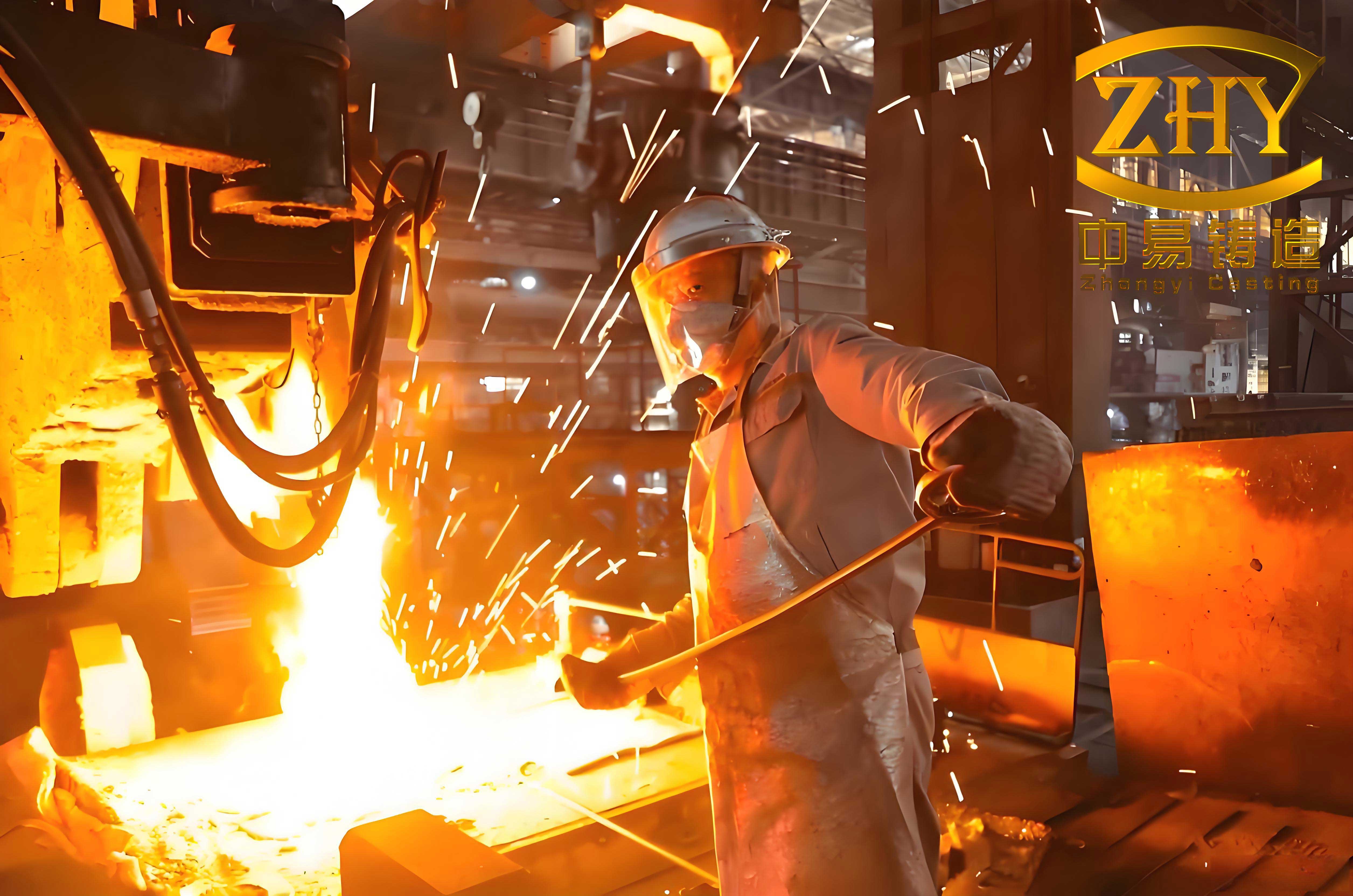
This is the core of our adapted investment casting process, where ductile iron is produced in a fuel-oil furnace.
A. Equipment: A diesel-fired reverberatory furnace with a water-cooled lid, a graphite crucible (100# capacity), a pressure oil pump/compressed air system for atomization, and a bell jar for magnesium treatment.
B. Charge Composition: Typical charge mixes for a 75 kg heat are shown in Table 3. Raw materials must be clean, with controlled sizing. Pig iron should ideally have Si < 2.0% and P < 0.1%.
| Material | Mix I | Mix II | Mix III | Mix IV |
|---|---|---|---|---|
| Pig Iron (Low P) | 50% | 40% | 45% | 50% |
| Returns (Gates/Risers) | 45% | 45% | 45% | 45% |
| Steel Scrap | 0% | 10% | 5% | 0% |
| Si-Mn-Fe Scrap | 5% | 5% | 5% | 5% |
C. Nodularizing Alloy (#4 Alloy) Preparation:
Composition: Pure Mg 10%, 1# Alloy (Ce-based) 34%, 75% Si-Fe 40%, Low-P Pig Iron 16%.
Melting is done in a graphite crucible within the reverberatory furnace. Materials are layered in the crucible (iron at bottom, then Si-Fe, 1# Alloy, magnesium, more 1# Alloy, more Si-Fe). After melting and thorough stirring, the alloy is cast into ingots.
D. Melting Operation Sequence:
1. Preheat the graphite crucible to a dull red heat.
2. Place crucible in furnace center. Add ~0.5 kg of carbonaceous material (charcoal, electrode graphite) to the bottom.
3. Charge metal. If steel scrap is used, place it on top for easier melting.
4. Ignite furnace. Start air flow, then fuel oil flow.
5. Cover furnace. Add remaining charge as initial metal melts.
6. After ~2 hours, when fully molten, superheat to ~1400°C. Turn off fuel and air.
7. Perform nodularizing treatment by plunging a bell jar containing preheated #4 alloy into the molten iron. A vigorous reaction lasts 1-2 minutes.
8. Remove cover, skim slag. Add preheated ferromanganese and ferrosilicon for inoculation. Stir thoroughly.
9. Perform a quick ladle test for nodularity. If satisfactory, the crucible is lifted from the furnace for pouring into the prepared shells.
VIII. Casting Cleaning and Finishing
Post-casting operations in our investment casting process involve: 1) Breaking away the shell using a hammer (carefully to avoid damaging castings). 2) Separating castings from the sprue using a mallet. 3) Removing residual shell material by boiling castings in a 30-40% sodium hydroxide (NaOH) solution for 4-8 hours, followed by rinsing with clean water.
IX. Quality Acceptance Criteria
A. Chemical Composition:
C: 3.7-3.9%, Si: 2.4-2.8%, Mn: 0.6-0.8%, P: <0.1%, S (post-treatment): <0.03%, Residual Mg: 0.03-0.05%, Residual RE: 0.03-0.05%.
B. Microstructure:
1. Nodularity Grade: General parts ≥ Grade III, critical parts (e.g., camshafts) ≥ Grade II (referencing standard charts).
2. As-cast matrix for parts requiring heat treatment should be predominantly pearlite (>70%) with ferrite, allowing minimal cementite.
C. Hardness:
As-cast: HB 200-250. After normalizing: HB 235-280.
D. Visual/Dimensional Inspection: Dimensions must meet drawing requirements (general tolerance ~0.2 mm). Castings must be free from defects like cold shuts, sand inclusions, slag, mistuns, and severe distortion.
X. Challenges and Solutions in Our Investment Casting Process
A. Shell Cracking: Two types were encountered. 1) External cracking after dewaxing: Caused by insufficient hardening due to low NH₄Cl concentration (<18%) in the hardening bath, leading to low shell strength unable to withstand wax expansion. 2) Internal surface cracking: Caused by excessive contraction from overly aggressive hardening (NH₄Cl concentration >25%). Solution: Maintain NH₄Cl concentration strictly at 20-25%.
B. Shell Warping/Deformation: Primarily caused by low shell strength (improper hardening or slurry specs) or excessive firing temperatures (>900°C) causing softening. Solution: Precise control of hardening parameters and firing temperature. The quality of quartz sand (SiO₂ content) and fireclay may also be factors requiring further study.
C. Gas Porosity: Can originate from high gas content in the metal or insufficiently fired (burned-out) shells. Solution: Minimize gas pickup during melting and ensure shells are fired thoroughly at the correct temperature and duration.
D. Cold Shuts/Mistuns: Typically occur with low shell and/or metal pouring temperatures, especially in thin sections. Solution: Control both shell temperature at knockout and molten metal pouring temperature.
E. Chemistry Variation with Local Pig Iron: Using local pig iron can lead to significant fluctuations in silicon and phosphorus, affecting mechanical properties and heat treatment response. Solution: Frequent chemical analysis of incoming pig iron to adjust charge calculations accordingly. Source pig iron with Si <2.0% and P <0.1% where possible.
In summary, our adaptation of the investment casting process, utilizing a fuel-oil fired furnace and ductile iron, demonstrates a viable and economical alternative to traditional steel investment casting for specific applications. It underscores the process’s flexibility and the potential for innovation within established manufacturing frameworks to achieve resource efficiency and cost savings without compromising on the essential precision that defines the investment casting process.