
In my extensive experience with advanced manufacturing, titanium alloys have consistently stood out due to their exceptional combination of low density, high specific strength, excellent corrosion resistance, low thermal conductivity, small coefficient of linear expansion, and non-toxic, non-magnetic properties. These characteristics make them ideal lightweight, high-strength, corrosion-resistant materials widely used in aerospace, aviation, marine, and petrochemical industries. However, the relatively high production costs have been a significant barrier to their broader application. One of the most effective ways to reduce these costs is through near-net or net-shape forming technologies, which minimize material waste. Among these, the investment casting process, also known as lost-wax casting, is a premier near-net-shape technique. It is particularly suitable for parts with complex geometries that are impossible to machine or weld directly, or for structural components where machining and welding are feasible but economically prohibitive due to high costs. In this article, I will detail the comprehensive investment casting process design I developed for a complex curved-blade impeller casting, focusing on how strategic adjustments in pattern scaling and deformation compensation led to successful production.
The impeller casting in question features a intricate design with four open blades uniformly distributed around a central hub. The blades have a complex curved surface, forming an irregular variable-cross-section flow channel. Key dimensions include an overall contour of approximately φ490 mm × 290 mm and a mass of 39 kg. The blade walls are exceptionally thin, with a minimum thickness of only 3.8 mm and edge radii as small as R1.5 mm. The material specified is ZTC4 titanium alloy, a common cast titanium alloy. This casting is classified as Category III with a quality grade of C, requiring rigorous inspection. Internal metallurgical quality must meet GJB2896A-2007 Grade C standards, necessitating X-ray inspection. Surface quality must comply with the same standard’s Grade C requirements, verified by penetrant testing, and the surface roughness must achieve 6.3 μm. Dimensional tolerances are to be executed according to GB/T6414-1999 CT9 level. Achieving these stringent requirements for such a geometrically challenging part was the core objective of my process design.
The foundation of any successful investment casting process lies in the precision of the wax pattern. For this impeller, I employed 3D printing for pattern fabrication, which offers excellent dimensional accuracy and the ability to create complex shapes. A critical challenge was accounting for differential shrinkage. The linear shrinkage of the wax pattern itself typically ranges from 1.0% to 2.0%. However, due to the impeller’s geometry, the distal ends of the blades are far from the casting’s natural contraction center (likely the central hub), meaning they would experience different contraction magnitudes compared to the proximal ends. A uniform scaling factor would lead to dimensional inaccuracies. Therefore, I implemented a segmented scaling approach for the wax model. The scale factor was set at 1.0% for the blade sections near the hub and gradually increased along the blade span to 2.0% at the distal tips. This ensured that the actual contracted dimensions of the model would align with the intended final casting dimensions after all process steps.
Furthermore, titanium alloy castings exhibit a linear shrinkage of approximately 0.5% to 0.8% during solidification and cooling. This shrinkage is not uniform; it varies based on section thickness and geometric constraints. Thicker sections and areas closer to the geometric center tend to shrink more, while thinner sections and free distal ends shrink less. Additionally, regions with abrupt changes in cross-section experience non-uniform cooling rates, leading to differential thermal stresses and distortion. To compensate for this anticipated deformation, I introduced a reverse deformation correction during the wax pattern design. This involved pre-distorting the wax pattern in the opposite direction of the expected casting distortion. The correction magnitude was also segmented: a correction of 0.8% was applied to proximal blade regions, gradually decreasing to 0.5% towards the distal ends. For certain thick sections like the hub, a correction of up to 1.0% was used. This meticulous compensation strategy was vital to ensure that the final shell cavity dimensions would accurately produce the desired cast shape. The relationship between designed dimension (D_d), pattern dimension (D_p), and final casting dimension (D_c) can be expressed through a series of scaling factors. If S_w is the wax pattern shrinkage factor (applied during 3D printing) and S_t is the titanium alloy shrinkage factor, and we include a reverse deformation correction factor C, the ideal pattern dimension can be conceptually derived. For a target casting dimension D_c, the pattern dimension before wax shrinkage should be D_p’ = D_c / (1 – S_t). To account for reverse deformation in areas prone to distortion, an additional correction is applied: D_p” = D_p’ * (1 + C). Finally, the actual 3D-printed wax pattern dimension must account for its own shrinkage: D_p = D_p” * (1 – S_w). In practice, for complex geometries, these factors are applied segmentally as described. A simplified formula for a linear dimension considering these effects is: $$ D_p = \frac{D_c \cdot (1 + C)}{(1 – S_t) \cdot (1 – S_w)} $$ where S_t, S_w, and C are expressed as decimals (e.g., 0.008 for 0.8%).
| Blade Region | Distance from Hub | Wax Pattern Scaling Factor (S_w) | Reverse Deformation Correction (C) | Effective Titanium Shrinkage Compensated (S_t) |
|---|---|---|---|---|
| Proximal (Near Hub) | 0-30% span | 1.0% | 0.8% | ~0.8% |
| Mid-Span | 30-70% span | 1.5% | 0.65% | ~0.65% |
| Distal (Tip) | 70-100% span | 2.0% | 0.5% | ~0.5% |
| Central Hub | N/A | 1.2% | 1.0% | ~1.0% |
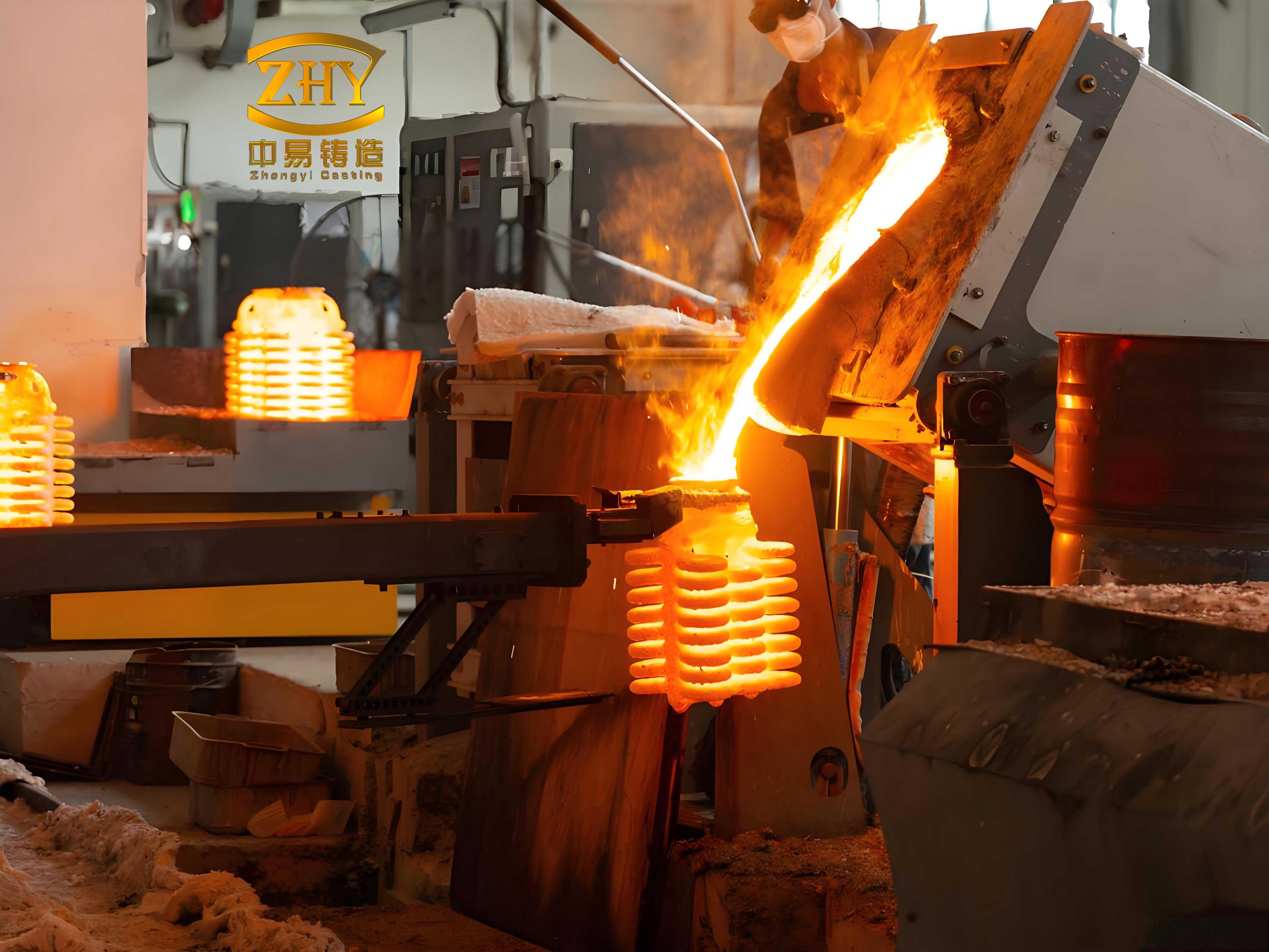
The gating and feeding system is paramount in the investment casting process to ensure sound casting. For this complex impeller, achieving smooth, laminar filling was essential to avoid defects like cold shuts, misruns, turbulence-induced porosity, and oxide inclusions. After analyzing various options, I designed a top-pouring system with a centralized sprue. This orientation promotes bottom-up filling and directional solidification from the blade tips inward toward the hub and feeders. A ring-shaped feeder was placed at the top center (above the hub) to act as a major riser. Additionally, each blade tip was equipped with an open feeder (riser) to feed the thin, extended sections and to act as a vent for gases. To further enhance filling stability and reduce velocity, I implemented a dispersed ingate system. Five separate ingates were designed to introduce molten metal from the ring feeder into the blade cavities in a controlled manner. This multi-gate approach reduces the metal velocity per gate, minimizes turbulence, and helps float inclusions and entrapped gases toward the feeders. Vent holes were also strategically placed along the blade, from proximal to distal ends, to facilitate the escape of air and gases from the mold cavity during pouring. The design principle for minimizing turbulent flow can be related to the Reynolds number (Re) for flow in channels: $$ Re = \frac{\rho v D_h}{\mu} $$ where $\rho$ is fluid density, $v$ is velocity, $D_h$ is hydraulic diameter, and $\mu$ is dynamic viscosity. To maintain laminar flow (Re < 2000), the ingate design aimed to reduce $v$ by increasing the total ingate cross-sectional area. If Q is the volumetric flow rate, and A_total is the total ingate area, then $v = Q / A_total$. By using multiple ingates, A_total is increased, thus reducing v and Re.
| Component | Quantity | Cross-Sectional Area (mm²) | Primary Function |
|---|---|---|---|
| Main Sprue (Top Ring Feeder) | 1 | ~4500 | Metal distribution, primary feeding |
| Ingates | 5 | ~300 each (total ~1500) | Dispersed, controlled metal entry |
| Blade Tip Open Feeders | 4 | ~800 each | Feeding blade tips, venting |
| Vent Holes (per blade) | 3-4 | ~20 each | Gas evacuation |
Shell building is a critical phase in the investment casting process that directly affects surface finish and chemical purity. Titanium in its molten state is highly reactive and readily reduces most oxide ceramics, leading to surface contamination and the formation of an alpha-case layer. Therefore, selecting chemically stable refractory materials is non-negotiable. For the face coat (the layer in direct contact with the molten metal), I chose yttria-stabilized zirconia (ZrO2) due to its excellent thermodynamic stability against molten titanium. The binder for the face coat was a zirconium acetate-based binder. For the backup coats, which provide structural strength to the shell, I used a fused alumina (alumina-silicate) slurry with colloidal silica binder. Stuccoing was performed with mullet sand (a type of aluminosilicate). The shell building process involved repeated cycles of dipping, stuccoing, and drying to build up sufficient thickness. After complete drying, the wax was removed using high-pressure steam or hot water autoclaving. The dewaxed shell was then fired in a box-type electric furnace. The firing was conducted at 900-950°C under a reducing atmosphere for 2-2.5 hours. This step serves to completely remove any residual wax, volatilize organic binders, and sinter the ceramic particles, thereby developing adequate shell strength and permeability. Following firing, the shells were inspected and repaired if necessary. A final and crucial step was vacuum degassing of the shell. The shells were placed in a vacuum furnace and heated to 950-1000°C under a high vacuum (≤5×10⁻² Pa) for 2-2.5 hours. This process removes any residual gases, moisture, or volatile compounds trapped within the porous ceramic, preventing gas evolution during metal pouring that could cause porosity in the casting. Only after this degassing were the shells deemed ready for melting and pouring.
| Shell Layer | Refractory Material | Binder | Stucco Material | Key Process Step | Temperature/Time |
|---|---|---|---|---|---|
| Face Coat (1st & 2nd) | Yttria-Stabilized Zirconia | Zirconium Acetate | Fine Zirconia Sand | Drying: 24h, 50% RH | N/A |
| Backup Coats (3rd-8th) | Fused Alumina Slurry | Colloidal Silica | Mullet Sand (Aluminosilicate) | Drying: 8-12h per coat | N/A |
| All Layers | N/A | N/A | N/A | Dewaxing | Steam Autoclave, ~150°C |
| Fired Shell | N/A | N/A | N/A | Firing/Sintering | 900-950°C, 2-2.5h |
| Fired Shell | N/A | N/A | N/A | Vacuum Degassing | 950-1000°C, ≤5e-2 Pa, 2-2.5h |
Melting and pouring of titanium alloys require specialized equipment to prevent contamination from atmospheric gases and crucible materials. I utilized a ZHK400-type vacuum consumable electrode arc skull furnace for this investment casting process. This furnace melts a titanium electrode in a water-cooled copper crucible under vacuum. The “skull” of solidified titanium that forms on the crucible wall acts as a contaminant-free lining. The consumable electrode was prepared from a secondary ingot of ZTC4 alloy produced by vacuum arc remelting. Careful control of melting parameters is essential for achieving the correct superheat, minimizing gas pickup, and ensuring a clean pour. The melting sequence began with a low-current arc initiation to establish a stable pool, followed by a preheating phase to gradually heat the electrode and crucible. The main melting was then conducted at a high current to achieve the required melt quantity and temperature. Throughout the melting and pouring, maintaining a stable vacuum was critical to prevent oxidation. The molten metal was poured into the preheated ceramic shells by rapidly tilting the furnace. The entire melting and casting cycle was performed under high vacuum. Key parameters monitored and controlled included melting current, voltage, vacuum level, and crucible cooling water temperature.
| Process Stage | Current (kA) | Voltage (V) | Vacuum (Pa) | Time (s/min) | Remarks |
|---|---|---|---|---|---|
| Arc Starting | 1.0 – 1.5 | 30-40 | < 0.1 | 10-20 s | Establish stable arc |
| Preheating | 3.0 – 5.0 | 35-45 | 1.0 – 5.0 | 60-80 s | Heat electrode & crucible |
| Main Melting | 28.0 – 36.0 | 34 – 41 | 3.0 – 5.0 | 45-60 min | Melt entire charge |
| Superheating/Holding | 9.0 – 12.0 | 30-35 | 3.0 – 5.0 | 30-45 s | Achieve pouring temp |
| Pouring | N/A (Tilting) | N/A | 3.0 – 5.0 | 5-10 s | Rapid tilt into molds |
Process Constraint: Crucible cooling water return temperature was maintained below 45°C to ensure proper skull formation and prevent crucible breakthrough.
After casting, the shells were removed via mechanical vibration and high-pressure water jetting. The castings were then separated from the gating system using abrasive cutting. Initial cleaning involved grit blasting to remove any residual ceramic shell. To evaluate the success of this investment casting process, a comprehensive series of inspections and tests were performed. Visual inspection and fluorescent penetrant inspection (FPI) were conducted on the cleaned casting surface. The surface was found to be smooth and continuous, free from cracks, cold shuts, folds, or any other surface defects. The surface roughness was measured using a profilometer and compared to standard blocks, confirming a value better than 3.2 µm, exceeding the specified 6.3 µm requirement. Critical dimensions were measured using coordinate measuring machines (CMM) and large vernier calipers. Key dimensions such as overall height, hub diameters, and outer diameter were all within the specified CT9 tolerance limits. For instance, the specified dimension for height was (290 ± 3.2) mm, and the measured value was 292.8 mm, well within tolerance. Similar conformance was found for all other critical features.
To ensure internal soundness, all castings underwent hot isostatic pressing (HIP). The HIP cycle was conducted at (920 ± 10)°C under an argon pressure of 100-140 MPa for 2-2.5 hours, followed by furnace cooling. HIPping effectively closes internal shrinkage porosity and homogenizes the microstructure. Post-HIP, the castings were subjected to X-ray radiography in accordance with the specified Grade C standard. The radiographs were evaluated for the presence of gas pores, shrinkage cavities, sponge-like or dendritic shrinkage, and low-density inclusions. The evaluation confirmed the absence of all such discontinuities, indicating excellent internal metallurgical quality. Chemical composition analysis was performed on samples taken from three representative locations: the distal blade tip, the proximal blade region near the hub, and the central hub itself. The samples were analyzed using optical emission spectrometry (OES) for metallic elements and combustion/inert gas fusion methods for interstitial elements (C, N, H, O). The results from all locations were consistent and met the composition requirements for ZTC4 alloy.
| Element | Specification Range (max or min) | Sample: Distal Blade | Sample: Proximal Blade | Sample: Central Hub | Compliance |
|---|---|---|---|---|---|
| Aluminum (Al) | 5.5 – 6.8% | 5.98 | 6.01 | 5.99 | Yes |
| Vanadium (V) | 3.5 – 4.5% | 4.08 | 4.10 | 4.09 | Yes |
| Iron (Fe) | ≤ 0.30% | 0.17 | 0.19 | 0.18 | Yes |
| Silicon (Si) | ≤ 0.15% | 0.08 | 0.09 | 0.08 | Yes |
| Carbon (C) | ≤ 0.10% | 0.069 | 0.070 | 0.071 | Yes |
| Nitrogen (N) | ≤ 0.05% | 0.022 | 0.020 | 0.021 | Yes |
| Hydrogen (H) | ≤ 0.015% | 0.0078 | 0.0080 | 0.0079 | Yes |
| Oxygen (O) | ≤ 0.20% | 0.11 | 0.12 | 0.13 | Yes |
| Titanium (Ti) | Balance | Balance | Balance | Balance | Yes |
| Inspection Category | Specification / Requirement | Result Obtained | Status |
|---|---|---|---|
| Surface Quality (Visual/FPI) | GJB2896A-2007 Grade C, no defects | No cracks, cold shuts, inclusions | Pass |
| Surface Roughness | ≤ 6.3 µm Ra | ~3.2 µm Ra | Pass (Exceeded) |
| Dimensional Accuracy | GB/T6414-1999 CT9 Level | All critical dimensions within tolerance | Pass |
| Internal Quality (X-Ray) | GJB2896A-2007 Grade C | No porosity, shrinkage, inclusions | Pass |
| Chemical Composition | ZTC4 alloy specification | All elements within specified ranges | Pass |
The success of this project underscores several key advantages of a well-engineered investment casting process for complex titanium components. Compared to the traditional manufacturing route for such an impeller – which would involve machining from a forged or rolled billet – the investment casting process resulted in dramatic savings. Material utilization efficiency improved from an estimated 10-15% for machining to over 80% for near-net-shape casting. The lead time was also significantly reduced, as the lengthy and complex multi-axis machining operations were eliminated. The ability to cast the complex blade geometry integrally with the hub eliminated the need for assembly or welding, further enhancing structural integrity and reducing cost. The investment casting process, when combined with advanced patternmaking techniques like 3D printing and meticulous process control, proves to be a highly capable and economical route for producing high-integrity titanium alloy components with intricate geometries. Future work could involve optimizing the gating design using computational fluid dynamics (CFD) simulation to further refine filling patterns and solidification sequences. Additionally, exploring the use of even more inert face coat materials like yttria or calcia could potentially reduce the alpha-case layer thickness, minimizing subsequent chemical milling requirements.
In conclusion, the investment casting process designed and implemented for this complex titanium alloy impeller was highly successful. By employing a segmented scaling and reverse deformation strategy for the wax pattern, the fundamental challenge of dimensional accuracy for long, thin, curved features was overcome. The top-pouring gating system with dispersed ingates and ample venting ensured a tranquil fill and sound feeding. The selection of a zirconia-based face coat and rigorous shell processing, including vacuum degassing, prevented metal-mold reactions and gas-related defects. Controlled vacuum arc skull melting provided a clean, homogeneous melt. The resultant castings met all stringent requirements for surface quality (exceeding roughness specs), dimensional accuracy (CT9), internal soundness (Grade C X-ray), and chemical composition. This case study demonstrates that a meticulously planned and executed investment casting process is not only viable but highly advantageous for manufacturing complex, thin-walled titanium alloy components, offering substantial benefits in cost reduction, lead time, and material efficiency compared to conventional subtractive methods.