
The relentless pursuit of performance, efficiency, and reliability in modern aerospace and automotive industries has placed unprecedented demands on the manufacturing of critical components. Among these, aluminum alloy housings and shells serve as foundational structures, where any imperfection introduced during the investment casting process can have severe consequences for the final product’s integrity and functionality. Traditional manufacturing approaches, heavily reliant on empirical knowledge and iterative trial-and-error, often struggle to precisely control the multitude of interacting variables inherent to casting. This limitation underscores the critical need for advanced methodologies. Consequently, the integration of numerical simulation technology to model, analyze, and optimize the investment casting process has emerged as a pivotal research focus. By enabling the virtual prediction and prevention of potential defects such as shrinkage porosity, misruns, and hot tears, simulation empowers a shift towards “zero-defect” and “near-net-shape” manufacturing paradigms, reducing development costs, shortening lead times, and enhancing quality assurance.
The investment casting process, also known as lost-wax casting, is a versatile and precise metal-forming technique. Its unique advantage lies in its ability to produce components with complex geometries, excellent surface finish, and minimal post-casting machining requirements. The core steps of the investment casting process are outlined below:
- Pattern Creation: A precise wax or polymer pattern of the desired component is produced, often using injection molding.
- Assembly: Multiple patterns are assembled onto a central wax gating system (sprue, runners, risers) to form a “tree.”
- Shell Building: The assembly is repeatedly dipped into a ceramic slurry, coated with refractory stucco, and dried. This builds up a multi-layered, high-strength ceramic shell around the patterns.
- Dewaxing: The shell is heated, typically in a steam autoclave or furnace, to melt out and remove the wax pattern, leaving a precise ceramic cavity.
- Firing: The empty ceramic mold is fired at high temperature to burn out any residual pattern material and to develop the final strength and permeability of the shell.
- Pouring: Molten metal is poured into the preheated ceramic mold.
- Solidification & Cooling: The metal fills the cavity and solidifies under controlled conditions.
- Shell Removal & Finishing: The ceramic shell is mechanically broken away, and the castings are cut from the gating system and finished.
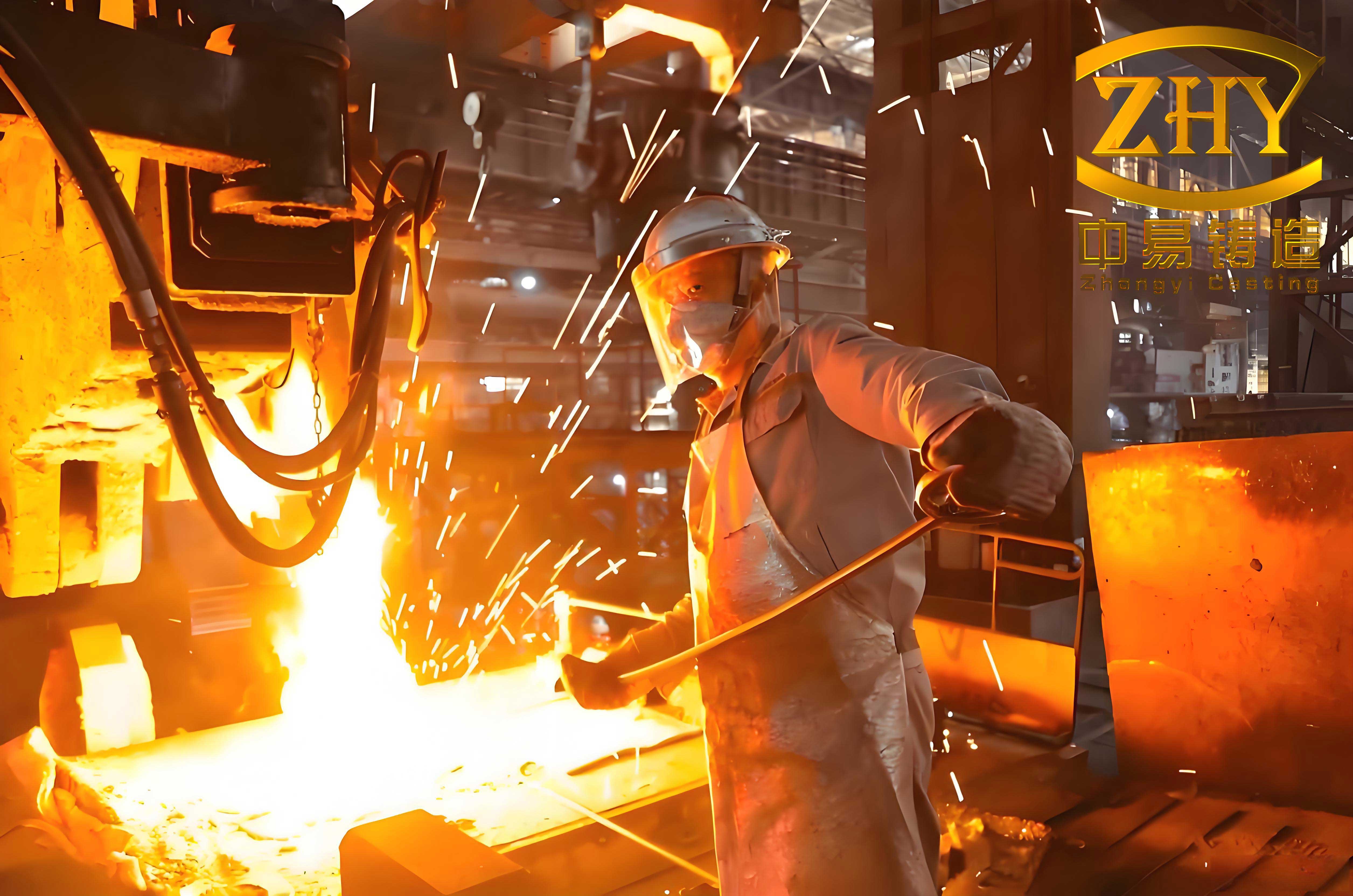
Despite its advantages, the traditional investment casting process is fraught with challenges. The sequential nature of shell building and drying makes the cycle time inherently long. Furthermore, designing an effective gating and risering system to ensure sound casting is a complex task. Incorrect parameters like pouring temperature, mold preheat temperature, and alloy composition can lead to costly defects, making the initial development phase expensive and time-consuming. This is where computational numerical simulation becomes an indispensable tool, transforming the investment casting process from an art to a more predictable science.
Fundamentals of Numerical Simulation for Investment Casting
Numerical simulation of casting processes involves solving the governing equations of fluid flow, heat transfer, and solidification physics within a discretized computational domain (mesh) that represents the mold and the casting. For the investment casting process, several key physical phenomena must be modeled:
- Fluid Flow: The transient flow of molten metal during mold filling, accounting for turbulence, free surface tracking, and the prevention of air entrapment.
- Heat Transfer: Conductive heat transfer within the metal and ceramic shell, convective heat loss at the metal-shell interface, and radiative heat loss from external surfaces.
- Solidification & Microstructure: The phase change from liquid to solid, release of latent heat, prediction of solidification time, and the potential for the formation of shrinkage porosity and microsegregation.
The core energy equation governing the heat transfer during the investment casting process is given by the transient heat conduction equation with a phase change source term:
$$
\rho c_p \frac{\partial T}{\partial t} = \nabla \cdot (k \nabla T) + \dot{Q}_{latent}
$$
where:
- $\rho$ is the density (kg/m³),
- $c_p$ is the specific heat capacity (J/kg·K),
- $T$ is the temperature (K),
- $t$ is the time (s),
- $k$ is the thermal conductivity (W/m·K),
- $\dot{Q}_{latent}$ is the latent heat release rate due to solidification (W/m³).
The release of latent heat, $L$ (J/kg), is often handled by defining an effective heat capacity or using an enthalpy method. The fraction of solid, $f_s$, is a key variable, often modeled as a function of temperature using a Scheil-Gulliver model or lever rule for equilibrium conditions. A simplified relationship is:
$$
\dot{Q}_{latent} = \rho L \frac{\partial f_s}{\partial t}
$$
The interfacial heat transfer between the casting and the ceramic shell is critical and is modeled using a heat transfer coefficient (HTC), $h_{int}$ (W/m²·K):
$$
q = h_{int} (T_{cast} – T_{mold})
$$
where $q$ is the heat flux. This coefficient is not a constant material property but depends on factors like interfacial pressure, surface roughness, and the presence of an air gap forming upon solidification and shrinkage.
| Material | Density, $\rho$ (kg/m³) | Thermal Conductivity, $k$ (W/m·K) | Specific Heat, $c_p$ (J/kg·K) | Latent Heat, $L$ (kJ/kg) | Solidus Temperature, $T_s$ (°C) | Liquidus Temperature, $T_l$ (°C) |
|---|---|---|---|---|---|---|
| ZL114A Alloy | ~2680 | ~150 (liq), ~100 (sol) | ~900 | ~390 | ~555 | ~615 |
| Ceramic Shell | ~2200 | ~1.5 | ~1100 | N/A | N/A | N/A |
Case Study: Numerical Simulation and Optimization of an Aluminum Alloy Shell
To illustrate the practical application of simulation in the investment casting process, we present a detailed study on a medium-sized aluminum alloy structural shell. The component, with approximate envelope dimensions of 321 mm x 303 mm x 142 mm and a mass of 3.1 kg, features significant variations in wall thickness, ranging from an average of 4 mm to a maximum of 11 mm. Such geometry promotes the formation of thermal centers (hot spots), which are prone to shrinkage defects, making it an ideal candidate for simulation-driven optimization.
Methodology: Simulation Setup and Design of Experiments
The material selected for the shell is ZL114A, a heat-treatable Al-Si-Mg casting alloy known for its good castability and mechanical properties. A three-dimensional model of the part and its gating system was created. A bottom-filling gating system was designed to promote tranquil, progressive filling and directional solidification towards the top risers.
The computational mesh, a critical element for accuracy, was generated using tetrahedral elements. A finer mesh size (3 mm) was applied to the casting to capture geometric details and thermal gradients, while a coarser mesh (5 mm) was used for the gating system and mold. The final mesh consisted of approximately 2.6 million volume elements. The thermal-physical properties of the ZL114A alloy and the ceramic shell material, including temperature-dependent conductivity and enthalpy, were either sourced from the simulation software’s database or calculated from the alloy composition.
The core of this optimization study was a Design of Experiments (DOE) approach focusing on two of the most influential parameters in the investment casting process:
- Pouring Temperature ($T_{pour}$): The temperature of the molten metal when it enters the mold.
- Mold Preheating Temperature ($T_{mold}$): The initial temperature of the ceramic shell before pouring.
A full factorial design with three levels for each parameter was implemented, resulting in nine distinct processing conditions.
| Experiment ID | Pouring Temperature, $T_{pour}$ (°C) | Mold Preheat Temperature, $T_{mold}$ (°C) |
|---|---|---|
| Exp 1 | 650 | 250 |
| Exp 2 | 650 | 300 |
| Exp 3 | 650 | 350 |
| Exp 4 | 700 | 250 |
| Exp 5 | 700 | 300 |
| Exp 6 | 700 | 350 |
| Exp 7 | 750 | 250 |
| Exp 8 | 750 | 300 |
| Exp 9 | 750 | 350 |
Simulation Results and Analysis
The simulation software calculated the filling sequence, temperature evolution, solidification progression, and predicted defect locations for all nine conditions.
1. Filling Analysis: For all scenarios, the simulated filling pattern was stable and progressive. The metal entered through the bottom gate, steadily filling the cavity from the bottom upwards without excessive turbulence or splashing, confirming the efficacy of the gating design. This is crucial in the investment casting process to avoid oxide film entrainment and air pockets.
2. Solidification and Thermal Analysis: The evolution of the solidification front was monitored. The desired sequence was observed: thinner sections solidified first, while thicker sections and the risers remained liquid longer, acting as reservoirs to feed shrinkage. The temperature gradient, $G$, and the solidification rate, $R$, are key metrics. A higher $G/R$ ratio is generally favorable for sounder casting. The simulations allowed for the visualization of thermal centers where cooling was slowest.
3. Porosity Prediction: The primary criterion for optimization was the predicted volume of shrinkage porosity. The software uses a porosity model, often based on the Niyama criterion or a mass continuity function, to identify regions where liquid metal feeding is insufficient to compensate for solidification shrinkage. The Niyama criterion, $N_y$, is defined as:
$$
N_y = \frac{G}{\sqrt{\dot{T}}}
$$
where $\dot{T}$ is the cooling rate. Regions with $N_y$ values below a critical threshold are flagged as potential porosity sites. The total predicted porosity volume for each experiment was quantified, providing a direct measure of comparative quality.
| Experiment ID | Predicted Porosity Volume (cm³) | Relative Quality Ranking | Critical Solidification Time (s) |
|---|---|---|---|
| Exp 1 | 1.31 | 9 (Worst) | ~185 |
| Exp 2 | 0.43 | 5 | ~210 |
| Exp 3 | 0.50 | 6 | ~235 |
| Exp 4 | 0.50 | 7 | ~165 |
| Exp 5 | 0.16 | 1 (Best) | ~190 |
| Exp 6 | 0.20 | 3 | ~215 |
| Exp 7 | 0.43 | 4 | ~150 |
| Exp 8 | 0.17 | 2 | ~175 |
| Exp 9 | 0.29 | 8 | ~200 |
The analysis revealed a clear trend. Experiment 5 ($T_{pour}$ = 700°C, $T_{mold}$ = 300°C) yielded the minimum predicted shrinkage porosity volume (0.16 cm³). This represents an 88% reduction compared to the worst-case scenario (Exp 1). The results demonstrate a non-linear interaction between the two parameters. A low pouring temperature combined with a low mold temperature (Exp 1) leads to rapid heat extraction, potentially causing premature freezing of feeding paths and severe centerline shrinkage. Conversely, very high temperatures can increase total shrinkage volume and grain size. The optimal combination found (700°C / 300°C) appears to create a thermal regime that supports efficient directional solidification and adequate feeding throughout the investment casting process.
Experimental Validation and Industrial Verification
To validate the numerical findings, physical castings were produced under the optimized parameters (Exp 5) and several other conditions for comparison. The standard investment casting process was followed: wax pattern injection, assembly, ceramic shell building via successive dips, autoclave dewaxing, high-temperature mold firing, pouring of ZL114A alloy, cooling, and shell removal.
The castings produced under the optimized parameters (700°C pour, 300°C mold) exhibited excellent visual and radiographic quality. Non-destructive evaluation (NDE) using digital radiography (DR) confirmed the absence of any detectable shrinkage cavities or major porosity in the critical sections of the housing. In contrast, castings made under conditions simulating Exp 1 showed clear radiographic evidence of shrinkage porosity in the predicted thick sections. Furthermore, dimensional inspection confirmed the “near-net-shape” capability of the process, with minimal deviations from the CAD model, reducing the need for subsequent machining.
| Process Condition (Tpour / Tmold) | Simulation Prediction | Physical Casting Result (DR Inspection) | Conclusion |
|---|---|---|---|
| 650°C / 250°C | High porosity volume (1.31 cm³) | Significant shrinkage cavity present | Simulation accurately predicted defect. |
| 700°C / 300°C | Minimal porosity volume (0.16 cm³) | No discernible shrinkage defects | Simulation successfully optimized process. |
| 750°C / 350°C | Moderate porosity volume (0.29 cm³) | Minor scattered microporosity | Simulation trend correct; qualitative match. |
Discussion and Broader Implications for the Investment Casting Process
This case study powerfully demonstrates the transformative role of numerical simulation within the modern investment casting process. The software acted as a virtual foundry, enabling the exploration of a wide design space (nine distinct process routes) at a fraction of the time and cost required for physical trials. The core value lies in its predictive capability, shifting the paradigm from defect detection and correction to defect prevention through proactive design and parameter optimization.
The success of the simulation hinges on accurate input data, particularly:
- Material Properties: Temperature-dependent thermal properties of the alloy and mold materials.
- Boundary Conditions: The interfacial heat transfer coefficient (HTC) is perhaps the most sensitive and difficult parameter to characterize. It evolves during solidification as an air gap forms. Using values calibrated from prior experiments or literature is essential for quantitative accuracy.
- Mesh Quality: A sufficiently refined mesh, especially in areas of geometric complexity and expected thermal gradients, is necessary to resolve the physics correctly.
The principles and methodology described here are universally applicable across the investment casting process for various alloys (e.g., steel, superalloys, titanium) and component sizes. Beyond porosity prediction, advanced simulation packages can model:
- Microstructure and Grain Structure: Predicting grain size, morphology (columnar vs. equiaxed), and phase fractions using cellular automaton (CA) or phase-field models coupled with thermal calculations.
- Residual Stress and Distortion: Predicting the final shape of the part after cooling and shell removal, enabling compensatory design to meet dimensional tolerances.
- Filling-Related Defects: Modeling surface oxide formation, bubble entrapment, and cold shuts during the filling stage.
Conclusion
The integration of numerical simulation into the investment casting process represents a cornerstone of advanced manufacturing. By solving the fundamental equations of heat, mass, and fluid flow, it provides deep insight into the complex interplay of parameters that determine final casting quality. As demonstrated in the optimization of an aluminum alloy shell, simulation enables the identification of an optimal process window—specifically a pouring temperature of 700°C and a mold preheat temperature of 300°C—that minimizes shrinkage defects. The subsequent experimental validation, yielding sound, high-integrity castings, confirms not only the feasibility but also the quantitative accuracy of the numerical approach. As computational power increases and models become more sophisticated—incorporating microstructure prediction, thermomechanical stresses, and more—the investment casting process will continue to evolve towards ever-higher levels of precision, reliability, and efficiency, solidifying its role in manufacturing the critical components of tomorrow.