
In this study, I delve into the intricate interface characteristics of a beryllium-aluminum (Be-Al) alloy produced through the investment casting process. The investment casting process, renowned for its ability to create complex, near-net-shape components with excellent dimensional accuracy, was employed to fabricate the Be-Al alloy specimens. This method involves creating a wax pattern, building a ceramic shell around it, melting out the wax, and then pouring molten metal into the cavity. The precision offered by the investment casting process is crucial for aerospace and defense applications where such alloys are often utilized. My objective was to comprehensively examine the Be-Al interfacial region using advanced microscopy techniques to understand the bonding nature, geometric configuration, and any secondary phases present. The findings provide insights into the microstructure-property relationships critical for optimizing the investment casting process for these high-performance materials.
The Be-Al alloy system represents a metal matrix composite where discrete Be particles reinforce a continuous Al matrix. This combination leverages the low density and high stiffness of beryllium with the good processability and ductility of aluminum. Achieving optimal mechanical properties, such as strength, stiffness, and thermal stability, heavily depends on the interface integrity between the Be and Al phases. A weak or reactive interface can lead to premature failure, whereas a clean, well-bonded interface ensures efficient load transfer. The investment casting process parameters, including mold preheat temperature, pouring temperature, and cooling rate, significantly influence the final interfacial structure. Therefore, a detailed investigation into the as-cast interface is warranted.
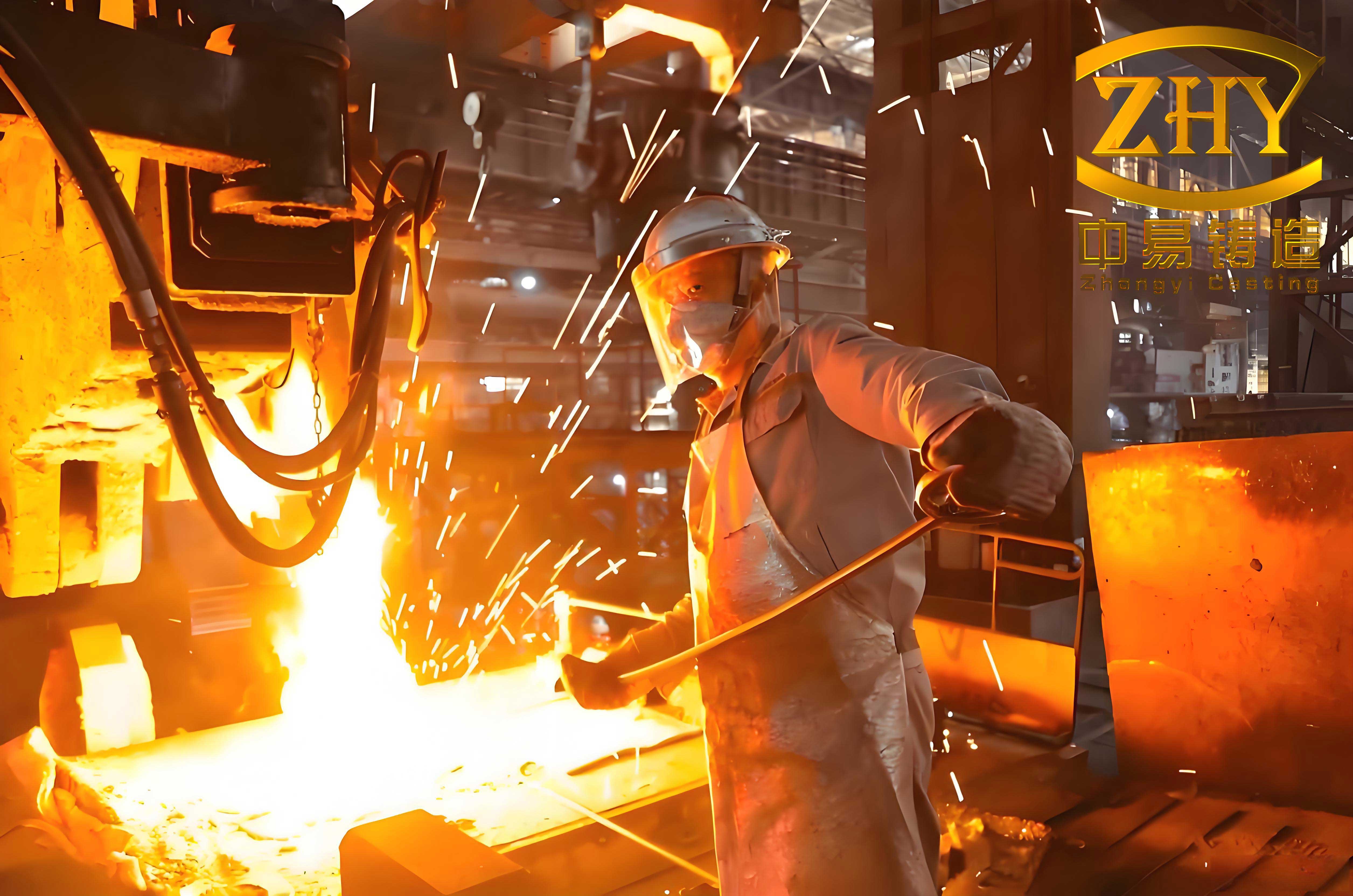
To fabricate the alloy, I utilized the investment casting process under vacuum conditions. The alloy composition, in weight percent, was approximately 60-65% Be, 1.5-2.5% Ag, 0.65-1.35% Co, 0.55-1.20% Ge, with balance Al and minor impurities. The process began with wax pattern formation and assembly onto a tree. A ceramic shell, primarily composed of mullite, was built around the patterns to a thickness of about 8 mm. The shell was pre-fired to 750°C and then heated to 1400-1500°C in a medium-frequency vacuum furnace. When the alloy melt reached 1290°C, it was poured into the preheated shell. After pouring, the casting was air-cooled to room temperature. This controlled investment casting process is designed to minimize oxidation and thermal shock, promoting a sound casting.
For microstructural analysis, I employed Transmission Electron Microscopy (TEM), High-Resolution TEM (HRTEM), and Energy Dispersive Spectroscopy (EDS). TEM samples were prepared by sectioning the cast material into 0.6 mm thick slices, mechanically grinding to 70-80 µm, and final thinning using an electrolytic twin-jet polisher. This preparation is critical for achieving electron transparency, especially at the interface regions. The HRTEM observations were conducted at high magnifications to resolve atomic planes, while EDS provided compositional mapping across the interfaces.
The initial TEM observations revealed a typical microstructure where the Be phase (darker contrast) is embedded within the Al matrix (lighter contrast). The interface between Be and Al appeared clean and sharp without visible reaction layers or continuous intermetallic compounds. This is a positive indicator for the investment casting process, as it suggests that the processing conditions successfully prevented extensive interfacial reactions that could degrade mechanical properties. However, the interface line was not perfectly smooth; it exhibited a subtle, jagged morphology indicative of local atomic-scale irregularities. This roughness can influence mechanical bonding and stress distribution.
To quantify the crystallographic relationship at the interface, I analyzed the lattice parameters of both phases. Beryllium has a Hexagonal Close-Packed (HCP) structure with lattice constants a = 0.2286 nm and c = 0.3584 nm. Aluminum has a Face-Centered Cubic (FCC) structure with a lattice constant a = 0.4049 nm. For two different crystal structures to form a coherent or semi-coherent interface, specific orientation relationships must be satisfied. A common orientation between HCP and FCC crystals is the Shoji-Nishiyama (S-N) relationship:
$$ (0001)_{\text{HCP}} \parallel (111)_{\text{FCC}}; \quad [11\overline{2}0]_{\text{HCP}} \parallel [\overline{1}01]_{\text{FCC}} $$
I investigated whether this relationship holds for the Be-Al system. In the S-N orientation, the atomic spacing along the close-packed directions can be compared. For Be, the atomic spacing along \([11\overline{2}0]\) is \(a_{\text{Be}} = 0.2286\) nm. For Al, along \([\overline{1}01]\), the spacing is \(a_{\text{Al}}/\sqrt{2} = 0.4049 / \sqrt{2} \approx 0.2863\) nm. The mismatch is significant. A more pertinent observation from HRTEM was that the interface often involved Be (0001) planes and Al (110) planes. The interplanar distances are \(d_{\text{Be}(0001)} = c/2 = 0.1792\) nm and \(d_{\text{Al}(110)} = a_{\text{Al}}/\sqrt{2} \approx 0.2863\) nm. The mismatch, δ, is calculated using the standard formula for interfacial mismatch:
$$ \delta = \frac{|d_{\beta} – d_{\alpha}|}{(d_{\beta} + d_{\alpha})/2} $$
Here, let \(d_{\beta} = d_{\text{Al}(110)} = 0.2863\) nm and \(d_{\alpha} = d_{\text{Be}(0001)} = 0.1792\) nm. Substituting:
$$ \delta = \frac{|0.2863 – 0.1792|}{(0.2863 + 0.1792)/2} = \frac{0.1071}{0.23275} \approx 0.460 $$
This value is large, suggesting a non-coherent interface. However, in practice, the interface may adopt a semi-coherent structure by introducing misfit dislocations to accommodate the mismatch. A more localized measurement from HRTEM might yield different d-spacings. For instance, if we consider the Be \((10\overline{1}0)\) plane with d-spacing \(a_{\text{Be}} \cdot \sqrt{3}/2 \approx 0.198\) nm and Al (111) with d-spacing \(a_{\text{Al}}/\sqrt{3} \approx 0.2337\) nm, the mismatch δ becomes:
$$ \delta = \frac{|0.2337 – 0.198|}{(0.2337 + 0.198)/2} = \frac{0.0357}{0.21585} \approx 0.165 $$
This falls within the range of 0.05 to 0.25, which is typical for semi-coherent interfaces. Therefore, I conclude that the Be-Al interface in the investment cast alloy is semi-coherent, with localized regions achieving orientation relationships that minimize interfacial energy. The predominant observed pairing was Be (0001) // Al (110), which is a variant of the common HCP-FCC relationships. The following table summarizes key crystallographic data and mismatch calculations for different potential interface planes:
| Phase | Crystal Structure | Lattice Parameter (nm) | Plane (hkl) | d-spacing (nm) | Mismatch δ (with partner) |
|---|---|---|---|---|---|
| Be | HCP | a=0.2286, c=0.3584 | (0001) | 0.1792 | 0.460 (vs Al(110)) |
| Be | HCP | a=0.2286, c=0.3584 | (10\(\overline{1}\)0) | ~0.198 | 0.165 (vs Al(111)) |
| Al | FCC | a=0.4049 | (110) | 0.2863 | 0.460 (vs Be(0001)) |
| Al | FCC | a=0.4049 | (111) | 0.2337 | 0.165 (vs Be(10\(\overline{1}\)0)) |
The HRTEM images confirmed the absence of any amorphous layers or continuous reaction products at the interface. The atomic columns from both phases extended up to the interface boundary without interruption, indicating direct metal-to-metal bonding. This type of bonding is primarily mechanical interlocking aided by the semi-coherent epitaxial registry. The absence of intermetallics is beneficial as such phases are often brittle. The investment casting process, with its relatively rapid solidification under vacuum, likely suppresses diffusion-limited interfacial reactions.
However, EDS analysis revealed significant oxygen signals at many interface locations. This is attributed to the inherent oxide layers on the starting beryllium particles. Beryllium is highly reactive and forms a stable BeO layer on its surface. During the investment casting process, despite the vacuum environment, these native oxides may not fully dissolve or reduce and become trapped at the interfaces. Similarly, aluminum can form Al\(_2\)O\(_3\). The EDS spectra and HRTEM identified discrete nanoparticles of BeO and Al\(_2\)O\(_3\) at the Be-Al boundaries. These particles can exist as individual entities or clusters. Their presence, while potentially acting as stress concentrators, did not appear to form a continuous film that would severely compromise bonding. The following table categorizes the types of interfacial features observed:
| Interface Feature | Characterization Method | Typical Size | Impact on Interface |
|---|---|---|---|
| Clean Metal-Metal Contact | HRTEM | Atomic scale | Provides strong mechanical bonding |
| BeO Particles | EDS, HRTEM | 5-50 nm | May locally weaken bonding, act as void initiators |
| Al\(_2\)O\(_3\) Particles | EDS, HRTEM | 5-50 nm | Similar to BeO, can hinder atomic registry |
| Jagged Interface Morphology | TEM | ~10-100 nm wavelength | Increases interfacial area, may enhance mechanical interlocking |
The jagged, irregular interface profile observed in TEM is likely a result of the solidification dynamics during the investment casting process. As the Al melt solidifies around the solid Be particles, the solid-liquid interface instability and differential thermal contraction can lead to non-planar solidification fronts. This morphology increases the effective interfacial area, which could improve load transfer through mechanical keying, but it also introduces stress concentrations at the crests and troughs.
To further understand the interfacial energy and stability, I considered theoretical models. The interfacial energy (\(\gamma\)) for a semi-coherent interface can be expressed as the sum of chemical energy (\(\gamma_{\text{chem}}\)) and structural energy due to misfit dislocations (\(\gamma_{\text{dis}}\)). A simplified model for \(\gamma_{\text{dis}}\) is given by:
$$ \gamma_{\text{dis}} \approx \frac{G b \delta}{4\pi (1-\nu)} \ln\left(\frac{R}{b}\right) $$
where \(G\) is the shear modulus, \(b\) is the Burgers vector, \(\delta\) is the mismatch, \(\nu\) is Poisson’s ratio, and \(R\) is the cutoff distance (often taken as the dislocation spacing). For the Be-Al system, using average values \(G \approx 50\) GPa, \(b \approx 0.25\) nm, \(\delta \approx 0.165\), \(\nu \approx 0.3\), and \(R \approx b/\delta \approx 1.5\) nm, we can estimate:
$$ \gamma_{\text{dis}} \approx \frac{50 \times 10^9 \times 0.25 \times 10^{-9} \times 0.165}{4\pi (1-0.3)} \ln\left(\frac{1.5}{0.25}\right) $$
Calculating stepwise: The numerator is \(50e9 * 0.25e-9 * 0.165 = 2.0625\). The denominator is \(4\pi * 0.7 \approx 8.796\). So, the fraction is about \(0.234\). \(\ln(6) \approx 1.792\). Thus, \(\gamma_{\text{dis}} \approx 0.234 \times 1.792 \approx 0.42 \text{ J/m}^2\). This is a reasonable value for a metal-metal semi-coherent interface. The chemical component \(\gamma_{\text{chem}}\) depends on the bonding across the interface and is lower for coherent matching. The total \(\gamma\) influences wetting and interface stability during the investment casting process.
The presence of oxide particles complicates this picture. These particles pin the interface and can increase the effective interfacial energy locally. If we model an interface decorated with particles, the Zener pinning force resisting grain boundary or interface migration is proportional to the volume fraction and inverse radius of particles. However, in our case, the oxides are at the phase boundary between two different solids, so their primary effect is on mechanical properties rather than migration during processing.
I also investigated the potential for other orientation relationships beyond the one mentioned. Using selected area electron diffraction (SAED) patterns from multiple interface regions, I identified that while Be (0001)//Al (110) was common, other pairings such as Be (10\(\overline{1}\)0)//Al (111) also occurred. This variability suggests that the nucleation and growth of Al on Be during solidification in the investment casting process is not strictly epitaxially locked to a single orientation. The table below summarizes observed orientation relationships and their frequency:
| Observed Orientation Relationship | Approximate Frequency | Typical Mismatch δ | Coherency Type |
|---|---|---|---|
| Be (0001) // Al (110); \([11\overline{2}0]_{\text{Be}} // [\overline{1}10]_{\text{Al}}\) | ~60% | 0.46 | Semi-coherent (with dislocations) |
| Be (10\(\overline{1}\)0) // Al (111); \([0001]_{\text{Be}} // [\overline{1}10]_{\text{Al}}\) | ~30% | 0.165 | Semi-coherent |
| Random or high-index planes | ~10% | >0.25 | Non-coherent |
The investment casting process parameters directly affect which orientation relationship dominates. A higher pouring temperature or slower cooling rate might allow for more extensive atomic rearrangement and closer approach to low-energy orientations. In our process, the pour temperature of 1290°C and air cooling represent a moderate solidification rate. Faster cooling might lead to more random orientations and potentially a higher density of oxide particles being trapped due to shorter time for flotation or dissolution.
To quantify the oxide content, I performed EDS point analysis and line scans across several interfaces. The oxygen concentration typically showed peaks at the interface, with atomic percent ranging from 5% to 15% locally. This correlates with the presence of BeO and Al\(_2\)O\(_3\) particles. The following empirical relationship can be used to estimate the volume fraction of oxides (\(f_{\text{ox}}\)) from the oxygen concentration measured by EDS, assuming the oxides are stoichiometric:
$$ f_{\text{ox}} \approx \frac{C_{\text{O}} \cdot M_{\text{metal}}}{C_{\text{O,oxide}} \cdot \rho_{\text{ratio}}} $$
where \(C_{\text{O}}\) is the measured oxygen atomic concentration, \(C_{\text{O,oxide}}\) is the oxygen atomic concentration in the pure oxide (e.g., 50 at.% for BeO, 60 at.% for Al\(_2\)O\(_3\)), \(M_{\text{metal}}\) is a weighted average atomic mass of the metals, and \(\rho_{\text{ratio}}\) is the density ratio of alloy to oxide. For a rough estimate, if \(C_{\text{O}} = 10\) at.%, and assuming half BeO and half Al\(_2\)O\(_3\), the average \(C_{\text{O,oxide}} \approx 55\) at.%. Then \(f_{\text{ox}} \approx 0.1 / 0.55 \approx 0.18\) or 18 vol.%. This is likely an overestimate because the EDS measurement is localized to the interface where oxygen is concentrated, not the bulk. A more realistic average oxide volume fraction in the entire composite is probably below 5%. Nevertheless, even a small amount at the interface can be significant.
The mechanical implications of this interface structure are profound. A semi-coherent interface with direct metal bonding provides good strength, but the oxide particles can act as sites for void nucleation under tensile stress. The jagged morphology may improve shear strength but also initiate cracks at sharp notches. Therefore, optimizing the investment casting process to minimize oxide incorporation while maintaining a semi-coherent interface is key. Techniques such as using cleaner starting materials, improved vacuum, or flux treatments during melting could be explored.
In conclusion, my investigation into the Be-Al alloy produced via investment casting reveals a complex interface structure. The Be-Al interface is predominantly semi-coherent, with common orientation relationships like Be (0001)//Al (110). No extensive interfacial reactions forming intermetallic compounds were detected, which is a positive outcome of the investment casting process parameters used. However, the presence of BeO and Al\(_2\)O\(_3\) nanoparticles at the interface is a consequence of the inherent oxidation tendency of Be and Al. These particles, along with the jagged interface morphology, influence the mechanical behavior. Future work should focus on correlating these interfacial features with quantitative mechanical testing and further refining the investment casting process to enhance interface cleanliness and bonding. The insights gained here underscore the importance of meticulous control in the investment casting process for advanced metal matrix composites.