
In the manufacturing of critical components for rail transit systems, the investment casting process has emerged as a pivotal near-net-shape technology, offering superior dimensional accuracy, excellent surface finish, and enhanced mechanical properties. This study focuses on optimizing the investment casting process for a high-speed rail pylon, a key load-bearing connector in automatic door systems. Traditionally produced via welding, the pylon often suffered from defects like slag inclusions and cracks, leading to inconsistent mechanical performance and higher machining costs. By adopting the investment casting process, we aim to achieve integral casting formation, thereby improving internal quality and structural integrity. This article details our comprehensive approach, from initial process design and numerical simulation to parameter optimization and experimental validation, emphasizing the iterative refinement of the investment casting process to eliminate defects such as shrinkage porosity and gas entrapment.
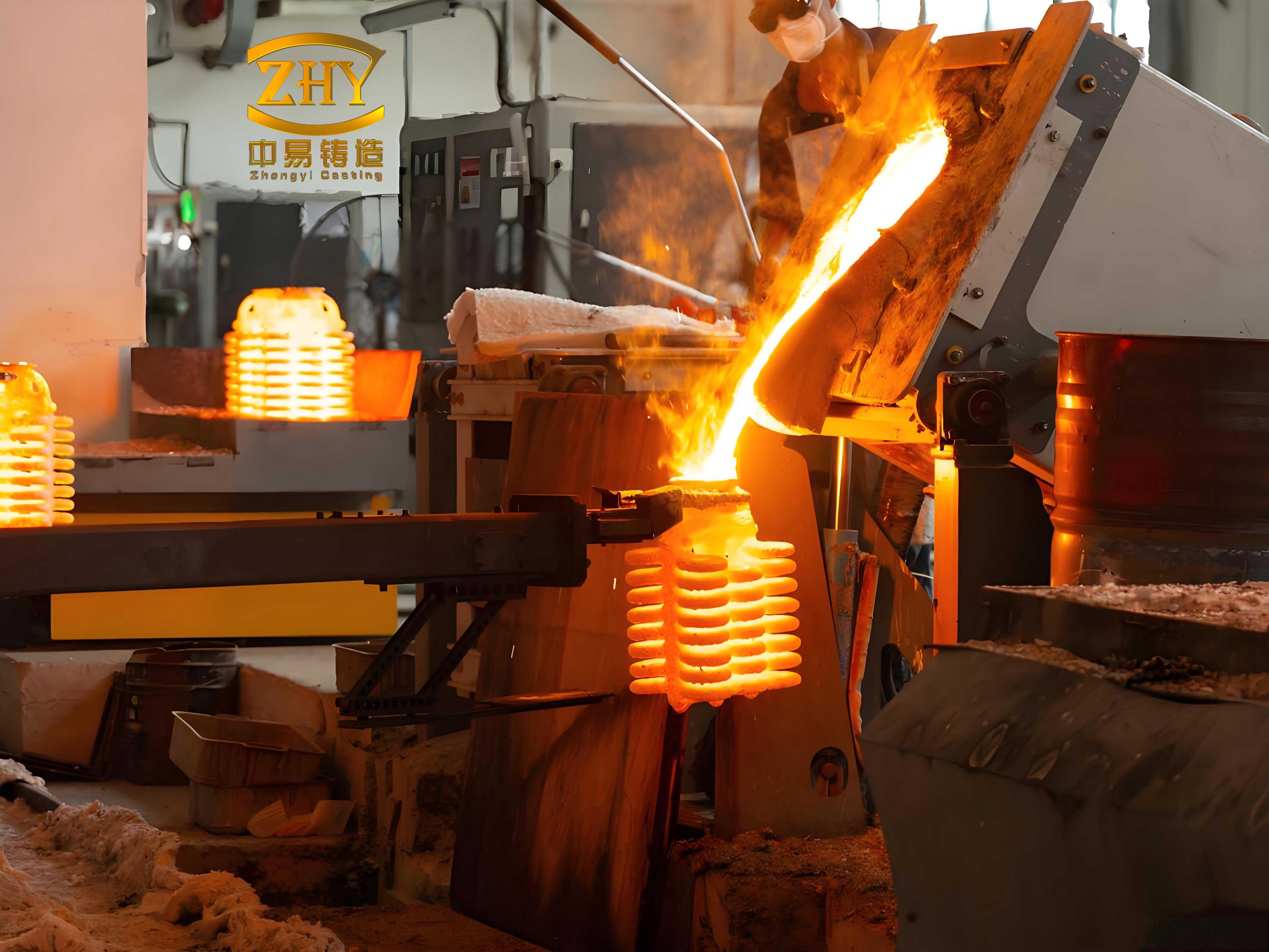
The investment casting process involves creating a precise wax pattern, coating it with refractory materials to form a shell, dewaxing, firing, and finally pouring molten metal. For complex geometries like the pylon, this method ensures high reproducibility and minimal post-processing. However, the success of the investment casting process heavily depends on meticulous design and parameter control to mitigate inherent issues like solidification shrinkage and turbulent filling. Our work leverages finite element simulation to predict defect formation and guide optimization, reducing reliance on trial-and-error methods. Throughout this discussion, the term ‘investment casting process’ will be frequently reiterated to underscore its centrality in achieving quality castings.
The pylon geometry, as shown in the image, consists of a cylindrical wall and a ribbed腹板, with critical thickness variations from 6 mm to 18 mm. Such variations pose challenges for uniform solidification in the investment casting process. The material is ZG270-500, a medium-carbon cast steel with composition as summarized in Table 1. This steel exhibits moderate fluidity, susceptibility to oxidation, and significant solidification shrinkage, necessitating careful control of pouring conditions.
| C | Si | Mn | S | P | Cr |
|---|---|---|---|---|---|
| 0.32-0.38 | 0.2-0.5 | 0.5-0.9 | ≤0.035 | ≤0.035 | ≤0.35 |
Initial investment casting process design employed a gating system with eight patterns arranged symmetrically, using a triangular cross-section runner and rectangular ingates attached to thick sections of the腹板 to facilitate feeding. Key parameters were set based on experience: pouring temperature 1580°C, mold shell temperature 600°C, pouring speed 3 kg/s. The shell material was phenolic resin sand with a thickness of 6 mm. To analyze the investment casting process, we performed finite element simulation using a mesh size of 3 mm, resulting in approximately 2.1 million elements. The governing equations for fluid flow and heat transfer during the investment casting process include the continuity, momentum, and energy equations:
Continuity: $$ \frac{\partial \rho}{\partial t} + \nabla \cdot (\rho \vec{v}) = 0 $$
Momentum (Navier-Stokes): $$ \rho \left( \frac{\partial \vec{v}}{\partial t} + \vec{v} \cdot \nabla \vec{v} \right) = -\nabla p + \mu \nabla^2 \vec{v} + \rho \vec{g} $$
Energy: $$ \rho c_p \frac{\partial T}{\partial t} + \rho c_p \vec{v} \cdot \nabla T = \nabla \cdot (k \nabla T) + Q $$
where $\rho$ is density, $\vec{v}$ velocity, $p$ pressure, $\mu$ viscosity, $\vec{g}$ gravity, $c_p$ specific heat, $k$ thermal conductivity, and $Q$ heat source. For solidification, the enthalpy-porosity technique was used, accounting for latent heat release.
Simulation of the filling stage in the investment casting process revealed turbulent flow at early stages, with metal entering from the ingates at the mid-section. At 10-45% fill, vortices formed near the cylindrical wall, entrapping air that led to gas porosity defects. The air distribution, as predicted by the software, indicated residual gas in upper regions of the cylinder and lower环形 areas. By 70% fill, the casting near the sprue was fully filled, but the腹板 sections showed unstable flow. The complete filling was achieved with overall紊流, suggesting a need for improved gating to reduce turbulence in the investment casting process.
Solidification analysis, depicted through fractional solid plots, showed that thin sections like the cylindrical wall solidified first, following a directional sequence from bottom to top initially. However, at 70% solidification, isolated liquid pools formed in thick sections of the腹板, particularly at the top and near circular holes, due to inadequate feeding. These hot spots solidified last, leading to shrinkage defects. The predicted shrinkage porosity volume was 7.26 cm³, primarily located in these regions. This outcome was validated experimentally, as actual castings produced with the initial investment casting process exhibited defects at identical locations, confirming simulation accuracy.
To optimize the investment casting process, we first conducted a parametric study using orthogonal experiments. Three critical factors were identified: pouring temperature (A), shell temperature (B), and pouring speed (C). Each factor was tested at three levels, as shown in Table 2. The response variable was total shrinkage porosity volume, minimized to improve quality.
| Level | A: Pouring Temperature (°C) | B: Shell Temperature (°C) | C: Pouring Speed (kg/s) |
|---|---|---|---|
| 1 | 1580 | 700 | 3.5 |
| 2 | 1560 | 600 | 3.0 |
| 3 | 1540 | 500 | 2.5 |
Nine trials (L9 array) were simulated, and results are summarized in Table 3. Analysis of means (K values) and ranges (R) determined the optimal combination. The range order RC > RB > RA indicated that pouring speed had the greatest influence on defects in the investment casting process, followed by shell temperature and pouring temperature.
| Trial | A | B | C | Defect Volume |
|---|---|---|---|---|
| 1 | 1 | 1 | 1 | 7.192 |
| 2 | 1 | 2 | 2 | 7.264 |
| 3 | 1 | 3 | 3 | 6.101 |
| 4 | 2 | 1 | 2 | 6.553 |
| 5 | 2 | 2 | 3 | 6.988 |
| 6 | 2 | 3 | 1 | 6.923 |
| 7 | 3 | 1 | 3 | 6.498 |
| 8 | 3 | 2 | 2 | 6.940 |
| 9 | 3 | 3 | 1 | 7.271 |
The mean values for each factor level are: For A, K1 = (7.192+7.264+6.101)/3 = 6.852, K2 = (6.553+6.988+6.923)/3 = 6.821, K3 = (6.498+6.940+7.271)/3 = 6.903; range RA = 0.082. For B, K1 = (7.192+6.553+6.498)/3 = 6.748, K2 = (7.264+6.988+6.940)/3 = 7.064, K3 = (6.101+6.923+7.271)/3 = 6.765; range RB = 0.316. For C, K1 = (7.192+6.923+7.271)/3 = 7.129, K2 = (7.264+6.553+6.940)/3 = 6.919, K3 = (6.101+6.988+6.498)/3 = 6.529; range RC = 0.600. Thus, the optimal levels are A2 (1560°C), B1 (700°C), C3 (2.5 kg/s). Simulation with these parameters reduced defects to 6.08 cm³, but further improvement was needed.
To enhance the investment casting process, we redesigned the gating system based on solidification principles. The key modification was adding risers at hot spots to ensure directional solidification toward the feeders. A conical riser was placed at the top thick section of the腹板, and a spherical riser at the lower circular hole corner. The riser design follows Chvorinov’s rule to ensure it solidifies last:
$$ t_{\text{riser}} > t_{\text{casting}} \quad \text{where} \quad t = B \left( \frac{V}{A} \right)^n $$
Here, $t$ is solidification time, $V$ volume, $A$ surface area, $B$ and $n$ constants. For the conical riser, the modulus $M = V/A$ was calculated to exceed that of the hot spot. Additionally, the runner dimensions were reduced to 37 mm triangular cross-section and ingates to 38 mm × 32 mm × 20 mm, with a longer runner (330 mm) acting as a pour well to dampen turbulence. This optimized investment casting process promotes sequential solidification, as shown in simulation results: the risers remain liquid longest, feeding shrinkage in the casting.
The effectiveness of the optimized investment casting process was verified through simulation and physical casting. Solidification plots demonstrated that with risers, the hot spots were eliminated, and the casting solidified directionally from thin to thick sections toward the feeders. The predicted shrinkage porosity volume plummeted to 0.15 cm³, a drastic reduction from the initial 7.26 cm³. Experimental castings produced using this optimized investment casting process were free of visible defects, aligning perfectly with simulation predictions. This validates the robustness of our approach in refining the investment casting process for complex geometries.
Further analysis of the investment casting process can be enriched by considering additional mathematical models. For instance, the feeding requirement can be expressed as:
$$ V_{\text{riser}} = \frac{V_{\text{casting}} \cdot \alpha}{1 – \alpha} $$
where $\alpha$ is the volumetric shrinkage coefficient (approximately 0.04 for ZG270-500). Using this, we estimated riser sizes to compensate for shrinkage. Moreover, the fluid flow during the investment casting process can be assessed using Reynolds number $Re = \frac{\rho v D}{\mu}$, aiming to keep $Re$ below 2000 for laminar flow in gating to reduce air entrainment. Our optimized parameters yielded a calculated $Re$ of ~1500 at the ingates, confirming improved flow conditions.
| Aspect | Initial Process | Optimized Process |
|---|---|---|
| Pouring Temperature (°C) | 1580 | 1560 |
| Shell Temperature (°C) | 600 | 700 |
| Pouring Speed (kg/s) | 3.0 | 2.5 |
| Riser Design | None | Conical + Spherical |
| Simulated Defect Volume (cm³) | 7.26 | 0.15 |
| Actual Defect Observation | Significant shrinkage | Negligible |
In conclusion, this study demonstrates a systematic method to optimize the investment casting process for high-speed rail pylons. By integrating numerical simulation with orthogonal experimentation and riser design, we achieved a remarkable reduction in defects, enhancing casting quality. The investment casting process, when meticulously engineered, can replace welding for such components, offering superior mechanical performance and cost efficiency. Future work could explore advanced simulation techniques or machine learning to further automate the optimization of the investment casting process for wider applications.
The success of this investment casting process optimization hinges on understanding interplay between parameters. For example, higher shell temperature in the investment casting process improves fluidity but may increase mold erosion risk. Our choice of 700°C balanced these aspects. Similarly, slower pouring speed minimized turbulence but required careful thermal management to avoid premature solidification. The investment casting process thus demands holistic design, as exemplified here.
To summarize key equations used in analyzing the investment casting process: Solidification time: $$ t = B \left( \frac{V}{A} \right)^n $$ Feeding requirement: $$ V_{\text{riser}} = \frac{V_{\text{casting}} \cdot \alpha}{1 – \alpha} $$ Reynolds number: $$ Re = \frac{\rho v D}{\mu} $$ These formulas guide critical decisions in the investment casting process, from riser sizing to gating design.
Ultimately, the investment casting process proves indispensable for manufacturing high-integrity components like rail pylons. Our optimized investment casting process reduced defects by over 98%, ensuring reliability in demanding transit applications. This case study provides a replicable framework for optimizing the investment casting process across similar castings, emphasizing simulation-driven design and parameter refinement. The investment casting process, with its versatility and precision, continues to be a cornerstone of advanced manufacturing, and through continuous improvement, as shown here, it can meet even the stringent requirements of modern rail systems.