
In my extensive experience with precision metal casting, the investment casting process stands out for its ability to produce complex, near-net-shape components with excellent surface finish and dimensional accuracy. However, scaling this process for large structural parts, such as pressure vessel shells weighing 70 kilograms or more, presents a unique set of challenges. Traditional methods often fall short when addressing the intense thermal shock during pouring, the prolonged solidification times, and the immense metallostatic pressure that can compromise mold integrity. This article details my first-hand account of developing and implementing a specialized investment casting process tailored for a large stainless steel shell. I will elaborate on the innovative techniques—such as integrated dewaxing vents, segmented shell construction, and reinforced binding—that were critical to success. The core of this discussion revolves around refining every stage of the investment casting process to achieve a 100% success rate for a demanding application.
The component in question was a pressure vessel shell manufactured from 1Cr18Ni9Ti stainless steel. Its primary function demanded exceptional integrity to withstand an internal pressure of 20 MPa. Any internal porosity, shrinkage, or surface defect like cracking or swelling would lead to catastrophic failure. These stringent requirements made the design of the gating, feeding, and mold system the most critical phase of the entire investment casting process. A bottom-gating system was selected to promote calm, controlled metal flow and minimize turbulence and slag entrapment. To ensure adequate feeding for solidification shrinkage, two large, elongated risers were positioned at the top of the casting. The fundamental fluid dynamics and heat transfer principles governing this design can be expressed through key formulas. The velocity of the molten metal in the sprue is governed by Torricelli’s law, derived from Bernoulli’s principle:
$$ v = \sqrt{2gh} $$
where \( v \) is the efflux velocity, \( g \) is acceleration due to gravity, and \( h \) is the effective sprue height. To ensure the gating system is choke-free and avoids aspiration, the continuity equation must be maintained:
$$ A_1 v_1 = A_2 v_2 $$
where \( A \) and \( v \) represent the cross-sectional area and velocity at different points in the system. The solidification time, a critical factor for large sections, is approximated by Chvorinov’s rule:
$$ t = k \left( \frac{V}{A} \right)^n $$
where \( t \) is solidification time, \( V \) is the volume of the casting, \( A \) is its surface area, \( k \) is a mold constant, and \( n \) is an exponent typically close to 2. For the thick sections of this shell, this rule underscored the necessity of robust thermal management from the mold.
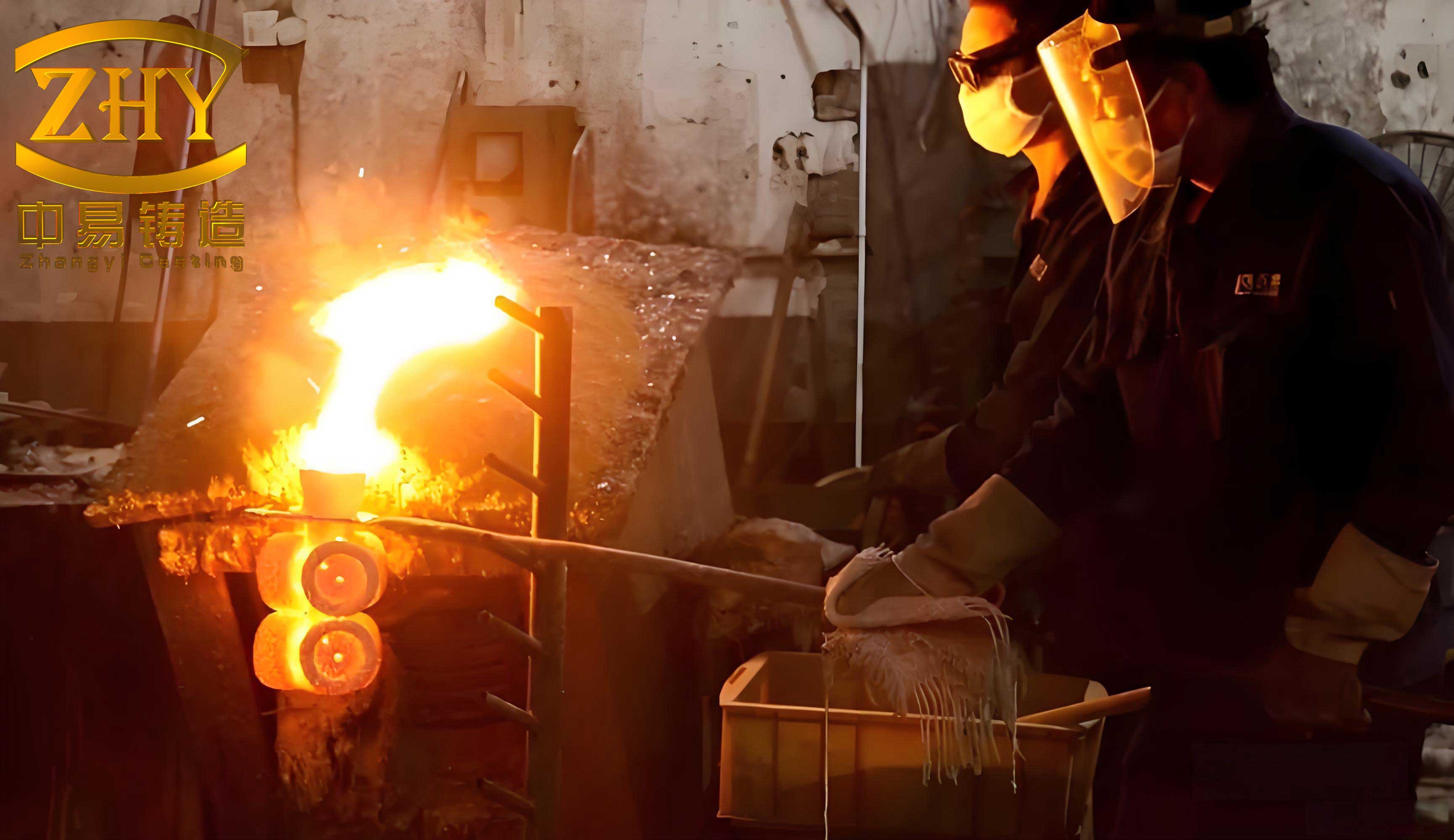
Conventional wisdom in the investment casting process might suggest creating a single, massive wax pattern and a corresponding monolithic mold. However, for this large component, a segmented approach was imperative. Creating a full-scale wax pattern in one piece was impractical due to equipment limitations and would result in poor surface quality from premature wax cooling. Therefore, the wax pattern was strategically divided into three primary segments. This segmentation allowed for easier handling, better control over wax injection parameters, and more efficient use of tooling for low-volume production. The following table summarizes the core challenges and our segmented solutions in pattern making:
| Challenge in Large Pattern Making | Segmented Solution Adopted | Benefit to the Investment Casting Process |
|---|---|---|
| Excessive weight and size for manual handling | Split pattern into three manageable sections (I, II, III) | Improved operator safety and pattern accuracy during assembly. |
| Limited capacity of wax injection equipment | Each section produced by a dedicated, smaller tool. | Ensured complete cavity fill and optimal wax density. |
| Long flow length leading to cold shuts | Shorter flow paths within individual segment tools. | Achieved excellent surface finish and dimensional fidelity. |
| High cost for single-use, full-scale tooling | Modular tool design for the segments. | Significant cost reduction for prototype/small batch production. |
The assembly of the wax pattern was a precision operation. The three major segments were carefully aligned using integral registration pins and sockets, then welded together with molten wax. A dedicated fixture was used to ensure the critical diameter maintained a height variation of less than 0.5 mm. The gating system was also assembled modularly. The sprue base and ingates were combined with standard cylindrical wax rods to form the main sprue, and a pour cup was fabricated by bonding pre-formed wax tubes. A pivotal innovation at this stage was the incorporation of dedicated dewaxing vents. During the subsequent autoclave or steam dewaxing stage, the expansion of the molten wax exerts tremendous pressure on the green ceramic shell. The pressure \( P \) inside a sealed cavity can be estimated by considering the thermal expansion of the wax:
$$ \Delta V = \beta V_0 \Delta T $$
and if constrained, this translates to a pressure increase. To mitigate this, four cylindrical vents (Ø20 mm x 30 mm) were strategically added to the wax assembly. These vents provided direct pathways for the liquid wax to escape during dewaxing, drastically reducing the internal pressure on the fragile shell and preventing cracks or distortions. This simple yet effective modification is a crucial enhancement to the standard investment casting process for large-volume patterns.
The shell-building stage is where the investment casting process truly tests its mettle for large castings. A monolithic shell for such a component would be prohibitively heavy, consume excessive material, and likely develop weak points due to handling stress. Therefore, a segmented shell construction method was employed. The entire assembly was divided into two major sub-assemblies for coating: the main casting with the lower gating, and the upper risers with the pour cup. This allowed for more manageable dipping and stuccoing operations. Furthermore, a composite shell structure was designed to optimize cost and performance. The primary coats, which define the surface finish, used a high-refractorory silica sol-alumina slurry. The backup coats switched to a more economical sodium silicate-coal gangue powder system. The detailed build-up schedule is outlined below:
| Layer Number | Slurry System | Stucco Material | Primary Function |
|---|---|---|---|
| 1-5 | Silica Sol / Alumina Flour | Fused Alumina Grit | Create a high-strength, smooth interface with the metal. |
| 6-12 | Sodium Silicate / Coal Gangue Flour | Zircon Sand (or similar refractory sand) | Build thickness and structural strength economically. |
| 13 (Seal Coat) | Sodium Silicate Slurry | None | Consolidate the outer surface and fill minor porosity. |
After the application of the 5th layer, a critical reinforcement step was taken. A network of mild steel wires (approximately 2 mm diameter) was tightly bound around the shell. This was specifically focused on areas of high stress concentration, such as the large flanges and the circumference of the shell. This reinforcement combats the significant tensile stresses that develop during the high-temperature burn-out and pouring stages. The stress \( \sigma \) on the shell due to metallostatic pressure at a depth \( h \) is given by:
$$ \sigma = \rho_{metal} \cdot g \cdot h $$
where \( \rho_{metal} \) is the density of molten steel. For a shell nearly 500 mm tall, this stress is substantial. The wire binding provides essential hoop strength, preventing shell expansion or “bulging” that leads to casting swell. The binding effectively creates a composite ceramic-metal structure, greatly enhancing the high-temperature strength of the mold, a non-negotiable requirement in the investment casting process for heavy sections.
Following the drying and hardening of the complete shell, the dewaxing process was conducted. The presence of the dedicated vents facilitated a rapid and low-pressure removal of wax, leaving a clean, crack-free cavity. The two shell segments were then subjected to a first-stage firing to burn out residual volatiles and develop initial strength. The assembly of the two major shell segments was a delicate operation. They were aligned and permanently joined using a high-temperature cement paste, a mixture of sodium silicate, asbestos-free fibers, and coal gangue flour. The previously critical dewaxing vents were now sealed shut with this same paste. Additional reinforcement paste was applied to sharp edges and corners of the shell, areas prone to mechanical damage and localized weakness, further fortifying the mold for the thermal assault to come.
The final mold preparation involved a second high-temperature firing to achieve the necessary thermal stability and remove any moisture from the assembly paste. To manage the extreme thermal shock and sustained pressure during pouring, the fired mold was not placed openly on the foundry floor. Instead, it was securely nestled inside a large steel drum and surrounded by loose, dry sand. This backup support provided lateral confinement, further resisting bulging forces, and helped to moderate the cooling rate of the casting after pour, promoting directional solidification.
The melting was carried out in a medium-frequency induction furnace. For the 1Cr18Ni9Ti alloy, precise temperature control was vital. The metal was superheated to approximately 1620°C for effective slag formation and removal, then allowed to cool to a pouring temperature of 1570°C to minimize gas solubility and reaction with the mold. The total weight of metal required for the casting, gating, and risers was about 120 kg. The pouring operation itself required coordination, as the ladle capacity necessitated a sequential pour from two ladles to maintain a continuous metal stream into the mold and complete the fill within the targeted 5-minute window. Immediately after the mold was filled, the risers were topped up, and an exothermic covering compound was applied to maintain their thermal gradient for effective feeding. The controlled solidification, guided by Chvorinov’s rule, was paramount. The mold was allowed to cool in its supporting sand bed for a critical period before shakeout, ensuring the metal had passed through the vulnerable mushy zone and gained sufficient strength to resist distortion.
The outcome of this meticulously tailored investment casting process was exceptionally successful. All castings produced were free from the specified defects—no swelling, cracks, shrinkage porosity, or sand inclusions. Pressure testing at 25 MPa confirmed their structural integrity, with no leakage detected. The successful implementation hinged on several key innovations integrated into the standard investment casting process. The following formula encapsulates the holistic approach to shell strength (\( S_{total} \)), which we treated as a system property:
$$ S_{total} = S_{ceramic} + S_{reinforcement} + S_{support} $$
where \( S_{ceramic} \) is the intrinsic strength from the composite shell layers, \( S_{reinforcement} \) is the added strength from the wire binding (acting like a pressure vessel hoop stress reinforcement), and \( S_{support} \) is the contribution from the external sand backing. This multi-faceted strategy was essential. To quantify the process parameters and their outcomes, the table below provides a consolidated summary:
| Process Parameter Category | Specification / Value | Role in Ensuring Quality |
|---|---|---|
| Pattern Strategy | Three-segment wax assembly with dewaxing vents | Enabled production of large pattern; prevented shell cracking during dewaxing. |
| Shell Architecture | 13-layer composite; layers 1-5: Alumina, 6-12: Coal Gangue | Balanced surface finish, refractoriness, and cost. Provided necessary permeability and strength. |
| Shell Reinforcement | External steel wire binding after layer 5 | Counteracted metallostatic pressure and thermal stress; prevented mold rupture. | Mold Assembly & Support | Segmented shell fired & joined; placed in sand-backed drum | Allowed handling of large mold; provided external constraint during pour and cooling. |
| Pouring Parameters | Temp: ~1570°C; Time: <5 min; Sequential ladle pour | Minimized turbulence and oxidation; ensured complete fill without cold shuts. |
| Solidification Control | Extended cooling in mold (~20 min) before shakeout | Promoted directional solidification feeding from risers; reduced thermal stress. |
In conclusion, the development of this specialized investment casting process for a large pressure vessel shell demonstrates that the fundamental principles of the method can be successfully extended to very heavy-section components through systematic innovation. The integration of segmented pattern and shell construction, proactive pressure management via dewaxing vents, and active shell reinforcement with wire binding were not mere adaptations but fundamental re-engineering steps. Each stage of the investment casting process—from wax design to final shakeout—was analyzed and optimized with the singular goal of managing the extraordinary thermal and mechanical loads involved. The consistent 100% success rate across multiple production runs validates this holistic approach. This case study provides a proven framework and a set of actionable techniques that can be applied to other large, complex, and high-integrity components, pushing the boundaries of what is achievable through precision investment casting process technology. The lessons learned emphasize that in investment casting, success for monumental tasks lies not only in material science but also in intelligent mechanical design of the mold system itself.