
The investment casting process is renowned for its ability to produce components with exceptional dimensional accuracy and complex geometries. However, like all casting methods, it is susceptible to internal and external flaws that can compromise the integrity and performance of the final part. Among these, shrinkage defects—manifesting as cavities or porosity—are some of the most common and critical challenges. These defects originate from the fundamental physical phenomenon of metal contraction during solidification. Within the investment casting process, the precise control of this solidification sequence is paramount. This article delves into the characteristics, formation mechanisms, root causes, and, most importantly, the comprehensive strategies for preventing shrinkage porosity and cavities in investment castings, drawing upon both theoretical principles and practical applications.
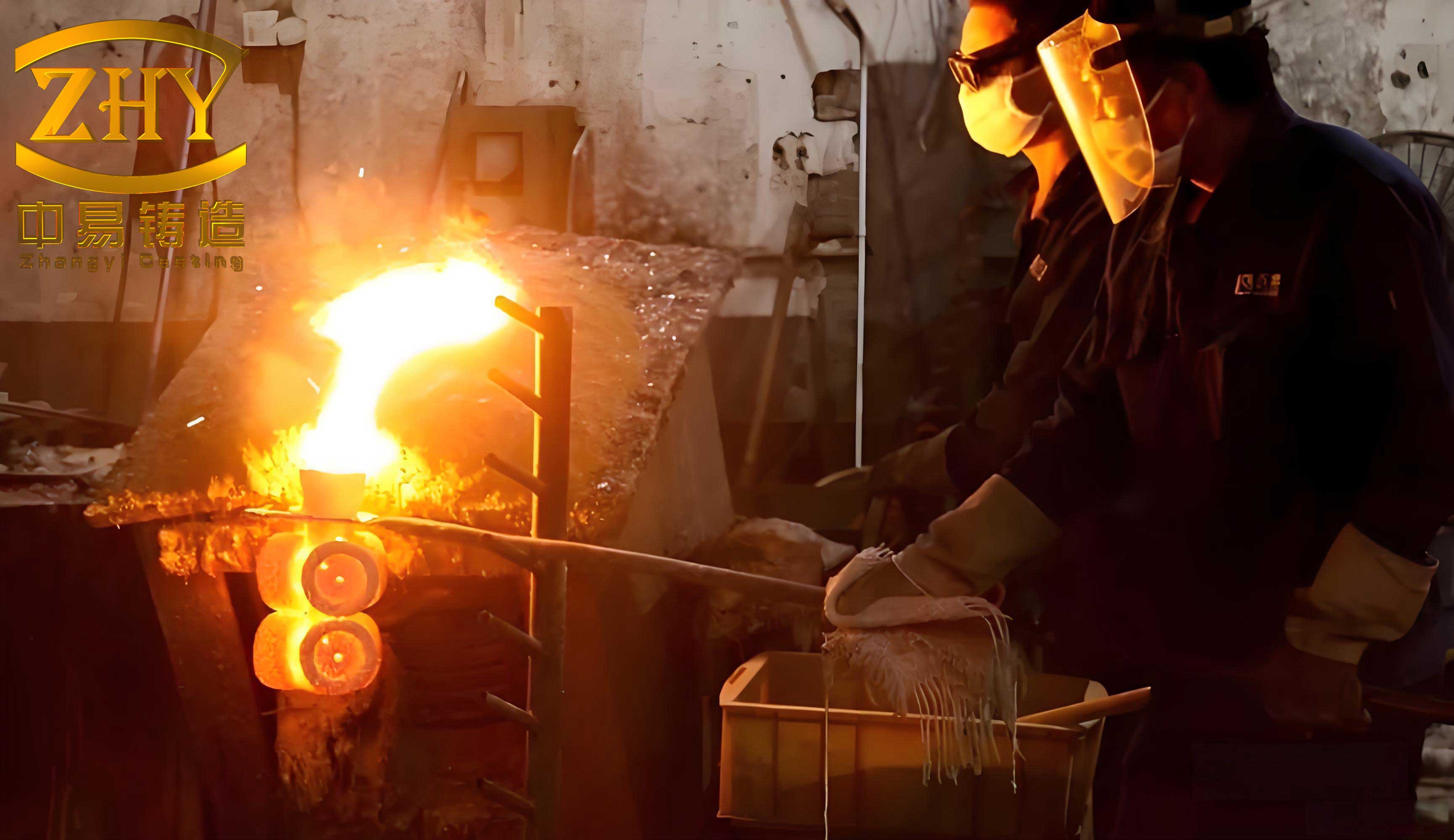
The success of the investment casting process hinges on meticulously managing the thermal history of the metal, from the moment it enters the ceramic shell until it cools to room temperature.
1. Characterization and Classification of Shrinkage Defects
Shrinkage defects in the investment casting process are not monolithic; they appear in different forms depending on the local solidification conditions and the availability of liquid metal feed. Understanding these variations is the first step toward effective control.
| Defect Type | Primary Characteristics | Typical Location |
|---|---|---|
| Macroshrinkage (Shrinkage Cavity) | Large, irregular cavities with a rough, dendritic interior surface. Often visible to the naked eye after machining or cutting. | Last-to-freeze regions, such as heavy sections (hot spots), junctions, and areas poorly fed by the gating system. |
| Microshrinkage (Shrinkage Porosity) | Dispersed, fine cavities located interdendritically. Not readily visible externally; requires radiography or destructive testing for detection. | Regions within heavy sections or between primary shrinkage cavities where final liquid feeding was insufficient. |
| External or Corner Shrinkage | Cavities forming at re-entrant angles or external surfaces of thick sections. | Areas with poor local heat dissipation from the ceramic shell, leading to delayed solidification. |
2. The Underlying Mechanism of Shrinkage Formation
The root cause of all shrinkage defects lies in the volumetric contraction of metal as it cools. In the investment casting process, this total contraction can be divided into three distinct, sequential stages: liquid contraction, solidification contraction, and solid-state contraction. The combined effect of the first two stages, if not compensated, directly results in shrinkage cavities or porosity.
2.1 Stages of Volumetric Contraction
Consider a carbon steel alloy as an example. Its total volumetric contraction from pouring temperature to room temperature can exceed 10%. The contributions are as follows:
1. Liquid Contraction ($\varepsilon_{V_{liquid}}$): This occurs as the superheated metal cools from the pouring temperature ($t_{pour}$) to its liquidus temperature ($t_{liquidus}$). The contraction is proportional to the degree of superheat.
$$
\varepsilon_{V_{liquid}} = \alpha_{V_{liquid}} (t_{pour} – t_{liquidus}) \times 100\%
$$
Where $\alpha_{V_{liquid}}$ is the average coefficient of volumetric thermal expansion for the liquid metal (for carbon steel, approximately $1.6 \times 10^{-4} \, ^{\circ}\mathrm{C}^{-1}$).
2. Solidification Contraction ($\varepsilon_{V_{solidification}}$): This is the contraction associated with the phase change from liquid to solid, occurring between the liquidus and solidus temperatures. For metals like steel that solidify as single-phase austenite, this is a significant factor. Its magnitude is primarily a function of chemical composition.
$$
\varepsilon_{V_{total (L+S)}} = \varepsilon_{V_{liquid}} + \varepsilon_{V_{solidification}}
$$
This sum represents the shrinkage volume that must be fed by residual liquid metal; otherwise, a cavity forms.
3. Solid-State Contraction ($\varepsilon_{V_{solid}}$): This is the thermal contraction of the solid metal from the solidus temperature down to room temperature. While it determines the final dimensional size of the casting and can lead to stresses, it does not directly cause internal cavities.
$$
\varepsilon_{V_{solid}} = \alpha_{V_{solid}} (t_{solidus} – t_{room}) \times 100\%
$$
The linear shrinkage, crucial for pattern design, is roughly one-third of the volumetric solid-state shrinkage.
| $\omega(C)$ (%) | $\varepsilon_{V_{solidification}}$ (%) | Total Linear Shrinkage $\varepsilon$ (%) |
|---|---|---|
| 0.10 | ~2.0 | ~2.47 |
| 0.35 | ~3.0 | ~2.40 |
| 0.70 | ~5.3 | ~2.18 |
2.2 Visualization of Cavity Formation
The formation of a centralized shrinkage cavity in a simple shape can be modeled sequentially. When molten metal is poured into the preheated shell, the layer in contact with the cooler ceramic wall solidifies first. As the solidified shell thickens inward, the combined liquid and solidification shrinkage of the remaining liquid pool creates a volume deficit. If this deficit is not continuously fed from a dedicated source of hot metal (a riser or feeder), a vacuum or low-pressure region forms, resulting in a macroscopic cavity in the last portion to solidify. This is the core challenge in the investment casting process: to design the system so that this inevitable cavity is relegated to a sacrificial part of the gating system.
3. Root Cause Analysis in the Investment Casting Process
Multiple factors within the investment casting process can disrupt the ideal directional solidification and feeding, leading to shrinkage defects.
3.1 Non-Optimal Gating and Feeding System Design
This is the most critical factor. The gating system must not only fill the mold but also establish a strong thermal gradient. Key failures include:
– Inadequate Riser (Feeder) Size/Location: Risers that are too small solidify before the casting hot spot, cutting off feed metal. Risers placed incorrectly fail to create a thermal gradient toward themselves.
– Poor Choke Design: The cross-sectional area of the ingate(s) controls the feeding rate. An ingate that is too large can solidify late, becoming a hot spot itself and requiring feeding.
– Lack of Directional Solidification: The system fails to ensure that solidification progresses sequentially from the remotest points of the casting back toward the riser.
3.2 Unfavorable Casting Geometry
The part design itself can create inherent solidification problems:
– Abrupt Section Changes: Sharp transitions from thin to thick walls create isolated hot spots that are difficult to feed.
– Isolated Heavy Masses: Thick sections surrounded by thinner walls act as thermal islands, solidifying last without a feeding path.
– Insufficient or Excessive Fillet Radii: Small radii create stress concentrators and can hinder feeding; excessively large radii create new, unintended hot spots.
3.3 Metal-Related Factors
– High Contraction Alloys: Alloys with high values for $\alpha_{V_{liquid}}$ and $\varepsilon_{V_{solidification}}$ inherently generate a larger feeding demand.
– Gas Evolution: Inadequate deoxidation can lead to gas precipitation during solidification. While this may slightly offset volumetric shrinkage, it typically exacerbates dispersed microporosity (shrinkage porosity).
3.4 Process Parameter Deviations
| Process Parameter | Typical Effect on Shrinkage | Mechanism |
|---|---|---|
| Pouring Temperature | Complex, non-linear effect. | Too low: Gating system freezes prematurely, stopping feed. Too high: Excessive superheat increases liquid contraction and can widen the mushy zone, promoting porosity. |
| Pouring Speed | Faster pour generally increases cavity volume. | Reduces the time for early-poured metal to be fed by later-poured metal during the fill, increasing the net liquid shrinkage deficit. |
| Shell Preheat Temperature | Lower temperature reduces shrinkage. | Increases thermal gradient, promoting directional solidification. However, too low can cause mistuns. |
| Shell Conductivity / Cooling | Poor cooling increases shrinkage. | Slows overall solidification, reduces thermal gradient, and diminishes the effectiveness of risers. |
| Localized Poor Cooling (e.g., corners) | Promotes external/corner shrinkage. | Creates a localized hot spot that solidifies last on its surface, drawing metal inward from already solidified areas. |
4. Comprehensive Mitigation Strategies
The overarching principle for preventing shrinkage in the investment casting process is to enforce directional solidification, channeling the shrinkage cavity into the designed feeders which are later removed. This requires a multi-faceted approach.
4.1 Scientific Design of the Gating and Feeding System
Every element of the system must serve the goal of thermal management:
– Pouring Cup/Button: Acts as a primary reservoir and provides initial metallostatic pressure.
– Main Runner/Down Sprue: Often serves as the primary feeder. Its cross-sectional area must be sufficient to remain liquid long enough to feed the entire cluster. A common rule is: $A_{runner} \geq 1.4 \times \sum A_{ingate}$.
– Ingates: The most critical design element. They must be sized to freeze at the correct time—after the casting section but before the runner.
– Sizing by Hot Spot: $D_{ingate} = K \times D_{hotspot}$, where $K$ is typically 0.7–0.9.
– Location: Attached to the casting’s heaviest section (hot spot).
– Length: Designed for easy removal (e.g., 10-15mm for knock-off).
– Use of Chills: Strategically placed metal or high-conductivity ceramic inserts in the shell can accelerate local cooling, creating a desired solidification front and extending the effective feeding distance of a riser.
| Aspect | Design Principle | Rationale |
|---|---|---|
| Position | At the largest thermal mass (hot spot). | Ensures the hottest part of the casting is directly connected to the feeder. |
| Number | Minimize, but use multiple for complex parts with isolated hot spots. | Simplifies system; multiple gates target multiple feeding zones. |
| Cross-Section | Calculated based on hot spot modulus or area. | Controls solidification timing to be between casting and feeder. |
| Length | Sufficient for easy separation (8-15 mm). | Facilitates post-casting cleanup without damaging the part. |
4.2 Casting Geometry Modification (Padding)
When the part geometry impedes directional solidification, “padding” or “draft addition” can be applied. This involves selectively adding mass to the casting (later machined off) to create a tapered thermal pathway that smoothly guides the solidification front toward the feeder. This is a powerful but cost-adding tool in the investment casting process, used when other options are exhausted.
3.3 Control of Metal and Process Variables
– Alloy Selection: Where specifications allow, choose alloys with lower solidification shrinkage.
– Deoxidation Practice: Thorough deoxidation (e.g., with Aluminum, Silicon, or rare earth elements) minimizes gas evolution, reducing the synergy between gas and shrinkage porosity.
– Optimized Pouring Practice: For top-gated systems, a higher pouring temperature with a slower fill can aid feeding. For bottom-gated systems, a faster fill with a slightly lower temperature may be beneficial. The “hot-top” practice—pouring additional metal into the feeder after the main pour—can be very effective.
– Advanced Feeding Aids: Use of exothermic or insulating sleeves/ toppings on risers dramatically improves their feeding efficiency by delaying their solidification.
4.4 Application of Computational Modeling
Modern simulation software for the investment casting process is an indispensable tool. It allows for the virtual visualization of mold filling, solidification patterns, and the prediction of shrinkage defect locations using criteria functions (e.g., Niyama criterion). This enables rapid iteration and optimization of gating designs before any wax is molded, saving significant time and cost.
5. Case Study: Enhancing Performance through Shrinkage Control and Alloy Modification
A critical wear component produced via the investment casting process was failing prematurely due to excessive wear. Metallurgical analysis revealed severe shrinkage porosity in the high-stress wear face, significantly reducing its density and abrasion resistance.
Solution Strategy: A dual approach was implemented:
1. Refinement of Feeding Design: The gating was redesigned using simulation software to ensure directional solidification away from the critical wear surface.
2. Alloy Enhancement with Rare Earth (RE) Addition: The base steel (similar to ZG20CrMnMo) was modified by the ladle addition of a rare earth silicide alloy (0.15 wt%).
Rationale for RE Addition: Rare earth elements act as potent deoxidizers and desulfurizers. They modify oxide and sulfide inclusions, improving cleanliness. More importantly for shrinkage, they can improve the fluidity of the steel and enhance its feeding characteristics during the final stages of solidification, thereby reducing both macro and micro shrinkage.
| Condition | Sulfur Content (After Treat.) | RE Recovery/Residual | Casting Soundness (Wear Area) |
|---|---|---|---|
| Without RE Addition | ~0.029% | 0% | Severe shrinkage porosity observed. |
| With 0.15% RE Addition | ~0.015% | 50-80% Recovery, ~0.10% Residual | Only minor, dispersed microporosity present. |
Results: The combined improvements in the investment casting process led to a dramatic increase in component service life. Field testing under harsh abrasive conditions showed that the new, sounder castings lasted over three times longer than the previous versions, successfully meeting and exceeding the performance target. This validated the integrated approach of optimizing both the thermal process and the metallurgy of the alloy.
6. Summary and Conclusions
Shrinkage defects are an inherent challenge in the investment casting process, stemming from the unavoidable physical contraction of metals. Their manifestation as cavities or porosity is not inevitable, but rather a consequence of the solidification conditions failing to provide adequate liquid metal feed to compensate for this contraction.
The fundamental strategy for mitigation is the enforcement of directional solidification, which requires a holistic analysis and control of the entire process:
1. The gating and feeding system must be scientifically designed to create and maintain a thermal gradient pointing toward a sacrificial feeder.
2. Casting geometry should be reviewed for castability, with modifications (padding) made if necessary.
3. Process parameters—shell temperature, pour temperature, and pour speed—must be optimized in concert with the design.
4. Metallurgical factors, including alloy selection and melt treatment (e.g., deoxidation, grain refinement, rare earth additions), play a crucial role in determining feeding behavior and final soundness.
5. Computational simulation is a powerful modern tool that allows for predictive optimization, drastically reducing the trial-and-error phase.
Ultimately, controlling shrinkage in the investment casting process is an exercise in meticulous thermal management. By understanding the mechanisms and systematically addressing each contributing factor, foundries can significantly reduce scrap rates, enhance the mechanical properties and reliability of their castings, and deliver high-integrity components capable of meeting demanding applications.