
From my extensive experience within the foundry, I have observed that one of the most persistent and quality-damaging challenges in the investment casting process is the failure of the ceramic shell. Defects arising from shell breakage refer to the formation of irregular, excess metal on the surface of a casting, or within its internal cavities and undercuts, due to the shell’s inadequate strength at elevated temperatures. The quality of the shell is, without question, the single most critical factor influencing the final quality of an investment casting. However, there often remains a significant gap between theoretical research on shell properties and the practical demands of production. The inherent difficulty in controlling raw material consistency, coupled with a complex, multi-step, and often manually intensive shell-building procedure, introduces numerous variables. This frequently results in unstable shell quality, which severely hinders the broader adoption of investment castings as replacements for forgings, machined parts, or fabricated structures in demanding applications like mining machinery. It is therefore imperative for practitioners of the investment casting process to understand, prevent, and eliminate these defects.
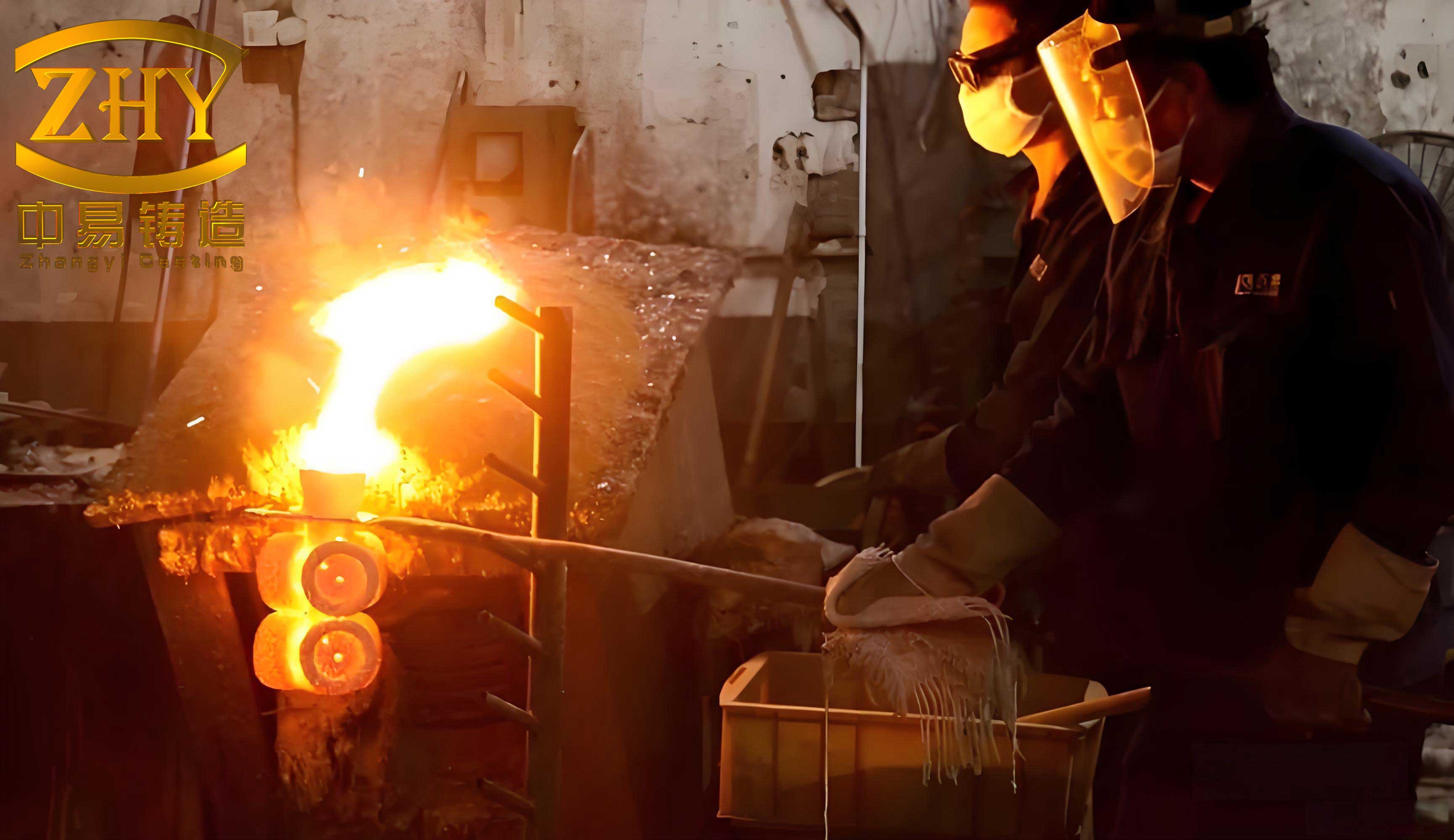
Broadly, defects in the investment casting process stemming from shell failure can be categorized into two types: external defects and internal cavity defects. A thorough investigation into their characteristics, root causes, and remedies is essential for process control.
External Casting Defects: Manifestation and Root Causes
External defects occur when the shell fractures during metal pouring, allowing molten metal to escape and solidify on the external surface of the casting. This is commonly termed “run-out” or “bleeding.”
Primary Locations: These defects consistently appear at the weakest points of the shell’s high-temperature strength.
Comprehensive Analysis of Causative Factors
The failure of a ceramic shell under stress is a fundamental mechanical event. During dewaxing, firing, and pouring, the shell is subjected to various thermal and mechanical stresses. Fracture occurs when these stresses exceed the shell’s strength limit at that specific stage. The microscopic failure mechanism typically involves either cohesive failure within the binder film binding the refractory particles, adhesive-cohesive failure where the binder film detaches from particle surfaces, or a combination thereof. Particle fracture itself is rare.
The reasons for shell fragility can be systematically broken down:
1. Inadequate Shell Strength or Pre-existing Cracks
Shell strength is not a constant; it varies dramatically between room temperature and pouring temperature.
- Low Green Strength Leading to Dewaxing Cracks: The room-temperature (green) strength is predominantly governed by the gelled binder’s bonding action. For instance, in a sodium silicate-based system, if the silicate’s modulus (m < 3.0), density (d < 1.26), or its ratio to refractory flour in the slurry falls below a critical threshold (e.g., < 0.8), the resulting green strength is perilously low. After firing, such shells become friable and crumbly. The green strength is also heavily influenced by process execution: uneven slurry coating, insufficient hardening or drying, low dewaxing medium temperature, prolonged dewaxing time, or delayed removal of support rods can all induce cracking during wax removal. An insufficient number of coating layers will also drastically reduce overall shell strength.
- Low High-Temperature Strength Leading to Firing or Pouring Failure: The shell’s strength at pouring temperatures depends on the factors affecting green strength plus the intrinsic properties of the binder and refractories. Generally, conventional sodium silicate shells exhibit the lowest high-temperature strength, ethyl silicate shells are intermediate, and modified (high-strength) silicate or silica sol-based shells offer superior performance. Inappropriate firing parameters, such as excessively high temperatures or overly rapid heating/cooling rates, generate thermal stresses that can crack even a reasonably strong shell.
2. Excessive Metallostatic Pressure Head
From the moment it enters the shell, molten metal exerts significant pressure. We must consider both static and dynamic components.
Static Pressure: Once the mold cavity is filled, the fluid metal exerts a hydrostatic pressure on all walls of the shell cavity. The force at any given point is given by:
$$ F_{static} = \gamma \cdot h \cdot S $$
where:
- $F_{static}$ = Static force exerted by the metal
- $\gamma$ = Specific weight of the molten metal
- $h$ = Height of the metal head above the point of calculation
- $S$ = Area of the shell wall section under consideration
This force acts to push the shell walls outward. The equation clearly shows that a taller sprue (increasing $h$) or a larger cavity area (increasing $S$) linearly increases the bursting force on the shell.
Dynamic Pressure: Metal entering the mold at velocity possesses kinetic energy, which converts to pressure upon impact. The dynamic pressure force can be expressed as:
$$ F_{dynamic} = \gamma \cdot S \cdot \frac{v^2}{2g} $$
where:
- $F_{dynamic}$ = Dynamic impact force
- $v$ = Pouring velocity
- $g$ = Acceleration due to gravity
This reveals a critical relationship: dynamic pressure increases with the square of the pouring velocity. If the mold cavity is largely enclosed, this sudden pressure spike can rupture the shell if it exceeds the shell’s hot strength.
3. Improper Pattern Cluster Design
The spatial arrangement of wax patterns on the cluster tree profoundly affects shell integrity. We can classify clusters based on pattern proximity:
| Cluster Type | Description | Relative Crack Tendency |
|---|---|---|
| Open | All shell surfaces are visible and free. | Lowest |
| Semi-Open | Some extremities contact nearby shell surfaces. | Low |
| Semi-Compact | Several contact points, but recesses are clear. | Medium |
| Compact | Most surfaces are in contact, forming a dense block. | Highest (e.g., ~66% failure rate) |
The detrimental effects of close spacing are twofold: First, it impedes free slurry drainage and entry during dipping, leading to poor coating uniformity, slurry pooling in recesses, and localized thick, weak areas that crack during drying. Second, during drying, the shell undergoes slight shrinkage. In an open design, this shrinkage is relatively unconstrained. In a compact cluster, shrinkage is severely restricted by the interlocking geometries, generating high tensile stresses and causing numerous, often severe, cracks.
4. Poor Thermal Shock Resistance (Low Thermal Stability)
Thermal stability is the shell’s ability to withstand rapid temperature changes without cracking. During pouring, the shell’s inner surface is subjected to intense thermal shock. The inner layers heat and expand rapidly, while outer layers remain cooler. This temperature gradient $\Delta T$ across the shell wall creates thermal stress ($\sigma_{thermal}$):
$$ \sigma_{thermal} = \pm K \cdot \frac{\alpha \cdot C \cdot R \cdot E}{\lambda (1 – \mu)} (T_{metal} – T_{shell}) $$
where:
- $K$ = Geometrical factor of the shell
- $\alpha$ = Coefficient of thermal expansion (CTE) of the shell
- $C$ = Specific heat of the shell
- $R$ = A factor relating to shell volume/mass
- $E$ = Elastic modulus of the shell
- $\lambda$ = Thermal conductivity of the shell
- $\mu$ = Poisson’s ratio
- $T_{metal}$ = Metal pouring temperature
- $T_{shell}$ = Shell preheat temperature
The risk of thermal shock cracking increases with a higher CTE ($\alpha$), a higher elastic modulus ($E$), and a larger temperature difference $(T_{metal} – T_{shell})$. It decreases with higher thermal conductivity ($\lambda$). Shells based on silica sand, which undergoes a disruptive crystalline phase transformation at 573°C with ~1.4% volume expansion, are particularly prone to thermal shock if poured with a low shell temperature.
Effective Countermeasures Against External Defects
| Target Area | Specific Actions | Mechanism & Goal |
|---|---|---|
| Enhance Shell Strength | Select advanced binders (e.g., silica sol, ethyl silicate). | Improve both green and high-temperature strength. |
| Optimize process parameters: slurry viscosity, hardening agent concentration/temperature/time, drying conditions. | Ensure complete, uniform hardening and layer bonding. | |
| Ensure proper coating technique: adequate drain time, uniform layer thickness, sufficient number of layers (typically 5-7+). | Build a dense, homogeneous, and robust shell structure. | |
| Control firing cycle: avoid excessive temperatures (800-850°C typical), control heating/cooling rates. | Remove volatiles without generating thermal stress cracks. | |
| Optimize Pressure | Design gating for minimum feasible metallostatic head height ($h$). | Reduce bursting static pressure ($F_{static} \propto h$). |
| Improve Cluster Design | Maintain sufficient spacing between patterns to allow free slurry flow, drainage, and unrestricted shell shrinkage. | Minimize stress concentration and coating defects; balance with yield. |
| Boost Thermal Stability | Preheat shells to a temperature above critical phase transformation points (e.g., >573°C for silica-based shells). | Minimize thermal gradient $(T_{metal} – T_{shell})$ and phase stress. |
| Use refractory materials with low/stable CTE (e.g., fused silica, zircon, aluminosilicates) for primary layers. | Reduce the thermal expansion coefficient ($\alpha$) in the critical zone. |
Internal Cavity Casting Defects: A Focus on Geometry
Internal defects occur when molten metal penetrates into and breaks through weak sections of the shell that form internal features like holes, slots, or deep recesses, creating unwanted internal metallic projections.
Primary Locations: Deep holes, blind holes, narrow slots, and complex internal passages where achieving a sound, uniform shell coating is challenging.
Root Causes Specific to Internal Defects
- Non-conforming Casting Design: Features like very small-diameter deep holes or extremely narrow-deep slots violate the fundamental capabilities of the investment casting process. They make slurry penetration, drainage, and stucco application difficult, inevitably leading to non-uniform, weak shell sections in those areas.
- Poor Shell Building Over Internal Features: Excessive slurry viscosity, improper dipping angle, or inadequate drain time can cause premature “bridging” across openings. This creates a hollow cavity within the shell wall or a pocket of unhardened slurry behind a poorly formed bridge, resulting in a severe local weakness.
- Incomplete Processing in Recessed Areas: Even with good geometry, if the hardening agent cannot fully penetrate or if drying is inhibited in deep cavities, the local shell will remain weak and susceptible to metal penetration during pouring.
Preventive Strategies for Internal Defects
The cornerstone of prevention is designing for manufacturability within the investment casting process.
1. Adhere to Design-for-Castability Guidelines:
| Feature | Condition | Recommended Limit (Typical) | Comment |
|---|---|---|---|
| Holes | Minimum Castable Diameter | ≥ 2.5 mm | Smaller holes are drilled post-casting. |
| Through Holes (Depth : Diameter) | ≤ (2.5 – 3) : 1 | Deeper ratios risk core deflection or breakage. | |
| Blind Holes (Depth : Diameter) | ≤ (1 – 1.5) : 1 | Shallower ratios are required for core stability. | |
| Slots | Width : Depth Ratio | See detailed table below | Wider slots are required for greater depth. |
| Slot Width (mm) | ≥2.5 | 4 | 6 | 8 | 10 | 16 | 20 | 24 |
|---|---|---|---|---|---|---|---|---|
| Max Depth (mm) | ≤5 | 8 | 20 | 32 | 46 | 80 | 120 | 150 |
2. Optimize Process for Deep Features: Use slightly lower viscosity slurries for better penetration. Employ specialized dipping and draining techniques (e.g., rotation) to ensure complete coating without bridging. Choose finer stucco sands for first coats to improve surface replication and strength.
3. Ensure Complete Hardening and Drying: Extend hardening time if necessary, use forced air drying directed into cavities, or consider using wetting agents (non-ionic surfactants) in the slurry and/or hardener. These agents improve wettability and capillary action, promoting more complete hardening agent penetration into deep, narrow sections of the shell.
Synthesis and Concluding Perspectives
Through the rigorous application of this analysis, I can confidently state that controlling shell integrity is the paramount task in achieving reliability in the investment casting process. The strategies can be succinctly summarized:
- For External Defects: The most effective approach is the systemic enhancement of shell strength—both green and hot—through advanced materials and meticulous process control. This should be the primary focus. Complementary, yet secondary, measures include intelligent cluster design to reduce stress and the optimization of gating to minimize metallostatic pressure.
- For Internal Cavity Defects: The primary solution lies in collaborative design—ensuring the component’s geometry respects the physical and practical limits of the shell-building process. Secondary, but vital, process optimizations involve tailored slurry handling and hardening techniques for complex internal features.
- The Path Forward: The continuous adoption of new materials—such as alternative binders, high-stability refractories, and advanced hardening systems—is not merely an option but a necessity for advancing the investment casting process. It improves quality, consistency, and environmental performance.
- Foundational Discipline: All technical solutions are underpinned by rigorous quality control: consistent inspection of incoming materials, strict adherence to documented procedures, and ongoing training for operators. This disciplined framework is the essential backbone for defect prevention in any investment casting operation.
In essence, mastering the ceramic shell—from its microscopic bonding mechanisms to its macroscopic structural integrity—is the definitive key to unlocking the full potential and reliability of the investment casting process for producing high-integrity, complex metal components.