
As a researcher deeply involved in the convergence of additive manufacturing and traditional foundry techniques, I have witnessed firsthand the transformative potential of this synergy. The quest for rapid, flexible, and precise manufacturing of complex metal parts inevitably leads us to the realm of prototype investment casting. For decades, this process has been the gold standard for producing high-integrity, dimensionally accurate components with excellent surface finish, particularly for aerospace, medical, and defense applications. However, its Achilles’ heel has always been the long lead time and high cost associated with creating the sacrificial wax or polymer patterns and the subsequent ceramic shell molds.
The integration of 3D printing, specifically binder jetting technology, promises a radical solution. The vision is direct digital manufacturing of the ceramic shell itself, eliminating the need for a physical pattern altogether. This approach, a form of direct shell production, could dramatically compress the timeline for prototype investment casting. My work, and that of my colleagues, focuses on the very foundation of this vision: the powder materials used to 3D print these shells. The performance of the final cast part is inextricably linked to the properties of the sintered ceramic mold—its strength, dimensional stability, and surface quality. This article delves into a systematic investigation of the key factors influencing these critical properties.
The traditional prototype investment casting process involves creating a wax pattern, assembling it into a cluster, repeatedly dipping it in ceramic slurry, stuccoing it with refractory particles, and then drying to build up a robust shell. The wax is then melted out (de-waxed), and the shell is fired at high temperature to develop strength before metal pouring. 3D printing the shell directly uses a similar principle but applies it in a layer-by-layer, digital fashion. A print head selectively deposits a liquid binder onto a thin layer of refractory powder, bonding the particles where the shell cross-section exists. This process repeats, building the complete, green-state shell within a powder bed. Post-processing typically involves depowdering (removing loose powder), and most critically, a high-temperature sintering step to burn out the binder and densify the ceramic particles, creating a strong, permeable mold ready for casting.
The core material is a refractory powder. Its characteristics dictate the shell’s behavior during sintering and its performance during metal pouring. We can define several key performance indicators (KPIs) for a shell destined for prototype investment casting:
- High-Temperature Strength: The shell must withstand the metallostatic pressure of the molten metal without cracking or deforming. This is measured as compressive strength (resistance to crushing) and tensile/ flexural strength (resistance to cracking).
- Dimensional Stability: The sintering process causes shrinkage. This shrinkage must be predictable, uniform, and minimal to ensure the final cast part meets tight dimensional tolerances. Dimensional shrinkage rate is a critical metric.
- Surface Finish: The interior surface roughness of the shell is directly transferred to the cast metal part. A low surface roughness (Ra value) is essential for high-quality prototype investment casting, reducing post-casting machining.
- Chemical Inertness & Thermal Stability: The material must not react with the molten alloy and must withstand thermal shock during pouring.
The pursuit of an optimal powder system led us to investigate four primary factors: the type of refractory material, the particle size distribution (mesh number), the type of sintering aid (flux), and the sintering (calcination) temperature. These factors are deeply interconnected. The refractory material sets the baseline properties—its melting point, thermal expansion coefficient, and density. The particle size affects packing density, surface area for sintering, and ultimately the surface finish of the shell. Sintering aids are crucial for lowering the energy required for densification and modifying the developing microstructure. Finally, the sintering temperature is the master variable that activates all these interactions.
To navigate this multi-variable space efficiently, we employed a Taguchi L9 (3^4) orthogonal array design. This method allows for the study of multiple factors with a relatively small number of experiments by systematically varying their levels. The factors and levels chosen for our study are summarized below:
| Factor | Level 1 | Level 2 | Level 3 |
|---|---|---|---|
| A: Refractory Type | Zircon Flour (ZrSiO₄) | White Fused Alumina (Al₂O₃) | Fused Silica (SiO₂) |
| B: Powder Mesh | 200 | 325 | 400 |
| C: Flux Type | Bismuth Oxide (Bi₂O₃) | Copper Oxide (CuO) | Magnesium Oxide (MgO) |
| D: Sintering Temp. | 1000°C | 1200°C | 1400°C |
The experimental workflow involved preparing powder blends according to the orthogonal array, 3D printing standard test specimens (e.g., cylinders for compression, bars for bending), carefully sintering them, and then measuring the KPIs: high-temperature compressive strength, high-temperature tensile/bending strength, linear shrinkage, and surface roughness (Ra).
The results from the orthogonal experiments provided a rich dataset. To analyze the influence of each factor, we performed an analysis of means and range (R). The range value (R) for each factor, across its three levels, indicates the magnitude of its effect on a given property. A larger R means that factor has a stronger influence. The tables below summarize the mean response and range analysis for each key property.
Analysis of High-Temperature Compressive Strength
| Factor | Mean at Level 1 (MPa) | Mean at Level 2 (MPa) | Mean at Level 3 (MPa) | Range (R) |
|---|---|---|---|---|
| A: Refractory Type | 27.21 | 18.98 | 14.95 | 12.26 |
| D: Sintering Temp. | 16.85 | 20.10 | 24.19 | 7.34 |
| C: Flux Type | 18.44 | 22.65 | 20.05 | 4.21 |
| B: Powder Mesh | 18.88 | 20.12 | 22.14 | 3.26 |
The analysis clearly shows that the refractory type (A) is the most dominant factor, followed by sintering temperature (D). Zircon flour consistently yielded the highest compressive strength. This can be attributed to its favorable sintering behavior and high intrinsic strength. Sintering temperature has a positive correlation with strength, as higher temperatures promote greater diffusion and particle bonding. The relationship between sintering density ($\rho$) and strength ($\sigma_c$) can be approximated by empirical models like:
$$
\sigma_c \propto \rho^n e^{(-Q/RT)}
$$
where $n$ is an exponent, $Q$ is an apparent activation energy, $R$ is the gas constant, and $T$ is the absolute sintering temperature. This explains the significant jump in strength from 1200°C to 1400°C.
Analysis of High-Temperature Tensile Strength
| Factor | Mean at Level 1 (MPa) | Mean at Level 2 (MPa) | Mean at Level 3 (MPa) | Range (R) |
|---|---|---|---|---|
| A: Refractory Type | 4.12 | 2.97 | 2.31 | 1.81 |
| D: Sintering Temp. | 2.56 | 3.04 | 3.80 | 1.23 |
| C: Flux Type | 2.84 | 3.54 | 3.02 | 0.70 |
| B: Powder Mesh | 2.96 | 3.02 | 3.42 | 0.46 |
The trend for tensile strength mirrors that of compressive strength. Refractory type (A) and sintering temperature (D) are again the primary drivers. Zircon flour and the highest sintering temperature produce the strongest bonds between particles, which is critical for load-bearing in tension. The superior performance of zircon can be linked to its lower thermal expansion anisotropy compared to alumina, resulting in lower residual stresses during cooling and fewer microcracks that would weaken the structure in tension.
Analysis of Dimensional Shrinkage
| Factor | Mean at Level 1 (%) | Mean at Level 2 (%) | Mean at Level 3 (%) | Range (R) |
|---|---|---|---|---|
| A: Refractory Type | 4.99 | 4.21 | 3.22 | 1.77 |
| D: Sintering Temp. | 3.45 | 4.29 | 4.68 | 1.23 |
| C: Flux Type | 3.91 | 4.75 | 3.77 | 0.98 |
| B: Powder Mesh | 4.05 | 4.23 | 4.14 | 0.19 |
Shrinkage is a natural consequence of sintering as pores are eliminated and particles move closer together. The significant influence of refractory type (A) is evident. Fused silica showed the lowest shrinkage, related to its glassy nature and viscous flow sintering mechanism, which can achieve density at lower volumetric change. Zircon, undergoing solid-state sintering, exhibited higher shrinkage. The sintering temperature (D) logically increases shrinkage, as higher thermal energy drives further densification. For predictable prototype investment casting, this shrinkage must be calibrated and compensated for in the original CAD model. A simple linear shrinkage model is often used:
$$
L_f = L_0 (1 – S)
$$
where $L_f$ is the final dimension, $L_0$ is the initial (printed) dimension, and $S$ is the linear shrinkage rate expressed as a decimal.
Analysis of Surface Roughness (Ra)
| Factor | Mean at Level 1 (µm) | Mean at Level 2 (µm) | Mean at Level 3 (µm) | Range (R) |
|---|---|---|---|---|
| A: Refractory Type | 5.18 | 7.30 | 7.59 | 2.41 |
| D: Sintering Temp. | 7.41 | 6.93 | 5.73 | 1.67 |
| C: Flux Type | 6.63 | 5.97 | 7.47 | 1.50 |
| B: Powder Mesh | 7.30 | 6.23 | 6.53 | 1.07 |
Surface roughness presents a different optimization goal: a lower Ra value is better. Here, refractory type (A) is again paramount, with zircon flour yielding the smoothest surfaces. This is likely due to its more rounded particle morphology and favorable sintering behavior that helps heal surface imperfections. Crucially, sintering temperature (D) has an inverse effect on roughness compared to strength. Higher temperatures promote surface diffusion and smoothing, thereby reducing Ra. This highlights a fundamental trade-off in process optimization for prototype investment casting: higher strength often comes with increased shrinkage, but it can also improve surface finish.
The orthogonal analysis provided the influence ranking, but to find the single best combination, we needed to perform a multi-response optimization. The goal was to maximize strength, minimize shrinkage, and minimize surface roughness. Analyzing the response tables for each KPI led to identifying promising factor level combinations. These were then verified through confirmation runs. The optimal combination identified was: Zircon Flour (A1), 325 Mesh (B2), Copper Oxide Flux (C2), and 1400°C Sintering Temperature (D3).
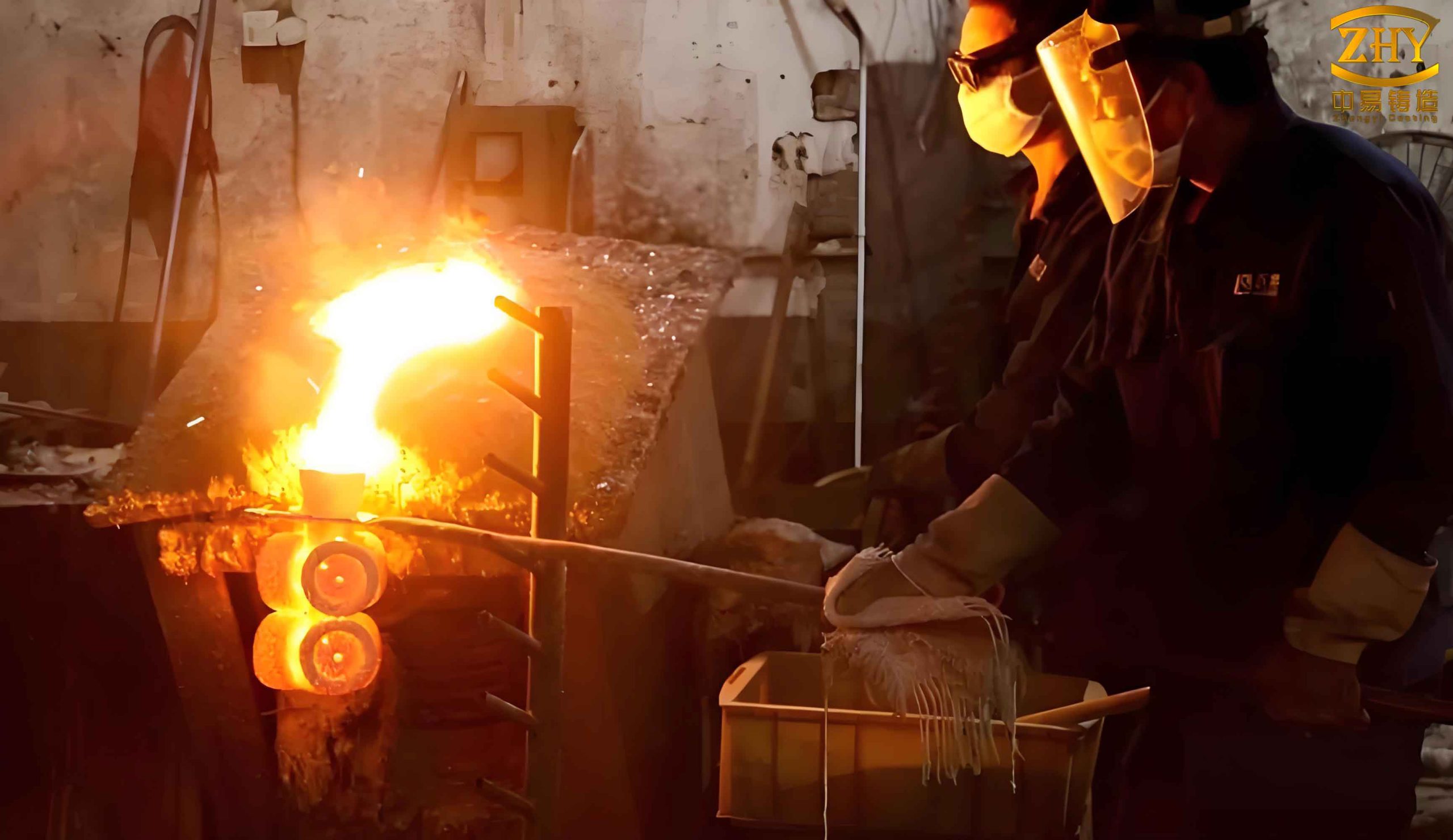
The confirmation test with this optimized formulation produced a shell with a high-temperature compressive strength of 45.42 MPa, a tensile strength of 6.78 MPa, a linear shrinkage of 6.0%, and a surface roughness Ra of 3.45 µm. This set of properties represents a high-performance shell well-suited for demanding prototype investment casting applications, offering an excellent balance of mechanical integrity, dimensional predictability, and fine surface reproduction.
The science behind these results is rooted in sintering theory. The role of the copper oxide flux is particularly interesting. It likely acts as a liquid-phase sintering aid at the high temperature. A small amount of liquid phase, wetting the zircon particles, dramatically increases the rate of densification by providing a fast diffusion path. The densification rate during liquid phase sintering can be described by models considering viscous flow or solution-reprecipitation mechanisms. The presence of a transient liquid phase allows the system to achieve high strength and a refined microstructure at a given temperature, which pure solid-state sintering might not reach. This explains why the CuO flux outperformed Bi₂O₃ and MgO in the zircon-based system under these conditions.
Looking beyond this specific study, the optimization of powders for 3D printed shells opens new frontiers for prototype investment casting. Future work involves exploring composite and graded powder systems. For instance, using a coarse stucco-like powder for the bulk shell layers to ensure permeability and low cost, while employing a fine, optimized facing powder (like the one developed here) for the first layer in contact with the metal to ensure superb surface finish. Furthermore, the development of reactive binder systems that transform into beneficial ceramic phases during sintering, or the incorporation of nanoparticles to enhance sintering and refine the microstructure, are exciting research avenues. The ultimate goal is a fully digital, rapid, and robust process chain for high-quality prototype investment casting, enabling the agile production of complex components that were previously impractical or too expensive to manufacture.
In conclusion, the journey towards perfecting 3D printed ceramic molds is a multidisciplinary challenge at the intersection of materials science, process engineering, and computational design. Through systematic investigation, we have quantified the profound influence of refractory material selection, particle engineering, flux chemistry, and thermal processing on the final shell properties. The identified optimal formulation of 325-mesh zircon flour with a copper oxide flux, sintered at 1400°C, provides a validated material solution that significantly advances the state-of-the-art for direct digital prototype investment casting. This work not only delivers a practical material specification but also provides a framework for the continued development and optimization of next-generation additive manufacturing materials for foundry applications.