
In the realm of high-performance mechanical transmissions, achieving stable meshing and minimal sensitivity to alignment errors is paramount. As an engineer focused on gear design and manufacturing, I have explored the integration of computer-aided topological modification with prototype investment casting to produce spiral face gears with superior contact characteristics. This approach leverages advanced numerical methods to design point-contact tooth surfaces, which are then realized through precision casting techniques, ensuring consistent performance in applications such as aerospace, automotive, and robotics. The use of prototype investment casting allows for the economical production of complex gear geometries with pre-defined contact patterns and transmission error functions, making it an ideal solution for prototyping and small-batch production. In this article, I will detail the methodology, mathematical foundations, and practical implementation of this design strategy, emphasizing the role of prototype investment casting throughout the process.
Spiral face gears, which mesh with helical cylindrical gears or worms, offer advantages like high single-stage transmission ratios and compact design. However, traditional designs often suffer from edge contact and sensitivity to installation errors due to their line-contact nature. To address this, I propose a topological modification method that transforms the contact from line to point, thereby enhancing meshing stability. This is achieved through a two-step computer-aided design process: first, modifying the tooth profile along a预设 contact path by prescribing a transmission error function; second, applying modification along the contact line direction to create a doubly convex surface. The resulting tooth geometry is then mapped onto mold cavities for prototype investment casting, enabling the manufacture of gears with controlled contact ellipses and low transmission error. The关键词 prototype investment casting is central to this workflow, as it facilitates the accurate replication of intricate topological surfaces without the need for expensive cutting tools, thus reducing lead times and costs for development cycles.
The design process begins with the generation of a基准齿面 for the spiral face gear using virtual shaper principles. A helical cylindrical gear serves as the virtual cutter, and its tooth surface is defined by parametric equations. Let the tooth surface of the virtual cutter be represented in a coordinate system \(S_s\) as \(\mathbf{r}_s(u_s, \theta_s)\), where \(u_s\) and \(\theta_s\) are surface parameters. The unit normal vector is \(\mathbf{n}_s(u_s, \theta_s)\). Through coordinate transformations and the meshing equation, the gear tooth surface \(\mathbf{r}_2(u_s, \theta_s, \phi_s)\) is derived, where \(\phi_s\) is the rotation angle of the cutter. The meshing condition is given by \(f(u_s, \theta_s, \phi_s) = \mathbf{n}_s \cdot \mathbf{v}_s^{(2)} = 0\), where \(\mathbf{v}_s^{(2)}\) is the relative velocity. This yields a line-contact gear pair, which is prone to edge contact. To overcome this, I introduce modifications along the contact path and contact line.
For contact path modification, a预设 transmission error function \(\Delta \phi_2(\phi_s)\) is incorporated into the kinematic relationship between the cutter and gear. The modified rotation angle of the gear is \(\phi_2 = m_{2s} \phi_s + \Delta \phi_2(\phi_s)\), where \(m_{2s} = N_2 / N_s\) is the gear ratio. The transmission error function is chosen as a fourth-order polynomial: $$\Delta \phi_2(\phi_s) = b_0 + b_1 \phi_s + b_2 \phi_s^2 + b_3 \phi_s^3 + b_4 \phi_s^4.$$ The coefficients \(b_i\) are determined based on desired contact points along the path. By discretizing the tooth surface into网格 points, the modification amount \(\delta_i\) at each point is calculated as the normal deviation between the基准齿面 and the modified surface. This ensures that the contact path follows a designated direction \(\eta\) on the projection plane, avoiding edge contact.
Subsequently, contact line modification is applied using computer-aided design techniques. Along the tangent direction of the contact line, a parabolic function defines the modification amount \(\xi\) based on the semi-major axis \(a\) of the contact ellipse and the distance \(l\) from the contact center: $$\xi = \frac{\zeta}{a^2} l^2,$$ where \(\zeta = 0.0068 \, \text{mm}\) is the contact deformation量. This creates a localized convexity, transforming the contact from line to point. The total modification at each grid point is the superposition of \(\delta_i\) and \(\xi_i\), resulting in a三维拓扑修形齿面 \(\mathbf{r}_2^c\): $$\mathbf{r}_2^c = \mathbf{r}_2^n + \mathbf{n}_2^m \xi_i,$$ where \(\mathbf{r}_2^n\) is the contact-path-modified surface and \(\mathbf{n}_2^m\) is the normal vector of the基准齿面. This doubly convex surface ensures point contact with a controlled ellipse size, reducing sensitivity to misalignment.
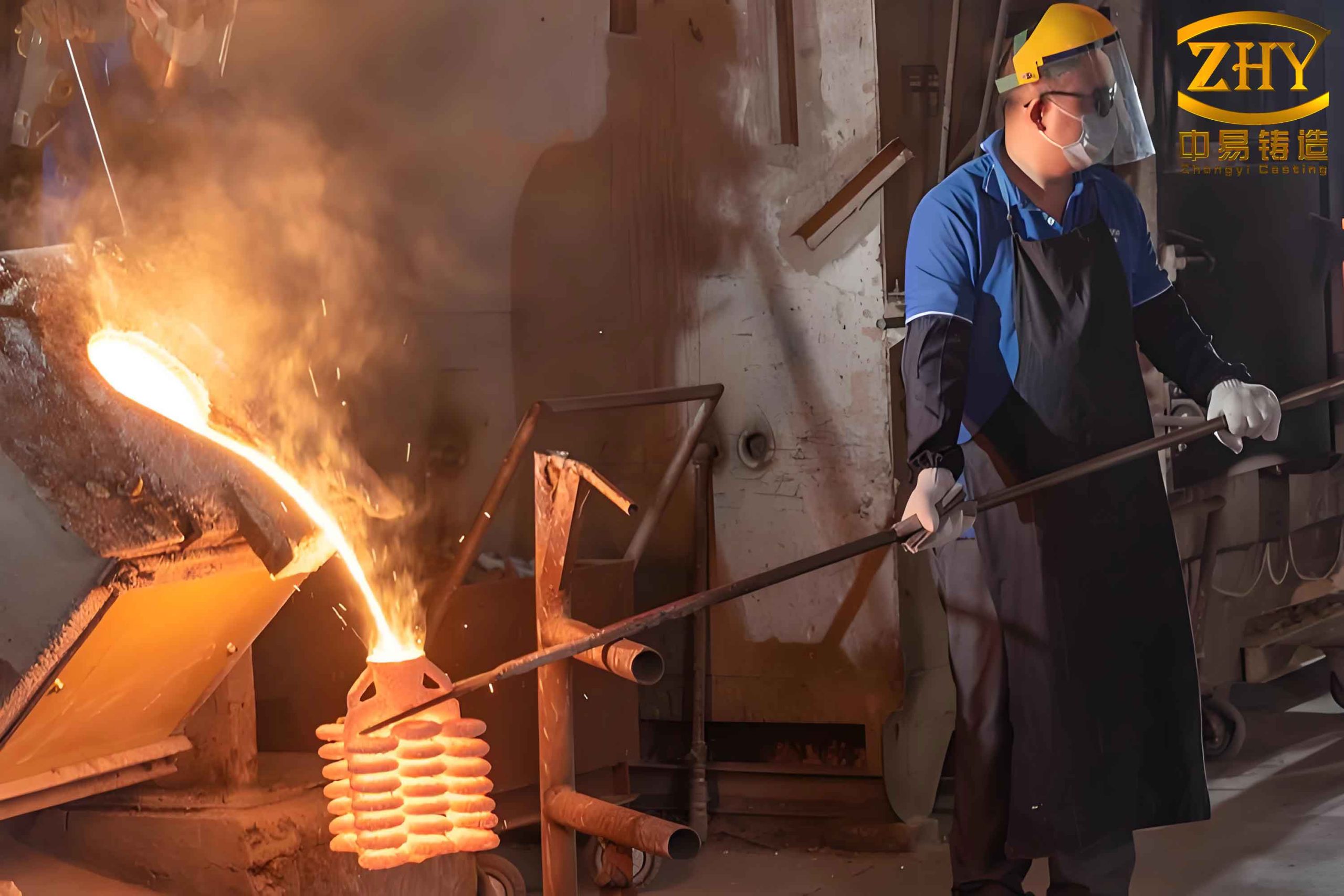
The integration with prototype investment casting is crucial for manufacturing these complex surfaces. Once the topological design is finalized, the tooth geometry is used to generate CNC toolpaths for machining mold cavities. The模具型腔 is crafted to mirror the modified齿面, allowing for the production of wax patterns or directly castable molds. During prototype investment casting, the mold is filled with molten alloy—such as Cu-Zn or aluminum—to create gear prototypes with high dimensional accuracy. This process is ideal for prototype investment casting because it accommodates intricate details and minimizes post-processing. Below is a table summarizing key parameters for two design cases, illustrating how different modification values affect the gear performance.
| Parameter | Case 1 (Convex Side) | Case 1 (Concave Side) | Case 2 (Convex Side) | Case 2 (Concave Side) |
|---|---|---|---|---|
| \(\Delta \phi_{2A}\) (arcmin) | 12 | 12 | 12 | 24 |
| \(\Delta \phi_{2B}\) (arcmin) | 4 | 4.5 | 4 | 9 |
| \(\Delta \phi_{2M}\) (arcmin) | 0 | 0.8 | 0 | 0.8 |
| \(\Delta \phi_{2C}\) (arcmin) | 3.5 | 4 | 3.5 | 9 |
| \(\Delta \phi_{2D}\) (arcmin) | 12 | 12 | 12 | 24 |
| \(2a\) (mm) | 1.14 | 0.96 | 1.14 | 0.96 |
| \(\eta\) (degrees) | 51 | -41 | 63 | -41 |
The effectiveness of this design is validated through tooth contact analysis (TCA). For Case 1, the contact path angle \(\eta\) is 51° for the convex side and -41° for the concave side, with contact ellipse半长轴 \(a = 0.57 \, \text{mm}\). The transmission error over one mesh cycle is 5.0 arcsec for the convex side and 7.4 arcsec for the concave side, indicating smooth operation. In Case 2, with increased modification amplitudes, the convex side has \(\eta = 63^\circ\) and transmission error of 5.52 arcsec, while the concave side shows 12.6 arcsec. These results confirm that the design parameters align with simulation outcomes, and the point contact eliminates edge contact. The use of prototype investment casting enables rapid iteration of such designs, as molds can be quickly adjusted based on TCA feedback.
From a manufacturing perspective, prototype investment casting offers several advantages for producing topologically modified gears. The process involves creating a precise mold from the CAD model, which can be done using additive manufacturing or CNC machining. Once the mold is ready, multiple prototypes can be cast with consistent quality, allowing for testing under real-world conditions. This is particularly beneficial for spiral face gears, which often require custom geometries for specific applications. For instance, in a fishing reel transmission, gears produced via prototype investment casting demonstrated improved smoothness and eliminated jamming issues compared to traditional methods. The ability to integrate topological modifications directly into the casting process reduces the need for secondary grinding or polishing, saving time and cost.
Moreover, the mathematical framework for topological modification is extensible to other gear types. The core equations involve solving for surface parameters under modified kinematics. For example, the meshing equation for the contact-path-modified surface is derived by substituting \(\phi_2 = m_{2s} \phi_s + \Delta \phi_2(\phi_s)\) into the coordinate transformation matrix \(M_{2s}\). This yields a system of equations that can be solved numerically for \(u_s\) and \(\theta_s\) at each grid point. Computer-aided design software automates this process, generating point clouds that define the tooth surface. These point clouds are then converted into NURBS surfaces for CNC machining or directly used in mold design. The flexibility of prototype investment casting accommodates such complex surfaces, as the mold material can replicate fine details without distortion.
In terms of material science, prototype investment casting supports a wide range of alloys suitable for gear applications. Common choices include bronze, steel, and aluminum alloys, each offering distinct strength and wear resistance properties. For spiral face gears, I often recommend Cu-Zn alloys due to their good machinability and durability. During casting, parameters like pouring temperature and cooling rate are controlled to minimize defects and ensure dimensional stability. Post-casting, gears may undergo heat treatment or coating processes to enhance performance. The integration of topological design with prototype investment casting thus creates a holistic approach from design to production.
To further illustrate the design process, consider the detailed steps for generating the modified tooth surface. First, the基准齿面 is discretized into a grid with parameters \(\phi_s\) and \(\theta_s\). For each grid point, the corresponding point on the modified surface is found by solving the meshing equation with the预设 transmission error. The modification amount \(\delta_i\) is computed as: $$\delta_i = \mathbf{n}_2^m \cdot (\mathbf{r}_2^m – \mathbf{r}_2^n),$$ where \(\mathbf{r}_2^m\) is the基准齿面 point and \(\mathbf{r}_2^n\) is the contact-path-modified point. Next, the contact line modification \(\xi_i\) is added based on the ellipse parameters. The total surface is reconstructed using interpolation techniques, ensuring continuity and smoothness. This data is exported to CAD software for mold design.
The advantages of using prototype investment casting for such gears are multifaceted. Economically, it reduces tooling costs compared to traditional gear cutting methods, especially for low-volume production. Technically, it allows for the incorporation of complex topological features that would be difficult or impossible to achieve with standard machining. For example, the doubly convex surface profile can be cast with high precision, maintaining the designed contact ellipse size and orientation. Additionally, prototype investment casting facilitates rapid prototyping, enabling designers to test multiple modification schemes quickly. In my experience, this iterative process has led to significant improvements in gear noise reduction and load distribution.
Looking ahead, the combination of computer-aided topological design and prototype investment casting holds promise for advancing gear technology. Future work could explore adaptive modification algorithms that respond to dynamic loading conditions, or the use of advanced materials like composites in casting. Furthermore, digital twins of the casting process could simulate solidification and shrinkage, optimizing mold designs for even greater accuracy. As additive manufacturing evolves, direct printing of mold cavities may further shorten lead times. The关键词 prototype investment casting will remain central to these developments, providing a versatile manufacturing platform for innovative gear designs.
In conclusion, the topological tooth flank design for spiral face gears, coupled with prototype investment casting, offers a robust solution for achieving point contact and high meshing stability. Through mathematical modeling and computer-aided design, modifications along the contact path and contact line create controlled convex surfaces that eliminate edge contact and reduce sensitivity to misalignment. The manufacturing process via prototype investment casting efficiently translates these designs into functional prototypes, supporting rapid iteration and cost-effective production. This approach has been validated through TCA and practical applications, demonstrating its effectiveness in enhancing gear performance. As gear systems continue to demand higher precision and reliability, the synergy between advanced design methodologies and prototype investment casting will play a crucial role in meeting these challenges.