
Prototype investment casting, a cornerstone of modern manufacturing for aerospace, power generation, and defense sectors, demands exceptional dimensional fidelity. The journey from a digital model to a functional metal component hinges on the precise replication of geometry at every stage. Among these stages, the creation of the sacrificial wax prototype, or wax pattern, is arguably the most critical. Its dimensional accuracy directly dictates the final casting’s conformance to specifications. In high-integrity applications involving superalloys like K648, where components often feature complex geometries with significant wall thickness variations, achieving and maintaining this accuracy presents a formidable challenge. This article delves into the core challenges of wax pattern dimensional control and presents a detailed investigation into an innovative structural solution—the hollow wax mold—as a means to dramatically enhance the precision of prototype investment casting.
The dimensional accuracy of a final investment casting is a cumulative result of shrinkages and distortions occurring at multiple phases: wax solidification and cooling, ceramic shell sintering, and metal solidification. Research consistently indicates that the dimensional variation introduced during the wax pattern production stage can account for over 50% of the total tolerance budget. Therefore, controlling wax pattern shrinkage is not merely important; it is the primary lever for improving overall casting precision. The linear shrinkage of a wax pattern, typically expressed as a percentage, is influenced by a triad of factors: the intrinsic properties of the wax formulation, the process parameters of injection (pressure, temperature, cycle time), and crucially, the geometric design of the pattern itself.
While advancements in wax chemistry and process automation have allowed for better control over the first two factors, the geometric challenge remains, especially for thick-section prototypes. Conventional solid wax patterns, when featuring cross-sectional thicknesses exceeding approximately 13 mm, suffer from non-uniform cooling. A rapid-cooling skin forms against the metal die, while the core remains molten and thermally massive. This thermal gradient generates significant internal stress upon cooling. Furthermore, after ejection from the die, the residual heat from the core can transfer back to the surface, causing localized “re-softening” and subsequent warpage or distortion. This inherent behavior of thick, solid wax sections leads to elevated and inconsistent linear shrinkage, directly translating into lower and unpredictable dimensional accuracy grades (e.g., CT7 per casting tolerance standards) for the final prototype investment casting.
Theoretical Foundation: Shrinkage Mechanics in Wax Patterns
The fundamental issue stems from the physics of cooling and phase change. The total linear shrinkage of a wax pattern ($$\alpha_{wax}$$) from the die dimension to the stabilized room-temperature dimension can be conceptually broken down. It is governed by the coefficient of thermal contraction of the solid wax and the volumetric shrinkage associated with the liquid-to-solid phase change, manifesting linearly. For a simple, unconstrained geometry, this can be approximated. However, in practice, the pattern’s geometry imposes constraints.
$$ \alpha_{wax} \approx \int_{T_{eject}}^{T_{room}} \beta_{wax}(T) , dT + S_{phase} $$
Where $$\beta_{wax}(T)$$ is the coefficient of linear thermal expansion/contraction of the solid wax (typically a negative value during cooling), and $$S_{phase}$$ is the linear component of the solidification shrinkage. In a thick section, cooling is not instantaneous. The temperature gradient $$( abla T)$$ between the surface and the core creates a differential in the local shrinkage strain $$(\epsilon_{local})$$:
$$ \epsilon_{local}(r,t) = \int_{T_{initial}}^{T(r,t)} \beta_{wax}(T) , dT $$
Where `r` is the radial position from the center and `t` is time. The surface contracts first, while the core is still expanded. This mismatch generates tensile stresses at the surface and compressive stresses in the core. Upon final uniform cooling, these stored stresses can partially relax, leading to unpredictable distortion and an effectively higher observed global shrinkage. The goal, therefore, is to minimize these thermal gradients and the associated stress build-up. By redesigning a thick solid section into a thinner-walled hollow structure, we achieve two things: a reduction in the thermal mass requiring cooling, and a more uniform wall thickness that promotes even heat extraction. This should, in theory, lead to a reduction in both the magnitude and the variability of $$\alpha_{wax}$$.
Experimental Methodology: Implementing the Hollow Structure
To validate this theory, a systematic study was conducted using a representative K648 superalloy prototype investment casting component. The casting, while having relatively uniform nominal walls, possessed several key functional features with substantial cross-sections, making it prone to the described wax pattern issues. The baseline was a traditional solid wax pattern design produced from a die built with an industry-standard compensatory shrinkage factor.
The innovative approach involved a complete redesign of the wax pattern’s internal geometry for these thick sections. The guiding principle was to replace solid wax with a controlled, self-supporting hollow structure. The target wall thickness for the hollowed sections was established between 4.5 mm and 5.0 mm. This range was selected based on material property benchmarks: standard test specimens for wax linear shrinkage are 4 mm thick, and flexural strength specimens are 6 mm thick. A 4.5-5.0 mm wall provides an optimal balance, ensuring sufficient mechanical strength for handling while drastically reducing the thermal mass compared to the original solid sections (often >13mm).
The hollowing was achieved through intelligent die design incorporating moving cores. For areas where straight withdrawal was feasible, a uniform wall thickness was maintained. For more complex features where core extraction required a draft angle, a tapered hollow design was implemented, starting with a 4.5 mm wall at the open end and incorporating a 5° draft. All hollow cavities were designed to be open on the pattern’s mounting face (the “gate” or “runner” side), allowing the cavities to be easily sealed during the subsequent assembly of the wax pattern cluster, thus forming enclosed air pockets within the final wax assembly. This design is a cornerstone for high-precision prototype investment casting.
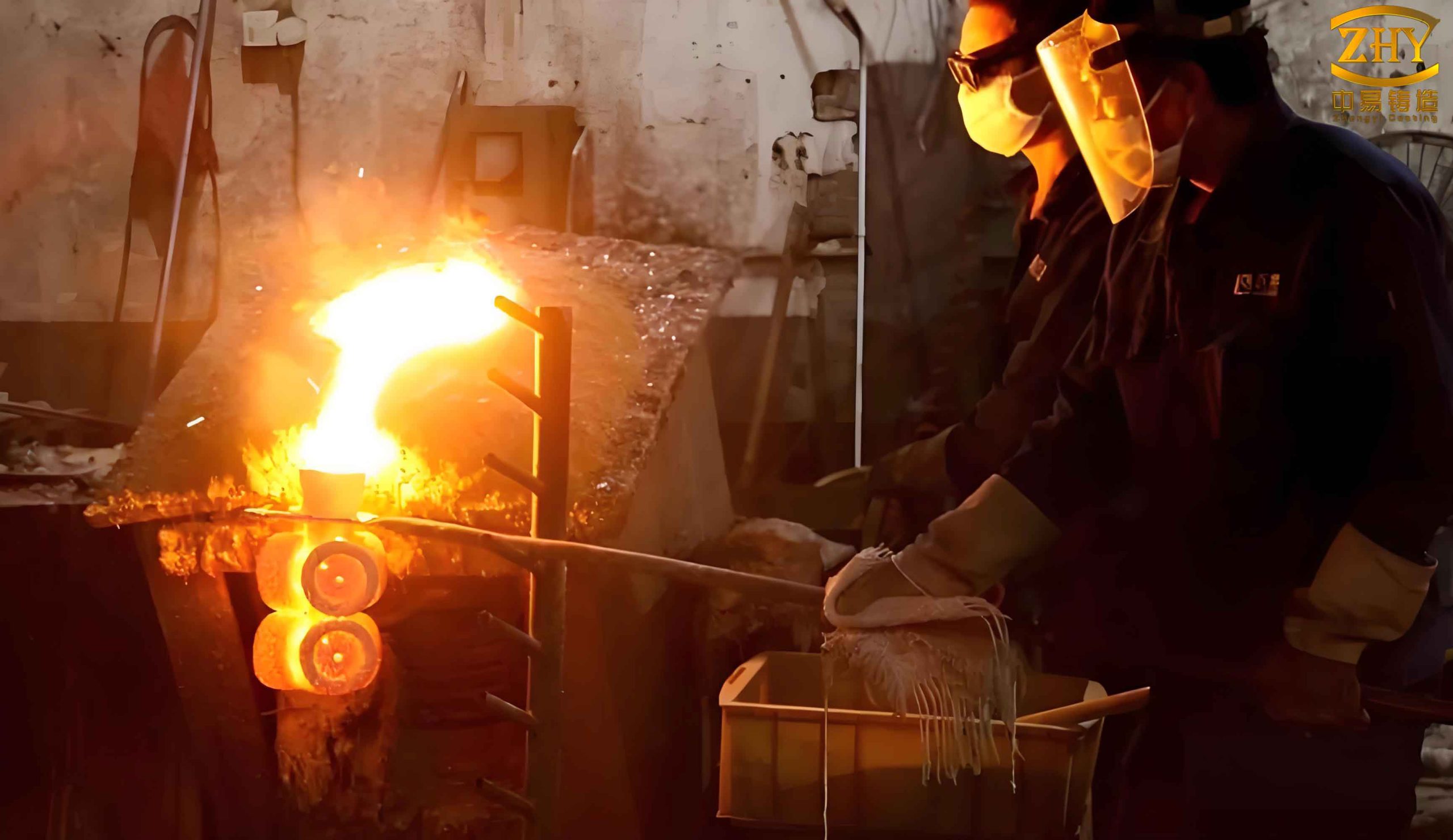
Both solid and hollow wax patterns were produced using 100% virgin mid-temperature wax (akin to a 162-type formulation) to eliminate variability from reclaimed wax content. Injection parameters were strictly controlled and identical for both sets to isolate the effect of geometry. After ejection, all patterns underwent a critical stabilization process: they were placed on a flat correction plate and weighted for over two hours to minimize any immediate warpage before measurement. The ceramic shells were fabricated using a standard colloidal silica process with zircon flour prime coats and fused silica backup coats. The K648 superalloy was melted in a vacuum induction furnace and poured into preheated shells, followed by standard knockout, heat treatment, and finishing operations.
Dimensional Metrology and Data Analysis
The dimensional analysis was conducted in two phases: wax pattern evaluation and final casting evaluation. For the wax patterns, non-contact blue light scanning was employed to capture the full 3D surface geometry. The point cloud data was compared to the nominal CAD model to generate full-field deviation maps, revealing areas of shrinkage, warpage, or swell. Furthermore, critical linear dimensions were physically measured using calibrated instruments. The pattern’s linear shrinkage was calculated for each dimension:
$$ \alpha = \left( \frac{A_0 – A_1}{A_0} \right) \times 100\% $$
where $$A_0$$ is the die cavity dimension and $$A_1$$ is the measured wax pattern dimension.
For the final castings, the same set of critical dimensions was measured. The total linear casting shrinkage relative to the die was calculated as:
$$ \beta = \left( \frac{A_0 – A_2}{A_0} \right) \times 100\% $$
where $$A_2$$ is the measured casting dimension. The dimensional accuracy was then classified according to the Casting Tolerance (CT) grade system by analyzing the spread of deviations.
The quantitative results were striking and are summarized in the tables below.
| Dimension ID | Die Dimension, A0 (mm) | Solid Wax Pattern, A1_solid (mm) | Solid Wax Shrinkage, α_solid (%) | Hollow Wax Pattern, A1_hollow (mm) | Hollow Wax Shrinkage, α_hollow (%) |
|---|---|---|---|---|---|
| 1 | 73.83 | 72.50 | 1.80 | 73.09 | 1.00 |
| 2 | 61.97 | 60.98 | 1.60 | 61.88 | 0.15 |
| 3 | 14.36 | 14.30 | 0.45 | 14.32 | 0.31 |
| 4 | 53.35 | 52.80 | 1.03 | 52.88 | 0.88 |
| 5 | 26.68 | 26.42 | 0.97 | 26.48 | 0.75 |
| 6 | 34.89 | 34.71 | 0.52 | 34.79 | 0.29 |
| 7 | 38.99 | 38.24 | 1.92 | 38.58 | 1.05 |
| 8 | 85.16 | 84.42 | 0.87 | 84.88 | 0.33 |
| 9 | 16.42 | 16.20 | 1.32 | 16.40 | 0.10 |
| Average Linear Shrinkage | 1.16% | 0.54% | |||
Table 1: Comparative Analysis of Wax Pattern Linear Shrinkage.
| Dimension ID | Die Dimension, A0 (mm) | Casting from Solid Pattern, A2_solid (mm) | Total Shrinkage β_solid (%) | Casting from Hollow Pattern, A2_hollow (mm) | Total Shrinkage β_hollow (%) |
|---|---|---|---|---|---|
| 1 | 73.83 | 72.45 | 1.87 | 72.17 | 2.25 |
| 2 | 61.97 | 59.97 | 3.23 | 60.24 | 2.79 |
| 3 | 14.36 | 14.07 | 2.07 | 14.04 | 2.26 |
| 4 | 53.35 | 52.33 | 1.91 | 52.19 | 2.17 |
| 5 | 26.68 | 25.71 | 3.62 | 26.15 | 1.97 |
| 6 | 34.89 | 34.15 | 2.11 | 34.08 | 2.31 |
| 7 | 38.99 | 37.98 | 2.60 | 37.98 | 2.58 |
| 8 | 85.16 | 82.47 | 3.15 | 82.69 | 2.89 |
| 9 | 16.42 | 15.80 | 3.73 | 16.01 | 2.49 |
| Average Total Shrinkage (β) | 2.70% | 2.41% | |||
| Dimensional Accuracy Grade (CT) | CT7 | CT5 | |||
Table 2: Impact on Final Casting Dimensions and Tolerances.
Discussion of Results and Technological Implications
The data unequivocally demonstrates the profound impact of the hollow wax mold strategy. The average linear shrinkage of the wax pattern itself was reduced from 1.16% to 0.54%, representing an improvement of over 53%. This is a direct consequence of the reduced and more uniform wall thickness. The thinner walls solidify faster and more uniformly, minimizing the thermal gradients and internal stresses described by the $$ abla T$$ and $$\epsilon_{local}(r,t)$$ relationships. The visual deviation maps from the 3D scans provided corroborating evidence, showing significantly reduced areas of sink and distortion on the large planar surfaces of the hollow pattern compared to the solid one.
The benefit cascades directly to the final component. While the metal solidification shrinkage is largely invariant, the reduction in the initial wax pattern variability allows for a more predictable and consistent total shrinkage. The average total linear shrinkage ($$\beta$$) decreased from 2.70% to 2.41%. More importantly, the spread or range of dimensional deviations was drastically narrowed. This reduction in variability is what enables the jump in the formal Casting Tolerance grade from CT7 to CT5. Achieving CT5 in a thick-section superalloy prototype investment casting is a significant accomplishment, as it denotes higher precision and potentially reduces the need for extensive post-casting machining.
The hollow structure approach presents distinct advantages over traditional methods for managing thick sections, such as using separately fabricated cold wax inserts. While effective, the cold insert method introduces additional complexity: it requires extra tooling (insert molds), increases production steps and cycle time, and poses risks related to insert bonding and surface finish at the joints. The integrated hollow design, created directly by the die’s moving cores, avoids these issues. It is a more elegant, repeatable, and scalable solution suitable for medium to high-volume production of precision prototypes.
This research underscores a critical paradigm in advanced prototype investment casting: dimensional control must be addressed proactively at the wax pattern design stage, not just compensated for empirically in the die. By viewing the wax pattern as an engineered structure rather than a solid replica, we can manipulate its thermo-mechanical behavior to our advantage. The hollow wax mold technique is a powerful manifestation of this principle.
Conclusion and Future Perspectives
This detailed investigation confirms that the strategic implementation of a hollow wax mold structure is a highly effective method for enhancing the dimensional accuracy of prototype investment castings, particularly those with challenging thick sections. By reducing the wall thickness of critical sections to an optimal 4.5-5.0 mm range:
- The inherent linear shrinkage of the wax pattern is substantially and consistently reduced.
- Problems associated with non-uniform cooling—such as planar sink, warpage, and dimensional scatter—are effectively mitigated.
- The dimensional accuracy of the final superalloy casting can be improved by multiple CT grades (from CT7 to CT5 in this study).
- A more predictable and slightly lower total linear shrinkage is achieved, improving the accuracy of die compensation factors for future production.
The implications for the field of prototype investment casting are substantial. This approach provides foundry engineers with a reliable and practical tool to meet ever-tightening geometric tolerances for high-performance components. Future work could involve finite element simulation of the wax injection and cooling process for hollow geometries to optimize wall thickness and hollow shape for specific wax formulations and part geometries. Additionally, exploring the integration of this concept with additive manufacturing for direct wax pattern or die production could open new frontiers for ultra-complex, high-precision prototype investment casting components that were previously unattainable through conventional means. The pursuit of precision continues, and the hollow wax mold stands as a testament to the innovative engineering possible within this vital manufacturing discipline.