
As a steel castings manufacturer operating within the European Union, I have witnessed firsthand the turbulent shifts in our industry’s economic landscape. The recent declines in key sentiment indicators, such as the European Foundry Industry Sentiment Indicator (FISI) and the Business Climate Indicator (BCI), resonate deeply with my daily operational realities. For a steel castings manufacturer, these indices are not merely abstract numbers; they are a pulse check on demand, production viability, and future planning. The continuous downward trajectory, with FISI falling below its initial 2015 value, signals a period of significant pressure where order books, though currently high, are being depleted without robust new inquiries to replenish them. This environment forces every steel castings manufacturer to scrutinize their processes, costs, and sustainability practices more intensely than ever before.
The fundamental equation governing our business sentiment can be partially encapsulated by the construction of these indices. The FISI, as a composite metric, likely synthesizes various survey responses from foundries. While its exact proprietary formula is not public, we can model a generalized sentiment index for a steel castings manufacturer as a weighted sum of key factors:
$$ \text{Sentiment Index (S)} = w_1 \cdot O_c + w_2 \cdot O_f + w_3 \cdot P_c + w_4 \cdot E_f $$
Where:
$O_c$ = Current order level assessment,
$O_f$ = Future order expectation (next 6 months),
$P_c$ = Current production assessment,
$E_f$ = Future economic expectation,
and $w_1$ to $w_4$ are respective weights summing to 1. The reported drop in FISI from 100.7 in May to 98.6 in June suggests negative movements across these components for the average foundry, including those specializing in steel castings.
The Business Climate Indicator (BCI) for the euro area manufacturing sector, which encompasses foundries, provides a broader yet equally concerning picture. Its calculation incorporates five survey balances: production trends, order books, export order books, stocks, and production expectations. A simplified representation of its monthly change might be:
$$ \Delta \text{BCI}_t = \alpha (\text{Balance}_{\text{Orders}, t} – \text{Balance}_{\text{Orders}, t-1}) + \beta (\text{Balance}_{\text{Expectations}, t} – \text{Balance}_{\text{Expectations}, t-1}) + \cdots $$
For a steel castings manufacturer, the drop in BCI to nearly pandemic-era negative territory implies a contraction in the fundamental drivers of growth. The anticipation of falling sales prices alongside declining production and order levels creates a precarious profitability equation.
| Month | FISI (Sector) | BCI (Euro Area) | Internal Order Book Index (Steel Castings Manufacturer) | Raw Material Cost Index |
|---|---|---|---|---|
| January 2023 | 101.5 | 0.25 | 110 | 105 |
| February 2023 | 100.9 | 0.22 | 108 | 107 |
| March 2023 | 100.5 | 0.19 | 106 | 109 |
| April 2023 | 100.2 | 0.15 | 103 | 111 |
| May 2023 | 100.7 | 0.19 | 102 | 110 |
| June 2023 | 98.6 | 0.06 | 98 | 112 |
The table above illustrates the correlated decline. For a steel castings manufacturer, the internal order book index is a critical survival metric. The precipitous drop from a stable 110 in January to 98 in June mirrors the “across-the-board collapse” in new orders mentioned in reports. This trend is unsustainable. The lifeblood of any steel castings manufacturer is a healthy pipeline of projects, and when that dries up, operational efficiency and cost management become paramount. This is where innovation in process sustainability transitions from a “nice-to-have” to a strategic imperative for a competitive steel castings manufacturer.
The environmental and economic logic for adopting advanced sand reclamation technologies is compelling. Consider a typical steel castings manufacturer producing 1,000 tonnes of castings annually. The traditional linear model consumes vast quantities of silica sand, a non-renewable resource often transported over long distances. The mass balance for such an operation is stark:
$$ M_{\text{sand, in}} = M_{\text{castings}} \cdot R_{\text{sand-to-metal}} $$
Where $M_{\text{sand, in}}$ is the mass of new sand required, $M_{\text{castings}}$ is the annual casting output (e.g., 1,000 t), and $R_{\text{sand-to-metal}}$ is the sand-to-metal ratio, historically as high as 2.5 or more. Thus,
$$ M_{\text{sand, in}} \approx 1000 \times 2.5 = 2500 \text{ tonnes/year}. $$
This generates an equivalent waste stream destined for landfill, $M_{\text{waste}}$, incurring disposal costs and environmental liabilities. For a forward-thinking steel castings manufacturer, this equation is unacceptable. The circular model, enabled by on-site sand reclamation, transforms this balance. If a reclamation system achieves a recovery rate $\eta$ (e.g., 90%), the annual requirement for new sand becomes:
$$ M_{\text{sand, in, new}} = M_{\text{sand, in}} \cdot (1 – \eta) + M_{\text{sand, makeup}} $$
Where $M_{\text{sand, makeup}}$ accounts for inevitable system losses. With high $\eta$, the new sand demand can plummet, saving over 2,000 tonnes annually for a mid-sized steel castings manufacturer. The economic saving $S$ can be modeled as:
$$ S = (M_{\text{sand, in, old}} – M_{\text{sand, in, new}}) \cdot C_{\text{sand}} + M_{\text{waste}} \cdot C_{\text{disposal}} – C_{\text{reclamation}} $$
where $C_{\text{sand}}$ is cost per tonne of new sand (including logistics), $C_{\text{disposal}}$ is landfill cost per tonne, and $C_{\text{reclamation}}$ is the annualized operational cost of the reclamation plant. For any steel castings manufacturer, a positive $S$ is a direct boost to the bottom line, increasingly crucial in a down market.
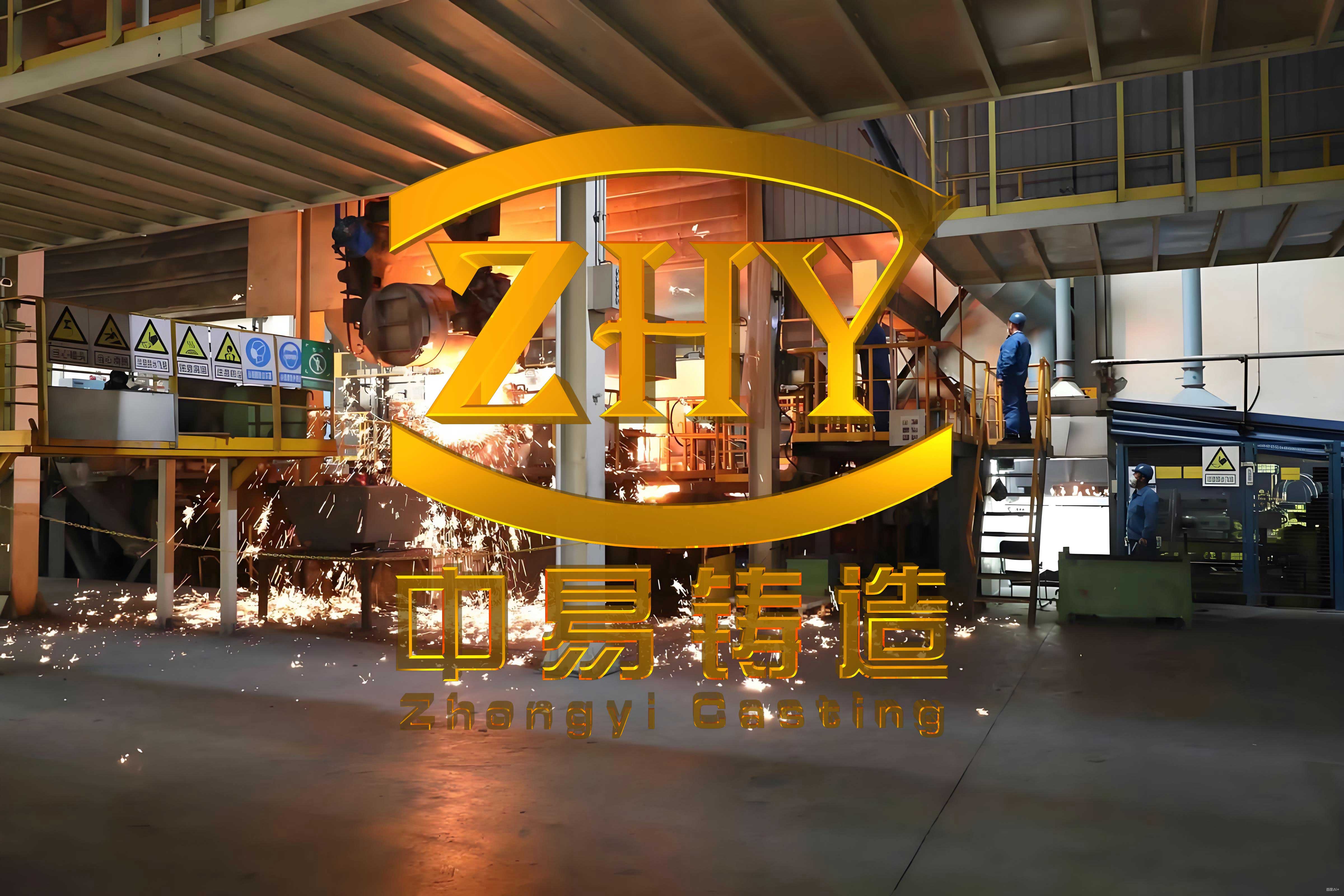
The image above represents the modern, integrated facility that a progressive steel castings manufacturer aspires to operate—where molten metal and material recovery flow in a controlled, sustainable loop. Implementing thermal and mechanical sand reclamation technology yields multifaceted benefits beyond simple mass balance. The process typically involves calcination to burn off organic binders and mechanical scrubbing to remove inorganic coatings. This results in reclaimed sand with superior and more consistent properties compared to raw sand. The grain size distribution becomes tighter, which for a steel castings manufacturer translates to several process advantages that can be quantified.
A key performance metric is the Acid Demand Value (ADV) or the consumption of chemical binders like furan resins. Reclaimed sand has a lower active surface area and fewer impurities, leading to reduced binder demand. The relationship can be expressed as:
$$ B_{\text{reclaimed}} = k \cdot B_{\text{new}} $$
where $B$ is the binder required per tonne of sand, and $k$ is a factor less than 1, often between 0.7 and 0.9. This reduction directly lowers material costs and volatile organic compound (VOC) emissions for the steel castings manufacturer. Furthermore, improved sand quality enhances the dimensional accuracy and surface finish of the final steel castings, reducing machining allowances and scrap rates. This is vital for a steel castings manufacturer serving demanding sectors like energy, transportation, or heavy machinery.
| Parameter | Traditional Linear Model | On-site Reclamation Model (η=90%) | Unit | Benefit/Impact |
|---|---|---|---|---|
| New Sand Imported | 2500 | ~300 | tonnes | ~88% reduction, lower logistics footprint |
| Sand to Landfill | ~2500 | ~50 (system losses) | tonnes | ~98% waste elimination |
| Binder Consumption | B0 | 0.75 · B0 | tonnes | 25% cost saving, lower emissions |
| CO2e from Sand Transport* | High | Low | kg CO2e | Significant reduction in scope 3 emissions |
| Sand Quality Consistency (Cpk)** | 1.0 | 1.5 | Process Capability Index | Higher casting yield, lower rework |
* Estimated based on long-distance maritime and road haulage.
** Hypothetical values illustrating improvement in process control.
For a steel castings manufacturer, the operational transition to such a system is a strategic investment. The modular nature of modern reclamation plants allows for scalability and integration into existing foundry layouts. The core process can be described through a series of unit operations with associated efficiency parameters. Let the initial waste sand mass be $M_0$. After shakeout and initial crushing, it enters a thermal unit where binder removal occurs. The mass after thermal processing, $M_1$, is given by:
$$ M_1 = M_0 \cdot (1 – f_{\text{organics}}) $$
where $f_{\text{organics}}$ is the fraction of volatile organics. Subsequently, mechanical attrition removes the inert coatings, yielding a final reclaimed sand mass $M_r$:
$$ M_r = M_1 \cdot (1 – f_{\text{attrition loss}}) $$
The overall recovery rate $\eta$ is then $M_r / M_0$. A well-designed system aims to maximize $\eta$ while minimizing energy input per tonne, $E_{\text{specific}}$. The total energy consumption $E_{\text{total}}$ for a steel castings manufacturer’s reclamation plant annually is:
$$ E_{\text{total}} = E_{\text{specific}} \cdot M_0 $$
Optimizing this equation is key, as energy costs directly affect $C_{\text{reclamation}}$ in the savings model earlier. The synergy between economic and environmental goals is clear: reducing new sand consumption lowers both costs and the carbon footprint associated with mining and transportation, making the steel castings manufacturer more resilient against volatile raw material markets and tightening environmental regulations.
The current pessimistic business climate, reflected in the BCI, necessitates such resilience. When future sales price expectations are falling, controlling and reducing variable costs becomes the primary lever for maintaining profitability. For a steel castings manufacturer, raw material and consumable costs like sand and binders constitute a significant portion of the variable cost structure. Therefore, the adoption of sand reclamation technology acts as a hedge against inflation in raw material prices and potential carbon taxes. This strategic move can be the difference between surviving a downturn and thriving when the market recovers. Every progressive steel castings manufacturer must evaluate this calculus.
Moreover, the negative sentiment in the industry may accelerate consolidation and force weaker foundries to exit. A steel castings manufacturer with advanced, sustainable practices and lower operational costs will be better positioned to capture market share when demand eventually rebounds. The integration of circular economy principles is no longer optional; it is a core component of operational excellence for a modern steel castings manufacturer. This aligns with broader EU policy goals under the Green Deal, potentially opening access to green financing or preferential procurement from environmentally conscious clients.
In conclusion, the dual challenges of deteriorating business sentiment and the imperative for sustainability define the current era for European foundries. From my perspective as a steel castings manufacturer, the declining FISI and BCI are urgent calls to action—to innovate, to optimize, and to future-proof our operations. Technologies that close material loops, such as advanced sand reclamation, offer a tangible path forward. They transform a cost center into a value center, reduce environmental impact, and build strategic resilience. As the industry navigates these “difficult times and weak expectations,” the steel castings manufacturer that embraces this integrated approach to economics and ecology will not only endure but also define the future of European manufacturing. The formula for success now unequivocally includes variables for resource efficiency, circularity, and sustainable innovation alongside traditional metrics of quality and delivery.