
In the realm of manufacturing, metal casting remains a cornerstone process, yet it is fraught with complexities that often lead to various metal casting defects. These defects, such as misruns, shrinkage, porosity, and shifts, significantly impact product quality and economic efficiency. Traditional approaches to diagnosing and preventing these issues have relied on empirical knowledge and isolated corrective actions, which may not address the systemic nature of the problems. To overcome this, we propose the application of Fault Tree Analysis (FTA), a systematic deductive methodology originally developed for reliability engineering, to the domain of metal casting. This approach treats each metal casting defect as a system failure, enabling a structured analysis of root causes and interdependencies. In this comprehensive exploration, we delve into the principles of FTA, demonstrate its application through detailed case studies on specific metal casting defects, and discuss its broader implications for quality management in foundries.
The core premise of FTA is to model a system’s failure (the top event) using a logical tree structure composed of basic events and gates. For metal casting defects, the top event is the occurrence of a specific defect, such as a shift or subsurface blowhole. The tree is constructed downwards, identifying intermediate events and basic causes through logical operators like AND gates (where all input events must occur for the output to happen) and OR gates (where any input event can cause the output). This graphical representation captures the chain of causality inherent in the casting process. The mathematical foundation of FTA lies in Boolean algebra. Let the top event be denoted as \(T\), and the basic events as \(x_1, x_2, …, x_n\). The fault tree structure defines a Boolean function \(\Phi(X)\) such that \(T = \Phi(x_1, x_2, …, x_n)\). The qualitative analysis involves finding all minimal cut sets (MCS). A cut set is a set of basic events whose simultaneous occurrence causes the top event; it is minimal if no subset is also a cut set. Formally, a set \(C = \{x_{i1}, x_{i2}, …, x_{ik}\}\) is a minimal cut set if \(\Phi(X)=1\) when all events in \(C\) are 1 (true), and for any proper subset \(C’ \subset C\), \(\Phi(X)=0\) if only events in \(C’\) are 1. The collection of all MCS, \(\{C_1, C_2, …, C_m\}\), represents all distinct failure pathways for the metal casting defect.
Quantitative analysis requires probabilistic data. Assuming basic events are independent, the probability of the top event, \(P(T)\), can be computed from the probabilities of basic events, \(q_i = P(x_i=1)\). For a simple OR gate with inputs \(A\) and \(B\), \(P(\text{output}) = 1 – (1-P(A))(1-P(B))\). For an AND gate, \(P(\text{output}) = P(A)P(B)\). For complex trees, approximation methods or algorithms based on minimal cut sets are used. Two key importance measures are calculated: Probability Importance (\(I^P_i\)) and Criticality Importance (\(I^C_i\)). The probability importance, also known as the Birnbaum measure, is the partial derivative of the top event probability with respect to the basic event probability:
$$I^P_i = \frac{\partial P(T)}{\partial q_i}.$$
It indicates the rate of change in system failure probability given a change in the reliability of a basic component. The criticality importance normalizes this by the relative likelihood of the event:
$$I^C_i = \frac{q_i}{P(T)} \cdot I^P_i.$$
These metrics help prioritize which factors most influence the occurrence of a metal casting defect, guiding effective quality control interventions.
The practical implementation of FTA for metal casting defects involves several steps, which we have streamlined using computer-aided methods, particularly a cut-set matrix algorithm to handle the combinatorial complexity (“NP-hard” problem) of large trees. The process begins with clearly defining the top event—the specific metal casting defect under investigation. Next, a multidisciplinary team constructs the fault tree by brainstorming potential causes, from raw material properties and melting practice to molding, pouring, and solidification parameters. This tree is then encoded for software analysis. The qualitative output lists all minimal cut sets, each a unique combination of basic failures leading to the defect. The quantitative analysis, given estimated failure probabilities for basic events (from historical data or expert judgment), computes the overall defect probability and importance rankings. This systematic approach transforms subjective troubleshooting into a data-driven diagnostic and predictive tool for metal casting quality.
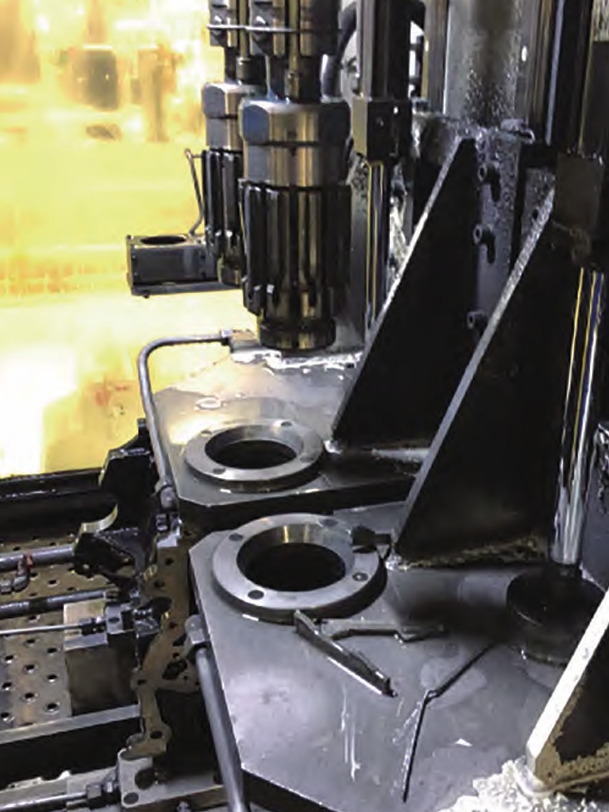
To illustrate the power of FTA, we first examine a common metal casting defect: mold shift or mismatch, often simply called “shift.” This defect results in misalignment between upper and lower parts of a casting, critically affecting dimensional accuracy. We analyzed this metal casting defect in the context of a high-production horizontal parting flaskless molding line (e.g., a Hunter-style machine). The top event, “Casting Shift Occurrence,” was decomposed into primary causes related to equipment, tooling, and operation. The resulting fault tree, though complex, was managed using our algorithmic approach. The logical structure included gates for sequential and concurrent failures. For instance, an AND gate might represent the combined need for both “insufficient mold clamping force” AND “fast mold closing speed” to cause a shift, while an OR gate would capture multiple independent paths, such as “pattern misalignment” OR “core seat mismatch.”
The qualitative analysis yielded 14 minimal cut sets, each a distinct recipe for the shift defect. These are summarized in Table 1, which enumerates the specific basic event combinations. This table serves as a comprehensive checklist for engineers when a shift metal casting defect is detected on the production line.
| Minimal Cut Set ID | Basic Events in the Set (Causal Combination) | Interpretation as a Failure Pathway |
|---|---|---|
| 1 | {15} | Misalignment between cope and drag pattern plates. |
| 2 | {7} | Improper fit between core print and core seat. |
| 3 | {3} | Failure of the mold closing mechanism guidance system. |
| 4 | {6} | Non-planar stripping of the cope mold. |
| 5 | {4} | Incorrect adjustment of the ball joint mechanism. |
| 6 | {5} | Incorrect setting of the drag table locating pins. |
| 7 | {14} | Uneven jacket or weighting system. |
| 8 | {1, 2} | Insufficient rigidity of closing mechanism AND excessive closing speed. |
| 9 | {8, 12} | Excessively light cope mold AND unbalanced pushing mechanism. |
| 10 | {8, 13} | Excessively light cope mold AND insufficient mold contact area. |
| 11 | {9, 11, 12} | Poor manufacturing precision of mold conveyor, high conveyor speed, AND light cope. |
| 12 | {9, 11, 13} | Poor conveyor precision, high speed, AND insufficient contact area. |
| 13 | {10, 11, 12} | Insufficient conveyor rigidity, high speed, AND light cope. |
| 14 | {10, 11, 13} | Insufficient conveyor rigidity, high speed, AND insufficient contact area. |
For quantitative assessment, we assigned a baseline failure probability of \(Q=0.01\) to each basic event, representing a 1% chance of that specific fault occurring during a cycle. The computed probability for the top event, \(P(T)\), was approximately 0.068 or 6.8%. This quantifies the expected scrap rate due to this metal casting defect under these conditions. A sensitivity analysis showed that improving component reliability, reducing each \(q_i\) to 0.001, lowered \(P(T)\) to about 0.007 (0.7%), demonstrating a tenfold reduction in this specific metal casting defect. The importance measures, calculated for the baseline scenario, are presented in Table 2. The probability importance values clearly highlight which basic events have the greatest leverage on overall system reliability regarding this metal casting defect. Events with high probability importance, such as those related to direct mechanical alignment, should be the primary targets for maintenance and process control to mitigate the shift metal casting defect.
| Basic Event Identifier | Description (Related to Metal Casting Defect Cause) | Probability Importance \(I^P_i\) | Criticality Importance \(I^C_i\) |
|---|---|---|---|
| 3 | Mold closing guide failure | 0.941195 | 0.137971 |
| 4 | Ball joint misadjustment | 0.941195 | 0.137971 |
| 5 | Drag pin misadjustment | 0.941195 | 0.137971 |
| 6 | Cope stripping issue | 0.941195 | 0.137971 |
| 7 | Core seat mismatch | 0.941195 | 0.137971 |
| 14 | Uneven jacket/weight | 0.941195 | 0.137971 |
| 15 | Pattern misalignment | 0.941195 | 0.137971 |
| 8 | Cope mold too light | 0.0185426 | 0.00271817 |
| 12 | Unbalanced push mechanism | 0.0094083 | 0.00137917 |
| 13 | Insufficient mold contact area | 0.0094083 | 0.00137917 |
| 1 | Insufficient closing rigidity | 0.00931876 | 0.00136605 |
| 2 | Excessive closing speed | 0.00931876 | 0.00136605 |
| 11 | High conveyor speed | 0.00036538 | 0.0000535614 |
| 9 | Poor conveyor precision | 0.000181772 | 0.0000266461 |
| 10 | Insufficient conveyor rigidity | 0.000181772 | 0.0000266461 |
A more metallurgically intricate metal casting defect is subsurface blowhole (porosity) in ductile iron castings. This defect is notoriously difficult to control due to multiple interacting mechanisms. We constructed a comprehensive fault tree for this metal casting defect by synthesizing three prevailing theories: reaction-gas evolution (e.g., from C-O reaction), slag-gas entrapment, and micro-gas invasion. The tree’s top event, “Subsurface Blowhole Formation,” was decomposed through several levels of logic. A key insight was the incorporation of pouring temperature as a major conditioning factor. The immense size of the full tree necessitated modular decomposition using the cut-set matrix algorithm. We created two primary subdivided trees: one for high-temperature conditions (\(D_{10}\)) and one for low-temperature conditions (\(D_{20}\)). Each was further split into three subtrees corresponding to the three formation mechanisms: reaction-gas (\(D_{11}, D_{21}\)), slag-gas (\(D_{12}, D_{22}\)), and invasion-gas (\(D_{13}, D_{23}\)).
The qualitative analysis produced counts of minimal cut sets for each tree and subtree. To interpret the dominance of different mechanisms under varying temperatures, we defined three metrics. Let \(N\) be the number of MCS in a primary subdivided tree (e.g., \(D_{10}\)), \(N_i\) the number in a subtree (e.g., \(D_{11}\)), and \(N_N\) the number of MCS common to both the subtree and its parent primary tree. The Cut-Set Confidence Degree for subtree \(i\) is:
$$K1_i = \frac{N_N}{N_i}.$$
This measures how representative the subtree’s failure modes are within its own context. The Cut-Set Effectiveness Degree is:
$$K2_i = \frac{N_N}{N}.$$
This indicates the subtree’s contribution to the overall failure modes of the primary condition. For quantitative comparison, let \(GQ\) be the top event probability of a primary tree and \(GQ_i\) that of a subtree. The Model Reliability Degree is:
$$K3_i = \frac{GQ_i}{GQ}.$$
This ratio shows the likelihood of a specific mechanism manifesting relative to the total defect probability under given conditions.
The results of this analysis are synthesized in Table 3 and Table 4. Table 3 presents the qualitative statistics, clearly showing a shift in dominant mechanisms with temperature. At high temperatures, the reaction-gas mechanism has the highest confidence and effectiveness, while the invasion mechanism is negligible. At low temperatures, the slag-gas mechanism becomes predominant. This aligns with physical understanding: high temperatures promote vigorous mold-metal reactions generating gases, while low temperatures increase melt viscosity, trapping slag and associated gases. This systemic view provided by FTA helps reconcile competing theories for this complex metal casting defect by contextualizing their relevance.
| Fault Tree Code | Description (Condition & Mechanism) | Number of Minimal Cut Sets | Common MCS with Primary Tree (\(N_N\)) | Confidence \(K1_i\) (%) | Effectiveness \(K2_i\) (%) |
|---|---|---|---|---|---|
| \(D_{10}\) | High Temperature – Overall | 163 | — | — | — |
| \(D_{11}\) | High Temp – Reaction-Gas | 117 | 23 | 19.66 | 14.11 |
| \(D_{12}\) | High Temp – Slag-Gas | 85 | 13 | 15.29 | 7.98 |
| \(D_{13}\) | High Temp – Invasion-Gas | 56 | 0 | 0.00 | 0.00 |
| \(D_{20}\) | Low Temperature – Overall | 112 | — | — | — |
| \(D_{21}\) | Low Temp – Reaction-Gas | 81 | 32 | 39.51 | 28.57 |
| \(D_{22}\) | Low Temp – Slag-Gas | 85 | 55 | 64.71 | 49.11 |
| \(D_{23}\) | Low Temp – Invasion-Gas | 60 | 11 | 18.33 | 9.82 |
Table 4 provides the quantitative probabilities and model reliability degrees, assuming representative basic event probabilities. The data strongly supports the qualitative findings. For the high-temperature condition, \(K3_{11} \approx 1.07\), indicating the reaction-gas model’s probability nearly matches the overall defect probability, confirming its dominance. For the low-temperature condition, \(K3_{22} \approx 0.998\), showing the slag-gas mechanism accounts for almost the entire defect risk. This FTA-based framework not only diagnoses this metal casting defect but also predicts how process changes, like adjusting pouring temperature, will alter the dominant failure modes.
| Fault Tree Code | Condition & Mechanism | Top Event Probability \(GQ\) or \(GQ_i\) (×10⁻⁶) | Model Reliability Degree \(K3_i\) |
|---|---|---|---|
| \(D_{10}\) | High Temperature – Overall | 2.21539 | 1.0000 |
| \(D_{11}\) | High Temp – Reaction-Gas | 2.38071 | 1.0746 |
| \(D_{12}\) | High Temp – Slag-Gas | 1.0511 | 0.4744 |
| \(D_{13}\) | High Temp – Invasion-Gas | 0.080463 | 0.0362 |
| \(D_{20}\) | Low Temperature – Overall | 105.278 | 1.0000 |
| \(D_{21}\) | Low Temp – Reaction-Gas | 1.23646 | 0.0117 |
| \(D_{22}\) | Low Temp – Slag-Gas | 105.116 | 0.9984 |
| \(D_{23}\) | Low Temp – Invasion-Gas | 0.080961 | 0.0007 |
The application of FTA extends beyond analyzing specific metal casting defects like shifts or porosity. We have successfully employed this methodology in broader foundry contexts, including the design evaluation of casting equipment, fault diagnosis in sand and conveyor systems, reliability analysis of mechanical control units in molding lines, and even in the development of high-alloy casting materials where defect formation is a critical barrier. In each case, treating the system or process as a network of potential failures allows for proactive identification of weak links. For equipment design, FTA helps specify reliability targets for components. For process control systems, it maps out how sensor or actuator failures could propagate to cause a metal casting defect. This holistic view is a significant advancement over traditional trial-and-error methods in managing metal casting quality.
Implementing FTA for metal casting defects offers several profound advantages. Firstly, it structures and documents expert knowledge about cause-effect relationships, creating a reusable asset for training and problem-solving. Secondly, the minimal cut sets provide an exhaustive failure mode list, ensuring no potential root cause is overlooked during diagnostics. Thirdly, the quantitative aspect enables predictive quality management; by monitoring or estimating the probabilities of basic events (e.g., sand moisture fluctuations, alloy composition variations), one can forecast scrap rates and conduct cost-benefit analyses for potential improvements. Fourthly, the importance measures offer scientifically grounded priorities for resource allocation, whether for preventive maintenance, process parameter tightening, or supplier quality audits. This is crucial for achieving systematic reduction in metal casting defects.
In conclusion, Fault Tree Analysis represents a powerful paradigm shift in addressing metal casting defects. By reframing these defects as system failures and applying rigorous logical and probabilistic analysis, FTA moves the field from reactive correction to proactive prediction and prevention. The case studies on shift and subsurface blowhole defects demonstrate its capacity to handle both mechanical and metallurgical complexities, revealing dominant failure pathways and their sensitivity to process conditions like temperature. The integration of computer-aided analysis, particularly through efficient algorithms for handling large trees, makes this approach feasible for industrial settings. We believe that the widespread adoption of FTA and similar system-engineering tools will be instrumental in achieving the next level of quality, efficiency, and scientific management in metal casting operations, ultimately reducing the economic and material waste associated with metal casting defects and enhancing the reliability of cast components across all industries.