
As an engineer specializing in metallurgy and welding repair, I have encountered numerous instances of metal casting defect that compromise the integrity and functionality of critical components. Metal casting defect, such as cracks, porosity, shrinkage cavities, and cold shuts, are common in industrial settings, often leading to costly downtime if not addressed properly. In this comprehensive guide, I will share my firsthand experiences and detailed methodologies for repairing these defects, drawing from two specific cases: a fractured rack gear and a defective slip ring. The focus will be on practical techniques, supported by tables and formulas, to ensure effective restoration. Throughout, I will emphasize the importance of understanding metal casting defect behavior to implement successful repairs.
Metal casting defect arise from various factors during the casting process, including improper cooling, alloy composition issues, and mold design flaws. These defects can manifest as structural weaknesses, requiring precise repair to restore mechanical properties. In my work, I have developed a systematic approach that involves pre-weld preparation, controlled welding parameters, and post-weld treatment. This approach minimizes the risk of further defects, such as increased brittleness or distortion, which are common challenges when dealing with metal casting defect.
Let me begin with the case of a rack gear that suffered a fracture due to pre-existing metal casting defect. The gear was initially repaired with inappropriate welding electrodes, leading to the incorporation of complex alloy elements and the formation of white iron structures, a typical consequence of improper handling of metal casting defect. To address this, I undertook a meticulous repair process. First, I prepared the weld area by using a suitable electrode to re-cut the weld seam, removing all previous weld metal and the white layer with a chisel. I then opened a V-groove, cleaned it with a blowtorch to eliminate oil contaminants, and brushed it with a steel wire to reveal metallic luster. This step is crucial for preventing the exacerbation of metal casting defect during welding.
The welding process involved depositing a transition layer using a specific electrode on both groove faces. I maintained a short arc and controlled the heat input carefully. After each 100 mm weld bead, I performed light hammering to relieve residual stresses, allowing the temperature to drop to a touch-safe level before proceeding. Alignment was critical; I used a platform and straight edge to align the broken teeth, inserting a 0.5 mm iron block for anti-deformation. The gap was set to approximately 1 mm. Positioning welds were applied on the backside, followed by a layered welding sequence with alternating, intermittent, narrow beads. Key parameters are summarized in the table below:
| Step | Electrode Type | Current (A) | Weld Bead Length | Temperature Control |
|---|---|---|---|---|
| Transition Layer | Specific Grade | 90-110 | 100 mm | Cool to touch |
| First Layer | Standard Grade | 90-110 | 50 mm | ~50°C |
| Second Layer | Standard Grade | 90-110 | 100 mm | Room temperature |
| Cover Layer | Standard Grade | 90-110 | Full bead | Lower than previous |
Throughout welding, I employed techniques like hammering and slag removal to mitigate metal casting defect propagation. The final step involved grinding the weld to match the tooth profile using a template. Inspection revealed minimal deformation: bending distortion of 0.5 mm and upward warping of 1.0 mm, with no cracks or slag inclusions under a 10x magnifier. This repair highlights how addressing metal casting defect requires precise thermal management, as expressed by the heat input formula: $$ Q = \eta \cdot I \cdot V \cdot t / v $$ where \( Q \) is heat input (J/mm), \( \eta \) is efficiency, \( I \) is current (A), \( V \) is voltage (V), \( t \) is time (s), and \( v \) is travel speed (mm/s). Controlling \( Q \) is essential to avoid overheating, which can worsen metal casting defect.
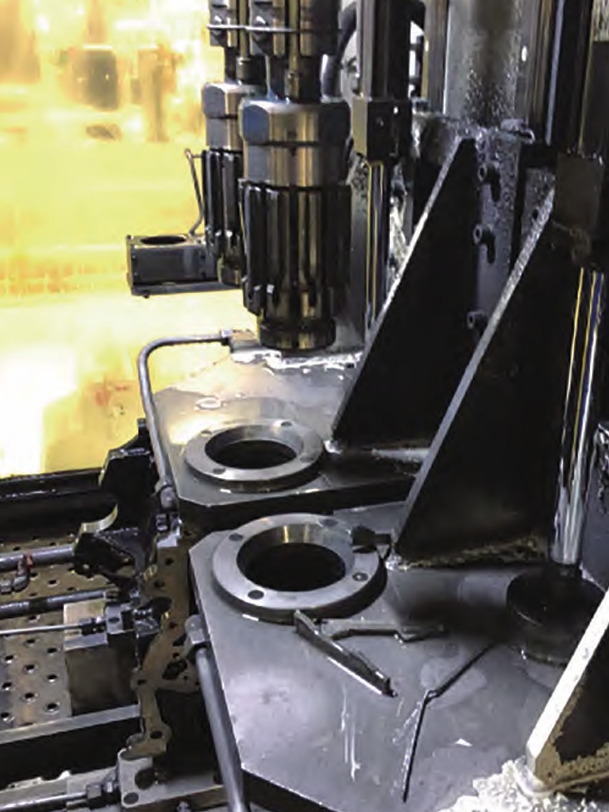
The second case involved a slip ring with severe metal casting defect, including porosity, shrinkage cavities, and localized looseness. This component, made of a copper alloy with over 10% tin, presented challenges due to its large size and weight. Metal casting defect of this nature often require localized repair or replacement. I used manual carbon arc welding, a method suitable for such alloys. The setup included a DC arc welding generator with a voltage booster to compensate for high current demands. Key welding parameters are tabulated below:
| Parameter | Value | Description |
|---|---|---|
| Carbon Electrode Diameter | 20 mm | For high heat concentration |
| Open Circuit Voltage | 80-90 V | Boosted for stability |
| Working Voltage | 40-50 V | During welding |
| Welding Current | 800-1000 A | DC positive polarity |
| Preheat Temperature | 300-400°C | To reduce thermal stress |
For the wing plate repair, I positioned it horizontally and preheated with an oxy-acetylene flame to around 300°C. This preheating is vital to prevent cracking, a common issue when welding metal casting defect. During welding, I applied compensatory heating and immediate hammering to each bead, which helps in stress relief. The heat flow during welding can be modeled using Fourier’s law: $$ q = -k \nabla T $$ where \( q \) is heat flux (W/m²), \( k \) is thermal conductivity (W/m·K), and \( \nabla T \) is temperature gradient. By managing \( \nabla T \), I minimized the risk of inducing new metal casting defect.
In one instance, a section of the wing plate had extensive metal casting defect, necessitating partial replacement. I cut out a 300 mm defective segment and prepared a butt joint with a matching cast piece. The groove was aligned and preheated to 400°C. I performed a root weld with full penetration, adding filler wire and following with hammering. The welding sequence involved sealing the ends first, then filling the center, and finally capping the surface. This method ensured uniform stress distribution, critical for repairing metal casting defect in large components. The deformation was minimal; the inner diameter changed from an initial 1010 mm to 1012 mm post-weld, but stabilized at 1010 mm after cooling, demonstrating effective control over distortion—a key concern when addressing metal casting defect.
For圆弧 (arc-shaped) sections with metal casting defect, I positioned the area horizontally, preheated, and fused the metal to eliminate shrinkage cavities. Filler metal was added to achieve the required machining height. Magnetic blow-induced undercut was mitigated by repositioning the component. The success here relied on understanding the solidification dynamics of metal casting defect, which can be described by the Chvorinov’s rule: $$ t_s = B \cdot (V/A)^n $$ where \( t_s \) is solidification time (s), \( B \) is a mold constant, \( V \) is volume (m³), \( A \) is surface area (m²), and \( n \) is an exponent. By controlling cooling rates, I reduced the likelihood of defect formation.
Beyond these cases, I have developed general principles for repairing metal casting defect. Pre-weld preparation is paramount: it involves thorough cleaning, groove preparation, and removal of any contaminated layers. This step directly impacts the quality of repair, as residual impurities can act as stress concentrators, exacerbating metal casting defect. Welding parameters must be tailored to the material; for instance, high-conductivity alloys like copper require higher heat inputs, but excessive heat can lead to grain growth and brittleness. I often use the following formula to estimate critical cooling rates to avoid martensite formation in steels: $$ CR = \frac{T_i – T_f}{t} $$ where \( CR \) is cooling rate (°C/s), \( T_i \) is initial temperature (°C), \( T_f \) is final temperature (°C), and \( t \) is time (s). Maintaining a slow cooling rate can prevent hard zones associated with metal casting defect.
Post-weld treatment is equally important. Hammering, as used in both cases, introduces compressive stresses that counteract tensile stresses from welding, reducing crack propensity. This can be quantified by the residual stress formula: $$ \sigma_r = E \alpha \Delta T $$ where \( \sigma_r \) is residual stress (Pa), \( E \) is Young’s modulus (Pa), \( \alpha \) is coefficient of thermal expansion (/°C), and \( \Delta T \) is temperature change (°C). By minimizing \( \Delta T \) through controlled cooling, I mitigate residual stresses that could worsen metal casting defect. Additionally, non-destructive testing, such as magnification inspection, ensures the absence of hidden defects.
To further elaborate on metal casting defect repair, I have compiled common defect types and their repair strategies in the table below. This serves as a quick reference for engineers dealing with similar issues.
| Metal Casting Defect Type | Typical Causes | Recommended Repair Method | Key Parameters |
|---|---|---|---|
| Cracks | Thermal stress, improper cooling | Welding with preheat and post-heat | Preheat >200°C, low hydrogen electrodes |
| Porosity | Gas entrapment, moist molds | Carbon arc welding or TIG welding | High current, filler wire addition |
| Shrinkage Cavities | Inadequate feeding, fast solidification | Localized fusion and buildup | Slow cooling, compensatory heating |
| Cold Shuts | Low pouring temperature | Grinding and re-welding | Controlled heat input, hammering |
| White Iron Formation | Rapid cooling, high carbon content | Removal and transition layer welding | Low current, intermittent welding |
In practice, the repair of metal casting defect often involves iterative adjustments. For example, when dealing with high-alloy castings, I monitor the dilution ratio to avoid undesirable microstructures. The dilution can be estimated as: $$ D = \frac{A_m}{A_m + A_f} \times 100\% $$ where \( D \) is dilution (%), \( A_m \) is cross-sectional area of melted base metal (mm²), and \( A_f \) is area of filler metal (mm²). Keeping \( D \) low helps maintain alloy integrity. Moreover, the use of specialized electrodes, such as those with nickel or chromium, can enhance compatibility when repairing metal casting defect in dissimilar materials.
Another critical aspect is distortion control. During welding, non-uniform heating causes expansion and contraction, leading to deformation. I apply the principle of balanced welding, where sequences are planned to symmetrically distribute heat. The angular distortion in a V-groove weld can be approximated by: $$ \theta = \frac{\alpha Q}{d^2} $$ where \( \theta \) is angular distortion (radians), \( \alpha \) is a material constant, \( Q \) is heat input (J), and \( d \) is plate thickness (mm). By reducing \( Q \) and using anti-deformation techniques, I successfully limited distortion in the slip ring repair to less than 2 mm, which is acceptable for such components prone to metal casting defect.
Throughout my career, I have found that successful repair of metal casting defect hinges on a deep understanding of metallurgy. For instance, in copper alloys, the presence of tin can lead to hot shortness, requiring precise temperature control. I often refer to phase diagrams to determine safe operating ranges. The Cu-Sn phase diagram, for example, shows eutectic points that influence solidification behavior; avoiding these ranges during welding prevents liquidation cracking, a severe metal casting defect. Similarly, for cast iron repairs, knowledge of graphite morphology is essential to avoid embrittlement.
In conclusion, repairing metal casting defect is a multifaceted process that demands careful planning, execution, and verification. From the rack gear to the slip ring, the common threads are thorough preparation, controlled welding parameters, and diligent post-weld treatment. By incorporating techniques like hammering, preheating, and symmetric welding, I have achieved durable repairs that restore functionality without introducing new defects. The formulas and tables provided here offer a scientific basis for these practices, emphasizing that metal casting defect repair is not just an art but a discipline grounded in engineering principles. As industries continue to rely on cast components, mastering these strategies will remain crucial for minimizing downtime and ensuring safety. Remember, every metal casting defect presents an opportunity to apply precision and knowledge—key to turning failures into successes.