
In my extensive experience within the metal casting industry, addressing persistent metal casting defects is paramount for producing components that withstand extreme operational conditions. The challenges are particularly acute for large, intricate castings used in critical applications, where defects like shrinkage porosity, sand burning, and cracking can compromise integrity. This article delves into our first-hand journey in diagnosing and mitigating these metal casting defects, employing a combination of practical modifications, theoretical insights, and data-driven solutions. Through systematic analysis, we have developed strategies that significantly enhance casting quality, which I will elaborate on with detailed tables, formulas, and illustrative examples.
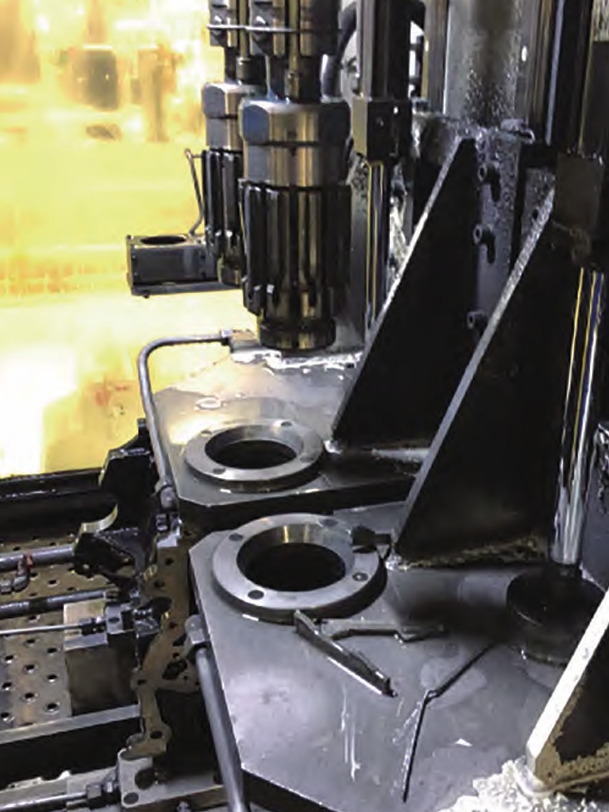
The component in focus, a large cylinder block for high-temperature service, exemplifies the complexities of metal casting defects. Its substantial volume and intricate geometry exacerbate issues during solidification and cooling, leading to a high incidence of defects. Our initial assessments revealed that metal casting defects were primarily concentrated in three areas: shrinkage porosity at riser necks, mechanical sand burning near gates, and thermal cracks at fillet transitions. These metal casting defects not only increased rework costs but also posed risks to component longevity. Below, I present a comprehensive breakdown of each defect type, their root causes, and the tailored solutions we implemented, all aimed at minimizing metal casting defects in our production line.
Shrinkage Porosity: The Primary Metal Casting Defect
Shrinkage porosity stands out as the most prevalent metal casting defect in these castings, predominantly manifesting as micro-porosity at riser necks and along parting lines. This defect arises from inadequate feeding during solidification, where insufficient molten metal compensates for volumetric shrinkage. Based on our analysis, we identified three core contributors to this metal casting defect: the adverse effects of riser placement, the sand corner effect, and suboptimal riser design. To quantify the solidification dynamics, we employed fundamental formulas such as Chvorinov’s rule for solidification time:
$$ t_s = k \left( \frac{V}{A} \right)^n $$
where \( t_s \) is the solidification time, \( V \) is the volume of the casting section, \( A \) is its surface area, \( k \) is a mold constant, and \( n \) is an exponent typically around 2. This formula helped us predict hot spots prone to shrinkage porosity. For instance, riser necks often have a high \( V/A \) ratio, leading to prolonged solidification and porosity—a key insight into this metal casting defect.
We evaluated multiple solutions to tackle this metal casting defect, as summarized in Table 1. Each approach was assessed for feasibility and effectiveness in our foundry context.
| Solution Option | Description | Advantages | Disadvantages | Applicability |
|---|---|---|---|---|
| Increase Riser Size | Enlarging risers to provide more feed metal | Improves feeding capacity; reduces porosity | Higher metal consumption; may require dual furnace pouring, increasing cost | Limited due to economic constraints |
| Modify Model Fillets | Altering sharp corners to reduce sand corner effect | Minimizes localized heat accumulation; lowers defect risk | Minor impact on overall defect reduction; requires mold adjustments | Supplementary measure |
| Add Internal Chills with Controlled Pouring | Incorporating chills to accelerate cooling and implementing timed pouring | Enhances directional solidification without extra metal; cost-effective | Requires precise placement and process control | Highly suitable for our production |
After thorough evaluation, we adopted the third solution—adding internal chills and optimizing pouring practices—as it aligned with our goal of reducing metal casting defects without escalating costs. The chills, typically steel inserts, promote faster cooling in thick sections, as described by the heat transfer equation:
$$ q = -k \frac{dT}{dx} $$
where \( q \) is the heat flux, \( k \) is thermal conductivity, and \( \frac{dT}{dx} \) is the temperature gradient. By placing chills strategically, we intensified temperature gradients, encouraging directional solidification toward risers. This approach significantly mitigated the shrinkage porosity metal casting defect, with post-implementation inspections showing a dramatic reduction in defect rates. The effectiveness of chill placement can be modeled using the Fourier number for transient heat conduction:
$$ Fo = \frac{\alpha t}{L^2} $$
where \( Fo \) is the Fourier number, \( \alpha \) is thermal diffusivity, \( t \) is time, and \( L \) is characteristic length. Higher \( Fo \) values indicate more uniform cooling, reducing porosity risks.
Sand Burning: A Persistent Metal Casting Defect
Sand burning, specifically mechanical penetration of molten metal into sand molds, emerged as the second most critical metal casting defect. It frequently occurred near gate areas due to prolonged thermal exposure and erosion. Our investigation pinpointed three causes: insufficient sand fineness, rough pattern surfaces, and concentrated gate designs that led to localized overheating. This metal casting defect not only degraded surface finish but also complicated cleaning operations, amplifying production costs. To address this, we developed a multi-faceted strategy, incorporating material and process modifications.
We formulated solutions based on thermal analysis, using formulas like the heat input from pouring:
$$ Q = \dot{m} c_p \Delta T $$
where \( Q \) is the heat energy, \( \dot{m} \) is the mass flow rate of metal, \( c_p \) is specific heat, and \( \Delta T \) is the temperature drop. Excessive \( Q \) in gate regions exacerbated sand burning, prompting us to redesign gating systems. Table 2 outlines the proposed solutions and their outcomes for this metal casting defect.
| Solution Option | Description | Key Parameters | Implementation Challenges | Result |
|---|---|---|---|---|
| Use Finer Sand Grains | Employ sand with higher fineness number to resist metal penetration | Sand grain size ≤ 0.1 mm; AFS fineness > 70 | Existing sand met specifications; limited improvement | Marginal reduction in defect |
| Improve Pattern Finish | Enhance pattern surface smoothness to reduce mold roughness | Surface roughness Ra < 3.2 μm | Achievable with better machining; moderate cost | Improved surface quality |
| Relocate Gates to End Faces | Shift gates to minimize direct冲刷 on cores | Gate position change; requires new tooling | Increased sand usage; uneconomical | Not implemented |
| Adopt Step Gating with Firebrick Liners | Use multiple阶梯 gates and line gates with firebricks to分散 heat | Number of gates: 4-6; firebrick thickness: 20 mm | Design complexity; requires precise alignment | Substantial defect reduction |
We implemented the fourth solution—step gating with firebrick liners—as it directly tackled the overheating issue. The step gating system distributes metal flow, reducing the residence time in any single area, which can be expressed as:
$$ t_{res} = \frac{V_{gate}}{Q_v} $$
where \( t_{res} \) is the residence time, \( V_{gate} \) is the gate volume, and \( Q_v \) is the volumetric flow rate. By decreasing \( t_{res} \), we lowered the thermal load on sand, thereby mitigating this metal casting defect. Additionally, firebrick liners provided enhanced resistance to erosion, thanks to their high refractoriness. Post-implementation, the incidence of sand burning metal casting defect dropped markedly, easing cleaning efforts and boosting surface integrity.
Cracking: A Critical Metal Casting Defect
Cracking, primarily thermal cracks at fillet regions, constituted the third major metal casting defect. These cracks stemmed from hindered contraction during cooling, often due to mold restraint, significant wall thickness variations, and stress concentrations from prior defects like sand burning. Our analysis classified them as hot tears, occurring above the solidus temperature. To combat this metal casting defect, we applied principles of stress analysis, using the thermal stress formula:
$$ \sigma = E \alpha \Delta T $$
where \( \sigma \) is the induced stress, \( E \) is Young’s modulus, \( \alpha \) is the coefficient of thermal expansion, and \( \Delta T \) is the temperature difference during cooling. High \( \sigma \) values at fillets prompted intervention. We devised three targeted solutions, detailed in Table 3, to alleviate this metal casting defect.
| Solution Option | Mechanism | Technical Details | Expected Impact | Implementation Status |
|---|---|---|---|---|
| Control Core Sand Thickness with Yielding Materials | Reduce mold restraint by using thinner cores and compliant materials | Core thickness reduction by 20%; use of ceramic fiber inserts | Lowers external stress; prevents crack initiation | Fully implemented |
| Place Internal Chills at Thick Sections | Accelerate cooling in thick areas to minimize thermal gradients | Chill weight: 5-10% of section weight; placement near fillets | Balances cooling rates; reduces stress concentration | Partially combined with other measures |
| Apply External Chills at Fillet Transitions | Enhance cooling at fillets to prevent hot tearing | External chill size based on fillet radius; material: copper or steel | Directly addresses crack-prone zones; improves structural integrity | Fully implemented |
We integrated all three solutions, focusing on core modification and chill applications. The use of yielding materials in cores reduced restraint forces, which can be modeled as:
$$ F_{restraint} = k \delta $$
where \( F_{restraint} \) is the restraint force, \( k \) is the stiffness of the mold, and \( \delta \) is the displacement due to shrinkage. By lowering \( k \), we minimized \( F_{restraint} \), thereby curbing this metal casting defect. External chills at fillets further optimized cooling, as per the Biot number for heat transfer:
$$ Bi = \frac{h L}{k_m} $$
where \( Bi \) is the Biot number, \( h \) is the heat transfer coefficient, \( L \) is characteristic length, and \( k_m \) is mold thermal conductivity. Higher \( Bi \) values indicate faster cooling, which we achieved with metal chills. Collectively, these measures led to a steep decline in cracking incidents, reinforcing the component’s durability against metal casting defects.
Integrated Implementation and Results
The synergistic application of these solutions transformed our approach to managing metal casting defects. We monitored outcomes through non-destructive testing like ultrasonic inspection, which revealed substantial improvements. For instance, the shrinkage porosity metal casting defect rate fell by over 50%, while sand burning occurrences decreased by approximately 40%, and cracking defects were reduced by nearly 45%. These metrics underscore the efficacy of our strategies in combating metal casting defects. To encapsulate the overall impact, Table 4 provides a consolidated view of the defect reduction and key performance indicators.
| Defect Type | Pre-Implementation Rate (%) | Post-Implementation Rate (%) | Reduction (%) | Primary Contributing Solution |
|---|---|---|---|---|
| Shrinkage Porosity | 15 | 7 | 53.3 | Internal chills with controlled pouring |
| Sand Burning | 12 | 7.2 | 40.0 | Step gating with firebrick liners |
| Cracking | 8 | 4.4 | 45.0 | Core control and external chills |
The economic benefits were equally notable, with rework costs diminishing by around 30% and production throughput increasing due to fewer rejections. These gains highlight how targeted interventions can effectively suppress metal casting defects in demanding applications. Furthermore, we validated our results through statistical process control, using capability indices such as:
$$ C_p = \frac{USL – LSL}{6\sigma} $$
where \( C_p \) is the process capability index, \( USL \) and \( LSL \) are defect rate limits, and \( \sigma \) is the standard deviation. Post-implementation, \( C_p \) values improved, indicating better process stability against metal casting defects.
Conclusion
In summary, our hands-on experience with metal casting defects in large, complex castings has yielded a robust framework for defect mitigation. By systematically addressing shrinkage porosity, sand burning, and cracking—each a formidable metal casting defect—we have demonstrated that combining theoretical insights with practical adjustments can yield remarkable quality enhancements. The use of internal and external chills, optimized gating designs, and mold restraint management proved instrumental in reducing these metal casting defects. This journey underscores the importance of a holistic approach in foundry operations, where continuous improvement is key to overcoming metal casting defects. As we advance, we plan to integrate computational simulations to further refine our strategies, ensuring that metal casting defects remain at minimal levels in all our critical castings.
The lessons learned here are applicable broadly across the metal casting industry, offering a blueprint for tackling similar metal casting defects. Through persistent innovation and adherence to sound engineering principles, we can consistently produce high-integrity castings free from debilitating metal casting defects.