
In my extensive experience in the foundry industry, I have observed that the metal casting defect known as incomplete casting, or misrun, is a prevalent issue, particularly in small and medium-sized enterprises where technical resources may be limited. This metal casting defect manifests as castings that are not fully formed, with rounded edges, missing details, or a smooth, glossy appearance in the unfilled areas, essentially where the molten metal fails to completely fill the mold cavity. Understanding and diagnosing the root causes of this metal casting defect is crucial for improving production quality and efficiency. In this article, I will delve into a detailed, first-person perspective analysis of the factors leading to incomplete casting, employing tables and formulas to encapsulate key concepts, and providing judgement methods to identify specific causes in production scenarios.
The phenomenon of incomplete casting is fundamentally a failure of fluidity—the ability of molten iron to flow and fill intricate mold passages before solidification. This metal casting defect is not merely an inconvenience; it leads to scrap parts, increased costs, and production delays. From my viewpoint, the causes are multifaceted, intertwining metallurgical, design, and process variables. I will systematically explore these aspects, emphasizing practical judgement strategies that can be implemented on the shop floor.
Characteristics of the Incomplete Casting Defect
As per standard casting terminology, incomplete casting is classified under残缺类缺陷 (incomplete casting defects). The defining特征 (characteristics) include: castings that are残缺 (incomplete) or have an incomplete轮廓 (contour), or虽可能完整但边角圆且光亮 (even if seemingly complete, possess rounded corners and a bright, smooth finish). In simpler terms, any casting where the molten iron did not reach all sections of the mold, resulting in unfilled areas, poorly defined details, or cold shuts (where two streams of metal meet but do not fuse properly), qualifies as this metal casting defect. The rounded, shiny appearance is often a telltale sign of premature solidification before the mold was fully filled.
Primary Causes Leading to Incomplete Casting
Based on my hands-on involvement, the reasons for this metal casting defect can be categorized into several interconnected domains. Each domain contributes to the overall fluidity challenge.
1. Fluidity of Molten Iron
The fluidity of molten iron is its inherent capacity to fill a mold. It is not a property measured in standard units but is influenced by several key factors. Poor fluidity is a direct precursor to the metal casting defect of incomplete casting.
a) Pouring Temperature: This is the most significant factor. Fluidity improves exponentially with increased pouring temperature. The relationship can be conceptually represented by an empirical function:
$$ F(T) = k \cdot e^{\alpha (T – T_{solidus})} $$
where \( F \) represents fluidity, \( T \) is the pouring temperature, \( T_{solidus} \) is the solidus temperature of the iron, and \( k \) and \( \alpha \) are material constants. Higher temperatures delay solidification, allowing the metal to flow further.
b) Chemical Composition: The chemical makeup, particularly the carbon equivalent (CE), profoundly affects fluidity. For gray cast irons with CE below approximately 4.6%, fluidity improves as CE increases. The carbon equivalent formula is fundamental:
$$ CE = C + \frac{1}{3}Si + \frac{1}{2}P $$
where \( C \), \( Si \), and \( P \) are the weight percentages of carbon, silicon, and phosphorus, respectively. At similar pouring temperatures, irons with similar CE values tend to have comparable fluidity. However, extremes can be detrimental. Very high CE can lead to graphite flotation, which may impede flow. High sulfur or manganese content can promote the formation of manganese sulfide inclusions, which also hinder fluidity. Furthermore, in alloyed irons like high-chromium or high-chromium cast irons, the formation of a surface oxide layer with high surface tension can significantly reduce fluidity, making them prone to this metal casting defect.
To summarize the compositional effects, I find the following table helpful:
| Element/Parameter | Effect on Fluidity | Notes Related to Incomplete Casting Defect |
|---|---|---|
| Carbon Equivalent (CE < 4.6%) | Positive correlation | Higher CE generally reduces the risk of this metal casting defect. |
| Excessive Carbon (Very high CE) | Can become negative due to graphite flotation | May cause a specific form of the metal casting defect in heavy sections. |
| Phosphorus | Strong positive effect (high fluidity promoter) | But high P can cause brittleness; a balance is needed. |
| Sulfur & Manganese (High S/Mn ratio) | Negative (MnS inclusion formation) | Inclusions block flow in thin sections, exacerbating the metal casting defect. |
| Chromium (Alloying element) | Negative (increases surface tension/oxides) | Special care in gating design is required to avoid this metal casting defect. |
2. Casting Design and Gating System
The geometry of the casting and the design of the system that delivers molten metal into the mold are critical. Large, thin-walled castings are inherently susceptible to the metal casting defect of incomplete casting because the metal loses heat rapidly. The gating system—comprising the pouring cup, sprue, runners, and gates—must be engineered to promote rapid, tranquil, and complete filling.
- Gating System Architecture: The choice between pressurized and unpressurized systems, the choke area, and the gating ratios (e.g., sprue:runner:gate areas) are vital. A poorly designed system can cause excessive turbulence, premature cooling, or insufficient metal delivery to remote sections.
- Ingate Placement and Number: Strategic placement is key. Techniques like top pouring, bottom gating, step gating, or using multiple, well-distributed ingates can ensure more uniform filling and reduce the incidence of this metal casting defect.
- Filling Time Calculation: An estimate for required filling time (\( t_f \)) for thin sections can be derived from empirical relations, such as:
$$ t_f \propto \frac{V_{casting}}{A_{choke} \cdot \sqrt{2gH}} $$
where \( V_{casting} \) is the casting volume, \( A_{choke} \) is the choke area in the gating system, \( g \) is gravity, and \( H \) is the effective metallostatic head. If the actual pouring time exceeds this, incomplete casting is likely.
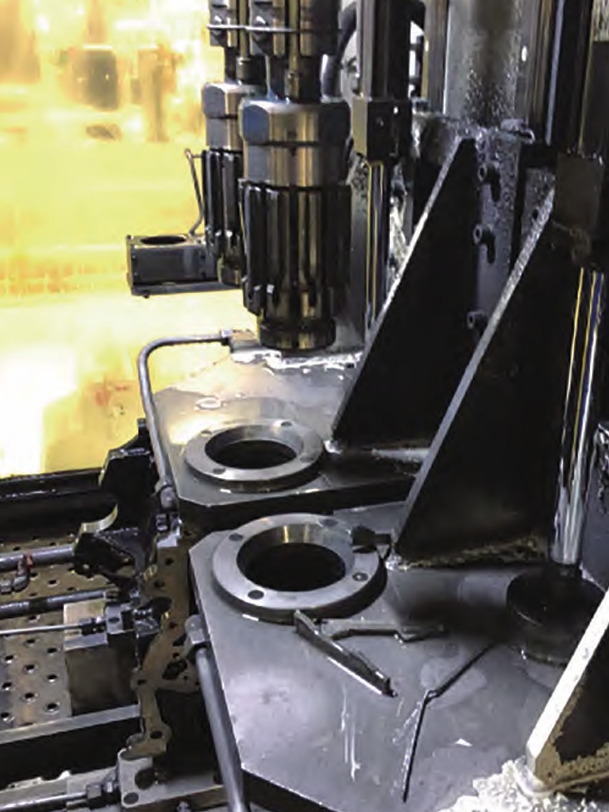
For instance, consider a complex casting like an engine cylinder block (as shown in the image above). Its intricate water jackets and thin walls demand a meticulously designed gating system with multiple ingates to ensure all cavities are filled, lest the metal casting defect of incomplete casting occurs in the core passages.
3. Molding Sand and Molding Process
The mold itself plays a passive but significant role in facilitating or hindering metal flow. Several factors related to sand and molding can lead to the metal casting defect of incomplete casting.
a) Sand Properties and Mold Atmosphere: If the molding sand contains high levels of volatile materials (e.g., moisture, organics), the heat from the molten metal causes rapid gas generation. If the mold permeability is low, back pressure builds up in the cavity, resisting the flow of metal and potentially causing an incomplete casting defect. Permeability (\( P \)) is a key sand property:
$$ P = \frac{V \cdot L}{A \cdot t \cdot \Delta p} $$
where \( V \) is the volume of air passing through a sand specimen of length \( L \) and area \( A \) in time \( t \) under a pressure difference \( \Delta p \). Low \( P \) values correlate with higher risk of gas-related defects, including misruns.
b) Mold Cleanliness and Inclusions: Loose sand grains dislodged from mold walls, or slag/dross carried by the metal, can physically block narrow passages. Additionally, as mentioned, the precipitation of MnS or floating graphite within the flowing stream can accumulate and obstruct flow, particularly in thin sections, directly creating a metal casting defect.
c) Dimensional Accuracy and Process Method: The casting process (e.g., green sand, resin shell, investment) affects dimensional tolerances. For thin-walled castings, even slight deviations from the pattern dimensions can effectively reduce the cross-sectional area for metal flow, increasing the chance of incomplete casting. A summary of mold-related factors is presented below:
| Molding Factor | Mechanism Impacting Fluidity | Contribution to Metal Casting Defect |
|---|---|---|
| High Volatile Content in Sand | Generates gas, creates back pressure | Resists metal flow, can cause misruns and gas holes. |
| Low Permeability | Prevents gas escape, increases cavity pressure | Directly leads to incomplete filling, a classic metal casting defect. |
| Poor Mold/Core Venting | Trapped air cannot escape | Creates air pockets that block metal advancement. |
| Loose Sand or Erosion | Physical obstruction in the cavity | Blocks flow paths, causing localized incomplete casting. |
| Inclusions (Slag, MnS) | Act as barriers within the flowing metal | Particularly detrimental in thin sections, leading to this metal casting defect. |
4. Pouring Practice
Finally, the human or automated operation of pouring is the last line of defense against this metal casting defect. Even with optimal metal and mold conditions, poor pouring can induce incomplete casting.
- Pouring Rate: A fast, steady pour is essential. A slow, interrupted pour allows the metal in the sprue and runners to cool too much, losing the thermal momentum needed to fill thin sections.
- Pouring Technique: Maintaining a full pouring basin (to maintain head pressure) and avoiding turbulence that entraps air are critical skills. “Pouring to a swirl” or using a stopper rod in ladles can help control the stream.
- Ladle Temperature Management: Temperature drop between furnace and mold must be minimized. Pre-heating ladles and ensuring quick transfer are crucial to maintain the superheat necessary to avoid this metal casting defect.
The interrelationship between these causes can be conceptualized using a fault tree or a proportional contribution model. For a given foundry, the dominant cause of the metal casting defect may shift depending on the product mix and daily conditions.
Judgement of Defect Causes in Production
Diagnosing the specific reason for the occurrence of the incomplete casting metal casting defect is a deductive process based on production patterns. From my experience, I have distilled the following judgement guidelines.
Scenario 1: Sporadic, Low-Probability Occurrence in Otherwise Stable Production
When production is running smoothly and the metal casting defect appears only occasionally on random castings, it is often attributable to “gross errors” or operational lapses. The root cause is likely not systemic but related to specific actions during a pour or mold preparation. Key suspects include:
– Careless pouring leading to interrupted flow or excessive slag entrainment.
– Inadequate slag skimming or filtering before the metal enters the mold.
– Negligence during mold assembly (closing), such as leaving loose sand in the cavity or damaging a core, creating an unintended obstruction.
In this scenario, the solution lies in reinforcing standard operating procedures and operator training, rather than changing metallurgy or design.
Scenario 2: Defect Concentrated on Specific Casting Designs
If production is normal for most castings, but the metal casting defect of incomplete casting consistently appears on one particular casting type or a family of similar designs, the problem almost certainly resides in the gating system design or the inherent geometry of that casting. The judgement is straightforward: the design is inadequate for ensuring complete fill under the prevailing process conditions. Remedies involve:
– Redesigning the gating system: optimizing ratios, adding more ingates, changing ingate locations, or implementing chills to control solidification direction.
– Re-evaluating the casting itself for possibilities of adding slight drafts or thickening critically thin sections, if functionally allowable.
This is a design-centric metal casting defect.
Scenario 3: Recurring, Unstable Defect Appearance Across Multiple Castings
When the metal casting defect appears repeatedly and unpredictably across various castings, and production consistency is poor, the cause is typically instability in the molten iron quality or key process parameters. The core issues often involve:
– Fluctuations in pouring temperature due to inconsistent furnace operation, measurement errors, or long transfer times.
– Variations in chemical composition, especially carbon and silicon content, leading to inconsistent carbon equivalent and hence fluidity. This can arise from charge material variability, inefficient melting practice, or poor inoculation control.
Judgement here requires statistical process control (SPC) on melting data. Plotting pouring temperature and CE values against defect occurrence rates will usually reveal correlations. Implementing tighter controls on charge makeup, melting, and holding practices is essential to mitigate this metal casting defect.
Scenario 4: Response to Intentional Process Changes
A very telling diagnostic approach is to make controlled changes and observe the effect on the metal casting defect.
– Changing Composition: If intentionally increasing the carbon equivalent (e.g., by adding more inoculant or adjusting charge) reduces the frequency of incomplete casting, it confirms that baseline fluidity was a limiting factor. However, this may alter the mechanical properties (grade) of the iron, which must be accounted for.
– Modifying Gating: If redesigning the gating system as per Scenario 2 successfully eliminates the defect, it validates the initial design flaw hypothesis.
– Temperature vs. Composition Trade-off: A useful rule of thumb I’ve observed is that, under constant other conditions, raising the pouring temperature by approximately 15°C to 20°C has a comparable effect on improving fluidity and reducing the metal casting defect as increasing the carbon equivalent by about 0.1%. This can be expressed heuristically as:
$$ \Delta T_{pour} \approx (300 \text{ to } 400) \cdot \Delta CE $$
where the units are °C for temperature and absolute change in CE. This equivalence helps in making practical decisions when material specifications constrain compositional changes.
To aid in systematic diagnosis, I propose the following decision matrix. When confronted with the metal casting defect of incomplete casting, one can trace through this logic based on observed production symptoms.
| Observed Production Pattern | Most Likely Primary Cause Domain | Key Investigation Actions | Typical Corrective Measures |
|---|---|---|---|
| Random, isolated defects on mixed castings | Pouring Practice / Mold Preparation | Review pouring logs, inspect for slag, check mold closure procedures. | Retrain operators, implement checklists, improve ladle pre-heat. |
| Defect consistently on one specific casting design | Casting & Gating Design | Analyze filling simulation (if available), review gating ratios, inspect wall thickness. | Redesign gating system, consider modest design modifications to part. |
| Recurring defects across many castings, unstable process | Molten Iron Quality (Temperature, Composition) | Implement SPC for pouring temperature and spectral analysis for chemistry. Check furnace controls. | Standardize charge materials, calibrate pyrometers, optimize inoculation practice. |
| Defect occurs after a material or process change | Specific Changed Parameter (e.g., new sand, different alloy) | Correlate defect onset with the change. Test fluidity using spiral molds. | Re-evaluate the change, adjust parameters (e.g., increase pouring temp for new alloy). |
Advanced Considerations and Preventative Strategies
Beyond basic judgement, a deeper understanding can help prevent this metal casting defect proactively. Fluidity is not just about chemistry and temperature; it involves the complex interplay of heat transfer, fluid dynamics, and solidification kinetics. The governing equations for fluid flow in a mold, while complex, can be simplified for estimation purposes. The distance a metal will flow in a channel before stopping due to solidification (\( L_f \)) can be approximated by:
$$ L_f \approx \frac{v \cdot \Delta T_{superheat}}{\beta} $$
where \( v \) is the flow velocity, \( \Delta T_{superheat} \) is the temperature above the liquidus, and \( \beta \) is a constant encompassing the thermal properties of the metal and mold. This illustrates why both high pouring temperature (high \( \Delta T_{superheat} \)) and fast pouring (high \( v \)) are beneficial in combating the metal casting defect of incomplete casting.
Furthermore, the role of surface tension (\( \gamma \)) and wetting angle (\( \theta \)) becomes critical in very thin sections or with certain alloys. The pressure required to force metal into a narrow capillary of diameter \( d \) is given by:
$$ P_{entry} = \frac{4 \gamma \cos \theta}{d} $$
For alloys with high \( \gamma \) or poor wettability (high \( \theta \)), this entry pressure can be significant, requiring greater metallostatic head from the gating system to overcome. This is particularly relevant for high-chromium irons mentioned earlier, making them more susceptible to this metal casting defect without proper design compensation.
Preventative strategies, therefore, should be holistic:
1. Metallurgical Control: Maintain tight control over melting and pouring temperatures. Aim for the highest practicable pouring temperature within the constraints of shrinkage and metal-gas reactions. Optimize carbon equivalent for the required mechanical properties while ensuring adequate fluidity to prevent the metal casting defect.
2. Design for Manufacturability: Work with designers to avoid excessively thin sections or abrupt changes in thickness. Implement computational fluid dynamics (CFD) simulations during the design phase to predict and optimize filling patterns, identifying potential misrun areas before tooling is made.
3. Process Standardization: Develop and adhere to strict protocols for sand preparation, mold and core making, mold assembly, and pouring. Regularly test sand properties like permeability and moisture content.
4. Continuous Monitoring: Use data logging for key parameters: furnace temperatures, ladle temperatures, pour times, and chemical analysis. Trend this data against defect rates to establish predictive correlations and enable proactive adjustments.
Conclusion
In my professional journey, addressing the metal casting defect of incomplete casting has been a recurring challenge that underscores the importance of a systematic, scientific approach to foundry practice. This defect is a clear indicator of a mismatch between the fluidity capabilities of the molten iron and the demands imposed by the casting design, mold system, and pouring process. By understanding the detailed causes—from the fundamental effects of carbon equivalent and pouring temperature on fluidity, to the nuances of gating design and mold sand properties—and by applying logical judgement based on production patterns, foundries, especially smaller ones, can effectively diagnose and eliminate this costly metal casting defect. The integration of empirical rules-of-thumb, such as the temperature-CE equivalence, with methodical observation and control, forms the bedrock of robust casting production. Ultimately, preventing the incomplete casting metal casting defect is about mastering the delicate balance of heat, chemistry, and flow to ensure that every cavity of the mold is faithfully reproduced in metal.