
In the realm of manufacturing, metal casting defects remain a persistent and costly challenge, significantly impacting product quality, production yield, and overall economic efficiency. The complexity of casting processes, involving intertwined variables from melting and molding to pouring and solidification, makes precise mathematical modeling of these defects exceedingly difficult. Throughout my research and development efforts, I have focused on encapsulating the nuanced, experience-based knowledge of seasoned foundry experts into a robust computational framework. This work culminated in the creation of an expert system dedicated specifically to the analysis of metal casting defects and the recommendation of scientifically-grounded process countermeasures. The core objective is to democratize high-level foundry expertise, making it accessible for widespread use to diagnose problems, identify root causes, and implement effective solutions, thereby elevating the standard of casting production.
The development of casting expert systems began in earnest in the 1980s, primarily targeting defect diagnosis. While diagnostic capabilities have advanced, a significant gap often exists in translating a diagnosis into a practical, effective, and feasible process solution. Therefore, the expert system I developed places strong emphasis on actionable process countermeasures. It is designed not only to identify a metal casting defect but to bridge the critical gap between diagnosis and resolution by providing tailored advice on melting practice, molding materials, and, most importantly, casting process design utilizing principles like balanced solidification theory.
The architecture of the expert system is built upon five fundamental modules that interact seamlessly to emulate expert reasoning. The relationship between these modules is foundational to its operation.
Knowledge Base: This is the repository of expertise. Knowledge is primarily sourced from decades of practical foundry experience and authoritative technical literature. To faithfully represent this heuristic knowledge, the system employs a production rule representation. Each unit of knowledge is structured as a simple conditional statement: IF [premise] THEN [conclusion]. This format is intuitive and effectively captures the cause-and-effect relationships prevalent in defect analysis.
Inference Engine: As the system’s “brain,” the inference engine controls the reasoning process. My implementation uses a backward-chaining strategy. The system starts with a hypothesized goal (e.g., the identity of a defect) and works backward, querying the user for observable features (the “premises”) to see if they support the hypothesis. It continuously matches user inputs against the IF-THEN rules in the knowledge base. This method is highly efficient for navigating through a rule-based system to confirm or reject potential conclusions regarding the nature of a metal casting defect.
Database: This module serves as the working memory during a consultation session. It temporarily stores the facts provided by the user (e.g., “defect is subsurface,” “color is white,” “shape is spherical”) and intermediate conclusions drawn by the inference engine, facilitating the logical chain of reasoning.
User Interface & Explanation Facility: A user-friendly interface is crucial for practical adoption. The system interacts with foundry personnel through clear, targeted questions. Furthermore, the explanation facility can justify its line of questioning or its final recommendations, enhancing user trust and providing an educational context. For instance, when recommending a change in gating design, it can reference the relevant rule from its knowledge base.
The functional capabilities of the expert system are organized into several key modules accessible through a central menu. Each module addresses a specific phase of the problem-solving workflow.
| System Module | Primary Function |
|---|---|
| Defect Analysis Consultation | Identifies the type of metal casting defect based on user-input characteristics (location, appearance, microstructure, etc.). |
| Defect Cause & Remedy Consultation | Provides a detailed analysis of potential causes (melting, molding, process) and suggests corrective actions for a known defect. |
| Process Strategy Consultation | Offers specific casting process designs and modifications, often based on balanced solidification theory, to address defects rooted in methodology. |
| Knowledge Base Expansion (Defect Analysis) | Allows authorized users to add new defect-characteristic rules, enabling system evolution and customization. |
| Knowledge Base Expansion (Causes & Remedies) | Permits the addition of new cause-and-remedy knowledge for existing or new defects. |
| Knowledge Base Expansion (Process Strategy) | Enables the incorporation of new, validated process designs and diagrams into the system’s recommendation library. |
The process of defect analysis follows a structured path. When a user encounters a metal casting defect, they initiate a consultation. The system, via the inference engine, begins asking a series of targeted questions. For example, to distinguish between common defects like gas porosity and shrinkage porosity, it might ask:
- “Is the defect located internally, at the surface, or just below the surface?”
- “What is the shape of the cavities: rounded, elongated, or irregular?”
- “What is the internal surface of the cavity like: smooth and bright, or rough and crystalline?”
- “Is the defect isolated or clustered?”
Based on the answers, the system matches the pattern against its knowledge base. A successful match for gas porosity might involve rules like:
$$ \text{IF } (Location = Internal/Surface) \text{ AND } (Surface = Smooth/Bright) \text{ AND } (Shape = Rounded/Elongated) \text{ THEN } Defect = Gas Porosity $$
Once the defect is identified, the user can proceed to the cause and remedy module.
This module provides a multi-faceted analysis. Causes are typically categorized, and corresponding measures are listed. For a defect like gas porosity, the system might structure the output as follows:
| Root Cause Category | Specific Causes | Recommended Preventive Measures |
|---|---|---|
| Melting-Related | Damp/rusty charge materials; Low pouring temperature. | Use dry, clean charge; Maintain pouring temp > 1420°C; Use flux cover (e.g., cryolite). |
| Molding-Related | High sand moisture; Low mold permeability. | Control moisture (3-5%); Increase permeability > 100; Add coal dust (4-6%). |
| Process-Related | Unbalanced gating causing turbulence; Improper venting. | Adopt top-priority gating systems; Use adequate vents/risers; Avoid hot spot contact with risers. |
When process design is implicated as a primary cause, the Process Strategy Consultation module becomes vital. Here, the system leverages balanced solidification theory, which optimizes feeding and pressure balance during solidification to minimize defects. The system can recommend specific gating and risering layouts. For instance, it can contrast an error-prone design with a corrected one, explaining the principles behind the change. The knowledge base stores numerous graphical and textual examples of both faulty and sound practices. A general principle for minimizing gas entrainment can be related to gating design parameters, where the goal is to minimize turbulent energy:
$$ E_{turb} \propto \frac{\rho \cdot v^2}{2} $$
where $\rho$ is the metal density and $v$ is the flow velocity at the ingate. The system would recommend designs that reduce $v$ (e.g., by increasing ingate area) to lower $E_{turb}$ and thus the risk of a metal casting defect like gas porosity.
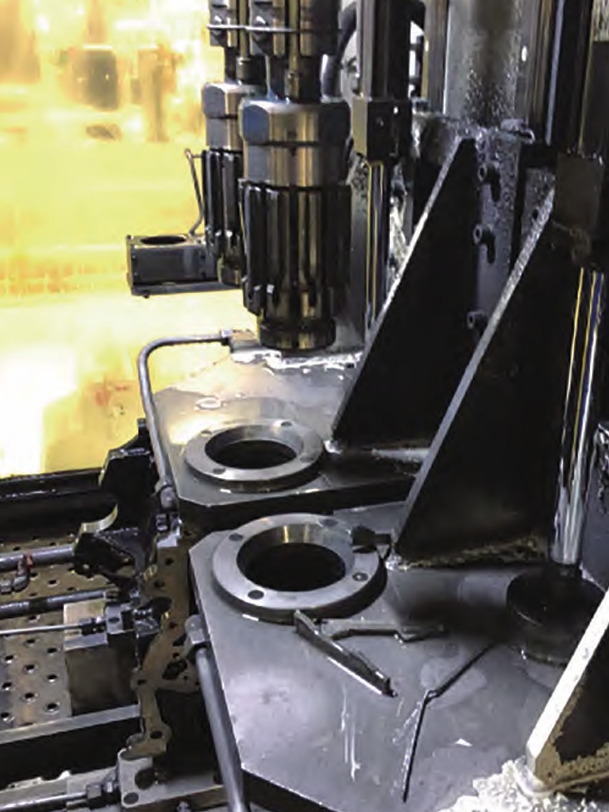
A practical case study illustrates the system’s application. A foundry producing diesel engine cylinder heads (a component analogous to the engine block shown) consistently faced a scrap rate exceeding 10% due to a specific metal casting defect. The defect manifested as small, shiny, white cavities at the junction between the riser and the casting. Consultation with the expert system proceeded as follows:
- Defect Analysis: The user answered queries about the defect’s features (subsurface, smooth/white, clustered near hot spots). The system concluded the defect was gas porosity.
- Cause & Remedy Analysis: The system outlined causes in melting, molding, and process. Initial fixes focusing on charge materials and sand control provided limited improvement, pointing to a fundamental process flaw.
- Process Strategy Consultation: When “Process-Related Causes” was selected, the system displayed a graphical comparison. The original gating/risering design was shown to cause severe turbulence and placed a riser directly on a thermal hot spot, creating ideal conditions for gas entrapment and precipitation. The system then recommended a new design based on balanced solidification principles. Key changes included:
- Replacing a bottom gating system with a top-priority, side-overflow system to ensure smoother, more laminar filling.
- Relocating and resizing the riser to avoid direct contact with the main hot spot, instead using a smaller vent/atmosphere riser.
Implementing this new design drastically reduced the incidence of the metal casting defect, lowering the scrap rate from over 10% to below 3%. This successful new process design was then added to the system’s knowledge base via the expansion module, ensuring its availability for future, similar cases.
A critical feature of any enduring expert system is maintainability. Foundry technology and specific plant practices evolve. The “Knowledge Base Expansion” modules are designed for this purpose. Authorized engineers can add new defect patterns, new cause-and-effect relationships from their experience, and—most powerfully—new validated process diagrams. For example, after the successful cylinder head redesign, the user could enter the process module’s expansion library. The system checks if a similar geometry exists in its database. If not, the new diagram is stored directly. If a similar one exists, the user is prompted: “Overwrite the existing process?” This allows the knowledge base to be continuously refined and updated, keeping the expert system current and increasingly valuable. This incremental development model is essential for the system’s long-term relevance in addressing ever-changing metal casting defect challenges.
In conclusion, the development and implementation of this expert system underscore a powerful approach to quality control in casting. By systematically encoding expert knowledge into an interactive, rule-based framework, the system provides a structured methodology for tackling the complex problem of metal casting defects. Its strength lies not just in accurate diagnosis but in its strong emphasis on actionable, theory-backed process countermeasures, particularly those derived from balanced solidification theory. The ability to learn and incorporate new solutions ensures its adaptability. Ultimately, such a system serves as both a powerful problem-solving tool for daily production and a dynamic repository of collective foundry wisdom, capable of significantly improving yield, quality, and consistency across the industry.