
In the context of rapid socio-economic development and intensified exploitation of marine and lacustrine resources, the dredging market has become increasingly active. The large dredge pump impeller, a critical component in this field, frequently exhibits various casting defects during its manufacturing process. These defects directly compromise the impeller’s performance, service life, and overall quality. Therefore, it is imperative to analyze the specific causes behind these imperfections and implement targeted countermeasures to ensure the铸造 quality of these large, structurally complex components. This article, based on our extensive experience as a specialized manufacturer, provides a detailed, first-person perspective analysis of common casting defects and the systematic strategies developed to overcome them. Through the rigorous application of these improved processes, the qualification rate for large dredge pump impeller castings in our foundry has been elevated to over 90%.
The manufacturing of large dredge pump impellers presents significant challenges due to their intricate geometry, involving complex internal flow channels, varying wall thicknesses, and numerous intersecting surfaces. This complexity creates numerous thermal and mechanical stress concentration points, which are primary origins for various casting defects. A proactive, defect-prevention-oriented approach is far more effective than post-casting remediation. The following sections dissect the most prevalent defects encountered, their root causes, and the corresponding mitigation strategies we have implemented.
1. Shrinkage Porosity and Cavities at Critical Junctions
One of the most critical casting defects involves shrinkage porosity and macro-shrinkage cavities, predominantly occurring at two locations: the riser neck of the shaft head and the riser neck connecting to the cover plate.
1.1 Shrinkage at the Shaft Head Riser
The shaft head, often with a wall thickness exceeding 200 mm, constitutes a massive thermal node. The solidification of such a section demands a substantial volume of liquid metal for effective feeding. The fundamental cause of this casting defect was the inadequate design of conventional risers, which failed to provide sufficient feed metal volume and efficiency. The riser’s dimensions (height and diameter) were often insufficient relative to the thermal modulus of the casting section it was intended to feed.
The thermal modulus (M) is a key parameter in riser design, calculated as the volume (V) of the section divided by its cooling surface area (A):
$$ M = \frac{V}{A} $$
For effective feeding, the riser’s modulus must be greater than the modulus of the casting section it feeds. Our analysis showed that conventional risers did not meet this criterion for the massive shaft head.
Corrective Action: We replaced conventional risers with exothermic (heating) risers at the shaft head. These risers contain compounds that undergo an exothermic reaction, significantly slowing the solidification of the riser metal and dramatically improving its feeding efficiency ($E_f$). The feeding efficiency can be conceptualized as:
$$ E_f = \frac{V_{f,e}}{V_r} \times 100\% $$
where $V_{f,e}$ is the volume of metal effectively fed to the casting and $V_r$ is the total riser volume. Exothermic risers can achieve an $E_f$ of 25-30%, compared to 12-15% for conventional risers. Furthermore, we standardized minimum riser heights (e.g., ≥500 mm for 700WN series, ≥600 mm for 800WN series). A post-pouring replenishment practice was instituted: 5-10 minutes after the initial pour, the riser is topped up with additional liquid metal, followed by the application of exothermic covering compound to further retard heat loss.
1.2 Shrinkage at the Cover Plate Riser Neck
Shrinkage in this area was primarily attributed to localized overheating of the sand mold at the riser neck junction. This overheating could lead to “boiling” or gas evolution from the sand, resulting in a combined gas-shrinkage casting defect. The conventional sand riser seat had limited refractoriness.
Corrective Action: We eliminated the molded sand riser seat and adopted pre-formed ceramic riser sleeves. These sleeves offer superior refractoriness, preventing sand breakdown and gas generation at the critical neck area. This is used in conjunction with exothermic risers to ensure an uninterrupted feed path with high thermal efficiency.
| Defect Location | Primary Cause | Corrective Measures | Key Parameter/Standard |
|---|---|---|---|
| Shaft Head Riser | Inadequate riser volume & efficiency for large thermal mass. | Use of exothermic risers; Standardized riser height; Post-pour replenishment. | Riser Height ≥500mm (700WN), ≥600mm (800WN); Feeding Efficiency $E_f$ >25%. |
| Cover Plate Riser Neck | Sand overheating and low refractoriness at the neck. | Replacement of sand seat with ceramic riser sleeve; Use of exothermic risers. | Ceramic sleeve refractoriness >1650°C. |
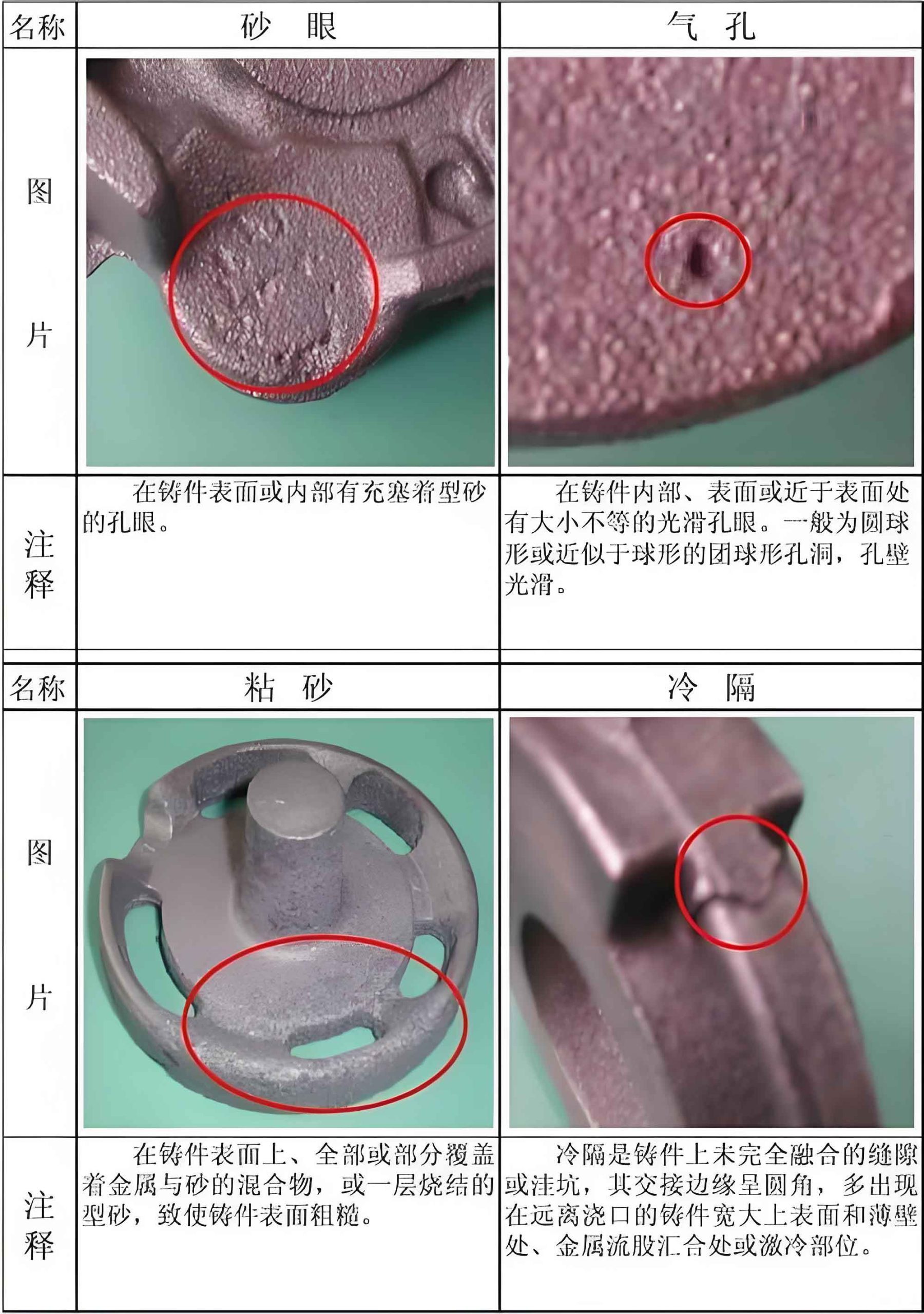
2. Adhesion, Gas Holes, and Micro-shrinkage at Blade-Root Fillets
A cluster of interrelated casting defects—including sand burning/penetration, gas holes, and micro-shrinkage—frequently occurred at the fillet radii where the blades, side walls, and front/rear cover plates intersect. This is a classic trouble zone in impeller casting.
Root Causes:
- Sharp Corners or Insufficient Radii: Original design or molding practices often resulted in acute angles or very small fillets. These act as stress raisers during solidification and create areas of high heat concentration in the sand mold, promoting metal penetration into the sand grains (chemical adhesion).
- High Gas Evolution: Excessive resin binder addition in the core sand to achieve strength led to high gas generation during pouring, which could become trapped at these hot spots, forming gas holes or porosity.
- Low Chill Rate: The standard silica sand in these areas did not extract heat quickly enough, extending the time the metal remained liquid and vulnerable to gas absorption and penetration.
Corrective Actions (A Multi-Pronged Approach):
- Design & Molding Modification: We collaborated with design to increase the specified fillet radius at these intersections. In the pattern shop, strict control is maintained to ensure these radii are correctly produced and free of sharp edges. A radius gauge template is used for inspection.
- Material Change: We substituted the standard sand in these specific mold areas with chromite sand. Chromite sand has a higher thermal conductivity (chill factor) and greater refractoriness, which rapidly draws heat away from the metal and resists penetration. The heat diffusivity, a factor in chilling power, is higher for chromite.
$$ \alpha = \frac{k}{\rho c_p} $$
where $\alpha$ is thermal diffusivity, $k$ is thermal conductivity, $\rho$ is density, and $c_p$ is specific heat capacity. Chromite’s $\alpha$ is significantly higher than silica sand’s. - Process Gas Control: Resin addition for cores is strictly limited to a maximum of 2.0% (by weight) for impellers below the 700WN class, effectively reducing potential gas volume. The core assembly is actively dried before pouring using a hot-air blower system inserted through the riser. The air outlet temperature is maintained between 120-150°C for 4-6 hours, removing residual moisture and low-temperature volatiles.
- Coating Enhancement: The application of a high-quality zircon-based refractory coating to these fillet areas is reinforced and meticulously inspected. The coating must meet strict criteria for viscosity, refractoriness, and gas permeability.
| Objective | Action | Technical Rationale |
|---|---|---|
| Reduce Thermal Stress Concentration | Increase fillet radius; Use radius gauge. | Lowers stress concentration factor; Reduces localized sand overheating. |
| Increase Cooling Rate & Refractoriness | Use chromite sand in critical areas. | Higher thermal diffusivity ($\alpha$) extracts heat faster; higher fusion point prevents sand melting. |
| Minimize Gas Generation | Limit resin binder to ≤2.0%; Implement mold drying. | Reduces gas volume $V_{gas}$ from decomposition: $V_{gas} \propto \%_{resin}$. |
| Create Barrier Layer | Apply enhanced refractory coating. | Prevents metal-sand interaction; improves surface finish. |
3. Sand Inclusions and Slag Holes on Machined Surfaces
After machining, sand inclusions and slag holes appearing on the cover plate or shaft face are a severe casting defect leading to scrap. These originate from mold/core integrity issues during pouring.
Root Causes:
- Loose Sand: Inadequate compaction of the mold surface or residual loose sand from core assembly (fettling) can be eroded by the turbulent metal stream and entrapped.
- Sand from the Gating System: Conventional sand-cut gating passages can erode, introducing sand grains into the melt.
- Slag Entrapment: Inadequate slag trapping mechanisms allow oxides and dross to enter the mold cavity.
Corrective Actions:
- Mold Integrity: Strict control of mold compaction hardness is enforced. Multiple “sand collection pockets” are incorporated at the lowest points of the bottom mold cavity. These pockets capture any loose sand that falls during core assembly, preventing it from being washed into the casting.
- Advanced Gating: We transitioned to pre-formed ceramic filters and gating tubes (sprues, runners). These ceramic components provide a smooth, non-erodible passage for the metal, physically filtering out slag and eliminating the risk of sand erosion from the gating system itself.
- Slag Control: A slag trap (skim bob) is designed at the end of the runner, just before the metal enters the gate. This utilizes Bernoulli’s principle to trap lighter slag particles.
$$ P + \frac{1}{2}\rho v^2 + \rho gh = \text{constant} $$
The change in velocity and direction in the trap causes a pressure change that encourages slag separation.
4. Cold Shut and Misrun at the Discharge and Periphery
Cold shuts, appearing as seams on the casting surface, particularly at the thin discharge opening and outer periphery of the front cover plate, are a casting defect resulting from premature solidification of metal streams before they fuse.
Root Causes: Prolonged pouring time, low pouring temperature, and insufficient metallostatic pressure head leading to intermittent flow (splashing) during the initial stage of mold filling.
Corrective Actions:
- Process Discipline: The pouring time ($t_p$) for each impeller size is precisely calculated and documented on the process card. An assigned technician supervises the entire pour to ensure compliance. Pouring temperature is tightly controlled within a ±15°C window of the optimum value.
- Pressure Head Control: The minimum height of the pouring basin (metallostatic head, $h$) is maintained at >200 mm to ensure sufficient pressure to drive the metal into thin sections. The velocity at the gate ($v_g$) is related to the head: $v_g \approx \sqrt{2gh}$, where $g$ is gravity.
- Pouring Basin Design: A specially designed basin with a well is used to maintain a constant head and ensure a smooth, uninterrupted flow of metal from the ladle, eliminating initial splashing and oxidation.
5. Analysis of Other Prevalent Casting Defects
5.1 Non-Uniform Flow Channel Width
This dimensional casting defect stems from inaccuracies in the core-making process. While using glass-reinforced plastic (GRP) core boxes, operational inconsistencies or long-term dimensional instability of the pattern can lead to core size variation.
Corrective Action: A two-tier inspection system was implemented. First, the pattern technician must verify key dimensions of the core box before any production run commences. Second, during mold assembly, the quality inspector measures and records the critical dimensions of each individual sand core before it is placed in the mold. Only cores within tolerance are used, ensuring the final flow channel geometry is consistent.
5.2 Cracking at the Cover Plate Periphery
Hot tears or cracks in this region are a critical casting defect often related to metallurgy and stress conditions during cooling.
Root Causes: Excessive levels of sulfur (S) and phosphorus (P) in the iron, which promote the formation of low-melting-point, brittle phases at grain boundaries. Additionally, premature shakeout (removal from the mold) while the casting is in a brittle temperature range introduces high thermal stress.
Corrective Actions:
- Metallurgical Control: Strict chemical composition limits are enforced: $[S] \leq 0.12\%$, $[P] \leq 0.07\%$. Heat analysis is performed before tapping, and metal is not poured if out of specification.
- Controlled Cooling: A standardized “holding in mold” procedure is mandatory. For impellers above the 700WN class, the minimum holding time is 8 days. The process is staged: weights are applied 5 hours after pouring; surrounding sand is loosened after 24 hours; the cope is partially lifted after 48 hours; final shakeout occurs only when the casting temperature is confirmed to be below 300°C. This slow, controlled cooling minimizes thermal gradients and stresses.
5.3 Excessive Unbalance in Static Balancing
This is not a casting defect in the conventional sense but a consequence of dimensional inaccuracies that manifest during machining and balancing. It is caused by non-uniform wall thickness in the cover plates and blades, and misalignment with the machining datum.
Corrective Actions: This requires cross-departmental coordination. First, pattern dimensions are controlled with higher precision. During core assembly, technicians actively measure and adjust the core positioning to ensure uniform wall thickness around the impeller. Crucially, before production begins, the foundry and machining department align on the exact location and specification of the machining datums and the designated areas for material removal (balance correction). This ensures the as-cast part is optimized for the subsequent balancing operation.
| Defect Type | Primary Cause | Corrective Action | Control Parameter/Standard |
|---|---|---|---|
| Dimensional Variation (Flow Channel) | Core box/pattern inaccuracy; inconsistent core making. | Two-stage inspection: pattern check & per-core measurement. | Core dimensions within ±1.5mm of drawing. |
| Hot Tears / Cracks | High S, P content; premature shakeout. | Stringent chemistry control; staged, prolonged cooling in mold. | $[S]≤0.12\%$, $[P]≤0.07\%$; Shakeout Temp. <300°C. |
| Static Balance Offset | Non-uniform wall thickness; datum misalignment. | Improved pattern control; core positioning adjustment; pre-production alignment with machining. | Wall thickness variation <±3mm; Clear datum definition. |
6. Conclusion
The pursuit of high quality is fundamental to sustainable enterprise development. For large dredge pump impellers, achieving consistent quality requires a meticulous, scientific approach to diagnosing and preventing casting defects. The strategies outlined herein—ranging from advanced riser technology (exothermic/insulating) and material science (chromite sand, ceramic filters) to rigorous process discipline (controlled pouring, cooling, and inspection protocols)—form a comprehensive defect mitigation system. The implementation of this system has proven highly effective, transforming a challenging production process into a reliable one with a consistently high yield. This success has not only enhanced product reliability for end-users but has also significantly strengthened our competitive position in the market, demonstrating that targeted technical solutions to casting defects are a direct driver of business growth and industrial leadership.