
In the manufacturing of high-grade ductile iron crankshafts, particularly those meeting QT800-2 specifications, the occurrence of slag inclusion defects on machined surfaces has been a persistent challenge. As an engineer involved in production process management and quality control, I have extensively studied this issue to identify root causes and implement effective solutions. Slag inclusions, which manifest as point-like or crack-like imperfections on critical areas such as oil hole edges and fillet radii, can lead to part rejection due to compromised fatigue strength and durability. This article delves into a comprehensive analysis of slag inclusion formation, leveraging data from our production line, and presents targeted measures that significantly reduced defect rates. Through this first-person account, I aim to share insights on how systematic improvements in raw material management, chemical composition control, and process adjustments can mitigate slag inclusion risks in casting operations.
The crankshaft is a pivotal component in internal combustion engines, subjected to cyclic bending and torsional loads, necessitating high rigidity, fatigue resistance, and wear properties. Our facility produces large-scale crankshafts via casting, employing ductile iron for its cost-effectiveness and mechanical performance. However, during post-machining inspections, we observed slag inclusion defects on the surface of crankshafts, primarily in the main journal and crankpin regions. These slag inclusions, if located in stress-concentration zones, can initiate cracks and cause catastrophic failure. To address this, we conducted a thorough review of the entire production chain—from raw materials to heat treatment—and identified multiple contributing factors. This article outlines our methodology, findings, and the corrective actions taken to minimize slag inclusion occurrences, with an emphasis on data-driven approaches and practical implementations.
Our production process for high-grade ductile iron crankshafts involves several stages: molding, melting, pouring, and post-processing. Each stage was scrutinized for potential sources of slag inclusions. The molding process utilizes alkaline phenolic resin self-setting sand, with upper and lower molds and chill sand cores for complex geometries. This method is relatively straightforward compared to other castings, but imperfections in sand preparation or core placement can introduce impurities. Melting is conducted in medium-frequency induction furnaces, with charge materials including pig iron, scrap steel, crank/cast iron returns, and ferroalloys. Precise control of base iron composition is critical to minimize harmful elements that exacerbate slag formation. The target chemical composition for base iron is shown in Table 1.
| Element | C | Si | Mn | S | P |
|---|---|---|---|---|---|
| Content | 3.6 – 3.8 | 1.2 – 1.5 | ≤0.6 | ≤0.022 | ≤0.06 |
After melting, treatment is performed in the ladle with ferroalloys, followed by spheroidization using a wire-feeding process. This involves magnesium-bearing spheroidizing wire (containing 20% Mg) and inoculating wire to promote graphite nodule formation. Alloying elements like copper and antimony are added to enhance pearlite formation, ensuring the desired mechanical properties. The final casting composition is controlled within the ranges specified in Table 2.
| Element | Si | Cu | Sb | Mg | RE |
|---|---|---|---|---|---|
| Content | 2.0 – 2.4 | 0.01 – 0.02 | 0.030 – 0.045 | 0.005 – 0.020 |
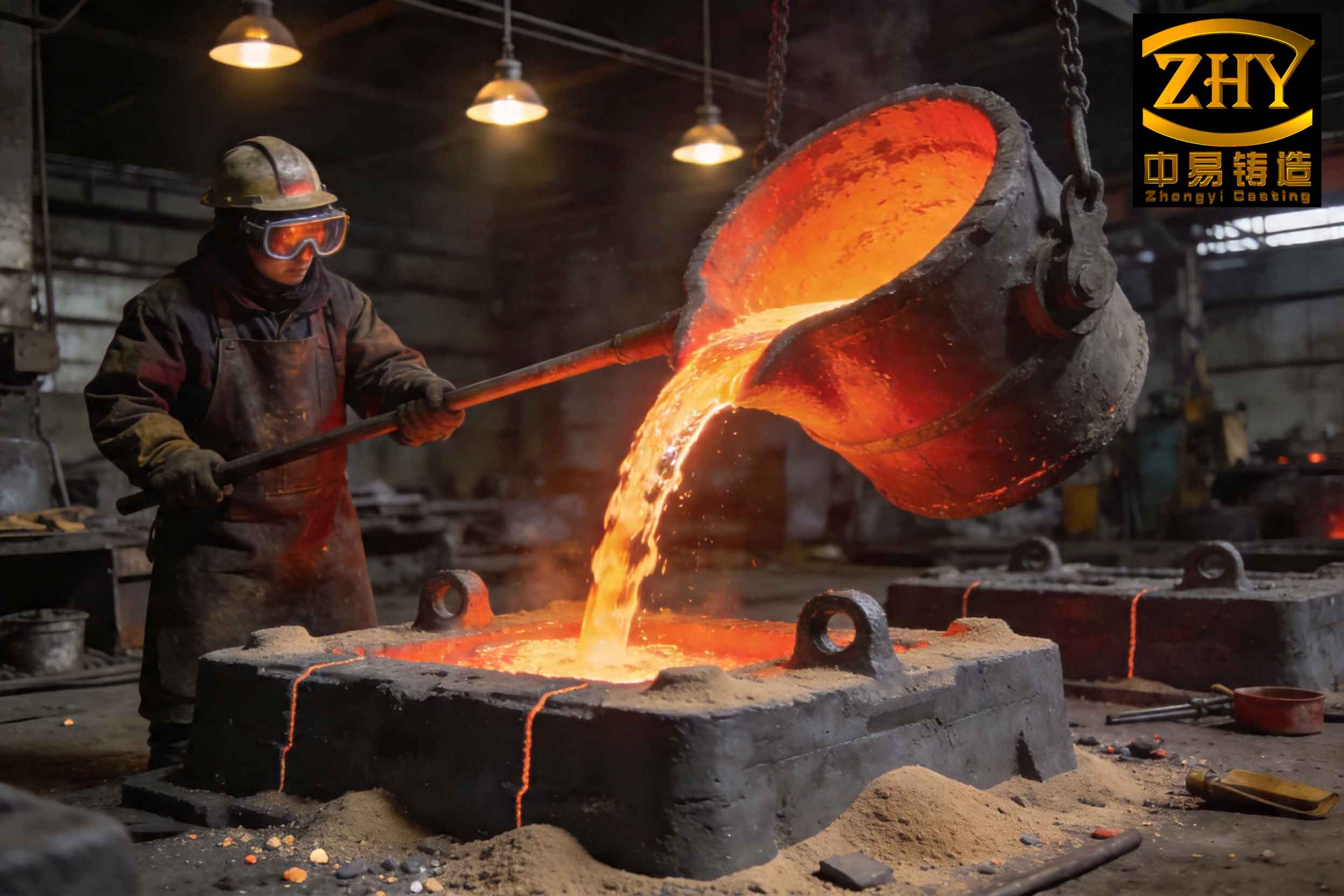
Pouring is carried out with a pouring machine using a teapot ladle, with temperatures maintained between 1380°C and 1400°C. To counteract inoculation fade and refine graphite, secondary inoculation is applied with a silicon-zirconium stream inoculant at 0.08% to 0.12% by mass. The casting is oriented horizontally during pouring and immediately rotated to a vertical position for cooling, facilitating feeding through the riser. This entire sequence, from pouring to vertical placement, is completed within 100 seconds to optimize solidification. Post-casting, the molds are broken after 24 hours, and the castings are cleaned of residual sand and gates. Heat treatment involves austenitizing at approximately 900°C, followed by air cooling to transform the matrix into fine pearlite, thereby improving overall strength. However, despite these controlled steps, slag inclusion defects persisted, prompting a deeper investigation.
To understand the nature of the slag inclusions, we performed scanning electron microscopy (SEM) and energy-dispersive X-ray spectroscopy (EDS) on defect samples. The specimens were ultrasonically cleaned to remove contaminants, and analysis revealed that the inclusions consisted primarily of oxides and sulfides. The EDS spectra showed elevated levels of oxygen (O), silicon (Si), magnesium (Mg), and aluminum (Al), indicating the presence of compounds like MgO, SiO2, and Al2O3. These findings align with typical secondary slag formations in ductile iron, where reactions occur between molten metal and mold materials or due to oxidation during flow. The SEM image below illustrates the morphology of such slag inclusions, highlighting their irregular structure and compositional complexity.
Slag inclusions in ductile iron castings are broadly categorized into primary and secondary types. Primary slag inclusions result from inadequate slag removal after spheroidization or poor gating system design, allowing reaction products to enter the mold cavity. These are relatively easier to address through improved ladle skimming and filter usage. In contrast, secondary slag inclusions form during mold filling, where the molten iron oxidizes or reacts with sand cores and mold materials. The chemical reactions involved can be represented by equations such as:
$$2Mg + O_2 \rightarrow 2MgO$$
$$Si + O_2 \rightarrow SiO_2$$
$$Mg + S \rightarrow MgS$$
These reactions generate non-metallic inclusions that can become trapped in the casting surface. In our case, the slag inclusions were predominantly secondary, driven by factors like excessive residual magnesium, sulfur content, and process irregularities. To quantify the impact, we analyzed historical data on defect rates and correlated them with process parameters. Our analysis indicated that slag inclusion frequency increased when residual Mg levels exceeded 0.040% and when sulfur content was poorly controlled. Additionally, crankshaft bending during heat treatment exacerbated the issue by reducing machining allowances, leaving subsurface inclusions exposed after final machining.
Based on this analysis, we implemented a multi-pronged strategy to reduce slag inclusion defects. The first focus was on controlling sulfur and residual magnesium content. Sulfur influences the amount of spheroidizing wire required, which in turn affects residual Mg levels. High residual Mg increases the risk of magnesium oxide and sulfide formation, contributing to slag inclusions. We adjusted the wire-feeding process to minimize Mg addition while maintaining satisfactory nodularity. Statistical data before and after the adjustment are summarized in Table 3, showing a shift in residual Mg distribution toward the lower end of the specification range.
| Period | Minimum Mg | Maximum Mg | Average Mg | Defect Rate Reduction |
|---|---|---|---|---|
| Before Adjustment | 0.030 | 0.045 | 0.038 | Baseline |
| After Adjustment | 0.030 | 0.040 | 0.035 | 60% |
Microstructural examination confirmed that the reduced Mg content did not compromise graphite nodularity. As shown in Figure 1 (referenced in the SEM image), the graphite spheres remained well-formed, with nodularity grades consistently above 3 and nodule sizes between 5 and 7, meeting the required standards. This demonstrates that optimizing Mg levels can mitigate slag inclusion formation without adversely affecting material properties. The relationship between residual Mg and slag inclusion propensity can be modeled empirically. For instance, the probability of slag inclusion occurrence, P, might be expressed as a function of residual Mg content (Mg_res) and sulfur content (S):
$$P = k_1 \cdot (Mg_{res})^2 + k_2 \cdot S + C$$
where \(k_1\) and \(k_2\) are constants derived from process data, and C represents other contributing factors. By minimizing \(Mg_{res}\) and S, we effectively reduce P, leading to fewer defects.
The second key measure involved stringent raw material management. Impurities in charge materials can introduce elements that foster slag formation. We switched from standard pig iron to high-purity, low-phosphorus, and low-titanium variants to reduce trace element contamination. Additionally, we enforced batch control for all raw materials, ensuring compositional consistency and minimizing fluctuations. Return materials, such as gating systems and risers, were meticulously cleaned via shot blasting to remove adhering sand, and cross-contamination with other scrap was prohibited. This holistic approach to raw material quality lowered the baseline impurity levels, making the melt less prone to slag generation. To illustrate, the overall impurity index (I) for a charge batch can be calculated as:
$$I = \sum_{i=1}^{n} w_i \cdot c_i$$
where \(w_i\) is the weight fraction of material i, and \(c_i\) is its impurity concentration. By selecting cleaner materials, we reduced I, thereby decreasing slag inclusion tendencies.
The third intervention addressed crankshaft bending during heat treatment. Bending causes uneven machining allowances; one side of the crankshaft may have insufficient material removal, leaving near-surface slag inclusions intact. We modified the process sequence by relocating the riser cutting operation from after heat treatment to before it. This reduced gravitational imbalances during heating and cooling, minimizing distortion. Furthermore, we developed a specialized gauge to measure bending, and any crankshaft exceeding tolerance limits was straightened prior to machining. The impact of bending on slag inclusion exposure can be quantified by considering the machining allowance differential, Δa, between the convex and concave sides:
$$\Delta a = \frac{D \cdot \theta}{2}$$
where D is the crankshaft diameter, and θ is the bending angle. By controlling θ through process adjustments, we minimized Δa, ensuring more uniform removal of surface layers and embedded inclusions. Post-implementation data showed a marked decrease in defects attributed to bending, corroborating the effectiveness of these measures.
To consolidate our findings, we conducted a series of validation trials, monitoring defect rates over several production batches. The results, summarized in Table 4, highlight the cumulative impact of our interventions. Notably, the overall slag inclusion defect rate dropped by approximately 60%, with most defects now confined to non-critical areas or eliminated entirely. This improvement underscores the importance of integrated process control in tackling complex casting defects.
| Defect Category | Pre-Intervention Rate (%) | Post-Intervention Rate (%) | Improvement (%) |
|---|---|---|---|
| Surface Slag Inclusions on Journals | 8.5 | 3.4 | 60 |
| Subsurface Inclusions in Critical Zones | 5.2 | 1.8 | 65 |
| Overall Rejection Due to Slag | 12.0 | 4.8 | 60 |
In conclusion, the mitigation of slag inclusion defects in high-grade ductile iron crankshafts requires a systematic approach that addresses multiple facets of production. Our experience demonstrates that controlling residual magnesium and sulfur content is paramount, as these elements directly influence the formation of oxide and sulfide inclusions. The chemical dynamics can be further explored through thermodynamic models. For example, the equilibrium constant for magnesium oxide formation, K_MgO, is given by:
$$K_{MgO} = \frac{a_{MgO}}{a_{Mg} \cdot a_O}$$
where a denotes activity. By maintaining low Mg and O activities through process controls, we shift the equilibrium toward reduced MgO formation, thereby minimizing slag inclusion risks. Similarly, raw material purity plays a crucial role; impurities act as nucleation sites for inclusions, and their reduction lowers the overall slag potential. Implementing rigorous batch management and using high-quality charge materials are essential steps in this regard.
Additionally, process-induced factors like crankshaft bending must not be overlooked. Bending alters machining dynamics, potentially exposing subsurface slag inclusions that would otherwise be removed. By adjusting the heat treatment sequence and implementing bending checks, we ensured more consistent machining, further reducing defect rates. These measures, combined with continuous monitoring and data analysis, have enabled us to achieve sustainable quality improvements. The recurring theme throughout this effort is the need for a holistic view—slag inclusions are not merely a melting issue but a systemic challenge influenced by chemistry, materials, and mechanics.
Looking forward, we plan to integrate advanced real-time monitoring systems, such as spectral analysis during melting and inline inspection during machining, to further enhance slag inclusion detection and prevention. The lessons learned here are applicable to other high-integrity castings where surface quality is critical. Ultimately, through diligent application of these principles, we have significantly enhanced the reliability and performance of our crankshafts, ensuring they meet the stringent demands of modern engines. This journey underscores the value of empirical research and cross-functional collaboration in resolving persistent manufacturing challenges, with slag inclusion reduction serving as a testament to the power of targeted, data-driven interventions.