
The occurrence of macroscopic slag inclusion defects on the tread surface of cast steel railway wheels represents a significant quality and productivity challenge in foundry operations. Such defects, often characterized by their glassy, non-metallic appearance, can lead to the rejection of finished components, resulting in substantial financial loss and disruption to production schedules. This analysis delves into the root causes, formation mechanisms, and practical countermeasures for tread slag inclusion, drawing from a detailed investigation of the defect’s characteristics, the steelmaking process, and thermodynamic principles. The core issue was traced to the complex interplay between steel oxidation, deoxidation practices, and the subsequent behavior of non-metallic inclusions within the casting process.
The production of these wheels utilizes a specific high-carbon steel grade. The typical chemical composition range and a standard target analysis are presented in Table 1.
| Element | Standard Range (wt.%) | Typical Target (wt.%) |
|---|---|---|
| C | 0.67 – 0.77 | 0.71 |
| Si | ≥ 0.15 | 0.50 |
| Mn | ≤ 1.20 | 0.75 |
| P | ≤ 0.030 | 0.030 |
| S | ≤ 0.040 | 0.040 |
| Al | ≤ 0.060 | 0.035 |
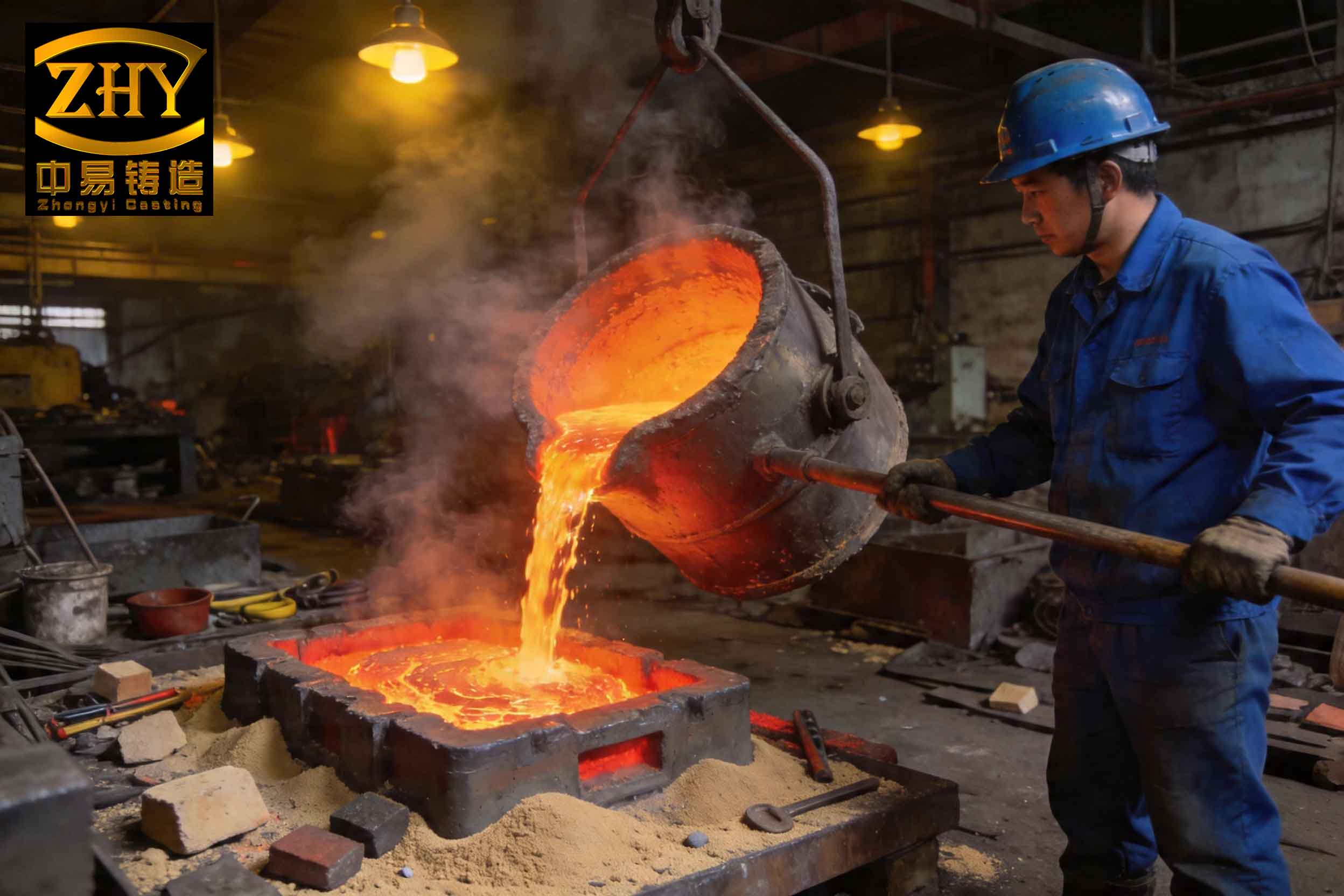
The casting process employs a graphite mold with a sand lining and a top-pouring system via a shroud. The steelmaking route is a single-slag process where the steel is tapped from the electric arc furnace (EAF) carrying the oxidizing slag. The operational sequence is as follows: meltdown with oxygen lancing, an oxidation period for decarburization and temperature rise, followed by a manganese addition in the furnace for pre-deoxidation. The steel is then tapped into a 25-ton ladle (teapot ladle) without removing the furnace slag. Alloying and secondary deoxidation with ferrosilicon and silicon-manganese occur in the stream during tapping. After a brief holding time (~6 minutes) for inclusion flotation, the steel is transferred to a bottom-pouring ladle where final micro-alloying and deoxidation with aluminum are performed before casting. The casting temperature is typically maintained at or below 1605°C.
Characteristics and Composition of the Slag Inclusion
The macroscopic slag inclusion defects observed on the wheel treads exhibited distinct features. In the hot state, they appeared as visible, non-metallic patches. Upon cooling, these defects presented a transparent, vitreous, glass-like structure with colors ranging from light green to dark green, sometimes with a yellowish tint. A strong correlation was noted between higher casting temperatures (≥1595°C) and an increased frequency of this slag inclusion defect.
Energy Dispersive Spectroscopy (EDS) analysis was conducted on samples extracted from the defective areas. The results from two different points on a typical slag inclusion are summarized in Table 2. The analysis consistently revealed that the primary constituents of the slag inclusion were manganese oxide (MnO), silica (SiO2), and alumina (Al2O3), with minor amounts of iron oxide (FeO).
| Component | Analysis Point 1 | Analysis Point 2 | Average |
|---|---|---|---|
| MnO | 40.17 | 32.68 | 36.43 |
| SiO2 | 40.99 | 45.07 | 43.03 |
| Al2O3 | 8.02 | 18.03 | 13.03 |
| FeO | 6.91 | 4.22 | 5.57 |
| Others (P2O5) | 3.91 | – | – |
Plotting the average composition (Al2O3: ~13%, SiO2: ~43%, MnO: ~36%) on the ternary MnO-SiO2-Al2O3 phase diagram places it within or near the spessartite (manganese aluminum silicate) phase field. The liquidus temperature for compositions in this region is well below 1200°C, classifying this slag inclusion as a low-melting-point complex silicate. The formation of such a phase can be understood from the thermodynamic tendency to form stable compounds. The free energy of formation for complex oxides is often lower than for simple ones. A simplified representation of the reaction between deoxidation products and oxidized slag components is:
$$ \text{SiO}_2 (from\ deox.) + \text{MnO} (from\ slag) + x\text{Al}_2\text{O}_3 (from\ slag/deox.) \rightarrow \text{MnO} \cdot \text{SiO}_2 \cdot y\text{Al}_2\text{O}_3 (slag\ inclusion) $$
Source Investigation and Formation Mechanism
Initial hypotheses considered external sources for the slag inclusion, such as mold erosion or ladle refractory contamination. To test this, artificial defect trials were conducted by intentionally introducing potential contaminants (e.g., nozzle glaze, ladle slag, coating material) into test molds. The chemical composition of the resulting defects was analyzed and compared to the actual tread slag inclusion. The results, shown in Table 3, clearly indicate that the composition of defects from refractory/coating sources (high in Al2O3, low in MnO) differed significantly from the tread slag inclusion. However, the composition of slag samples from the bottom-pouring ladle was notably closer, suggesting an internal origin related to the steelmaking and ladle treatment process.
| Source Material | Al2O3 | SiO2 | MnO | FeO | CaO/MgO |
|---|---|---|---|---|---|
| Tread Slag Inclusion | 13.03 | 43.03 | 36.43 | 5.57 | – |
| Nozzle Glaze | 88.14 | 2.96 | – | 6.36 | – |
| Ladle Slag | 34.53 | 35.08 | 11.27 | 4.67 | 11.98 |
| Mold Coating | 71.65 | 11.43 | 4.31 | 3.77 | 0.77 |
A detailed review of the melting log for a heat with severe slag inclusion problems revealed critical insights. The data for a representative problematic heat is summarized in Table 4. The analysis points to several key issues:
- Excessive Oxidation: The melt-down carbon was high (1.49%), requiring a massive decarburization of 0.80% to reach the target tap carbon. This intense oxidation, achieved through aggressive oxygen lancing, led to severe oxidation of silicon and manganese, enriching the slag with SiO2 and MnO.
- Slag Carry-Over: Tapping with the oxidizing slag (single-slag practice) transferred this highly oxidized, MnO-rich slag into the teapot ladle.
- Deoxidation Dynamics: In the teapot ladle, the added ferrosilicon performed dual duty: alloying and deoxidation. The low silicon recovery rate (54% in this case, compared to a theoretical yield) was a direct indicator of the high oxygen potential of the steel-slag system. The deoxidation product (SiO2) reacted in situ with the carried-over slag components (MnO, Al2O3, FeO) to form the low-melting-point manganese-aluminum-silicate droplets, as described thermodynamically earlier.
- Insufficient Flotation Time: The production rhythm allowed only about 6 minutes of holding in the teapot ladle. The Stokes’ law governs the flotation velocity of these inclusions:
$$ v = \frac{2 g (\rho_{steel} – \rho_{slag}) r^2}{9 \eta} $$
where \( v \) is the rising velocity, \( g \) is gravity, \( \rho \) are densities, \( r \) is the inclusion radius, and \( \eta \) is the steel viscosity. For small, complex slag inclusion droplets, the rising velocity \( v \) can be very low, making the allotted time insufficient for complete removal. - Transfer and Casting: The subsequent transfer to the bottom-pouring ladre agitated the steel, potentially re-entraining any floated slag or re-melting slag layers that had built up on the ladle walls. During casting, these low-density inclusions were carried into the mold cavity with the steel stream. Upon contact with the cold graphite mold surface at the tread, the steel solidified rapidly, trapping the still-liquid slag inclusion at the surface, where it finally solidified into the observed glassy defect.
| Stage / Sample | C | Si | Mn | Al | Temp. (°C) | Notes |
|---|---|---|---|---|---|---|
| Melt-down | 1.49 | 0.04 | 0.26 | – | 1490 | High initial C, Si/Mn oxidized. |
| Oxidation Period 1 | 0.83 | 0.03 | 0.39 | – | 1600 | Intense decarburization. |
| Oxidation Period 2 | 0.75 | 0.03 | 0.40 | – | 1690 | |
| Pre-Tap (After FeMn) | 0.69 | 0.03 | 0.60 | – | 1708 | Mn recovery from slag. |
| Teapot Ladle | 0.68 | 0.34 | 0.78 | – | 1605 | Low Si yield (54%). |
| Bottom-Pour Ladle | 0.72-0.73 | 0.38-0.46 | 0.70-0.71 | 0.028-0.030 | 1579-1602 | High Al yield (>80%). |
Corrective Actions and Process Optimization
The root cause was identified as the excessive generation of primary oxidized slag due to intense oxidation, followed by its transformation into a persistent, low-melting-point secondary slag inclusion during deoxidation. The core improvement strategy focused on minimizing the total oxygen input and the quantity of primary deoxidation products. The key measures implemented were:
- Optimized Charge Carbon and Melting Practice: The target melt-down carbon was carefully controlled to a lower range (0.95-1.05%), directly reducing the required decarburization depth. The oxidation period practice was modified to emphasize “foamy slag” operation using higher voltage arcs to transfer heat efficiently from the arc to the bath, thereby reducing reliance on oxygen lancing solely for temperature rise. The target tap carbon was set at 0.70-0.75%, effectively lowering the average decarburization required.
- Controlled Melt-Down Temperature: A strict rule was established to prohibit sampling and proceed with oxidation until the melt-down temperature reached 1530-1550°C. This ensured better dissolution and homogeneity of carbon additives, leading to more predictable and consistent melt-down carbon levels, which in turn allowed for more precise control over oxygen blowing.
The impact of these corrective measures was significant and quantifiable. Statistical process control data from a large number of heats before and after implementation was analyzed. The key performance indicators are compared in Table 5.
| Parameter | Before Improvement | After Improvement | Impact |
|---|---|---|---|
| Average Melt-down Carbon (wt.%) | ~1.23 | ~1.05 | Reduced initial oxidation load. |
| Average Decarburization (ΔC, wt.%) | ~0.60 | ~0.36 | ~40% reduction in oxygen demand. |
| Teapot Ladle Si Yield (Recovery, %) | Lower (Data inferred) | Achieved ~0.48% avg. [Higher yield] | Indicator of lower oxygen level post-tap. |
| Incidence of Tread Slag Inclusion | 11.34% | 3.34% | ~70% reduction in defect rate. |
The reduction in decarburization can be expressed as a direct measure of oxygen saved. Assuming primary decarburization follows the reaction:
$$ [C] + \frac{1}{2}{O_2} \rightarrow {CO_{(g)}} $$
The reduction in decarburization by 0.24% (from 0.60% to 0.36%) translates to a substantial decrease in the amount of oxygen introduced into the bath, thereby lowering the overall oxidation potential and the mass of oxides available to form the problematic slag inclusion.
Conclusion
The formation of tread slag inclusion defects in cast steel wheels produced via a single-slag, oxidizing slag tap practice is a direct consequence of process-induced over-oxidation. Aggressive oxygen blowing during melting generates a slag rich in MnO and other oxides. During tapping and subsequent deoxidation with silicon, the deoxidation product SiO2 reacts with this carried-over slag to form low-melting-point manganese-aluminum-silicate droplets. Under the constraints of industrial holding times, these droplets cannot fully separate from the steel. They are ultimately transported into the mold cavity and, due to the rapid chilling effect of the graphite mold, become entrapped at the tread surface upon solidification.
The problem is fundamentally thermodynamic and kinetic in nature. The solution lies in proactive process control aimed at minimizing the source term—the total oxygen input. By optimizing charge carbon, implementing a controlled foamy slag practice to reduce oxygen lancing, and ensuring proper melt-down temperature, the oxidation level of the steel is drastically reduced. This leads to less oxidized slag carry-over, fewer deoxidation products, and a lower probability of forming the complex, low-melting-point slag inclusion. The successful implementation of these measures, resulting in a dramatic reduction in the defect rate, validates this mechanistic understanding and provides a reliable framework for controlling slag inclusion defects in similar casting operations.