
In my experience working in the railway wheel manufacturing industry, slag inclusion defects on the tread surface of cast steel wheels have been a persistent challenge, leading to significant fluctuations in scrap rates and economic losses. Specifically, during certain periods, the scrap rate due to these defects soared to as high as 7%, well above the typical controlled level of ≤4.0%. This article delves into a comprehensive analysis of the slag inclusion defect, focusing on its characteristics, formation mechanisms, and the effective preventive measures implemented in our production process. Through detailed investigation and process optimization, we have successfully reduced the incidence of slag inclusion defects, and I will share these insights from a first-person perspective.
The slag inclusion defect manifests as transparent, glass-like inclusions with a greenish or yellowish hue on the wheel tread. These defects are particularly prevalent when the pouring temperature exceeds 1,595 °C. To understand their nature, we conducted energy-dispersive X-ray spectroscopy (EDS) analysis on samples, revealing that the primary components are alumina (Al2O3), silica (SiO2), and manganese oxide (MnO), with minor amounts of iron oxide (FeO). The average composition approximates to 15% Al2O3, 47% SiO2, and 33% MnO, which places it within the low-melting-point manganese-aluminum-silicate phase in the ternary MnO-SiO2-Al2O3 system. This composition is critical, as low-melting-point slag inclusions tend to remain suspended in the steel melt and solidify on the tread due to rapid cooling by graphite molds.
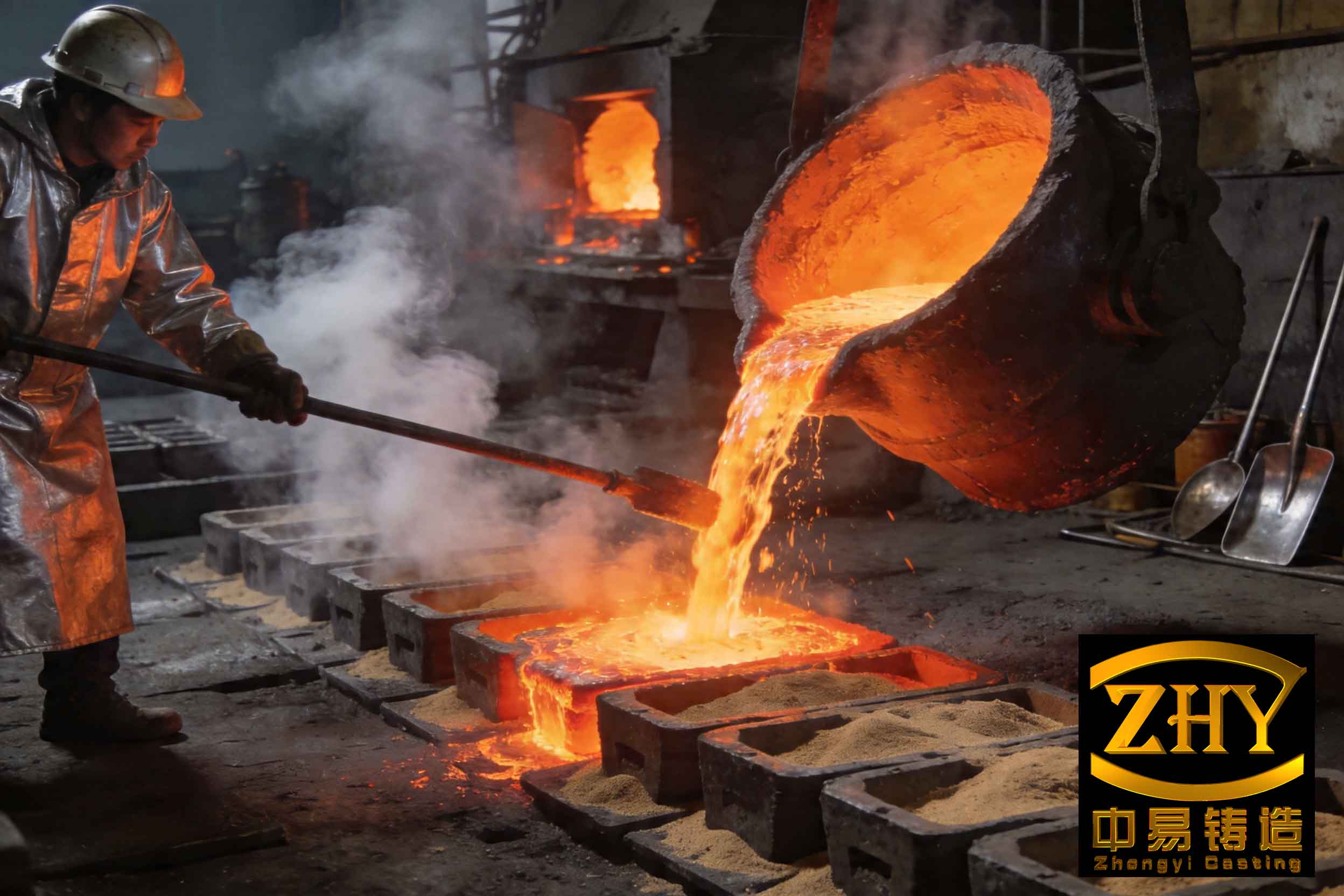
Our manufacturing process for cast steel wheels involves electric arc furnace (EAF) steelmaking, followed by casting using graphite-lined molds with a top-pouring gating system. The steel grade is a high-carbon plain carbon steel, with chemical composition targets as shown in Table 1. The steelmaking process employs a single-slag method with oxidizing slag taping, which eliminates the reduction phase to minimize gas absorption. However, this method can lead to over-oxidation if not carefully controlled.
| Element | Standard Range (wt%) | Target Value (wt%) |
|---|---|---|
| C | 0.67–0.77 | 0.71 |
| Si | ≥0.15 | 0.50 |
| Mn | ≤1.20 | 0.75 |
| P | ≤0.030 | 0.030 |
| S | ≤0.040 | 0.040 |
| Al | ≤0.060 | 0.035 |
During steelmaking, the process includes oxygen blowing for melting and decarburization, with no slag removal before tapping. Pre-deoxidation is done by adding high-carbon ferromanganese in the furnace, aiming for 0.55% Mn. The steel is then tapped into a ladle, where ferrosilicon and silicon-manganese alloys are added for alloying and secondary deoxidation. After a short holding time of about 6 minutes, the steel is transferred to a pouring ladle for final deoxidation with aluminum and other additives before casting. The pouring temperature is controlled at ≤1,605 °C. A schematic of the casting process illustrates the setup, but key factors include the rapid cooling effect of graphite molds, which can trap slag inclusions on the tread surface.
To pinpoint the source of the slag inclusion defect, we performed artificial slag experiments using materials like stopper rod residues, ladle slag, and coating samples. These were introduced into test molds, and the resulting defects were analyzed via EDS. The results, summarized in Table 2, show that stopper residues and coatings primarily consist of Al2O3 with little MnO, whereas ladle slag closely matches the tread slag composition. This indicates that the slag inclusion defect likely originates from the steelmaking process rather than external contamination during casting.
| Sample Type | Al2O3 (wt%) | SiO2 (wt%) | MnO (wt%) | Other Oxides (wt%) |
|---|---|---|---|---|
| Stopper Residue | 88.14 | 2.96 | ~0 | K2O, FeO |
| Ladle Slag | 34.53 | 35.08 | 11.27 | MgO, CaO, TiO2, FeO |
| Coating Material | 71.65 | 11.43 | 4.31 | MgO, TiO2, FeO, ZnO |
| Tread Slag (Average) | 15 | 47 | 33 | FeO |
Analysis of a specific heat (e.g., Heat 1-282-17) revealed critical insights into the steelmaking dynamics. The melting period involved intense oxygen blowing, which oxidized silicon and manganese early on, forming low-melting-point manganese silicates. The decarburization amount was as high as 0.80%, indicating severe oxidation. Manganese content increased from 0.26% at melt-down to 0.60% at tap, partly due to reduction of MnO from the slag at high temperatures (~1,690 °C). Silicon recovery in the ladle was only 54%, suggesting significant oxidation during tapping. In contrast, aluminum recovery in the pouring ladle was 80–86%, implying less oxidation at that stage. This over-oxidation leads to the formation of complex slag inclusions.
The formation mechanism of slag inclusion defects can be described thermodynamically and kinetically. During oxidation, elements like Si and Mn are oxidized to form oxides:
$$ \text{Si} + \text{O}_2 \rightarrow \text{SiO}_2 $$
$$ \text{Mn} + \frac{1}{2}\text{O}_2 \rightarrow \text{MnO} $$
These oxides combine with Al2O3 from deoxidation products to form low-melting-point manganese-aluminum-silicates. The ternary phase diagram for MnO-SiO2-Al2O3 shows that the composition range of the slag inclusion defect lies within the manganese-aluminum-garnet phase, with a melting point below 1,200 °C. The reaction can be represented as:
$$ x\text{MnO} + y\text{SiO}_2 + z\text{Al}_2\text{O}_3 \rightarrow \text{Mn}_x\text{Si}_y\text{Al}_{2z}\text{O}_{x+2y+3z} $$
where the coefficients depend on the specific composition. In practice, the slag forms as droplets suspended in the steel melt. Due to the short holding times in the ladles (6 minutes in the first ladle and negligible time in the pouring ladle), these droplets do not fully float out. During casting, they are carried into the mold cavity and, upon rapid cooling by the graphite mold, solidify on the tread surface as slag inclusion defects. Higher pouring temperatures exacerbate this by increasing slag fluidity and reducing flotation efficiency.
To mitigate the slag inclusion defect, we implemented several control measures focused on reducing oxygen input and improving steelmaking practices. First, we optimized charge carbon levels to lower the initial carbon content, aiming for a melt-down carbon range of 0.95–1.05% and a tap carbon range of 0.70–0.75%. This reduces the required decarburization amount, minimizing over-oxidation. Second, we adjusted oxygen blowing practices during oxidation by using higher voltage and longer arcs to create foamy slag, which improves thermal efficiency and reduces oxygen consumption. We also set a minimum melt-down sampling temperature of 1,530–1,550 °C to ensure uniform carbon distribution and better control over oxidation. Data from before and after these improvements, summarized in Table 3, show a significant reduction in decarburization amount and more consistent silicon recovery.
| Parameter | Before Improvement | After Improvement |
|---|---|---|
| Average Melt-Down Carbon (wt%) | 1.23 | 1.05 |
| Average Decarburization Amount (wt%) | 0.60 | 0.36 |
| Silicon Recovery in Ladle (%) | ~54 | Improved to higher levels |
| Incidence of Slag Inclusion Defect (%) | 11.34 | 3.34 |
Additionally, we emphasized controlling pouring temperatures to below 1,595 °C whenever possible, as statistical analysis indicated that 66% of slag inclusion defects occurred at higher temperatures. This is linked to increased oxidation and slag melting in the pouring ladle. The improvements also included enhancing the power capacity of the furnace transformer to facilitate faster heating, thereby reducing reliance on oxygen blowing. While our current transformer power is 360 kVA/t, benchmarking against international practices suggests that levels above 600 kVA/t are beneficial for minimizing oxidation.
The effectiveness of these measures is evident in the reduced scrap rates. By controlling oxygen blowing intensity and refining melting operations, the probability of slag inclusion defect formation decreased from 11.34% to 3.34%. This underscores the importance of precise process control in steelmaking to manage oxide formation and slag behavior. The slag inclusion defect is not merely a casting issue but a systemic problem rooted in metallurgical reactions.
In conclusion, the slag inclusion defect on cast steel wheel treads is primarily caused by over-oxidation during steelmaking, leading to the formation of low-melting-point manganese-aluminum-silicates that fail to float out due to insufficient holding times. Through comprehensive analysis and targeted improvements in charge carbon control, oxygen blowing practices, and temperature management, we have successfully mitigated this defect. Continuous monitoring and adaptation of steelmaking parameters are essential to maintain low defect rates. This experience highlights the critical role of thermodynamic and kinetic factors in controlling slag inclusion defects, and the strategies discussed can be applied broadly in cast steel production to enhance quality and efficiency.
Further research could explore advanced deoxidation techniques or the use of flux additions to modify slag composition, but the core principle remains: minimizing oxygen input and optimizing process dynamics are key to preventing slag inclusion defects. As I reflect on this journey, it is clear that a deep understanding of material science and process engineering is indispensable for tackling such challenges in manufacturing.