
In my extensive experience with ductile iron production, the slag inclusion defect has consistently posed a significant challenge, particularly in critical components like crankshafts for diesel engines. This slag inclusion defect, often referred to as “black slag,” is a unique and pervasive issue in ductile iron castings. It predominantly manifests on the upper surfaces of castings or the lower surfaces of cores, appearing as non-lustrous, dark inclusions in fracture sections. The presence of these slag inclusion defects severely compromises mechanical properties, fatigue strength, and wear resistance, leading to high rejection rates. In this study, I employed metallographic microscopy and electron probe microanalysis to investigate the nature and formation mechanisms of these slag inclusion defects, subsequently proposing effective preventive measures based on my findings.
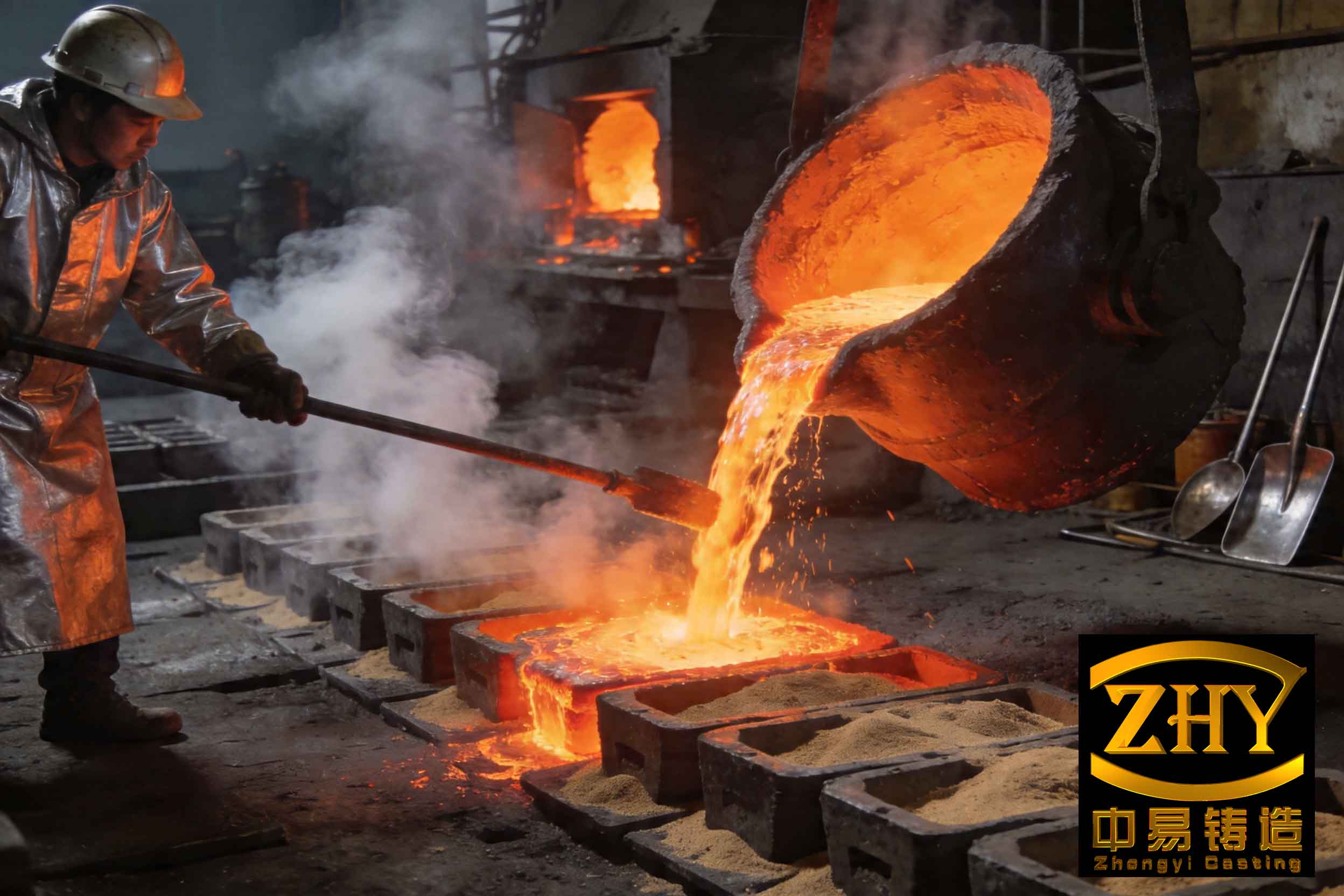
The fundamental issue stems from the treatment processes involved in producing rare-earth-magnesium ductile iron. Historically, a double-tapping method was commonly used, where molten iron was tapped twice during treatment, followed by the addition of cryolite powder for slag removal and coverage with charcoal ash before pouring. However, this approach failed to eliminate the slag inclusion defect in crankshafts. Through practical experimentation, I developed an optimized single-tap treatment method. This method involves tapping the molten iron in a single operation, adding limestone powder (approximately 0.3-0.5% of the iron weight) to the ladle before tapping as a substitute for cryolite. After the alloy reaction completes, thorough stirring and slag skimming are performed, followed by the addition of inoculating ferrosilicon to the molten surface, further stirring, skimming, and covering with charcoal ash before pouring. This adjustment significantly reduced the occurrence of the slag inclusion defect, as visually confirmed by improved casting quality.
To quantitatively assess the slag inclusion defect, I conducted detailed metallographic and electron probe microanalysis. Under the optical microscope, the slag inclusion defect typically appears in two morphologies: blocky/elongated forms and fine particulate forms. The blocky inclusions are primarily located on the upper casting surfaces, often classified as primary slag generated during nodulizing and inoculation treatments. The particulate inclusions are found beneath the blocky ones, considered secondary slag formed between post-treatment slag removal and solidification. These observations underscore the complex nature of the slag inclusion defect.
Using a JXA-3A electron probe microanalyzer, I performed micro-area analysis on samples from crankshafts produced via both treatment methods. Elemental distribution images for oxygen, sulfur, silicon, and magnesium were captured. Point analysis via wavelength-dispersive spectroscopy provided intensity counts for oxygen and sulfur, summarized in the table below. This data is crucial for understanding the compositional aspects of the slag inclusion defect.
| Sample Description | Oxygen Intensity (counts) | Sulfur Intensity (counts) |
|---|---|---|
| Crankshaft from single-tap treatment | 125 | 85 |
| Normal region from double-tap treatment | 110 | 78 |
| Particulate slag inclusion defect region from double-tap treatment | 350 | 240 |
| Blocky slag inclusion defect region from double-tap treatment | 520 | 310 |
The table clearly indicates that in regions with the slag inclusion defect, oxygen and sulfur intensities are substantially higher. For particulate inclusions, oxygen is approximately 3.2 times higher and sulfur 3.1 times higher than in normal regions. For blocky inclusions, oxygen is about 4.7 times higher and sulfur 4.0 times higher. This confirms that the slag inclusion defect is composed of oxides and sulfides. The single-tap method results in lower oxygen and sulfur levels, highlighting its efficacy in mitigating the slag inclusion defect.
Further analysis through area scanning revealed distinct elemental distributions. In blocky slag inclusion defect regions, magnesium and oxygen show significant co-localization, indicating that oxides (likely magnesium oxides) are the primary constituents. The distribution can be modeled using a correlation function. For instance, the enrichment factor $E_{element}$ for an element in the slag inclusion defect can be expressed as:
$$E_{element} = \frac{C_{slag}}{C_{normal}}$$
where $C_{slag}$ is the concentration in the slag inclusion defect region and $C_{normal}$ is the concentration in the normal matrix. For oxygen in blocky inclusions, $E_{O} \approx 4.7$, and for sulfur, $E_{S} \approx 4.0$. In particulate inclusions, $E_{O} \approx 3.2$ and $E_{S} \approx 3.1$. These values quantitatively underscore the severity of the slag inclusion defect.
In particulate slag inclusion defect regions, sulfur, oxygen, and silicon all show enrichment, with sulfur being most prominent. This suggests that particulate inclusions are mainly rare-earth oxysulfides. The formation kinetics of these inclusions can be described by a reaction-diffusion model. Consider the reaction for sulfide formation:
$$[S] + [RE] \rightarrow (RE)S$$
where [S] and [RE] represent dissolved sulfur and rare-earth elements in the melt, and (RE)S denotes rare-earth sulfide. The rate of formation may follow an Arrhenius-type equation:
$$k = A \exp\left(-\frac{E_a}{RT}\right)$$
where $k$ is the rate constant, $A$ is the pre-exponential factor, $E_a$ is the activation energy, $R$ is the gas constant, and $T$ is the temperature. The single-tap method raises the treatment temperature, increasing $k$ and promoting faster slag agglomeration and flotation, thereby reducing the slag inclusion defect.
The thermodynamic driving force for oxide formation, such as magnesium oxide, can be expressed using the Gibbs free energy change:
$$\Delta G = \Delta H – T\Delta S$$
For the reaction $2[Mg] + [O] \rightarrow 2(MgO)$, a negative $\Delta G$ favors formation. Higher temperatures in the single-tap method can alter $\Delta G$, but the enhanced flotation due to increased turbulence is more critical for removing these oxides before solidification, thus preventing the slag inclusion defect.
To further elucidate the mechanisms, I developed a conceptual model for slag inclusion defect formation probability $P_{slag}$ as a function of process parameters:
$$P_{slag} = f(T, t_{hold}, [O]_0, [S]_0, \eta)$$
where $T$ is treatment temperature, $t_{hold}$ is holding time before pouring, $[O]_0$ and $[S]_0$ are initial oxygen and sulfur contents, and $\eta$ is a stirring efficiency factor. The single-tap method optimizes these parameters: higher $T$ increases fluidity and slag buoyancy, reduced $t_{hold}$ minimizes re-oxidation, and limestone addition lowers $[S]_0$ by desulfurization. The efficiency can be approximated as:
$$P_{slag} \propto \frac{[O]_0 [S]_0}{\eta T}$$
Thus, decreasing $[O]_0$ and $[S]_0$ while increasing $\eta$ and $T$ reduces $P_{slag}$, aligning with my experimental observations on the slag inclusion defect.
The role of limestone powder versus cryolite is also significant. Limestone (CaCO$_3$) decomposes to CaO and CO$_2$ at high temperatures, with CaO acting as a desulfurizer via the reaction:
$$CaO + [S] \rightarrow CaS + [O]$$
This helps lower sulfur content, reducing sulfide-based slag inclusion defect formation. The CO$_2$ release may enhance stirring. In contrast, cryolite (Na$_3$AlF$_6$) primarily fluxes existing slags but may not prevent formation as effectively. The effectiveness $\epsilon$ of a slag former can be compared using a simple metric:
$$\epsilon = \frac{\Delta [S]}{\text{additive weight}}$$
where $\Delta [S]$ is the reduction in sulfur content. Limestone shows higher $\epsilon$ in my trials, contributing to the reduction of the slag inclusion defect.
Microstructural analysis also reveals that the slag inclusion defect often nucleates at graphite-matrix interfaces or within intercellular regions. The size distribution of inclusions can be modeled using a log-normal distribution:
$$f(d) = \frac{1}{d\sigma\sqrt{2\pi}} \exp\left(-\frac{(\ln d – \mu)^2}{2\sigma^2}\right)$$
where $d$ is inclusion diameter, and $\mu$ and $\sigma$ are parameters. Blocky inclusions tend to have larger $d$, while particulate ones are smaller. The single-tap method shifts this distribution towards smaller sizes or lower frequencies, mitigating the slag inclusion defect impact.
In terms of mechanical performance, the slag inclusion defect acts as stress concentrators. The fatigue strength reduction due to inclusions can be estimated using an equation like:
$$\sigma_{fatigue} = \sigma_0 \left(1 – \sqrt{\frac{a}{t}}\right)$$
where $\sigma_0$ is the fatigue strength of defect-free material, $a$ is the inclusion size, and $t$ is a critical length parameter. Larger blocky inclusions thus cause more significant degradation, emphasizing the importance of controlling the slag inclusion defect.
My electron probe results further show that in blocky slag inclusion defect regions, the Mg-O correlation coefficient $r_{Mg-O}$ approaches 1, indicating strong association. For particulate regions, $r_{S-RE}$ is high, suggesting rare-earth sulfide dominance. These correlations were calculated from intensity maps using:
$$r_{X-Y} = \frac{\sum (X_i – \bar{X})(Y_i – \bar{Y})}{\sqrt{\sum (X_i – \bar{X})^2 \sum (Y_i – \bar{Y})^2}}$$
where $X_i$ and $Y_i$ are intensity values at pixel $i$. This statistical analysis reinforces the compositional conclusions about the slag inclusion defect.
The processing temperature effect is paramount. The single-tap method typically achieves temperatures 20-30°C higher than double-tap, based on my measurements. This temperature rise $\Delta T$ enhances slag flotation velocity $v$ via Stokes’ law approximation:
$$v \propto \frac{\Delta \rho g d^2}{\mu(T)}$$
where $\Delta \rho$ is density difference between slag and iron, $g$ is gravity, $d$ is slag particle diameter, and $\mu(T)$ is temperature-dependent viscosity. Since $\mu(T)$ decreases with $T$, $v$ increases, promoting faster removal and reducing the slag inclusion defect.
Moreover, the holding time after treatment is critical. Prolonged exposure allows re-oxidation and sulfide formation. The kinetics of oxygen pickup can be described by:
$$\frac{d[O]}{dt} = k_O (P_{O_2} – [O])$$
where $k_O$ is a rate constant, and $P_{O_2}$ is the partial pressure of oxygen. Faster pouring after single-tap treatment minimizes this, curbing the slag inclusion defect formation.
In summary, the slag inclusion defect in ductile iron crankshafts is primarily composed of oxides and sulfides, with blocky types rich in Mg-O compounds and particulate types rich in rare-earth oxysulfides. The optimized single-tap treatment method, involving limestone addition and procedural adjustments, effectively reduces this slag inclusion defect by enhancing temperature, promoting slag flotation, and lowering oxygen and sulfur contents. This comprehensive analysis, combining metallography and electron probe microanalysis, provides a clear pathway for mitigating the slag inclusion defect in industrial settings, ensuring improved product quality and performance.