
The production of high-integrity, heavy-section ductile iron castings, such as gear housing components, presents a formidable challenge to foundry engineers. These castings are typically specified for critical applications demanding exceptional mechanical properties, particularly high elongation and impact resistance, alongside flawless internal soundness. The technical requirements often mandate rigorous non-destructive testing, such as ultrasonic inspection, where any discontinuity, especially a slag inclusion defect, can lead to rejection. This article details a comprehensive, first-person perspective on the holistic process design, execution, and targeted problem-solving methodology required to achieve stable, high-quality production. Central to this discussion is the analysis and mitigation of the pervasive slag inclusion defect.
1. Foundry Process Design and Parameters
The foundation of quality casting lies in a robust and meticulously designed foundry process. For a gear housing weighing approximately 2,055 kg with a primary wall thickness of 100-108 mm, every parameter must be optimized for control of solidification and metal flow.
1.1 Molding and Gating System
A no-bake furan resin sand system is employed for its excellent dimensional stability and high strength, which is crucial to withstand the metallostatic pressure of the heavy casting. The mold strength is controlled at $\sigma_b \geq 0.98 \text{ MPa}$. The gating system is designed based on the principles of an open, pressurized, and skim-gating configuration to ensure a calm, controlled fill and maximize slag trapping before the metal enters the cavity.
The key gating parameters are summarized below:
| Component | Description | Quantity |
|---|---|---|
| Sprue | $\varnothing 90$ mm ceramic tube | 1 |
| Runner | 70/90 mm x 130 mm (tapered) | 1 section |
| Ingates | $\varnothing 30$ mm ceramic tubes | 10 |
| Feeder (Riser) | Wedge-shaped, 500 mm height | 1 |
The gating ratio (Sprue area : Runner area : Ingate area) is carefully calculated to ensure a non-turbulent fill. Ceramic components are used for their erosion resistance and thermal stability, preventing sand erosion which can be a source of inclusions.
1.2 Use of Chills
To manage the solidification of thick sections and promote directional solidification towards the feeder, an extensive array of chills is strategically placed. Both external and internal (conforming) chills are used to accelerate cooling at critical thermal centers, thereby preventing shrinkage porosity and promoting a finer microstructure. The placement, size, and quality control of these chills are critical; poorly maintained chills can become a source of gas and slag inclusion defects themselves.
2. Melting, Composition, and Treatment Control
The target material is QT400-18RT, a ferritic ductile iron grade requiring high elongation ($A \geq 12\%$). The chemical composition is the primary lever for achieving the desired matrix structure.
2.1 Charge Material and Target Chemistry
To minimize the presence of carbide-promoting and trace elements that hinder graphite nodulization and ferrite formation, the charge consists of 20-30% high-purity pig iron and 70-80% selected steel scrap. No returns are used to avoid the buildup of trace elements from repeated melting and treatment. The target base iron chemistry is tightly controlled as follows:
| Element | Target (wt.%) | Rationale |
|---|---|---|
| Carbon (C) | 3.8 – 3.9 | High carbon equivalent for good fluidity and graphitization potential. |
| Silicon (Si) | 0.9 – 1.0 | Low base silicon to allow for powerful inoculation. |
| Manganese (Mn) | ≤ 0.3 | Minimized to prevent pearlite stabilization and segregation. |
| Phosphorus (P) | ≤ 0.05 | Minimized to avoid brittle phosphide eutectics. |
| Sulfur (S) | ≤ 0.02 | Low sulfur is essential for efficient Mg treatment. |
The final chemistry after treatment must also control residual magnesium ($Mg_{res}$) and rare earths ($RE_{res}$) to the minimum necessary for successful nodulization, as they increase the tendency for dross and slag inclusion defect formation.
2.2 Nodulization and Inoculation Practice
The treatment process is conducted in a 5-ton medium frequency induction furnace. A sandwich method in a well-designed treatment ladle is used for nodulization.
Nodulization: The FeSiMg nodulant is placed in the pocket of the ladle, covered by a primary inoculant, and then topped with a steel punch. The treatment reaction is controlled by the tightness of this covering. The goal is to achieve a residual Mg level just sufficient for spheroidization, typically in the range of 0.035-0.050%.
Inoculation: This is the critical step defining the final graphite morphology and count. A multi-stage inoculation process is employed:
$$ \text{Total Inoculation} = I_{primary} + I_{stream} + I_{late} $$
where:
$I_{primary}$ = 0.3-0.5% (in the ladle pocket),
$I_{stream}$ = 0.4-0.5% (during tapping),
$I_{late}$ = 0.10-0.15% (fine-grain inoculant added during pouring).
The late inoculation, added using a dedicated feeder into the pouring stream, is particularly effective in increasing graphite nodule count and ensuring a fully ferritic matrix by counteracting chilling effects.
3. Quality Assessment and Initial Results
Quality is verified using separately cast coupons and non-destructive testing on the actual castings.
3.1 Mechanical and Metallographic Properties
Test coupons from initial production runs met all specified requirements, as shown below:
| Coupon ID | Rm (MPa) | Rp0.2 (MPa) | A (%) | Hardness (HBW) | Nodularity (%) | Ferrite (%) |
|---|---|---|---|---|---|---|
| A1 | 383 | 246 | 25.5 | 126 | 95 | >98 |
| A2 | 379 | 241 | 26.0 | 130 | 95 | >98 |
The microstructure consisted of well-formed, fine graphite nodules (Size 6, ~200 nodules/mm²) in a matrix of over 98% ferrite, explaining the excellent ductility.
3.2 Non-Destructive Testing and Defect Identification
While mechanical tests passed, ultrasonic testing (UT) of the first batch of castings revealed an issue. One casting (associated with coupon A1) showed UT indications characteristic of non-metallic discontinuities. Further investigation, including sectioning and metallographic examination, confirmed the presence of a slag inclusion defect on the upper surfaces of the casting.
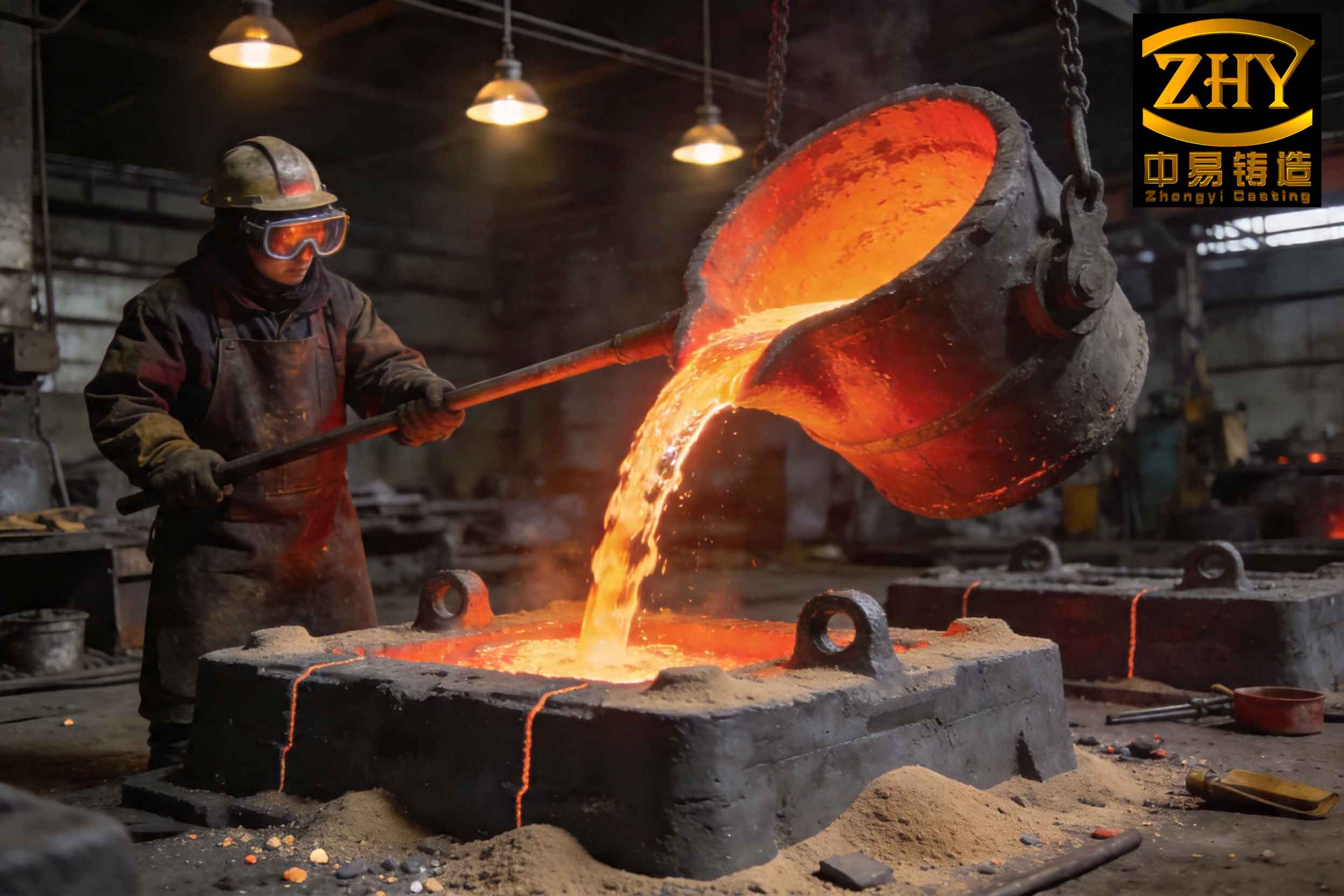
4. In-Depth Analysis of Slag Inclusion Defect Formation
The discovery of the slag inclusion defect triggered a systematic root-cause analysis. In ductile iron, slag, also known as dross, primarily consists of magnesium silicates, sulfides, and oxides formed during the treatment and pouring process. Two main types exist:
| Type | Formation Time | Primary Composition | Typical Location |
|---|---|---|---|
| Primary Slag | During Mg-treatment/post-treatment in ladle | MgO, MgS, SiO₂, RE-oxides | Ladle surface, transferred into mold |
| Secondary Slag (Reoxidation Film) | During pouring and mold filling | Oxides of Fe, Si, Mn | Upper surfaces, downstream of turbulent areas |
For the gear housing casting, the analysis discounted charge materials as the primary source and focused on process dynamics. The key contributing factors identified were:
4.1 The Critical Role of Pouring Temperature
Pouring temperature has a non-linear, parabolic relationship with the risk of slag inclusion defect. The initial process aimed for a range of 1300-1340°C. However, when multiple castings are poured from one ladle, the last casting often falls below 1300°C.
$$ \text{Risk of Slag Inclusion} \propto k_1 \cdot \frac{1}{\eta(T)} + k_2 \cdot \Gamma(T) $$
Where $\eta(T)$ is the metal viscosity (decreases with higher T, helping slag float), and $\Gamma(T)$ represents the reoxidation/scum-forming tendency (increases with higher T). At low temperatures (~1300°C), high viscosity dominates ($k_1$ term), trapping slag. At optimal temperatures (1350-1380°C), both terms are minimized. At very high temperatures (>1400°C), the $k_2$ term dominates, creating thin, tenacious oxide films that are easily entrained. The initial process was operating on the high-viscosity (low-temperature) side of the curve.
4.2 Gating System Efficacy and Operator Dependency
Although an open, skim-gating system was designed, its effectiveness was highly dependent on operator practice. Maintaining a full pouring basin was essential to create a calm, non-turbulent entry point and allow slag to float. Inconsistent practices could lead to vortex formation, sucking surface slag into the sprue. Furthermore, the system lacked a final, physical barrier to capture any slag that passed the initial skimming action.
4.3 Chill Quality and Management
The extensive use of chills introduced another variable. Chills that were rusty, damp, porous, or had been used beyond their effective life (typically 5 cycles) could outgas or react with the iron. The gases released could create turbulence, promoting reoxidation and film entrainment, leading to a combined gas and slag inclusion defect. Inadequate cleaning and storage of chills between uses exacerbated this risk.
5. Implemented Countermeasures and Results
Based on the root-cause analysis, three interconnected corrective actions were implemented to form a robust defense against the slag inclusion defect.
5.1 Optimized and Elevated Pouring Temperature
The target pouring temperature range was strictly elevated to 1360-1380°C. This was achieved by adjusting tapping temperatures and optimizing ladle preheating and logistics to reduce heat loss. The higher temperature significantly reduced metal viscosity, providing more time for buoyant slag particles to float to the surface of the molten metal in the ladle and gating system before solidification.
5.2 Incorporation of Ceramic Foam Filters
The gating system was redesigned to include a final, physical filtration stage. A 150 mm x 150 mm x 32 mm ceramic foam filter with a pore size suitable for heavy ductile iron was installed in the runner, just before the ingates. This filter acts as a mechanical and surface adhesion barrier, capturing any remaining macro-inclusions and promoting laminar flow into the cavity. The equation for filtration efficiency highlights its importance:
$$ \eta_{filter} = 1 – \exp\left(-\frac{\alpha \cdot L \cdot \phi}{d_p}\right) $$
where $\alpha$ is a collector efficiency factor, $L$ is filter thickness, $\phi$ is filter porosity, and $d_p$ is particle size. For large slag particles, this efficiency approaches 100%.
5.3 Strict Chill Control Protocol
A formal chill management system was instituted:
- Life Tracking: All chills were marked and their usage cycles logged. They were retired after a maximum of 5 uses.
- Surface Preparation: Before each use, the working face of chills was cleaned by grit blasting or, for critical conforming chills, machining to ensure a clean, oxide-free metallic surface.
- Preheating: Chills were preheated to 80-120°C in a dedicated oven to eliminate moisture and reduce thermal shock, which can cause gas evolution.
5.4 Outcome: Stable, High-Quality Production
The implementation of this three-pronged strategy (Temperature + Filtration + Chill Control) was immediately effective. Over a subsequent production run of 18 gear housing castings, ultrasonic inspection revealed no indications of slag inclusion defects. All castings passed the rigorous UT standards, and the mechanical properties from their accompanying test coupons remained consistently within specification. This confirmed that the slag inclusion defect had been systematically controlled without compromising the metallurgical quality of the iron.
6. Conclusion
The successful, stable production of heavy-section, high-ductility ductile iron castings is an exercise in integrated process engineering. It requires a synergistic approach where design (gating, feeding), metallurgy (composition, treatment), and process execution (temperature control, procedure adherence) are perfectly aligned. The slag inclusion defect serves as a critical quality indicator, often revealing weaknesses in this chain. As demonstrated, its mitigation is not achieved by a single silver bullet but through a combination of scientifically grounded measures: optimizing the pouring temperature to reduce viscosity and control oxidation, incorporating effective filtration in the gating system as a fail-safe, and exercising stringent control over all factors influencing metal tranquility, including auxiliary tooling like chills. This holistic methodology ensures that the inherent excellent properties of ductile iron are fully realized in a sound, reliable casting, free from detrimental discontinuities like the slag inclusion defect.