
In the high-precision field of metal casting, particularly for critical components like diesel engine cylinder blocks, the occurrence of internal defects remains a primary challenge impacting yield, structural integrity, and overall production cost. Among these defects, porosity stands out as one of the most prevalent and detrimental. The formation of cavities within the cast metal structure, known as porosity in casting, can severely compromise the pressure tightness, mechanical strength, and fatigue life of the final part. This article delves into a detailed investigation of a specific case of persistent porosity in casting defects encountered during the initial production phases of a 2.5-liter diesel engine cylinder block. Through a first-person engineering perspective, we will systematically explore the defect’s characteristics, employ simulation tools for root-cause analysis, and implement a multi-faceted strategy for process optimization. The focus will be on elucidating the mechanisms behind porosity in casting, specifically subsurface blowholes, and demonstrating how targeted modifications in gating design, core venting, and thermal management can effectively mitigate this issue.
The subject component is a compact, thin-walled cylinder block with a nominal wall thickness of 4.5mm, cast in Grade HT250 gray iron using high-pressure green sand molding technology. Despite employing a well-established production platform common for other engine families, the initial low-volume production batches of this specific 2.5L block were plagued by a high scrap rate, with defect analysis revealing that over two-thirds of the rejected parts were due to porosity in casting. The scrap rate attributed solely to this defect approached 11%, signaling a critical need for intervention. The defects were not randomly distributed but consistently localized in specific regions of the water jacket core, most notably around the water pump mounting boss area. This localization provided the first crucial clue in the diagnostic process.
To understand the failure, one must first categorize the types of porosity in casting. Generally, gas-related pores in castings originate from four primary sources:
1. Entrapped Air or Mold Gases: Gases engulfed during turbulent filling of the mold cavity.
2. Precipitation Porosity: Gases (like hydrogen or nitrogen) dissolved in the molten metal that precipitate out during solidification.
3. Reaction Porosity: Gases formed by chemical reactions between the metal, slag, or mold materials (e.g., C + FeO → Fe + CO).
4. Core/Gas Invasion Porosity: Gases generated from the thermal decomposition of organic binders in sand cores (or molds) that infiltrate the solidifying metal.
The visual characteristics of the defect—larger, smooth-walled cavities often with an oxidized surface, located at isolated high points or near core surfaces—are classic hallmarks of invasive porosity in casting, specifically Type 4: Core/Gas Invasion. This preliminary diagnosis was corroborated by the fact that the foundry’s base processes for melting, core sand, and molding were proven stable for other similar castings, directing suspicion towards the interaction between this specific part’s geometry, its core assembly, and the thermal dynamics during pouring.
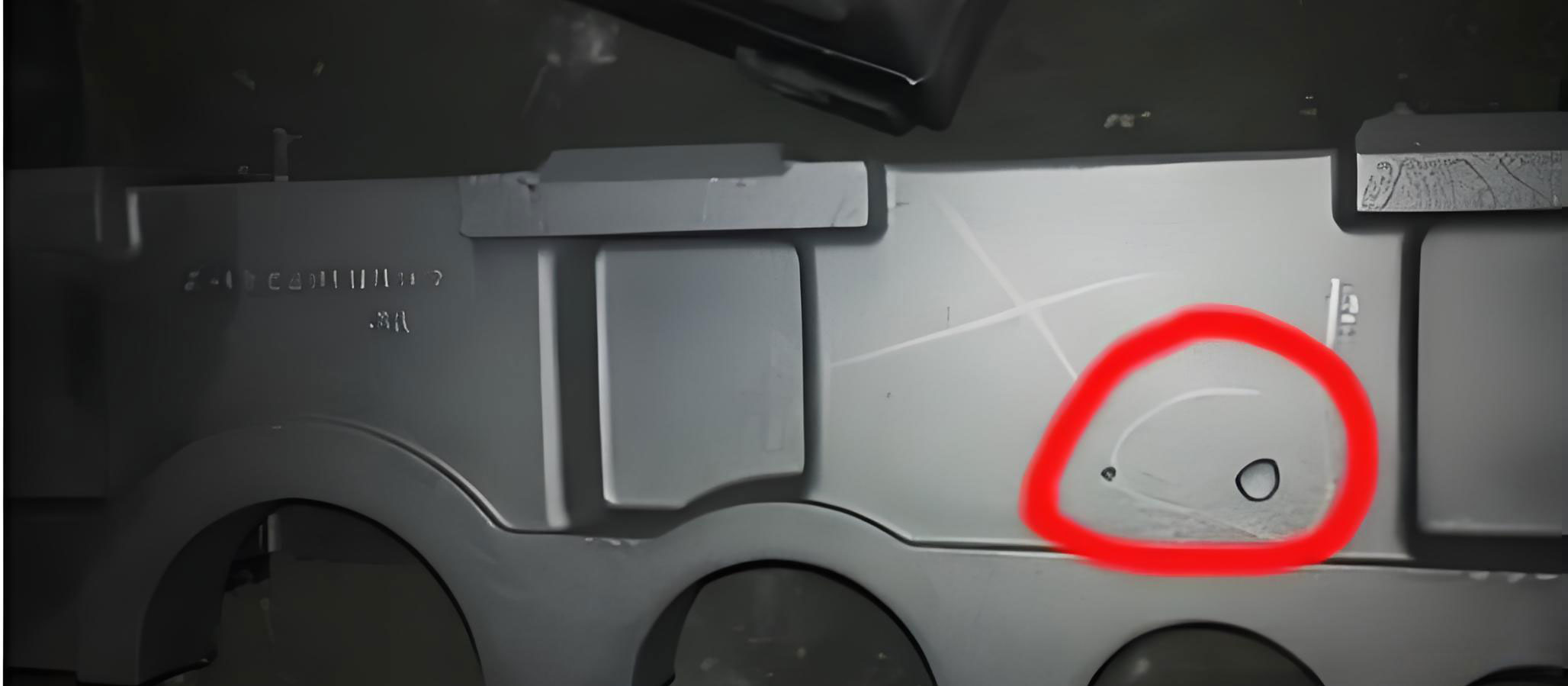
A meticulous examination of the casting and core assembly layout was conducted. The water jacket core, responsible for forming the intricate coolant passages around the cylinders, featured several voluminous sections. The water pump boss area, in particular, represented a relatively massive volume of core sand compared to the slender core prints (locators) designed for it. In the original process, these small-diameter core prints served as the only venting path for the enormous volume of gas generated when the hot iron (1410-1430°C) enveloped this core. The surrounding casting geometry showed that this boss area was an isolated thermal “high point”—a raised section on the top casting face where metal flow was last to arrive and first to cool, creating a potential cold spot.
Advanced simulation software (AnyCasting) was deployed to model the solidification sequence and, critically, the gas pressure buildup within the core. The results were illuminating. The temperature field simulation clearly identified the water pump boss region as a distinct cold zone, marked by significantly lower temperatures compared to the surrounding areas shortly after pour completion. Concurrently, the gas pressure simulation predicted high pressure levels building up within the confined volumes of the water jacket core, precisely in the problematic regions. The synergetic effect of these two simulated conditions—low metal temperature (high viscosity, reduced gas solubility and escape capability) and high localized core gas pressure—created a perfect storm for the formation of invasive porosity in casting. The gas, unable to escape rapidly through the inadequate vents and encountering a cool, viscous metal skin, was forced into the semi-solid metal matrix, resulting in the observed blowholes.
The physics behind this can be partially described by considering the pressure balance at the metal-core interface and the kinetics of gas evolution. The core gas generation rate peaks shortly after the metal contacts the core. For the gas to vent through the core print, the pressure differential must overcome the metallostatic pressure and the resistance in the vent channel. If the vent is insufficient, the internal core pressure $P_{core}$ rises. Invasion occurs when $P_{core}$ exceeds the sum of the local metallostatic pressure $P_{metal}$ and the capillary pressure $P_{cap}$ at the pore initiation site, plus the strength of the forming metal skin $\sigma_{skin}$.
$$ P_{core} > P_{metal} + P_{cap} + \sigma_{skin} $$
A cooler metal temperature increases the metal’s viscosity $\mu$, accelerates skin formation (increasing $\sigma_{skin}$), and reduces gas diffusion coefficients, making it harder for any invading bubbles to redissolve or escape, thereby trapping them permanently. This confirms the critical link between thermal management and susceptibility to porosity in casting.
| Production Batch | Quantity Produced | Total Scrap | Scrap Rate (%) | Scrap Due to Porosity | Porosity Share of Scrap (%) |
|---|---|---|---|---|---|
| Batch 1 | 54 | 10 | 18.52 | 7 | 70.0 |
| Batch 2 | 44 | 7 | 15.91 | 2 | 28.6 |
| Batch 3 | 34 | 5 | 14.71 | 3 | 60.0 |
| Batch 4 | 46 | 7 | 15.22 | 4 | 57.1 |
| Batch 5 | 38 | 5 | 13.16 | 3 | 60.0 |
| Batch 6 | 80 | 11 | 13.75 | 9 | 81.8 |
| Batch 7 | 148 | 25 | 16.89 | 20 | 80.0 |
| Cumulative | 444 | 70 | 15.77 | 48 | 68.6 |
Based on this root-cause analysis, a three-pronged improvement strategy was formulated and executed to combat the porosity in casting defect.
1. Gating System Optimization for Thermal Management:
The original gating system was a two-level horizontal step gate. Analysis suggested the upper gates were not delivering sufficient hot metal to elevate the temperature of the top sections of the casting, including the critical water pump boss. To rectify this, a third, upper-level ingate was added directly opposite the problematic boss area. This modification aimed to direct a sustained stream of hotter metal to this isolated thermal high point, raising its solidification temperature and extending the time available for gas escape. Computational fluid dynamics and thermal analysis comparing the old and new designs confirmed the efficacy of this change. The simulated temperature in the target zone increased by 30-40°C with the three-layer gating system. This can be conceptualized as enhancing the thermal gradient and delaying local solidification time $t_s$, which is inversely related to the susceptibility to gas entrapment. The improved thermal profile helps maintain metal fluidity and gas permeability for a longer duration. The modified gating ratio was carefully balanced to maintain filling time within the optimal 16-18 second window while achieving the desired thermal effect.
| Gating Design | Simulated Peak Local Temperature (°C) | Relative Temperature Increase | Implied Solidification Delay |
|---|---|---|---|
| Original Two-Level Gate | ~1180 | Baseline | Baseline |
| Modified Three-Level Gate | ~1220 | +40°C | Significant |
2. Enhanced Core Venting Network:
Addressing the inadequate venting was paramount. Simply enlarging the existing core prints was not feasible due to dimensional constraints on the casting. Instead, an integrated “ventilation circuit” was designed within the core assembly itself. This involved:
* Creating dedicated internal vent channels within the thick sections of the water jacket core using permeable ceramic rods or by designing hollow passages into the core box.
* Strategically adding auxiliary core prints (venting bosses) on non-critical casting surfaces to provide additional, larger-diameter outlets for these internal channels.
* Ensuring all vent channels from the core interior were reliably connected to these new prints or the existing ones, forming a low-resistance path to the atmosphere outside the mold.
* Installing robust vent pins in the mold at the locations of these prints to prevent metal intrusion while allowing gas exhaust.
The goal was to dramatically increase the total effective vent area $A_v$ and reduce the flow resistance, thereby lowering the maximum internal core gas pressure $P_{core_{max}}$. The gas flow $Q$ through a vent can be approximated by Darcy’s law or an orifice equation, emphasizing that $Q \propto A_v$. By increasing $A_v$, the system can handle the high gas generation rate $G(t)$ without a dangerous pressure buildup:
$$ \frac{dP_{core}}{dt} \propto G(t) – Q(P_{core}) $$
With a larger $A_v$, the venting capacity $Q$ is greater for any given $P_{core}$, leading to a lower equilibrium pressure and a significantly reduced risk of causing porosity in casting.
| Measure | Purpose | Implementation Method |
|---|---|---|
| Internal Vent Channels | Create gas pathways from core interior to prints | Embedded ceramic vents or core box design |
| Auxiliary Vent Prints | Increase total exhaust area | Added non-functional bosses on casting exterior |
| Vent Pin Assurance | Prevent metal ingress into vents | Mandatory check and use of hardened steel pins in mold |
| Circuit Connectivity | Ensure no dead-ends in vent system | Detailed core assembly and inspection procedure |
3. Controlled Increase in Pouring Temperature:
While the original pouring temperature range of 1410-1430°C was standard, the analysis indicated that a slight increase could be beneficial specifically for this casting’s vulnerability to porosity in casting. A higher pouring temperature ($T_{pour}$) directly increases the superheat, delaying the onset of solidification and lowering the metal viscosity $\mu$ during the critical gas evolution period. Lower viscosity facilitates the buoyant rise and escape of any gas bubbles that may form or invade. The modified process raised the target range to 1430-1450°C, an increase of 20°C. This adjustment was made cautiously, monitoring for potential side effects like core sand burning or mold metal penetration, which were not observed within this controlled increase. The relationship between viscosity and temperature for iron can be simplified as $\mu \propto e^{E_a / RT}$, where $E_a$ is an activation energy, $R$ is the gas constant, and $T$ is temperature. Thus, even a modest temperature increase causes an exponential decrease in viscosity, markedly improving the metal’s ability to shed gases.
The combined improvements were implemented and validated over several production batches. The results were definitive and highly positive. The scrap rate due to porosity in casting, which had averaged approximately 11% in the initial phase, plummeted to an average of around 0.6% in the validation batches. The overall casting quality yield improved significantly.
| Validation Batch | Quantity Produced | Total Scrap | Scrap Rate (%) | Scrap Due to Porosity | Porosity Scrap Rate (%) |
|---|---|---|---|---|---|
| Post-Change Batch 1 | 64 | 4 | 6.25 | 1 | 1.56 |
| Post-Change Batch 2 | 128 | 6 | 4.69 | 0 | 0.00 |
| Post-Change Batch 3 | 140 | 6 | 4.29 | 1 | 0.71 |
| Cumulative (Post-Change) | 332 | 16 | 4.82 | 2 | ~0.60 |
In conclusion, the persistent and costly problem of porosity in casting in the water jacket region of the 2.5L cylinder block was successfully resolved through a systematic engineering approach grounded in a clear understanding of defect genesis. The key learning and implemented solutions are: Firstly, invasive porosity in casting often results from a confluence of factors—in this case, high core gas generation paired with restricted venting and unfavorable thermal conditions at isolated thick core sections. Secondly, gating system design must be evaluated not only for filling tranquility but also for its role in establishing a favorable temperature gradient. Directing hotter metal to thermal “hot spots” (which are often potential “cold spots”) can effectively delay solidification and provide a longer window for gas evacuation. Thirdly, core design must prioritize venting as a fundamental requirement. A proactive design of an internal venting network with ample, clear paths to the atmosphere is crucial for preventing pressure buildup. The venting efficiency $\\eta_v$ can be considered a key design parameter, where $\\eta_v = f(A_v, L_{path}, \\text{permeability})$. Finally, process parameters like pouring temperature should be optimized for the specific part geometry and core package. A controlled increase can significantly reduce metal viscosity, enhancing its natural degassing capability and resistance to gas invasion.
The success of this project underscores that solving complex porosity in casting issues requires moving beyond trial-and-error. It demands an integrated analysis of the casting process using modern simulation tools to diagnose the interrelated thermal and gas pressure phenomena, followed by the precise application of synergistic corrections in design and process parameters. The dramatic reduction in scrap rate validates this methodology and provides a reliable framework for addressing similar challenges in the production of other complex, cored castings where porosity in casting is a primary quality concern.