
As a researcher focused on metallic materials, I have spent considerable time examining the intricate relationship between processing, microstructure, and performance in alloy systems. Among these, the family of high manganese steels, particularly the classic Hadfield steel, presents a fascinating case study due to its unique combination of high toughness and unparalleled work-hardening capacity. This article delves deeply into the critical heat treatment process—water toughening or quenching—required to unlock the desired properties in high manganese steel casting. The as-cast condition of a high manganese steel casting is far from optimal; it contains brittle carbides that severely compromise toughness. Therefore, a meticulously controlled thermal cycle is not just a supplementary step but the definitive transformational process that dictates the service life of components like railway crossings, crusher liners, and dredger buckets.
The fundamental metallurgy of a standard Mn13 high manganese steel casting dictates its processing needs. With a nominal composition of 1.0-1.4% C and 11-14% Mn, the equilibrium microstructure at room temperature is not single-phase austenite. In the as-cast state, alongside the austenite matrix, various carbides precipitate both within the grains and, more detrimentally, along the grain boundaries. These carbides, primarily of the (Fe,Mn)3C type, act as stress concentrators and brittle fracture paths. The core objective of heat treatment is to dissolve these carbides completely into a homogeneous austenitic solid solution and then preserve this metastable structure to room temperature through rapid cooling. This process, known as water toughening, involves heating the high manganese steel casting to a temperature between 1000°C and 1100°C, holding for a sufficient time, and then quenching aggressively in water.
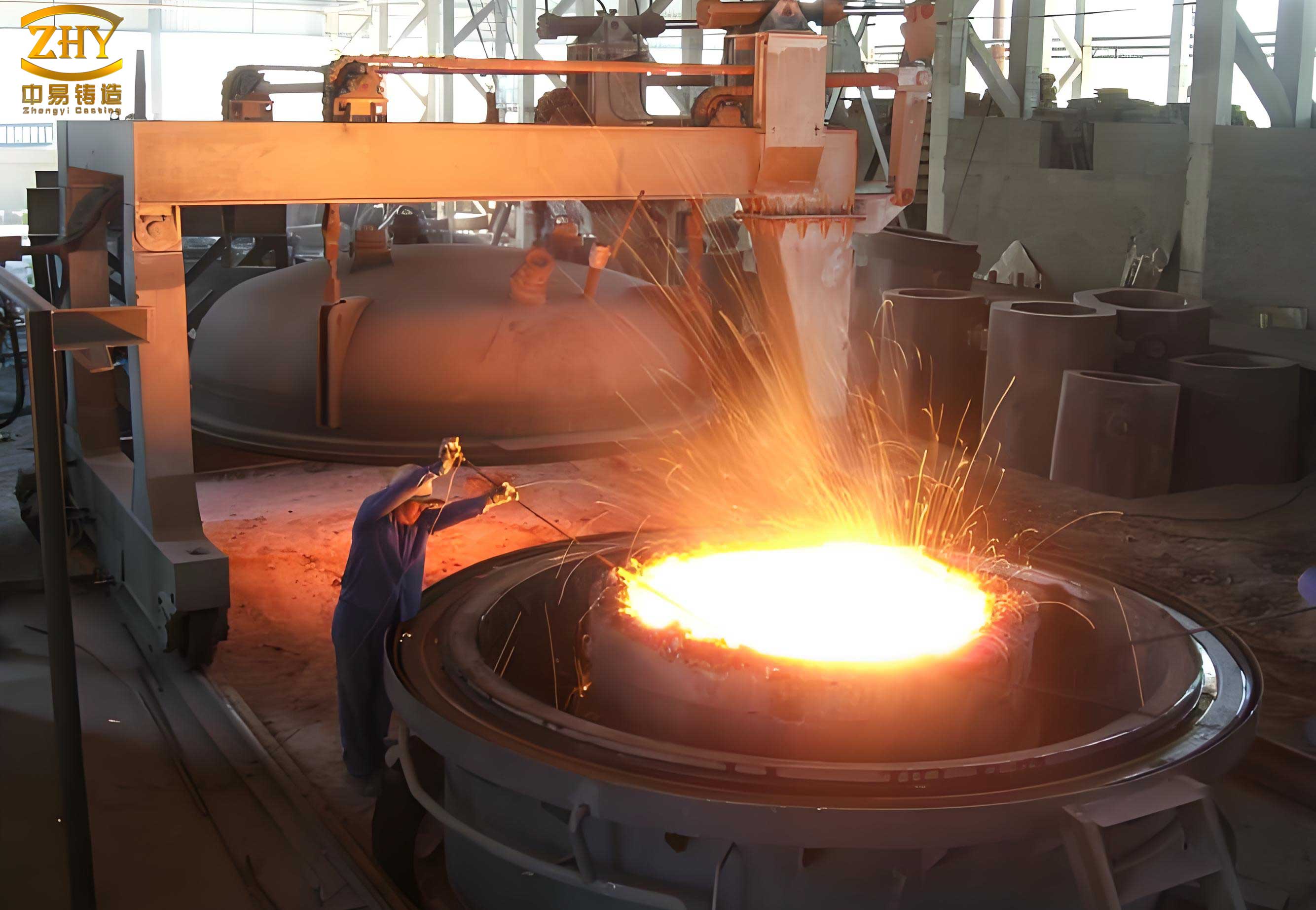
The journey to a successful heat treatment begins before the casting even enters the furnace. Preparation of the high manganese steel casting is paramount. All adhering sand, fins, and gating system remnants must be thoroughly removed. Sand acts as an insulator, creating temperature gradients during both heating and cooling, which can lead to uneven microstructures and stress. Thin fins are prone to decarburization during heating; subsequent quenching can transform this decarburized layer into martensite. The martensitic transformation, accompanied by a volume expansion, can induce tensile stresses in the adjacent base metal, potentially initiating cracks. The inherent physical properties of high manganese steel make it particularly sensitive to thermal shocks. Its thermal conductivity ($\kappa$) is remarkably low, approximately 1/4 to 1/6 that of plain carbon steel at 100°C, only improving to about 1/2 to 5/7 at 600°C. Concurrently, its coefficient of thermal expansion ($\alpha$) is nearly double that of carbon steel, and this disparity increases above 500°C. These factors, combined with significant casting stresses from complex geometries (like a crossing with variable section thickness), necessitate extreme care during heating to avoid crack formation from superimposed thermal and residual stresses.
We can classify the treatment of high manganese steel casting based on their entry temperature into the furnace: “hot” casting treatment and “cold” casting treatment. While treating castings while they are still hot from mold stripping (hot treatment) seems energy-efficient, in practice it introduces severe risks. The initial temperature of individual castings can vary widely due to different shakeout times, seasonal ambient temperatures, and their position in the batch. Placing a cooler casting into a hot furnace, or vice-versa, creates massive thermal gradients. Our refined practice, therefore, dictates a more controlled approach. For both scenarios, the castings should be loaded into the furnace at a standardized, lower temperature. “Hot” castings are cooled to approximately 150°C, while “cold” castings are brought to room temperature. Once loaded, a homogenizing soak of 1.0 to 1.5 hours is applied before initiating the programmed heating.
The heating rate below 650°C is critical and must be slow. In this temperature range, two detrimental phenomena can occur: further precipitation of carbides and, in some cases, a partial isothermal transformation to pearlite. The kinetics of carbide precipitation can be influenced by composition, particularly carbon and phosphorus content. A higher level of these elements generally necessitates an even slower heating rate to avoid embrittlement. Our optimized heating curve establishes a rate of 90°C/h from 150°C to 650°C for both hot and cold castings, with an even more cautious 70°C/h for cold castings starting from room temperature up to 150°C. Upon reaching 650-700°C, a holding period of 1-2 hours is essential. At this temperature, the steel transitions from elastic to plastic behavior, allowing for the relief of casting stresses. Furthermore, the previously formed carbides begin to dissolve back into the austenite, improving ductility. After this stress-relief plateau, the heating rate can be significantly increased, often to 150°C/h or more, up to the final solution treatment temperature.
The selection of the solution treatment temperature (water toughening temperature) is a balance between complete carbide dissolution and microstructural degradation. Standards typically specify a range of 1000-1100°C. The dissolution of (Fe,Mn)3C carbides is a diffusion-controlled process. The driving force and diffusion rates increase with temperature. While 1000°C may be sufficient for basic dissolution, a temperature in the range of 1050-1100°C is preferred to ensure complete dissolution, enhance chemical homogeneity, and improve the solution strengthening effect. However, this window is narrow. Exceeding approximately 1100°C leads to rapid austenite grain growth. At 1150°C, severe overheating occurs, characterized by coarse grains and the possible formation of eutectic carbides at grain boundaries. Unlike the secondary carbides, these eutectic carbides are irreversible; they cannot be dissolved by subsequent heat treatment and permanently embrittle the high manganese steel casting. Excessive temperature also accelerates surface decarburization, depleting the carbon necessary for work-hardening in the critical surface layer. The relationship between grain size ($d$), temperature ($T$), and time ($t$) often follows a kinetic equation of the form:
$$ d^n – d_0^n = K t \exp\left(-\frac{Q}{RT}\right) $$
where $d_0$ is the initial grain size, $n$ is the grain growth exponent, $K$ is a constant, $Q$ is the activation energy for grain growth, and $R$ is the gas constant. This underscores the exponential acceleration of grain coarsening with temperature.
The holding time at the solution temperature must be sufficient for complete austenitization and homogenization but not so long as to promote excessive grain growth. The required time depends on the casting’s section thickness and the initial carbide dispersion. Empirical data, as summarized in the table below, provides clear guidance. A holding time of 0.5 hours is insufficient, leading to undissolved carbides and suboptimal properties. A 2-hour hold typically yields the best combination of strength, ductility, and impact toughness. Prolonging the hold to 3 hours offers no benefit and can lead to a decrease in key properties like impact energy, likely due to incipient grain growth.
| Holding Time (h) | Yield Strength, $\sigma_{0.2}$ (MPa) | Tensile Strength, $\sigma_b$ (MPa) | Elongation, $\delta$ (%) | Reduction of Area, $\psi$ (%) | Impact Energy, $\alpha_k$ (J/cm²) |
|---|---|---|---|---|---|
| 0.5 | 389.3 | 789.4 | 41.5 | 32.4 | 263.8 |
| 1.0 | 407.0 | 739.4 | 28.2 | 32.5 | 267.7 |
| 2.0 | 394.2 | 769.8 | 33.3 | 34.8 | 281.5 |
| 3.0 | 400.1 | 751.2 | 32.4 | 37.4 | 232.4 |
The success of the entire process culminates in the quenching operation. The goal is to cool the homogeneous austenite so rapidly that there is no time for carbon to precipitate as carbides during cooling. The critical temperature range for carbide precipitation starts just below the solution temperature, with significant kinetics below about 900°C. Therefore, the transfer time from furnace to quench tank must be minimized, ideally to under 60 seconds, ensuring the casting enters the quenchant above 900°C. The quenchant is almost always water. The cooling capacity must be substantial. The water volume should be 8-10 times the mass of the charge to limit temperature rise. The quench bath should be deep enough to fully submerge the high manganese steel casting and should ideally be equipped with agitation (air bubbles or mechanical movement) to disrupt steam blankets and ensure uniform, high-speed cooling. The incoming water temperature should be below 30-45°C, and the post-quench temperature should not exceed 60°C. The required cooling rate to suppress carbide formation is on the order of 30°C/s or higher through the critical range. The detrimental effect of delayed or slowed cooling is starkly evident in mechanical property tests, as shown in the following comparison:
| Cooling Condition | Bending Strength (MPa) | Deflection (mm) |
|---|---|---|
| 1050°C, 90 min hold, direct water quench | 909.0 | 61 |
| 1050°C, 90 min hold, furnace cool for 2 min then water quench | 884.6 | 56 |
| 1050°C, 90 min hold, air cool for 2 min then water quench | 877.7 | 53 |
An often-overlooked but practically significant factor is the arrangement of castings within the furnace. In a car-bottom or bogie hearth furnace, the position of a specific high manganese steel casting influences its exposure to heat sources, gas flow, and radiant heat from other castings. Statistical analysis of crack occurrence reveals distinct patterns. For instance, in a five-layer arrangement, castings in the middle layers (e.g., layer 3) often exhibit a higher probability of cracking compared to those on the top or bottom. This is attributed to poorer gas circulation and shadowing effects, leading to less uniform heating. Similarly, castings positioned near burner ports or at the furnace edges, where radiant heat flux is most intense, are also more prone to thermal shock and cracking during the initial heating stages. The geometry of the high manganese steel casting itself plays a role; a complex crossing with drastic thickness variations is inherently more susceptible to stress concentration than a simpler plate casting. Therefore, furnace loading patterns must be designed to maximize temperature uniformity across all castings, sometimes requiring sacrificial dummy loads or strategic spacing.
The final microstructure and properties of a properly heat-treated high manganese steel casting are a testament to this precise control. The single-phase austenitic matrix has a hardness of approximately 200-250 HB but possesses extraordinary ductility and toughness, with elongation often exceeding 40%. The true magic of this material lies in its service performance: under impact or high-stress abrasion, the surface layer work-hardens dramatically to levels exceeding 500 HB, while the tough core absorbs energy and prevents catastrophic fracture. This transformation is driven by the formation of mechanical twins and dislocation networks, a process enabled by the low stacking fault energy of the high-manganese austenite. The work-hardening behavior can be described by relationships like the Hollomon equation: $\sigma = K \epsilon^n$, where the work-hardening exponent ($n$) for high manganese steel is exceptionally high.
In conclusion, the heat treatment of high manganese steel casting is a non-negotiable, precision-driven science. It transforms a brittle, as-cast structure into one of the most durable and uniquely adaptive engineering materials. The process demands respect for the material’s poor thermal conductivity and high expansion coefficient through controlled, staged heating. It requires a precise solution treatment window to dissolve carbides without causing grain coarsening or eutectic formation. It culminates in an aggressive quench that must be fast enough to outrun the precipitation kinetics of embrittling phases. Every step, from charge preparation and furnace loading to the final water quench parameters, must be meticulously planned and executed. Deviations at any stage directly manifest as reduced toughness, cracking, or poor in-service work-hardening capability. Therefore, mastering the water toughening process is synonymous with mastering the performance potential of the high manganese steel casting, ensuring its reliability in the most demanding impact and abrasion applications.