
The lost wax investment casting process using plaster molds is a critical technique for producing complex, thin-walled, and high-precision aluminum alloy castings. The properties of the final casting are intimately tied to the quality of the plaster mold, which is predominantly determined by its baking, or firing, cycle. An improper baking schedule can lead to severe defects, primarily due to the evolution of gases during metal pouring. This article details an investigation into optimizing the plaster mold baking process to eliminate such defects, based on experimental trials and precise in-mold temperature measurements.
In the context of lost wax investment casting, the plaster mold serves as a single-use, precision refractory. Its formulation typically includes a blend of calcium sulfate hemihydrate (plaster), refractory fillers like silica, and additives to control setting time and strength. After the wax pattern is invested and the plaster sets, the critical drying and firing stages begin. The primary objectives of baking are:
- Complete Elimination of Free and Chemically Bound Water: The plaster contains both free water from the slurry and water of crystallization (chemically bound). Inadequate removal leads to steam explosion or violent gas generation (choking fire) upon contact with molten metal.
- Controlled Burnout of Wax Residues: While most wax is removed during dewaxing, some residue may remain and must be cleanly oxidized.
- Development of Necessary Mold Strength and Permeability: The sintering of the plaster and filler particles during high-temperature soaking imparts sufficient hot strength to withstand metalostatic pressure and minimizes further gas generation.
The initial, standard baking process followed for shell-shaped castings was as follows:
- Heating Rate: ≤ 50 °C/h.
- Hold Stages: 2-2.5 hours at 300 °C and again at 500 °C.
- Venting: Initiate exhaust fan and open furnace valves at 350-400 °C.
- Final Soak: 15-40 hours at 680-720 °C (duration based on mold size).
- Cooling Rate: ≤ 50 °C/h down to the prescribed pouring temperature, followed by a hold of ≥ 6 hours.
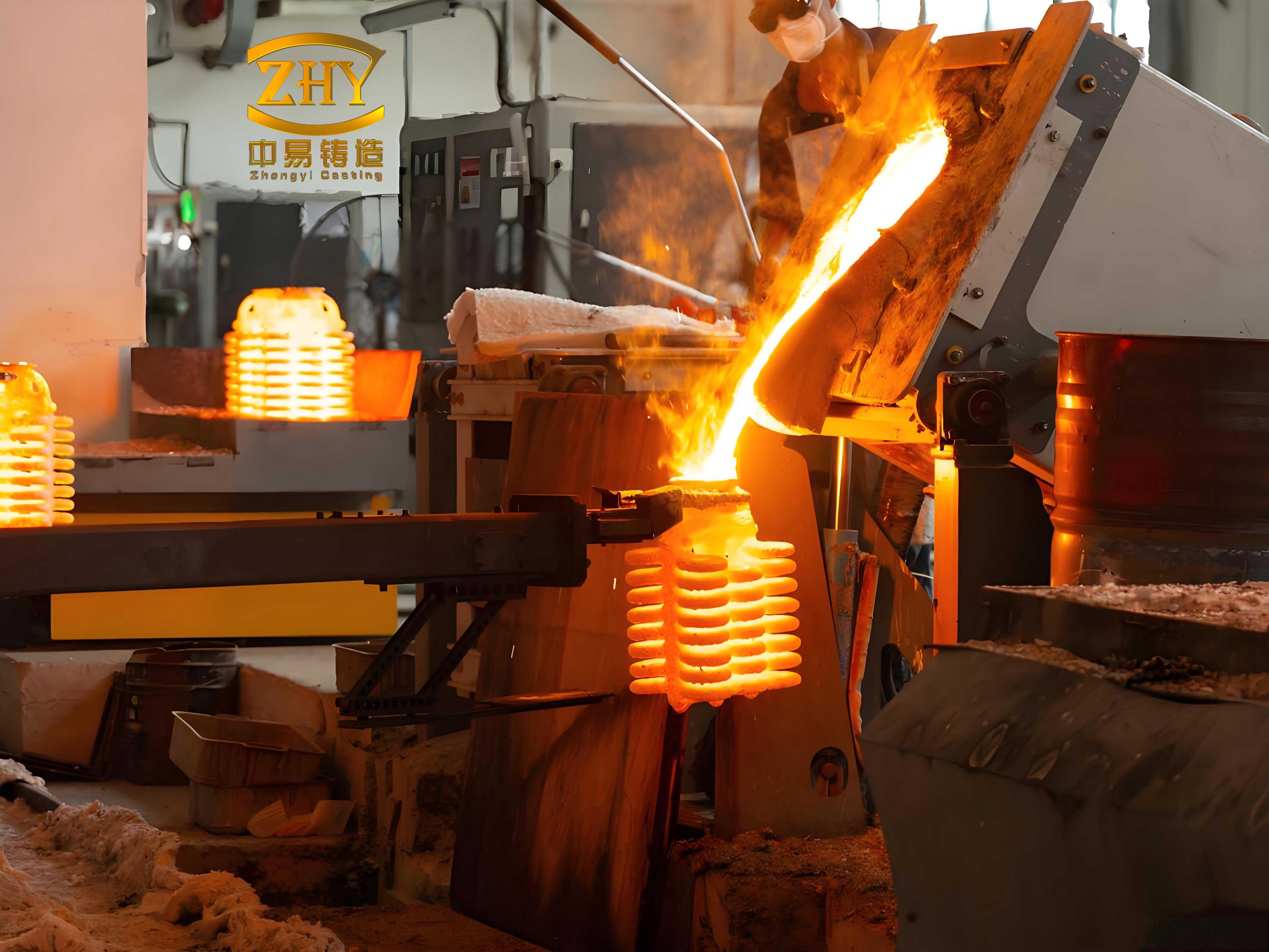
Application of this standard cycle resulted in an unacceptably high scrap rate. The dominant failure mode was severe surface defects characterized by pitting, scabbing, and bloated surfaces, as shown in the referenced figure. Metallurgical analysis confirmed these were not shrinkage defects but were caused by “choking fire” – a violent reaction at the metal-mold interface due to rapid gas evolution. Given the inherently low permeability of plaster molds, this pointed conclusively to insufficient removal of volatiles (water, organics) during the baking stage.
Methodology for Process Optimization
The core hypothesis was that the standard temperature profile, based on furnace ambient temperature, did not accurately represent the thermal conditions within the thick, low-thermal-conductivity plaster mold. A significant thermal lag existed. To optimize the cycle, it was essential to control the process based on the actual temperature inside the mold.
A new experimental methodology was adopted:
- In-Mold Temperature Monitoring: During the investment (pouring of plaster slurry around the wax cluster), sheathed thermocouple wires were strategically embedded deep within the plaster mass of a representative production mold (e.g., a complex shell mold).
- Real-Time Profile Recording: During subsequent baking, the temperature from these embedded thermocouples was recorded continuously alongside the furnace ambient temperature.
- Iterative Process Validation: Multiple baking trials were conducted with varying time-temperature profiles. The quality of the resulting aluminum alloy castings was the ultimate validation metric. The goal was to find the profile that reliably produced sound castings.
The relationship between the furnace temperature ( \( T_f \) ) and the mold core temperature ( \( T_c \) ) can be modeled simplistically by considering the heat transfer through the plaster, which has a low thermal diffusivity \( \alpha \). The temperature lag \( \Delta T_{lag} \) and the time \( t \) to reach a target core temperature are not linear. A more relevant approach is to ensure the core temperature history satisfies the dehydration kinetics of the plaster. The critical parameter is the time-integrated thermal exposure at the core.
Experimental Results and Analysis
The key finding from the in-mold measurements was a substantial delay in the core reaching critical dehydration temperatures. The standard holds at 300°C and 500°C (furnace temperature) were too short when considering the actual core temperature. The following table summarizes the different baking schedules tested and their outcomes on the shell casting.
| Scheme | Initial Hold (Furnace Temp. & Time) |
Intermediate Hold (Furnace Temp. & Time) |
Final Soak (Furnace Temp. & Time) |
Casting Result |
|---|---|---|---|---|
| Scheme 1 (Original) | 300°C × 2.5 h | 500°C × 2.5 h | 680°C × 25 h | Severe choking fire, deep pitting and shrinkage cavities. |
| Scheme 2 | 300°C × 5 h | 500°C × 2.5 h | 720°C × 28 h | Choking fire present, with surface peeling and blistering. |
| Scheme 3 | 250°C × 5 h | 500°C × 8 h | 700°C × 25 h | Minor choking fire and surface peeling. |
| Scheme 4 (Optimized) | 250°C × 10 h | 500°C × 8 h | 730°C × 20 h | No choking fire. Sound casting with good surface finish. |
The progression is clear. Schemes 1 and 2, with shorter low-temperature holds, failed to adequately remove lower-temperature volatiles. Extending the hold at 250-300°C (Scheme 3) showed improvement. The final optimized profile (Scheme 4) features a significantly extended low-temperature dehydration stage (10h at 250°C) and a prolonged intermediate stage (8h at 500°C) to ensure complete removal of chemically bound water from the plaster’s gypsum (CaSO₄·2H₂O) before decomposition. The final soak temperature was slightly increased to 730°C to ensure proper sintering of the refractory filler, thereby stabilizing the mold and minimizing late-stage gas generation. Venting was also initiated earlier, at 250-300°C, to actively remove evolved vapors.
The successful baking curve for the complex shell mold, derived from in-mold data, is characterized by the following equation for the heating and holding phases, where \( T_m(t) \) is the target mold core temperature over time \( t \):
$$
T_m(t) =
\begin{cases}
50t & \text{for } 0 \leq t \leq 5 \, \text{h} \quad (\text{Ramp to } 250^\circ\text{C}) \\
250 & \text{for } 5 < t \leq 15 \, \text{h} \quad (\text{Extended Hold}) \\
250 + 25(t-15) & \text{for } 15 < t \leq 25 \, \text{h} \quad (\text{Ramp to } 500^\circ\text{C}) \\
500 & \text{for } 25 < t \leq 33 \, \text{h} \quad (\text{Intermediate Hold}) \\
500 + 20(t-33) & \text{for } 33 < t \leq 44.5 \, \text{h} \quad (\text{Ramp to } 730^\circ\text{C}) \\
730 & \text{for } 44.5 < t \leq 64.5 \, \text{h} \quad (\text{Final Soak})
\end{cases}
$$
Where the heating rate in °C/h is constrained by \( \frac{dT_m}{dt} \leq 50 \). The cooling phase follows a similar constraint: \( \frac{dT_m}{dt} \geq -50 \) until reaching the pouring temperature of ~250°C, where it is held for stabilization.
The Optimized Baking Process for Plaster Molds in Lost Wax Investment Casting
Based on multi-cycle verification, the generalized, optimized baking process for complex plaster molds in lost wax investment casting is defined as follows. This process emphasizes control based on the thermal state of the mold itself, accounting for its geometry and complexity.
- Heating Phase: A controlled heating rate not exceeding 50 °C/h (furnace ambient) is maintained to prevent thermal stress cracking.
- Critical Dehydration Holds:
- Low-Temperature Hold: A prolonged hold at 250 °C for 8 to 20 hours. This extended duration is crucial for the complete removal of free water and the onset of bound water release without causing excessive pressure build-up. Venting (exhaust fans, open furnace valves) must be activated during the ramp to this temperature (250-300°C) and maintained.
- Intermediate-Temperature Hold: A second prolonged hold at 500 °C for 8 to 20 hours. This stage ensures the complete decomposition of calcium sulfate dihydrate into the anhydrous form, a major source of potential gas if incomplete.
$$ \text{CaSO}_4\cdot2\text{H}_2\text{O} \xrightarrow{\Delta} \text{CaSO}_4 + 2\text{H}_2\text{O}\uparrow $$
The time at this stage is critical for the diffusion of released water vapor out of the thick mold sections.
- Final Sintering Soak: The mold is heated to a final temperature between 700 °C and 730 °C and held for 10 to 30 hours. The exact temperature and time depend on mold size, wall thickness, and the specific refractory filler used. This stage sinters the mold, developing adequate hot strength and dimensional stability, and ensures any residual carbonaceous materials are eliminated.
$$ \text{SiO}_2 (\text{filler}) + \text{surface interactions} \rightarrow \text{Sintered network} $$ - Cooling and Stabilization Phase: The mold is cooled at a rate ≤ 50 °C/h to the intended pouring temperature (typically around 250°C for many aluminum alloys). It is then held at this temperature for a minimum of 6 hours to achieve thermal uniformity before the lost wax investment casting pour.
The success of this optimized protocol lies in its acknowledgment of the kinetics of dehydration and diffusion within a low-permeability medium. The extended holds provide the necessary time for moisture to travel from the core to the surface, governed by diffusion laws. The flux \( J \) of vapor can be approximated by Fick’s first law, where the driving force is the concentration gradient \( \frac{dC}{dx} \) established by the temperature profile:
$$ J = -D_{eff}(T) \frac{dC}{dx} $$
Here, \( D_{eff}(T) \) is the effective temperature-dependent diffusion coefficient of water vapor through the porous plaster matrix. The optimized schedule maximizes \( J \) over a sufficient time \( t \) without letting \( \frac{dC}{dx} \) (and thus internal pressure) become dangerously high.
Conclusion
This study underscores that the baking process is the most critical control point in the lost wax investment casting of aluminum alloys using plaster molds. Relying solely on furnace ambient temperature profiles is insufficient for complex, thick-sectioned molds due to significant thermal lag. The implementation of direct in-mold temperature monitoring was pivotal in diagnosing the root cause of choking fire defects.
The derived optimized baking schedule, characterized by significantly extended holds at 250°C and 500°C, a final soak at 730°C, and controlled heating/cooling rates, ensures the complete and gradual removal of all volatiles. This process transforms the plaster mold from a potential source of gas defects into a stable, sintered refractory capable of producing high-integrity castings. The methodology of tailoring the thermal profile to the actual mold core temperature and the mold’s geometric complexity provides a robust framework for qualifying baking processes for new components in lost wax investment casting, ensuring that complex thin-walled aluminum castings meet stringent technical requirements.