
In my extensive experience within a manganese steel casting foundry, I have observed that the in-service failure of critical components like grates, liner plates, and bucket teeth is seldom due to a single factor. More often, it is the synergistic result of shrinkage cavities, porosity, and micro-shrinkage coalescing into what we term “gas-shrinkage brittleness.” To consistently produce sound, high-performance castings and improve yield rates, every single stage of the foundry process must be meticulously controlled. This requires a disciplined, detail-oriented approach from initial pattern design and molding through alloy composition control, melting, pouring, shakeout, and final heat treatment. Only through rigorous standardization across all these production links and attention to intricate process details can we effectively prevent or eliminate casting defects.
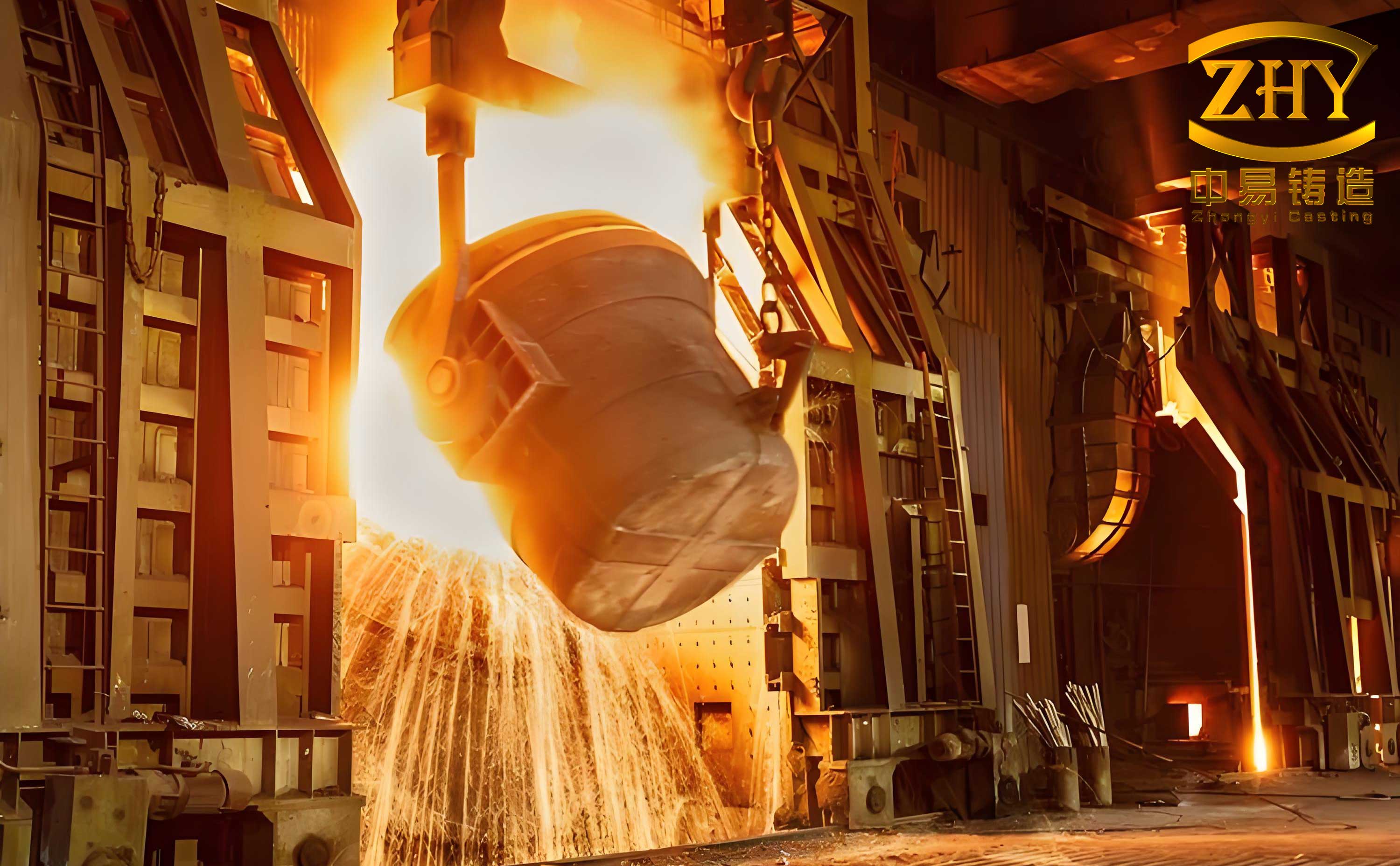
The successful operation of a manganese steel casting foundry hinges on understanding the unique challenges posed by this material. Austenitic manganese steel (Hadfield steel) possesses exceptional work-hardening capability and toughness, but its low thermal conductivity and high expansion coefficient make it particularly susceptible to certain defects during the solidification and heat treatment phases. Let’s delve into the most common issues, their root causes from a foundry perspective, and the systematic preventive measures we implement.
1. Penetration and Burn-on (Scabbing)
This defect manifests as a layer of fused sand adhering tenaciously to the casting surface, increasing cleaning costs and potentially causing surface irregularities.
Root Causes in the Manganese Steel Casting Foundry:
- Mechanical Penetration: Insufficient mold compaction, a rough mold surface, or the use of low-quality mold washes can allow molten steel to infiltrate the inter-sand voids, mechanically locking sand grains onto the casting surface.
- Chemical Burn-on (Reaction): This is particularly prevalent in manganese steel. The steel contains significant amounts of the basic oxide MnO. When the molten metal contacts the acidic silica (SiO₂) in conventional molding sand, a chemical reaction occurs, forming low-melting-point manganese silicate slag: $$ \text{MnO} + \text{SiO}_2 \rightarrow \text{MnO}\cdot\text{SiO}_2 $$ This slag wets and fuses with the sand grains, creating a hard, glassy layer that is extremely difficult to remove.
Preventive Measures for the Foundry:
| Target | Specific Action | Rationale |
|---|---|---|
| Improve Mold Quality | Utilize metal pattern plates and standardized flasks. Employ facing sand with finer grain size. | Enhances mold dimensional accuracy and compaction, reducing pore size for metal penetration. |
| Mitigate Chemical Reaction | For cores, use basic refractory materials like magnesite bricks or cores. | Eliminates the SiO₂ source that reacts with MnO. |
| Optimize Mold Coating | Replace fireclay-based washes with basic, high-refractoriness coatings like olivine or magnesia-based slurries. Control coating thickness to ≤1mm without pooling. | Creates a stable, inert barrier between the molten manganese steel and the silica sand mold, preventing the chemical reaction. |
2. Gas Porosity and Pinholes
These appear as spherical or elongated cavities within the casting wall, often with a smooth, shiny surface. They significantly reduce the effective load-bearing area and can act as stress concentrators.
Root Causes in the Manganese Steel Casting Foundry:
- Molding Materials: Excessive clay content or improper mulling can create “clay balls” and reduce permeability. Upon contact with molten steel, these wet clay agglomerates generate large volumes of gas which can be trapped.
- Inadequate Drying: Insufficiently dried molds and cores, or “hot” mold assembly followed by prolonged waiting before pouring, release moisture into the casting cavity.
- Gating System Design & Pouring Practice: A poorly designed gating system that causes turbulent metal entry can aspirate air into the stream. Excessively fast pouring rates do not allow gases displaced from the mold cavity to escape through the vents.
Preventive Measures for the Foundry:
| Aspect | Control Parameter | Implementation |
|---|---|---|
| Gating Design | Employ a well-proportioned open system. | Use the ratio: $$ \sum F_{\text{runner}} > \sum F_{\text{gate}} > \sum F_{\text{sprue}} $$ A typical ratio is 1 : (1.0~1.1) : (1.0~1.4). The sprue size is matched to the ladle nozzle. This ensures laminar, non-aspirating fill. |
| Mold/Core Preparation | Control moisture, gas evolution, and permeability. Ensure thorough drying and venting. | Strictly control sand properties. Provide ample venting channels (pins, vents) in cores and molds to facilitate gas escape. |
| Metal Treatment | Implement proper “killing” or holding time. | Allow the ladle to sit for a calculated time after tapping to let entrapped gases float out. The holding time is based on the liquid steel’s skin-forming tendency, as shown in the table below. |
The relationship between solidification skin time and required holding time is critical for a manganese steel casting foundry:
| Skin Formation Time (seconds) | Recommended Holding Time (seconds) |
|---|---|
| < 11 | 0 |
| 12 – 14 | 2 – 3 |
| 15 – 18 | 3 – 8 |
| 19 – 22 | 8 – 14 |
| 23 – 25 | 14 – 18 |
| 26 – 30 | 18 – 22 |
3. Coarse Grain Structure
Austenitic manganese steel has a notoriously low thermal conductivity, approximately: $$ \lambda_{\text{manganese steel}} \approx \frac{1}{4} \text{ to } \frac{1}{3} \lambda_{\text{carbon steel}} $$ This results in very slow solidification, promoting a mushy or pasty mode. The prolonged period in the solid-liquid region allows dendrites to grow extensively, often forming large columnar grains. This coarse microstructure drastically reduces ductility and impact toughness in the as-cast state.
Preventive Measures for the Foundry:
- Grain Refinement through Inoculation: While not a conventional grain refiner like in aluminum, increasing the final deoxidizer addition can promote heterogeneous nucleation. Typically, Aluminum (Al) is added at 0.1% of the tap weight. To enhance its effect, we increase this to ~0.2%. The goal is to achieve a residual Al content (wAl) > 0.08%. The Al reacts with dissolved nitrogen and can form high-melting-point AlN particles or complex Al-P compounds, which can act as nucleation sites. This also helps tie up phosphorus. The effect can be conceptualized as increasing the number of nucleation sites (N) to reduce the final grain size (d): $$ d \propto \frac{1}{\sqrt[3]{N}} $$
- Controlled Pouring Temperature: This is paramount. There is a direct correlation between pouring temperature (Tpour) and grain size. Higher superheat increases the thermal gradient and extends the solidification time (tsolid), allowing for greater grain growth. We enforce a strict “low-temperature pouring” policy. The target range is 1360°C to 1420°C, calibrated for the specific casting section thickness.
4. Cracks (Hot Tears and Quench Cracking)
Cracking is the most catastrophic defect for a manganese steel casting foundry, leading to immediate scrap. It can occur during cooling in the mold (hot tears) or during heat treatment (quench cracking).
Root Causes:
- Foundry Process Design: Improper placement of gates and risers can create unfavorable thermal gradients and hinder sequential solidification, inducing high thermal stresses. Rough handling during shakeout or sudden cooling (e.g., water spray) on the brittle as-cast structure (austenite + carbides) can also cause fracture.
- Chemical Composition: Two elements are critical:
- Phosphorus (P): A severely detrimental tramp element. P segregates strongly to austenite grain boundaries during solidification, drastically reducing intergranular cohesion. Its solubility in austenite decreases with increasing carbon content, exacerbating segregation. It can form low-melting, brittle phosphide eutectics (e.g., Steadite) along grain boundaries, which are perfect initiation sites for cracks under stress. The embrittlement effect is nonlinear and severe above ~0.05% P.
- Carbon (C) and Manganese-to-Carbon Ratio: If the Mn/C ratio is less than approximately 8, even after standard solution treatment, a continuous or semi-continuous network of carbides may persist at grain boundaries. This, combined with P segregation, makes the steel extremely brittle. The relationship can be expressed as a critical factor for toughness: $$ \text{Toughness} \propto \frac{Mn}{C} \quad \text{for Mn/C > 8} $$ Excessive carbon also lowers the solubility of P in austenite, as per the interaction coefficient.
- Heat Treatment (Water Quenching): The combination of low thermal conductivity and high thermal expansion coefficient (≈ 2x that of carbon steel) makes ZGMn13-1 extremely prone to thermal shock. Incorrect heating rates through the low-temperature range (<600°C) where the material is still brittle can generate stresses exceeding its low hot strength, causing cracking.
Comprehensive Preventive Measures for the Foundry:
| Process Stage | Preventive Action |
|---|---|
| Pattern & Process Design | Minimize machining allowance (3-5mm, max 10mm). Use negative tolerance on external dimensions, positive on internal. Employ washburn/kalmin sleeves for risers to ease removal. Distribute gating to avoid hot spots. |
| Shakeout & Handling | Calculate shakeout time based on wall thickness (~1 min/5mm). Shakeout and “relieve” the mold to allow initial contraction. NEVER water-quench or place hot castings in drafts. Handle carefully to avoid impact. Cut-off risers with sleeves while casting is still above 400°C if possible. |
| Pre-Quench Preparation | Before loading into the furnace, remove all gates, risers, fins, and flash by grinding or hammering. If torch-cutting is necessary, leave ample stock for final machining post-quench to avoid exposing the heat-affected zone in service. |
| Water Quench (Solution Treatment) | This is the most critical step. The heating cycle must be strictly controlled based on casting complexity and section thickness (t). The general rule is: For t < 25mm: Heating rate ≈ 70°C/h to 600°C. For t = 25-50mm: Heating rate ≈ 50°C/h to 600°C. For t > 75mm & complex shapes: Heating rate ≈ 30-50°C/h to 600°C. Above 600°C, the rate can increase to 100-150°C/h up to the solution temperature (typically 1050-1100°C). Soak time is critical to dissolve carbides: $$ t_{\text{soak}} (\text{hours}) \approx \frac{\text{Max Section Thickness (mm)}}{25} $$ (Typically 2-4 hours). The transfer from furnace to quench tank must be rapid (< 2 minutes) to prevent temperature drop below ~950°C. Quench water temperature should be maintained between 10-30°C, never exceeding 60°C to prevent carbide re-precipitation. For large batches, use cooling systems or dry ice to manage water temperature. |
The standard water-quench heat treatment cycle practiced in a modern manganese steel casting foundry can be summarized by the following schematic procedure, which is crucial for achieving the desired austenitic microstructure free of harmful carbides:
$$ \text{Room Temp} \xrightarrow[\text{Rate: 30-70°C/h}]{\text{Slow Heat}} 600^\circ\text{C} \xrightarrow[\text{Rate: 100-150°C/h}]{\text{Faster Heat}} T_{\text{solution}} (1050^\circ\text{C}-1100^\circ\text{C}) $$ $$ \xrightarrow[t_{\text{soak}} = \frac{t}{25} \text{ h}]{\text{Soak}} \xrightarrow[\Delta t < 2 \text{ min}]{\text{Rapid Transfer}} \text{Water Quench (10-30°C)} \rightarrow \text{Austenitic Matrix} $$
In conclusion, achieving high integrity in manganese steel castings is a holistic endeavor. It demands not just isolated adjustments but a fully integrated quality system within the manganese steel casting foundry. From selecting the right refractory materials to counteract chemical reactivity, to designing gating for laminar flow, to enforcing strict chemical limits on P and C, and finally to executing a perfectly controlled heat treatment cycle—each step is interlinked. The prevention of coarse grains, porosity, and cracks is fundamentally about managing thermal and stress histories throughout the casting’s journey from liquid to finished component. By treating the entire process chain as a single, optimized system, a manganese steel casting foundry can reliably produce defect-free castings that meet the severe demands of impact and abrasion service.