
In industrial applications, abrasive wear stands as one of the most prevalent forms of material degradation, accounting for approximately 50% of all machine component failures. The economic impact is substantial, with millions of tons of steel consumed annually in manufacturing wear-resistant parts for crushing cement, coal powder, ores, and other abrasive materials. Enhancing the service life of these components through improved material selection and design can lead to significant cost savings and productivity gains. This study focuses on the abrasive wear behavior and wear resistance of white cast iron, a material widely used in such demanding environments due to its high hardness and wear resistance. By investigating the wear mechanisms under abrasive conditions, I aim to provide insights for optimizing the performance of white cast iron through appropriate alloying and microstructure control.
White cast iron is characterized by its high carbon content, which leads to the formation of hard carbides, primarily cementite (Fe3C), embedded in a pearlitic or martensitic matrix. This microstructure imparts excellent resistance to abrasion, but the material’s toughness is often limited, making it susceptible to brittle fracture under impact or severe stress. To address this, various modification treatments, such as rare earth (RE) or niobium (Nb) additions, are employed to refine the carbide morphology and improve mechanical properties. In this work, I examine three series of white cast iron subjected to different modification treatments: rare earth-only modification, rare earth-silicon composite modification, and niobium-silicon composite modification. The goal is to correlate the material’s mechanical properties, particularly hardness and impact toughness, with its abrasive wear resistance and underlying wear mechanisms.
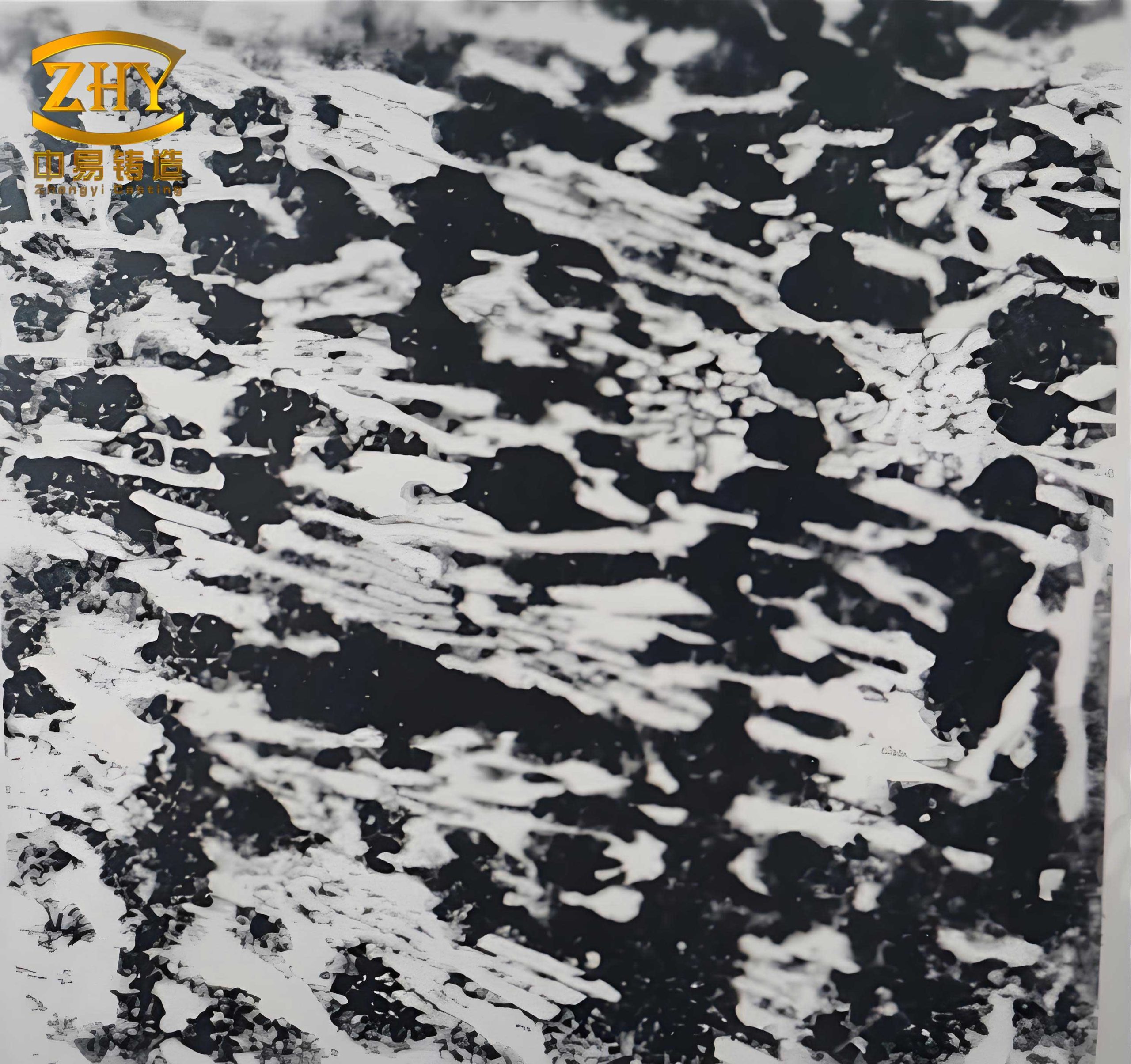
The experimental approach involved preparing white cast iron samples with specific chemical compositions, as detailed in Table 1. The base composition was designed to yield a hypereutectic white cast iron with high carbide volume fraction. Modification treatments were applied during melting and casting to alter the microstructure. After casting, samples were machined into standard specimens for mechanical testing and wear evaluation. All tests were conducted in a controlled laboratory environment to ensure reproducibility.
| Series | C | Si | Mn | Cr | Mo | Modification Type | Modifier Addition (wt.%) |
|---|---|---|---|---|---|---|---|
| Series A | 3.2-3.6 | 0.6-1.0 | 0.5-0.8 | 1.5-2.0 | 0.3-0.6 | Rare Earth (RE) Only | RE residual: 0.02-0.04 |
| Series B | 3.2-3.6 | 0.6-1.0 | 0.5-0.8 | 1.5-2.0 | 0.3-0.6 | RE-Si Composite | RE residual: 0.03-0.05, Si added |
| Series C | 3.2-3.6 | 0.6-1.0 | 0.5-0.8 | 1.5-2.0 | 0.3-0.6 | Nb-Si Composite | Nb: 0.1-0.3, Si added |
Modification treatments were performed at a temperature of 1450°C, with the melt poured into dry sand molds to produce impact toughness specimens (10 mm × 10 mm × 55 mm, unnotched) and wear specimens (Ø30 mm × 10 mm). The modification agents were added to the melt to promote carbide refinement and matrix strengthening. For instance, rare earth elements act as inoculants to reduce carbide size, while niobium forms hard NbC particles that enhance wear resistance. The processing parameters are summarized in Table 2.
| Parameter | Value |
|---|---|
| Melting Temperature | 1450°C |
| Modification Addition Temperature | 1450°C |
| Holding Time After Modification | 5 minutes |
| Casting Method | Dry Sand Mold |
| Cooling Rate | Approx. 10°C/s in mold |
Mechanical properties were evaluated through hardness and impact toughness tests. Hardness was measured on the wear specimen surfaces using a Rockwell hardness tester (HRC scale), with at least five readings per sample to ensure accuracy. Impact toughness was determined using a small pendulum-type impact tester with a span of 40 mm and unnotched specimens, as per standard practices. The results, averaged over multiple samples, are presented in Table 3.
| Series | Hardness (HRC) | Impact Toughness (J/cm²) |
|---|---|---|
| Series A (RE Only) | 58-62 | 4-6 |
| Series B (RE-Si) | 60-64 | 6-9 |
| Series C (Nb-Si) | 62-66 | 5-8 |
Abrasive wear tests were conducted on a custom-built abrasion tester simulating the ML-10 design. The working principle involves a rotating copper disc (Ø200 mm × 10 mm) against which the white cast iron specimen is pressed under a normal load, with quartz sand (80-100 mesh size) fed as the abrasive medium. The test parameters are listed in Table 4. Each test was run for a fixed duration, and weight loss was measured using an analytical balance with a precision of 0.1 mg. To quantify wear resistance, the relative wear resistance coefficient ε was calculated as follows:
$$ \varepsilon = \frac{\Delta W_s}{\Delta W_t} $$
where ΔWs is the weight loss of the standard sample (medium carbon steel, 0.45% C) and ΔWt is the weight loss of the white cast iron test sample. A higher ε value indicates better wear resistance. All tests were repeated three times to minimize error, with a maximum deviation of ±5%.
| Parameter | Value |
|---|---|
| Disc Material | Copper |
| Disc Dimensions | Ø200 mm × 10 mm |
| Disc Rotation Speed | 60 rpm |
| Abrasive Type | Quartz Sand |
| Abrasive Grain Size | 80-100 mesh (approx. 150-180 μm) |
| Abrasive Flow Rate | 200 g/min |
| Normal Load | 50 N |
| Test Duration | 30 minutes |
| Test Error | ±5% |
The wear resistance results for the white cast iron series are compiled in Table 5. It is evident that the modification treatments significantly influence the performance of white cast iron under abrasive conditions. Series A, with rare earth-only modification, showed the lowest wear resistance, while Series B and C exhibited substantial improvements. To further analyze the relationship between hardness and wear resistance, I plotted the data, which reveals a nonlinear trend: for Series A, increasing hardness led to only marginal gains in wear resistance, whereas for Series B and C, wear resistance increased markedly with hardness. This behavior is rooted in the distinct wear mechanisms operative in these materials.
| Series | Average Hardness (HRC) | Average Weight Loss (mg) | Relative Wear Resistance Coefficient (ε) |
|---|---|---|---|
| Series A (RE Only) | 60 | 120 | 1.5 |
| Series B (RE-Si) | 62 | 80 | 2.2 |
| Series C (Nb-Si) | 64 | 60 | 3.0 |
| Standard (Medium Carbon Steel) | 25 | 180 | 1.0 |
To elucidate the wear mechanisms, I examined the worn surfaces and wear debris using scanning electron microscopy (SEM). The morphology of wear tracks and debris provides critical insights into material removal processes. For white cast iron with low toughness (e.g., Series A), the dominant mechanism was brittle spalling or fracture. Under abrasive loading, the hard carbides in white cast iron can crack or detach from the matrix due to limited ductility, leading to large-scale material loss. This is described by a brittle fracture model where wear rate W can be expressed as:
$$ W = k_b \cdot \frac{H^{1/2}}{K_{IC}} \cdot F \cdot d $$
where kb is a material constant, H is hardness, KIC is fracture toughness, F is applied load, and d is abrasive particle size. In this case, even with high hardness, the low KIC of white cast iron in Series A results in poor wear resistance, as spalling occurs readily.
In contrast, for white cast iron with higher toughness (e.g., Series B and C), the wear mechanisms shifted to micro-cutting and plowing deformation. Here, abrasive particles slide across the surface, causing plastic deformation and gradual material removal through shear. The wear rate for such ductile materials can be approximated by the Archard wear equation modified for abrasion:
$$ W = k_d \cdot \frac{F \cdot L}{H} $$
where kd is a wear coefficient, L is sliding distance, and H is hardness. For white cast iron in Series B and C, the enhanced toughness, due to refined carbides and strengthened matrix from composite modifications, allows the material to resist crack propagation and sustain plastic flow, thereby reducing wear. The presence of hard phases like NbC in Series C further supports the matrix by bearing loads and deflecting abrasives, as quantified by a composite wear model:
$$ \varepsilon_{\text{composite}} = f_c \cdot \varepsilon_c + (1 – f_c) \cdot \varepsilon_m $$
where fc is the volume fraction of hard carbides, εc is the wear resistance of carbides, and εm is the wear resistance of the matrix. In white cast iron, increasing fc through Nb addition boosts overall wear resistance.
The SEM observations confirmed these mechanisms: Series A surfaces showed extensive cracking and carbide pull-out, while Series B and C exhibited smoother wear tracks with fine grooves indicative of micro-cutting. Wear debris from Series A consisted of large, angular fragments, whereas debris from Series B and C was finer and more granular. These findings align with the mechanical property data, underscoring the importance of balancing hardness and toughness in white cast iron for optimal abrasive wear resistance.
To generalize the results, I propose a wear mechanism map for white cast iron based on hardness and toughness, as summarized in Table 6. This map categorizes wear behavior into distinct regimes, guiding material selection for specific abrasive environments. For instance, in high-stress abrasion where impact is involved, white cast iron with higher toughness (e.g., from RE-Si modification) is preferred, whereas in low-stress abrasion, harder grades (e.g., from Nb-Si modification) may suffice.
| Material Condition | Dominant Wear Mechanism | Key Characteristics | Relative Wear Resistance |
|---|---|---|---|
| Low Toughness (High Brittleness) | Brittle Spalling/Fracture | Crack propagation, carbide detachment, large debris | Low to Moderate |
| Medium Toughness | Mixed Mode (Spalling + Micro-cutting) | Combined fracture and plastic deformation | Moderate |
| High Toughness | Micro-cutting and Plowing | Plastic flow, fine grooves, small debris | High |
The role of microstructure in white cast iron cannot be overstated. The distribution, size, and type of carbides critically influence wear resistance. For example, eutectic carbides in white cast iron typically form a network that can act as crack initiation sites if coarse. Modification treatments like rare earth or niobium addition refine this network, reducing mean free path and improving load-bearing capacity. The effect of carbide refinement on wear resistance can be modeled using a Hall-Petch type relationship for wear:
$$ \varepsilon \propto \frac{1}{\sqrt{d_c}} $$
where dc is the average carbide size. Smaller carbides enhance toughness and hinder crack growth, thereby boosting the wear resistance of white cast iron.
Furthermore, the matrix phase in white cast iron plays a complementary role. A martensitic matrix, achievable through heat treatment, offers high hardness and good support for carbides. The wear resistance of such white cast iron can be estimated by considering the composite nature. For instance, if the matrix is martensitic with hardness Hm and carbide hardness Hc, the overall wear resistance ε scales with the rule of mixtures:
$$ \varepsilon = V_c \cdot \varepsilon_c + V_m \cdot \varepsilon_m $$
where Vc and Vm are volume fractions of carbides and matrix, respectively. In practice, for white cast iron, Vc can range from 20% to 40%, depending on carbon content.
To optimize white cast iron for abrasive wear applications, I recommend a holistic approach that considers both composition and processing. Based on this study, composite modification with elements like niobium and silicon is highly effective, as it refines microstructure and introduces hard phases. The processing parameters, such as modification temperature and cooling rate, should be controlled to avoid excessive brittleness. For practical engineering, a trade-off between hardness and toughness is essential; a target hardness of 60-65 HRC with impact toughness above 6 J/cm² seems optimal for many abrasive scenarios.
In conclusion, the abrasive wear behavior of white cast iron is governed by a complex interplay of hardness, toughness, and microstructure. Through systematic testing and analysis, I have demonstrated that modification treatments significantly alter wear mechanisms: low-toughness white cast iron fails by brittle spalling, while high-toughness white cast iron resists wear through micro-cutting and plowing. The relative wear resistance coefficient ε serves as a useful metric for comparing materials. These insights can inform the selection and design of white cast iron components in industries facing abrasive wear challenges, ultimately leading to longer service life and economic benefits. Future work could explore the effects of other alloying elements or advanced heat treatments on the wear performance of white cast iron, further expanding its applicability in harsh environments.