
In the realm of advanced manufacturing, precision investment casting stands as a critical process for producing complex, near-net-shape components with exceptional dimensional accuracy and surface finish, particularly for demanding applications in aerospace, power generation, and medical implants. The pursuit of perfection in this process is a meticulous balancing act, governed by a multitude of interconnected variables. From the initial formation of the wax pattern to the final solidification of molten metal, each step harbors potential deviations that can compromise the integrity of the final casting. This analysis, drawn from extensive hands-on experience, delves into the core factors influencing dimensional precision and surface roughness, framing the discussion within the essential framework of robust process control for high-integrity precision investment casting.
The journey of a precision investment casting begins with the creation of a sacrificial pattern. The dimensional fidelity of the final metal part is intrinsically linked to the accuracy and stability of this wax prototype. Control starts at the very foundation: the environment. Wax blends, typically composed of natural and synthetic polymers with melting ranges between 50°C and 80°C, are highly sensitive to ambient conditions. I have observed that uncontrolled workshop temperatures can lead to measurable daily variations in pattern dimensions, often exceeding 0.2 mm seasonally. This thermal expansion and contraction of the wax model is a primary source of systemic error. Implementing and maintaining a stable workshop temperature between 21°C and 23°C is not merely advisable but economically justified and fundamental for repeatable precision investment casting.
Beyond environmental control, the pattern-making technique itself requires careful engineering. Thick sections in a wax pattern are prone to shrinkage cavities or sinks as the material cools and contracts. A common and effective practice is to insert pre-formed wax inserts or “chill blocks” into these areas of the die cavity before injection. This strategy serves a dual purpose: it reduces the effective thermal mass and cross-sectional variation of molten wax within the die, promoting more uniform cooling, and the inherent rigidity of the insert provides internal support, mitigating distortion caused by differential shrinkage stresses. The design and placement of these inserts are critical skills in optimizing the pattern for precision investment casting.
Furthermore, the cooling protocol post-ejection is frequently underestimated. Even after a standard holding time of one to two minutes within the die, the extracted wax pattern retains significant plasticity. Unsupported, free-air cooling allows residual thermal stresses to manifest as warpage or distortion. The solution lies in the use of conformal cooling fixtures—essentially negative molds replicated from the master die using materials like plaster or epoxy resin. The freshly ejected wax pattern is immediately placed into this fixture, often with a weighted top plate to ensure intimate contact, and allowed to cool fully to room temperature. The required dwell time in the fixture varies with the pattern’s geometric complexity but is indispensable for locking in dimensional accuracy in the preliminary stage of precision investment casting.
Once a dimensionally stable wax pattern is achieved, the focus shifts to the ceramic shell system, which forms the negative mold. The choice of refractory material profoundly impacts the casting’s final dimensions due to thermal expansion characteristics and high-temperature behavior. While fused silica is common, its numerous phase transformations and associated volume changes make it less suitable for the most demanding precision investment casting applications. Alternative materials like alumina (Al2O3) and calcined bauxite (mullite-rich, Al2O3-SiO2) are often preferred. To quantify their performance, I have conducted comparative analyses of shell systems bonded with silica sol, measuring key properties such as linear expansion, high-temperature flexural strength, and crucially, high-temperature deformation or creep.
| Shell System | CTE (20-1000°C), 10-6/K | Flexural Strength at 900°C (MPa) | Flexural Strength at 1300°C (MPa) | Deformation Rate at 1300°C (%) |
|---|---|---|---|---|
| Alumina – Silica Sol | ~8.2 | 117 | 53 | 5.0 |
| Calcined Bauxite – Silica Sol | ~5.8 | 104 | 52 | 1.7 |
The data reveals a critical insight. While the alumina shell exhibits higher hot strength at 900°C, its deformation rate at 1300°C is nearly three times greater than that of the calcined bauxite system. During the casting process, the shell is exposed to temperatures in the range of 1250-1300°C. At these temperatures, alumina begins to soften. As the metal solidifies and cools, it contracts, imposing significant stress on the surrounding shell. If the shell’s resistance to deformation (its hot creep strength) is low, it will yield, allowing the casting to distort. Therefore, for supreme dimensional control in precision investment casting, a shell material with a lower thermal expansion coefficient and superior resistance to high-temperature deformation, such as calcined bauxite, is often the superior choice despite a marginally lower mid-range strength.
The pursuit of excellence in precision investment casting extends beyond mere geometry to the very texture of the cast surface. For components like gas turbine blades, surface roughness directly impacts performance metrics such as fatigue life and aerodynamic efficiency. Achieving a smooth surface often involves a specialized surface coating or “face coat” applied to the initial wax pattern. This coat may contain grain refiners like cobalt aluminate (CoAl2O4) to promote fine, equiaxed surface grains for improved fatigue resistance. The formulation and application of this primary slurry are paramount.
The viscosity of this face coat slurry is arguably its most critical property. It must be precisely calibrated: too low, and the refractory “stucco” sand grains applied subsequently can penetrate to the pattern surface, creating embedded particles that manifest as rough “nodules” or “fins” on the final casting; too high, and the slurry cannot properly wet and coat the intricate details of the pattern, leading to voids and shell weakness. The viscosity $\eta$ of a slurry is a complex function of the binder properties, the solids loading $\phi$, and the particle size distribution of the refractory flour.
$$ \eta = \eta_0 e^{k\phi} $$
Where $\eta_0$ is the base viscosity of the binder and $k$ is a constant dependent on particle interactions. From experience, the target viscosity for a silica sol-based face coat often lies between 25 and 35 seconds (as measured by a Zahn or Ford cup). Deviating from this window consistently correlates with surface defects.
The binder itself can be modified. For instance, the addition of a wetting agent like ethanol (e.g., 20 wt%) to silica sol reduces surface tension, promoting better wetting of the refractory powder. However, it also accelerates the gelation process of the sol particles, increasing the initial binder viscosity $\eta_0$ and altering the slurry’s aging kinetics. One observes that an ethanol-modified sol reaches a stable slurry viscosity more quickly but may have a lower ultimate solids loading capacity compared to an unmodified sol given the same initial powder.
The refractory flour’s fineness directly impacts the maximum achievable solids loading and the resulting surface finish. Finer powders (e.g., -325 mesh or M7 designation) have a larger specific surface area, absorbing more binder liquid and increasing slurry viscosity at a lower solids fraction. This limits the slurry’s ability to fill fine pattern details densely. Coarser, but still fine, powders (e.g., -200 mesh or M14/M20) allow for higher solids loading, creating a denser, more uniform layer that faithfully replicates the pattern’s smoothness.
| Slurry Formulation (Binder: Silica Sol) | Refractory Flour Blend | Typical Binder: Powder Ratio (by weight) | Resultant Viscosity Range | Coating Quality on Pattern |
|---|---|---|---|---|
| Face Coat with Grain Refiner | 15% CoO, 85% M20 Alumina | 1 : 3.0 – 3.2 | 30-35 s | Excellent, fluid, good detail replication |
| Face Coat with Grain Refiner | 15% CoO, 85% M7 Alumina | 1 : 2.1 – 2.3 | >45 s | Poor, paste-like, poor flow and coverage |
Mixing time is another controlled variable with significant effect. The purpose of extended mixing is to fully de-aerate the slurry, ensure complete powder wetting, and break down any agglomerates. Monitoring viscosity over time reveals a distinct trend: viscosity decreases markedly during the first 4-6 hours of continuous mixing as entrapped air is removed and the system homogenizes, after which it stabilizes. Using a slurry before it reaches this plateau can lead to inconsistent coating thickness and trapped bubbles, which become surface pits on the casting. Therefore, a standardized mixing and aging cycle is a cornerstone of reliable precision investment casting practice.
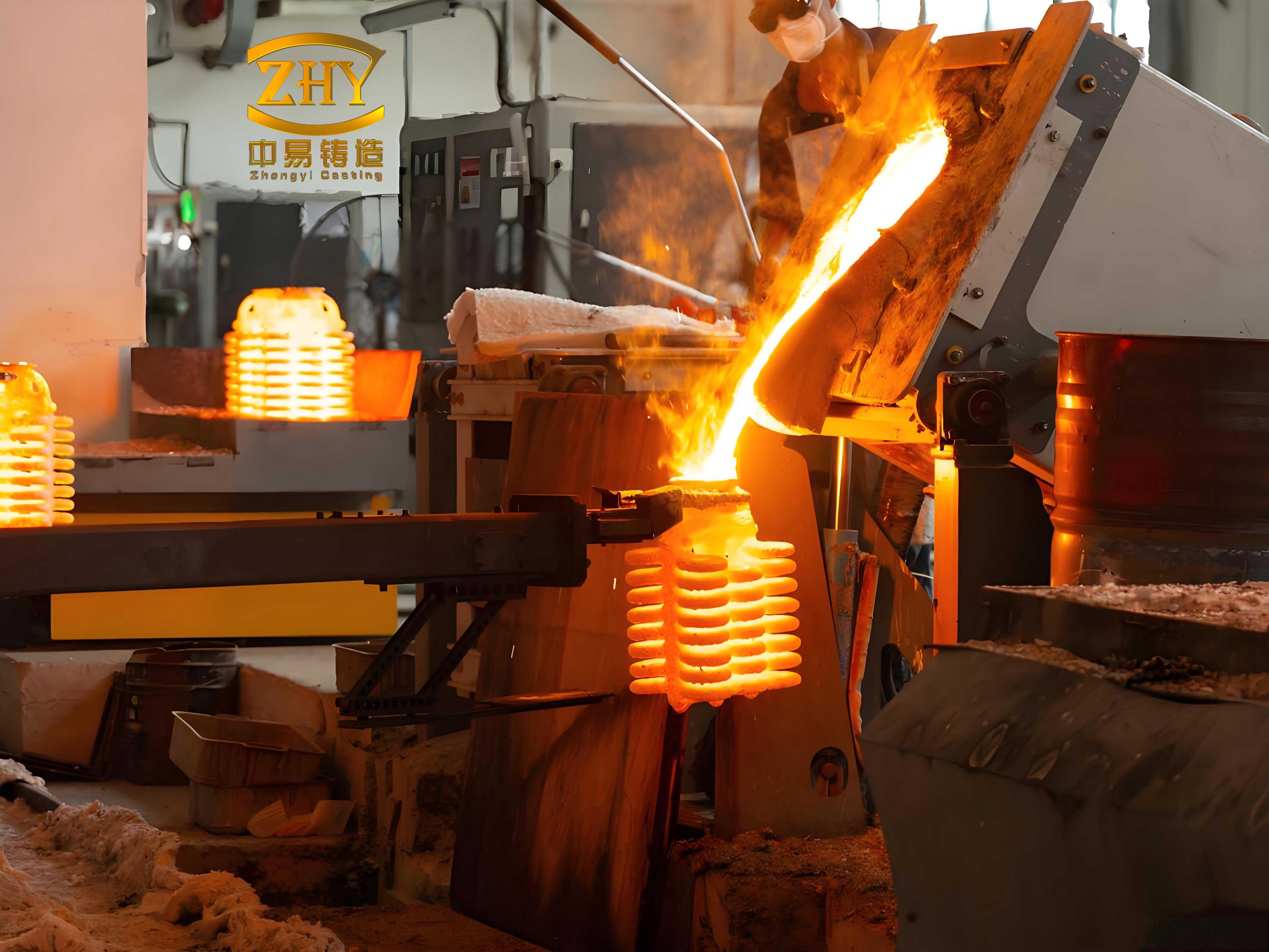
The final act of precision investment casting is the pour itself. The temperatures of both the metal and the pre-fired ceramic shell (the mold) are decisive parameters that bridge dimensional stability and surface quality. The metal pouring temperature $T_{pour}$ must be selected to satisfy competing requirements:
$$ T_{pour} = T_{liquidus} + \Delta T_{superheat} $$
The superheat $\Delta T_{superheat}$ must be sufficient to ensure complete mold filling without premature freezing, especially in thin sections, but excessive superheat promotes coarse grain structure, increases metal-shell interaction (potential for sand burning), and can exacerbate shrinkage porosity. Conversely, the mold preheat temperature $T_{mold}$ influences the cooling rate. A hotter mold slows solidification, which can improve feedability to reduce microporosity but may allow grains to grow larger and increase the risk of metal penetration into the shell, degrading surface finish. For high-integrity superalloy castings, a common approach is to use a moderately high metal superheat combined with a lower mold preheat (often between 800°C and 1050°C) to achieve a favorable balance of fill, grain structure, and surface finish.
In conclusion, mastering precision investment casting is an exercise in systemic control. Dimensional accuracy is not a product of a single step but a chain of controlled processes: stabilizing the wax pattern through environmental control and engineered cooling; selecting a shell material with favorable thermal expansion and creep resistance; and understanding the deformation mechanics during metal contraction. Surface integrity demands a scientific approach to slurry rheology, optimizing binder-powder interactions, particle sizing, and mixing dynamics to deposit a dense, flawless initial layer. All these factors are then integrated and finalized through the precise thermal management of the casting event itself. Each variable interlinks, meaning a holistic, data-driven methodology—where every parameter from room temperature to pouring speed is measured, analyzed, and controlled—is the only path to consistently achieving the exceptional quality demanded by modern precision investment casting. The continuous refinement of these relationships, often modeled through empirical data and increasingly through computational simulation, remains the central endeavor in advancing the state of the art in this foundational manufacturing process.