
In the realm of silica-sol investment casting, particularly for complex stainless steel components, the defect of shrinkage porosity remains a persistent and costly challenge. This challenge is magnified in components characterized by significant variations in wall thickness and the presence of isolated hot spots—areas of concentrated material that are thermally isolated from feeding sources or effective heat dissipation paths. The inherent limitations of the investment casting process, such as the use of hot ceramic shells and the geometric constraints on riser placement, often converge to create conditions ripe for the formation of shrinkage defects. My extensive experience in foundry practice has consistently shown that while riser-based feeding is the primary defense against shrinkage in casting, many complex geometries render this approach impractical. This leads to a critical focus on manipulating the casting’s thermal environment post-pour. Controlling and enhancing the heat dissipation conditions of a solidifying casting is not merely a supplementary tactic but can be the fundamental solution to eliminating shrinkage in casting in components dominated by isolated thermal masses.
The classic feeding mechanism relies on a gradient of solidification where the riser remains liquid longest, supplying metal to compensate for the volumetric contraction of the casting. The efficiency of this mechanism is governed by the feeding distance, often approximated for steel castings by Chvorinov’s rule and empirical relations. The solidification time, \( t_s \), for a simple shape is given by Chvorinov’s Rule:
$$ t_s = B \left( \frac{V}{A} \right)^n $$
where \( V \) is volume, \( A \) is surface area, \( B \) is a mold constant, and \( n \) is an exponent (typically ~2). The modulus, \( M = V/A \), is a key geometric indicator of a section’s propensity to shrink; a higher modulus signifies a slower cooling rate and a greater need for feeding. For an isolated hot spot, the local modulus is high, and its connection to a feeding source (riser) is often tenuous or non-existent, breaking the required solidification gradient. In such scenarios, the thermal condition—specifically, the rate at which heat is extracted—becomes the dominant controllable variable. The heat flux, \( q \), from the casting into the mold can be described by:
$$ q = -k_m \frac{\partial T}{\partial x} $$
where \( k_m \) is the thermal conductivity of the mold shell and \( \frac{\partial T}{\partial x} \) is the temperature gradient. Enhancing this gradient or the effective conductivity at strategic locations is the essence of managing shrinkage in casting for isolated hot spots.
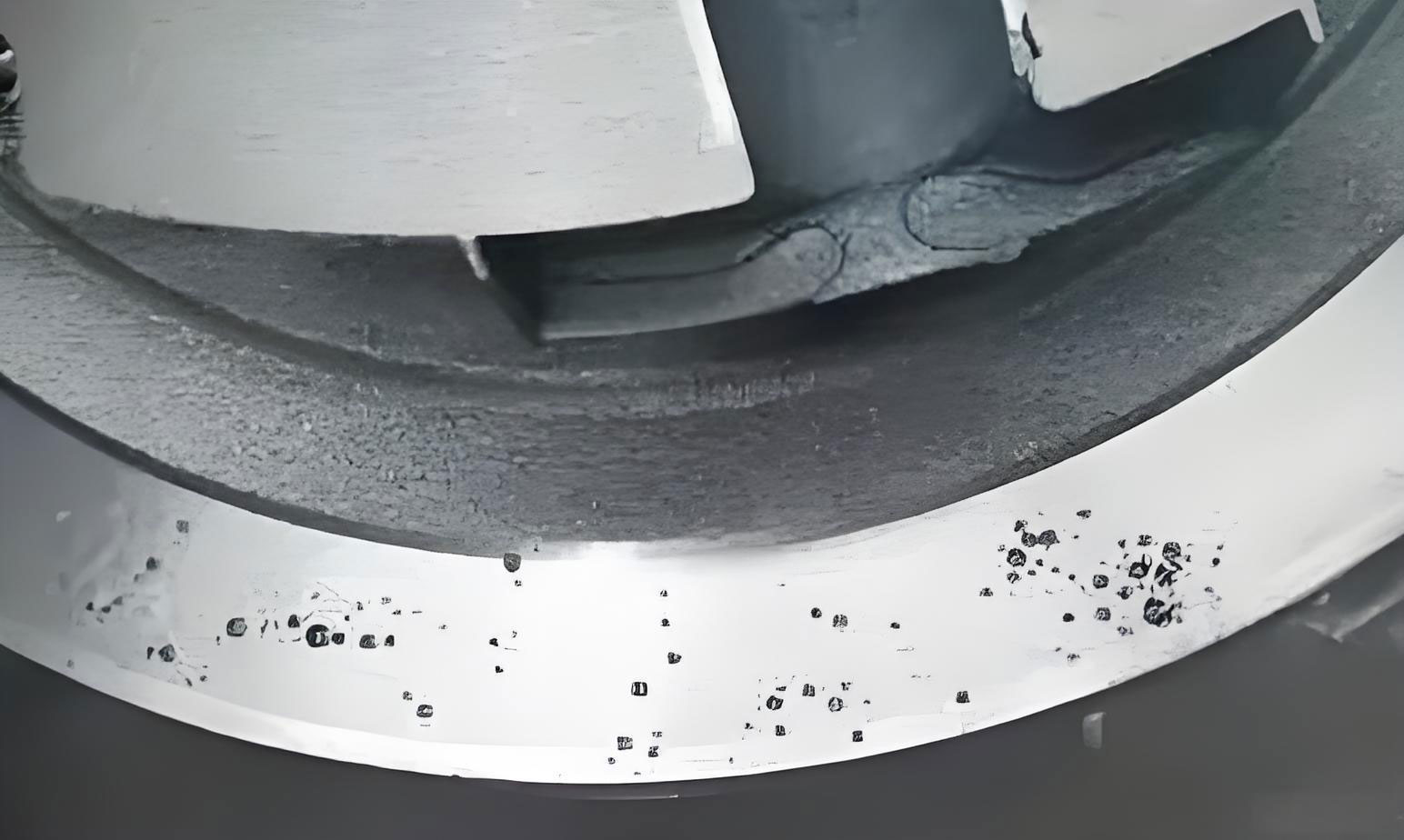
A definitive case study that underscores this principle involved a valve-type casting with a problematic configuration. The component featured a central body with two opposing flanges, creating a classic “T” or “cross” junction internally. This internal junction, along with the outer sections of the flanges adjacent to the body, constituted severe isolated hot spots. The initial gating and risering strategy, which placed risers on the side of the flanges, failed catastrophically. Severe shrinkage porosity and cavities were present externally on the flanges and, more critically, internally at the junction core. The rejection rate approached 100%, as repair welding of the internal defect was nearly impossible. This failure starkly highlighted that traditional feeding was ineffective because the thermal geometry prevented the establishment of a directional solidification path toward the risers. The hot spot was essentially thermally isolated, solidifying last in an enclosed environment with no liquid metal supply.
The subsequent investigation and iterative problem-solving focused solely on altering the thermal environment. The initial improvements, while logical, only yielded partial success. These steps and their theoretical basis are summarized below:
| Improvement Step | Theoretical Rationale | Observed Impact on Shrinkage |
|---|---|---|
| Relocating riser to top of flange. | Alters thermal gradient; top riser may promote slightly better directional solidification downwards. | Minor reduction in external flange shrinkage. |
| Applying local insulation (exothermic/sleeve) near hot spot. | Reduces heat extraction rate (\( k_{eff} \)) at the intended “hot” end of the gradient, aiming to keep it liquid longer relative to adjacent sections to open a feeding path. The goal is to satisfy the feeding distance criterion: \( L_f = C \sqrt{M} \) (where C is a material constant). | Improved feeding to external hot spots, but internal junction remained problematic. |
| Localized shell quenching (dipping) of casting bottom. | Dramatically increases heat flux (\( q \)) from the lower section, accelerating its solidification to create a steep thermal gradient (\( \frac{\partial T}{\partial x} \)) upward. | Enhanced overall solidification progression, reducing overall porosity severity. |
| Reducing pre-pour shell temperature (~600°C). | Increases the initial temperature differential (\( \Delta T \)) between molten metal and mold, increasing initial \( q \) and shortening total solidification time \( t_s \). | General improvement in soundness, but insufficient for the critical internal hot spot. |
Despite these scientifically sound modifications, which collectively reduced the scrap rate to around 60%, the core issue of shrinkage in casting at the internal junction persisted. This indicated that the thermal geometry was still too constrained; the heat from the central hot spot could not dissipate quickly enough, causing it to remain a isolated liquid pool surrounded by solidified metal.
The breakthrough came from a radical reinterpretation of the gating system’s function. Instead of viewing gates and risers solely as feed metal conduits, they were reconceptualized as primary heat extraction channels. The final successful strategy involved the complete removal of the traditional risers from the flanges. Instead, two generous internal gates were attached directly to the casting body, adjacent to the problematic junction and flanges. This was a counter-intuitive move: rather than attempting to feed the hot spot, the goal was to expose it. By attaching gates of substantial cross-section to the hottest region, these sections effectively became massive external fins, drastically increasing the effective surface area (\( A \)) for heat loss from the core thermal mass.
The impact on the modulus and solidification time is illustrative. Consider the hot spot volume \( V_{hs} \). Initially, its cooling surface area \( A_{hs-initial} \) was limited to the contact area with the thin shell wall, a small value leading to a high modulus \( M_{hs-initial} = V_{hs} / A_{hs-initial} \). After attaching the gate, the effective cooling area increased to include the gate’s surface area \( A_{gate} \), significantly lowering the effective modulus \( M_{hs-effective} = V_{hs} / (A_{hs-initial} + A_{gate}) \). According to Chvorinov’s Rule, this directly and substantially reduces the solidification time of the hot spot region, bringing it closer to or even below the solidification time of surrounding sections. The thermal isolation is broken.
The mathematical representation of this heat sink effect can be modeled via an energy balance. The rate of heat loss from the hot spot-gate assembly is proportional to the integrated surface heat flux. By increasing surface area, the integral increases, accelerating cooling:
$$ \frac{dQ}{dt} = \iint_{A_{total}} q \, dA = \iint_{A_{hs} + A_{gate}} -k_m \frac{\partial T}{\partial x} \, dA $$
where \( A_{total} \) is now significantly larger. This configuration successfully transformed the internal hot spot from the last-to-freeze region into a section that solidified concurrently with or before its surroundings, thereby eliminating the conditions necessary for shrinkage in casting to form. Radiographic inspection confirmed the complete elimination of internal porosity, achieving a sustainable production solution with near-zero defect rates for this specific shrinkage in casting problem.
This case study crystallizes a broader set of principles for tackling shrinkage in casting in investment castings where feeding paths are blocked. The following table synthesizes the strategic approach:
| Factor Influencing Shrinkage | Conventional Approach (Riser Feeding) | Alternative Strategy (Thermal Management) | Key Actionable Levers |
|---|---|---|---|
| Solidification Gradient (dT/dx) | Create gradient from casting to riser via chills or padding. | Create gradient within the casting itself by selective cooling/heating. | Use of water-based shell dips, copper chills embedded in shell, localized gas cooling. |
| Local Modulus (M=V/A) | Add padding to increase modulus of feeding path. | Decrease effective modulus of hot spot by adding thermal connections (gates as heat sinks). | Design gates to act as cooling fins; use “cooling risers” that are not for feeding but for heat extraction. |
| Thermal Isolation | Difficult to address; often leads to scrapped designs. | Break isolation by creating new, high-conductivity heat flow paths. | Strategic gate placement to “open up” enclosed hot sections; use of high-thermal conductivity mold facecoats (e.g., zirconia with additives). |
| Solidification Time (t_s) | Increase \( t_s \) of riser relative to casting. | Decrease \( t_s \) of hot spot relative to its surroundings. | Lower pre-pour shell temperature; increase shell permeability for faster heat transfer to environment. |
In conclusion, the paradigm for solving shrinkage in casting, especially in intricate investment castings, must extend beyond the traditional focus on liquid metal feeding. For isolated hot spots, thermal management is paramount. The successful strategy demonstrated that a gating system can be designed primarily as a heat extraction network. The governing principle is to aggressively reduce the effective modulus of the problematic region by integrating it with sections designed to rapidly shed heat. This involves calculating not just feeding distances but also thermal balances, considering gates as heat sinks, and employing active shell temperature management. Future work in simulation should focus on coupled thermal-fluid models that can optimize gate and chill placement specifically for heat dissipation, not just flow and feeding. As casting geometries grow more complex, mastering the science of controlled heat dissipation will be as critical as mastering the art of feeding in the relentless pursuit to eliminate shrinkage in casting.