
In the production of high-performance injection molding machinery, certain components bear the brunt of immense operational stresses. One such critical element is the front plate of the injection unit, a part upon which the machine’s precision, force, and reliability fundamentally depend. The successful manufacture of this component from nodular cast iron presents a significant metallurgical and foundry engineering challenge, particularly when it must withstand sustained hydraulic pressures exceeding 20 MPa while maintaining impeccable surface finish after machining. This account details the comprehensive process design and control strategies we developed and implemented to produce a high-integrity, high-pressure-rated nodular cast iron front plate casting.
The casting in question is substantial, with a finished weight of approximately 1,700 kg and dimensions of 1,330 mm x 620 mm x 850 mm. Its geometry features significant variation in wall thickness, ranging from 40 mm to a massive 360 mm. The core of its function lies in two precision-bored cylinder holes. The technical specifications for these bores are stringent: after machining, a surface roughness of Ra 0.4–0.8 μm is required, and more critically, the material must be completely free from shrinkage porosity, shrinkage cavities, or any other discontinuity that could serve as a failure initiation point under high cyclic pressure. The material specification is a ferritic-pearlitic nodular cast iron, equivalent to QT450-10A, requiring a combination of good tensile strength (≥ 390 MPa from attached test blocks), yield strength, and, importantly, elongation (≥ 8%). Microstructurally, a nodularity rate exceeding 85% and a graphite size grading between 4 to 7 are mandated.
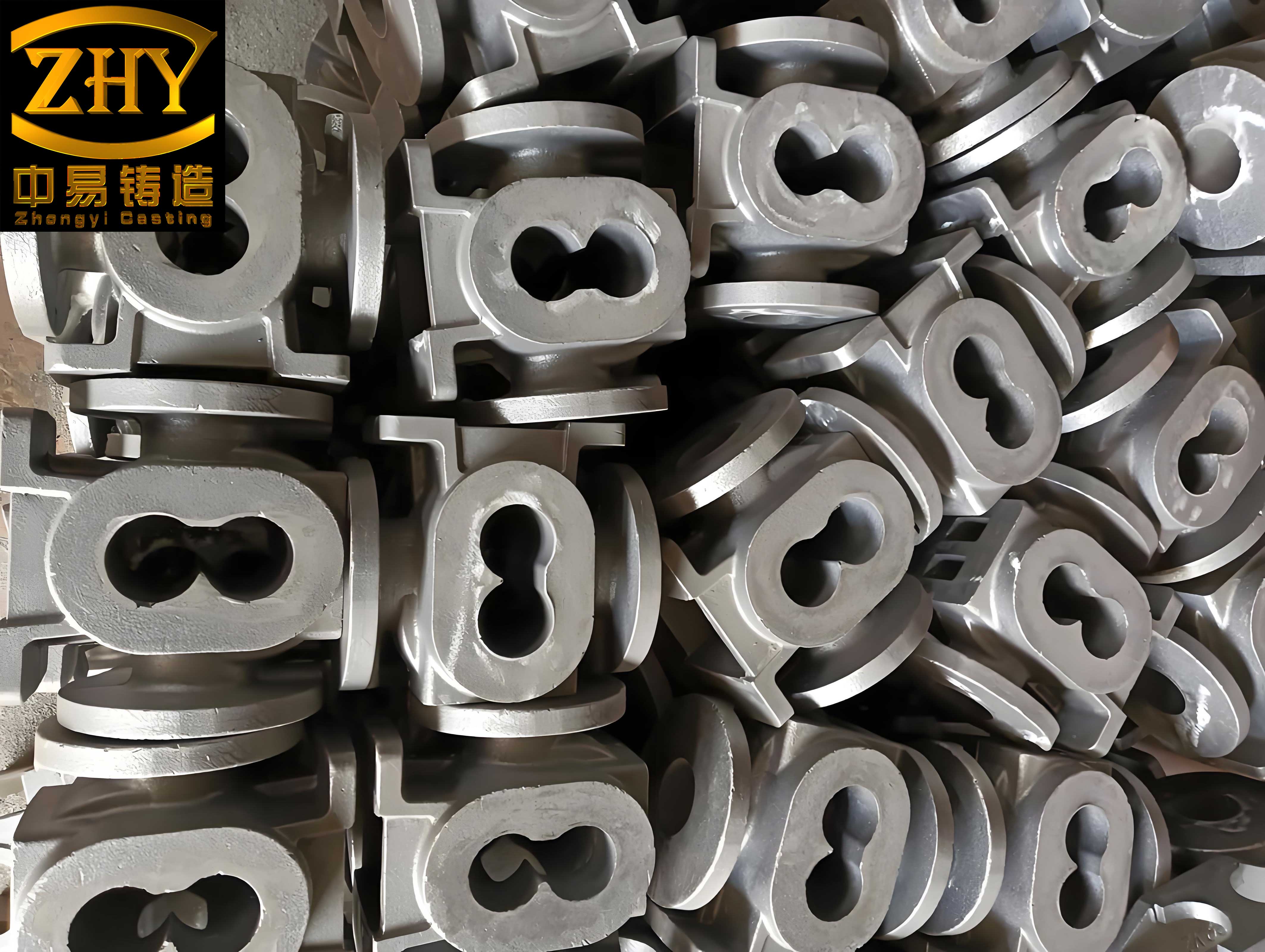
Foundry Process Design: Addressing Solidification Challenges
The primary challenge in producing this nodular cast iron casting is managing its solidification to eliminate defects in the critical cylinder regions. The thick sections and isolated heavy bosses act as pronounced hot spots, favoring the formation of shrinkage porosity. Our process design philosophy centered on achieving controlled, directional solidification where possible, and employing intensive, localized cooling where directional solidification to a feeder was impractical.
Gating and Feeding System Strategy
We adopted a bottom-gating system with multiple ingates to ensure a calm, non-turbulent fill. Turbulence promotes slag entrapment and mold erosion, which are unacceptable for pressure-containing surfaces. The system was designed as slightly pressurized to aid in slag retention within the runner. All channels were formed using ceramic tubes to prevent sand wash-in. The critical parameter is the choke area, calculated using the principle of flow from a large orifice, which governs the pouring time and initial velocity.
$$F_g = \frac{G}{0.31 \times \mu \times t \times \sqrt{H_p}}$$
Where:
$F_g$ is the choke area (cm²),
$G$ is the pouring weight (1,850 kg),
$\mu$ is the flow coefficient (0.35),
$t$ is the target pouring time (140 s),
$H_p$ is the average metallostatic head (10.02 cm).
Applying these values yielded a choke area $F_g \approx 38.5 \text{ cm}^2$. This was implemented as one $\varnothing 70$ mm ceramic tube for the sprue. The cross-sectional area ratios for the gating system were set as $ \Sigma F_{sprue} : \Sigma F_{runner} : \Sigma F_{ingate} = 1 : 1.25 : 1.10 $, resulting in a runner of appropriate dimensions and six $\varnothing 30$ mm ceramic tubes as ingates.
Given the pronounced thermal mass of the cylinder bosses, two safety feeders (risers) were placed above them. In nodular cast iron, these feeders serve a dual purpose: they provide a limited amount of liquid feed during the early stages of contraction and, more importantly, they act as pressure relief points to accommodate the significant graphite expansion during the eutectic freeze, helping to compress any remaining liquid within the casting body and mitigate micro-shrinkage.
Innovative Cooling System: Hybrid Sand-Core Design
Conventional external chills were applied to the four smaller bosses to accelerate their cooling and reduce their effective thermal modulus. However, for the two main cylinder holes, which are deep within the casting, a more radical solution was required. Simply using a large sand core would create a massive, slow-cooling hot spot at its center, virtually guaranteeing shrinkage defects in the bore wall.
Our solution was a composite, or hybrid, core design. The core was built around a robust cast iron skeleton, which acted as a massive, high-conductivity chill. This skeleton was then enveloped with a 20-30 mm thick layer of a special facing sand mixture (30% chromite sand, 70% silica sand). Chromite sand was selected for its high chilling power and thermal stability. This design presented several advantages:
- Intensive & Uniform Cooling: The cast iron skeleton rapidly extracts heat from the solidifying metal, dramatically increasing the cooling rate of the cylinder wall and promoting a finer, denser microstructure.
- Defect Translocation: The extreme cooling shifts the last point of solidification away from the critical bore surface and towards the center of the core or up into the safety feeder.
- Structural Integrity: The cast iron backbone provides excellent core strength, minimizing the risk of distortion or breakage during handling or metal pouring.
We validated this approach using solidification simulation software. A comparison between a standard sand core and our hybrid design starkly illustrated the benefit. The model for the standard core showed a large, contiguous hot spot encompassing the cylinder region and the feeder. The Niyama criterion (a predictor for shrinkage porosity) highlighted a high probability of defects in the bore walls. In contrast, the simulation for the hybrid core design showed a significantly reduced and fragmented hot spot pattern, with the critical cylinder wall area cooling much faster. The predicted shrinkage was successfully moved to the non-critical region at the top of the feeder.
| Core Type | Max. Thermal Modulus in Cylinder Wall (cm) | Last Point to Solidify | Predicted Shrinkage in Critical Bore Area |
|---|---|---|---|
| Standard Sand Core | ~4.2 | Center of Cylinder Mass | High Probability |
| Hybrid (Chill) Core | ~2.8 | Top of Safety Feeder | Very Low Probability |
Material Science: Chemistry and Melt Treatment for Superior Nodular Cast Iron
The performance of nodular cast iron is intrinsically linked to its chemical composition and the efficacy of its treatment. Our target was to achieve the required mechanical properties in the as-cast state, ensuring high nodularity and a controlled matrix without excessive ferrite or pearlite stabilizers.
| Element | Target Range | Metallurgical Rationale |
|---|---|---|
| Carbon (C) | 3.45 – 3.65 | Maximizes graphite precipitation for expansion-based feeding and fluidity. High Carbon Equivalent (CE 4.3–4.45) is maintained without causing graphite flotation. |
| Silicon (Si) | 2.3 – 2.6 | Powerful graphitiser, promotes ferrite formation for ductility. Also provides solid solution strengthening. Final content controlled to avoid excessive hardness embrittlement. |
| Manganese (Mn) | < 0.40 | Kept low to minimize segregation and stabilization of pearlite/carbides at cell boundaries, which would impair elongation. |
| Phosphorus (P) | < 0.02 | Minimized to prevent formation of brittle phosphide eutectics that severely reduce toughness. |
| Sulfur (S) | < 0.015 | Minimized pre-treatment to reduce Mg/S consumption during nodularization, leading to more predictable and efficient treatment. |
| Magnesium (Mg)res | 0.03 – 0.05 | Essential for spheroidization. Controlled within a tight window to ensure full nodularity without excessive carbide promotion. |
| Rare Earths (RE)res | 0.01 – 0.03 | Counteracts the deleterious effects of trace elements like Pb, Sb, Bi; aids in nodule formation and shape control. |
Nodularization and Inoculation Practice
Consistent production of high-quality nodular cast iron relies on rigidly controlled treatment practices. We employed a sandwich method for nodularization in a preheated treatment ladle, using a Fe-Si-Mg alloy containing rare earths. The addition rate was carefully calibrated between 1.1–1.2% to consistently achieve the target residual magnesium level. A large, powerful stream of base iron was used to charge the treatment ladle, ensuring vigorous mixing and high Mg recovery. Immediately after reaction, slag was thoroughly removed and the metal surface was covered with insulating exothermic material to prevent re-sulfurization from the atmosphere.
Inoculation is critical for achieving a high nodule count, which refines the matrix structure and improves mechanical properties, particularly in thick sections prone to chilling. We implemented a multi-stage inoculation strategy:
- Post-Inoculation: A primary inoculant was added to the metal stream as it was transferred from the treatment ladle to the pouring ladle.
- Stream Inoculation: The most critical step involved the addition of a fine-grade inoculant (0.10–0.15%) directly into the metal stream during casting. This late inoculation provides the most effective nuclei for graphite formation, countering fade and ensuring a uniform, fine nodule structure throughout the casting, especially in the slowly cooling sections.
The relationship between cooling rate, inoculation potency, and final nodule count ($N_v$) can be conceptually framed. While complex, a simplified expression highlights the dependencies:
$$N_v \propto \frac{[I]_{eff} \cdot Q}{\Delta T_{eus}}$$
Where $[I]_{eff}$ is the effective concentration of active inoculant particles at the time of eutectic nucleation, $Q$ is the local cooling rate, and $\Delta T_{eus}$ is the undercooling below the eutectic temperature. Our hybrid core increases $Q$ at the bore surface, and stream inoculation maximizes $[I]_{eff}$, together promoting a high $N_v$.
Pouring Parameters
Pouring was conducted within a strict 20-minute window post-treatment to prevent significant inoculation fade. The temperature was controlled to a “low” range of 1,290–1,320 °C. This low-temperature pouring minimizes total heat input into the mold, reduces shrinkage volume, and promotes a faster overall solidification rate, leading to a finer microstructure. However, it is balanced against the need for sufficient fluidity to fill the mold completely.
| Process Stage | Parameter | Control Limit / Target |
|---|---|---|
| Melting / Base Iron | Pouring Temperature | 1,290 – 1,320 °C |
| Treatment Delay Time | < 20 minutes | |
| Nodularization | Alloy Addition | 1.10 – 1.20% |
| Residual Mg | 0.03 – 0.05% | |
| Inoculation | Stream Inoculant Addition | 0.10 – 0.15% |
| Molding | Hybrid Core Sand Strength | 0.9 – 1.1 MPa |
Quality Assurance and Results
The effectiveness of the integrated process—encompassing the hybrid core design, optimized gating, precise chemistry, and rigorous melt treatment—was validated through the production of prototype castings. Non-destructive testing via liquid penetrant inspection (PT) was performed on the critical areas of the castings, including the cylinder bore surfaces. All inspected areas met the stringent requirements of quality level 1 according to EN 1371, indicating no detectable surface-breaking defects.
Destructive testing was performed on attached test blocks representative of the casting’s wall thickness. The results confirmed that the material consistently met and exceeded the specified requirements.
| Property | Specification Requirement | Average Measured Result |
|---|---|---|
| Tensile Strength (Rm) | ≥ 390 MPa | 480 MPa |
| Yield Strength (Rp0.2) | ≥ 260 MPa | 340 MPa |
| Elongation (A%) | ≥ 8 % | 11 % |
| Hardness (HB) | 160 – 210 | 162 |
| Nodularity | ≥ 85 % | 90 % |
| Graphite Size | 4 – 7 | 6 |
Metallographic examination revealed a well-nodularized structure with a predominantly ferritic matrix containing islands of pearlite, perfectly aligned with the QT450-10A grade. The graphite nodules were uniformly distributed and of the desired size. Subsequent machining of the cylinder bores confirmed the absence of sub-surface defects, and the achieved surface finish comfortably met the Ra 0.4–0.8 μm specification. Most importantly, the components successfully passed the ultimate validation: a high-pressure hydrostatic test at 20 MPa without failure or leakage.
Conclusion
The production of high-integrity, pressure-rated components from nodular cast iron demands a holistic approach that seamlessly integrates innovative foundry engineering with precise metallurgical control. For the injection unit front plate, the key to success lay in several interdependent factors:
- The development and application of a hybrid cast-iron-chill sand core, which provided the intense, localized cooling necessary to shift the shrinkage-prone thermal center away from the critical bore surface and promote a dense, refined microstructure in the nodular cast iron.
- A gating and feeding system designed for calm filling and controlled management of the graphite expansion phase inherent to nodular cast iron solidification.
- A meticulously balanced chemical composition aimed at achieving the desired as-cast mechanical properties, with particular emphasis on low impurity elements (P, S) and controlled alloying (Si, Mn).
- A robust and repeatable melt treatment practice featuring multi-stage inoculation, with a focus on late stream inoculation to ensure a high, effective nodule count throughout the heavy-section casting.
This systematic methodology, where process design is driven by solidification science and material requirements, resulted in a nodular cast iron casting of exceptional quality. The process reliably delivers components that satisfy the most demanding mechanical, microstructural, and pressure-containing specifications, demonstrating the capability of well-engineered nodular cast iron for critical industrial applications.