
In modern manufacturing, the demand for high-quality, complex thin-walled aluminum alloy components has driven significant advancements in foundry technology. Counter gravity casting, as a pivotal method in this domain, enables the production of intricate parts with superior mechanical properties and minimal defects. This research delves into the application of counter gravity casting for large thin-wall flat parts, focusing on optimizing process parameters to mitigate common issues like shrinkage porosity. By leveraging numerical simulations and experimental validations, we explore the interplay between chill distribution, pressure values, and geometric factors, aiming to enhance the reliability and efficiency of foundry technology in aerospace and other high-performance sectors.
The evolution of foundry technology has been instrumental in addressing the challenges associated with manufacturing large thin-wall aluminum alloy flat parts. Traditional casting methods often struggle with achieving uniform filling and solidification, leading to defects that compromise component integrity. Counter gravity casting, however, employs controlled pressure differentials to facilitate逆重力方向充型, resulting in smoother metal flow and reduced turbulence. This approach not only improves the dimensional accuracy of castings but also enhances their microstructural density, making it a cornerstone of modern foundry technology. In this study, we investigate various aspects of this technique, including the effects of chill arrangement and pressure parameters, to establish guidelines for optimizing casting quality.
Counter gravity casting encompasses several specialized processes, each with distinct characteristics that cater to different foundry technology requirements. Low-pressure casting, for instance, utilizes compressed air to push molten metal into the mold cavity, typically at pressures ranging from 20 kPa to 60 kPa. This method is widely adopted in lightweight alloy production due to its ability to enhance metal fluidity and support the formation of complex thin-walled structures. The pressure-assisted solidification in low-pressure casting contributes to improved mechanical properties, making it a staple in foundry technology for applications demanding high strength-to-weight ratios.
Differential pressure casting, another variant, relies on pressure differences between the crucible and mold chamber to drive metal filling. It can be implemented through pressurization or减压 methods, offering precise control over filling rates and minimizing turbulence. This foundry technology excels in producing castings with fine microstructures and reduced porosity, as the adjustable pressure differentials allow for optimal solidification conditions. Compared to low-pressure casting, differential pressure techniques often yield components with higher tensile strength and elongation, underscoring their value in advanced foundry technology for critical applications.
Pressure-regulated casting builds upon these foundations by incorporating vacuum and pressure cycles to further refine the casting process. In this foundry technology, both the upper and lower chambers are evacuated simultaneously, creating a负压 environment that removes gases and moisture from the mold surface. This not only purifies the metal but also ensures stable filling. Subsequent application of high pressure during solidification prevents metal backflow and enhances feeding, effectively reducing shrinkage defects. The versatility of pressure-regulated casting makes it ideal for producing thin-walled parts with thicknesses as low as 1 mm to 5 mm, representing a significant leap in foundry technology capabilities.
| Technique | Pressure Range | Key Advantages | Typical Applications |
|---|---|---|---|
| Low-Pressure Casting | 20-60 kPa | Enhanced fluidity, reduced turbulence | Automotive, aerospace components |
| Differential Pressure Casting | Adjustable压差 | Precise control, improved microstructure | Complex thin-walled structures |
| Pressure-Regulated Casting | Vacuum to high pressure | Defect reduction, stable solidification | Ultra-thin wall castings |
To quantify the pressure requirements in foundry technology, we can use the relationship between pressure and metal液柱 height. For aluminum alloys with a density of $$ \rho = 2.7 \, \text{g/cm}^3 $$, the pressure equivalent to a unit height can be derived as follows: $$ P = \rho g h $$, where $$ g $$ is acceleration due to gravity. Given that 100 kPa corresponds to approximately 3828 mm of aluminum液柱, we have $$ 1 \, \text{kPa} \approx 38 \, \text{mm} $$ of aluminum液柱. This formula is essential in foundry technology for determining the minimum pressure needed to fill mold cavities, especially for large thin-wall parts where height differences are significant.
In our research methodology, we employed a平板结构件 with a slit-type gating system to simulate low-pressure casting conditions. The initial design featured a flat plate with dimensions of 576 mm × 573 mm and a thickness of 20 mm, accompanied by six strategically placed chills to study their impact on solidification. The gating system included a runner with a diameter of 67 mm and a length of 800 mm, designed to facilitate adequate feeding and reduce defects. This setup aligns with advanced foundry technology practices, where numerical simulations play a crucial role in predicting and optimizing casting outcomes.
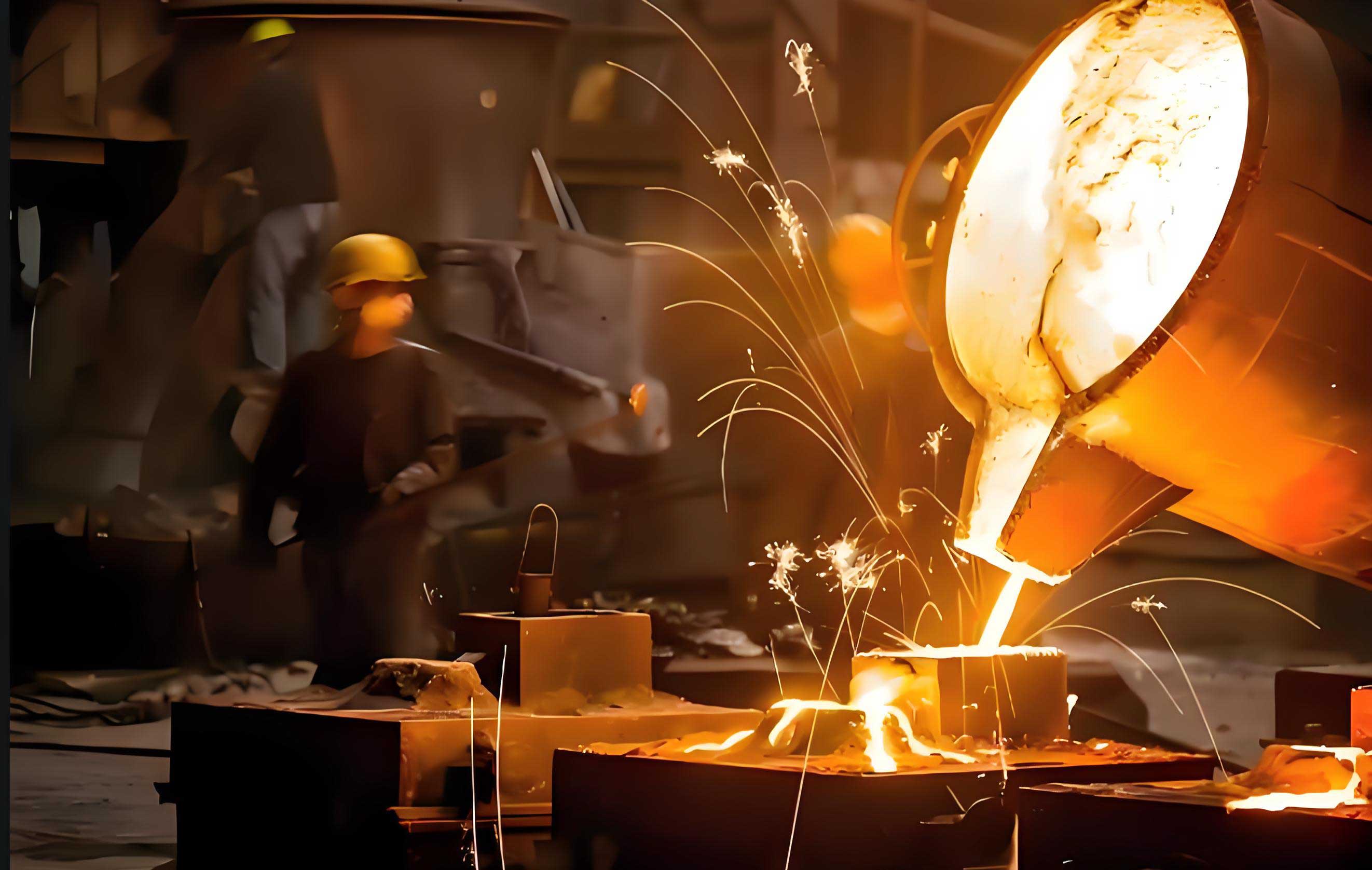
The experimental phase involved varying key parameters such as chill distribution and pressure holding values to assess their influence on defect formation. For instance, we observed that chill gaps exceeding 30 mm often led to localized shrinkage porosity due to delayed solidification in those regions. This highlights the importance of precise chill placement in foundry technology to ensure uniform cooling and minimize defects. Through iterative simulations, we refined the chill arrangements to maintain gaps below 5 mm, which significantly improved casting integrity and demonstrated the efficacy of integrated foundry technology approaches.
Pressure parameters, particularly the boost and holding pressure values, were critical in determining the final casting quality. We conducted simulations with holding pressure values of 15 kPa, 20 kPa, and 35 kPa, while keeping other parameters constant, such as a filling rate of 1.0 kPa/s and a shell pressure of 10 kPa. The results indicated that higher holding pressures, like 35 kPa, effectively reduced shrinkage defects by enhancing feeding during solidification. This correlation can be expressed using the feeding pressure equation: $$ P_f = P_h – \Delta P_c $$, where $$ P_f $$ is the effective feeding pressure, $$ P_h $$ is the holding pressure, and $$ \Delta P_c $$ represents pressure losses in the system. In foundry technology, optimizing these values is essential for achieving defect-free castings.
| Process Parameter | Value 1 | Value 2 | Value 3 |
|---|---|---|---|
| Lifting Rate (kPa/s) | 1.1 | 1.1 | 1.1 |
| Filling Rate (kPa/s) | 1.0 | 1.0 | 1.0 |
| Shell Pressure (kPa) | 10 | 10 | 10 |
| Holding Pressure (kPa) | 35 | 20 | 15 |
| Holding Time (s) | 240 | 240 | 240 |
Further analysis focused on the relationship between casting thickness and chill thickness, which are pivotal in foundry technology for controlling solidification patterns. We derived a model to predict defect propensity based on these variables: $$ D_p = k \cdot \frac{T_c}{T_w} $$, where $$ D_p $$ is the defect propensity, $$ T_c $$ is the chill thickness, $$ T_w $$ is the wall thickness, and $$ k $$ is a material-specific constant. Simulations showed that reducing chill thickness from 15 mm to 10 mm or increasing wall thickness from 16 mm to 20 mm decreased shrinkage porosity, emphasizing the need for balanced geometric parameters in foundry technology. This approach enables manufacturers to tailor casting designs to specific application requirements, thereby advancing foundry technology practices.
Defect formation mechanisms were examined through微观结构 analysis, revealing that shrinkage porosity predominantly occurred on the side opposite to the chills, with depths around 11 mm. This is attributed to the chilling effect, where rapid solidification near the chills creates narrow feeding channels. The pressure required for effective feeding can be modeled as: $$ P_r = \frac{\sigma}{r} $$, where $$ \sigma $$ is the surface tension and $$ r $$ is the radius of the feeding channel. In foundry technology, ensuring sufficient holding pressure counteracts this issue by maintaining metal flow into these regions, thereby mitigating defects and improving overall casting quality.
In conclusion, our research underscores the significance of counter gravity casting in modern foundry technology for producing large thin-wall aluminum alloy flat parts. Key findings indicate that chill distribution must be optimized to avoid large gaps, while holding pressure values should exceed critical thresholds to facilitate adequate feeding. The interplay between casting and chill thickness further highlights the need for integrated design strategies in foundry technology. Future work should explore the application of these principles to high-temperature alloys and complex geometries, potentially revolutionizing foundry technology for next-generation manufacturing. By continuously refining these techniques, foundry technology can achieve higher efficiency, reduced waste, and superior component performance, solidifying its role in industrial advancement.
The adoption of numerical simulations in foundry technology has proven invaluable for predicting and addressing casting defects. For example, we utilized finite element analysis to model temperature gradients and solidification fronts, which allowed us to visualize defect-prone areas and adjust parameters accordingly. This proactive approach in foundry technology not only saves time and resources but also enhances the reproducibility of high-quality castings. As computational power increases, the integration of machine learning and real-time monitoring could further elevate foundry technology, enabling adaptive control systems that respond dynamically to process variations.
Moreover, the economic and environmental benefits of advanced foundry technology cannot be overstated. By minimizing defects and improving yield, counter gravity casting reduces material waste and energy consumption, aligning with sustainable manufacturing goals. In large-scale production, even marginal improvements in foundry technology can lead to significant cost savings and reduced carbon footprints. Therefore, ongoing research and development in this field are crucial for fostering a greener and more efficient industrial landscape, where foundry technology serves as a backbone for innovation.
In summary, this study demonstrates that counter gravity casting is a robust foundry technology for manufacturing aluminum alloy large thin-wall flat parts. Through careful parameter optimization and simulation-driven insights, we can overcome traditional limitations and achieve castings with exceptional mechanical properties. As foundry technology evolves, it will continue to push the boundaries of what is possible in metal forming, enabling the creation of lighter, stronger, and more complex components for various industries. The future of foundry technology lies in its ability to integrate multidisciplinary approaches, from materials science to digital twins, ensuring that it remains at the forefront of manufacturing excellence.