
In my years of experience working with aero engine manufacturing, I have consistently observed that the integrity of internal oil circuits in complex castings is paramount for operational safety and performance. The advent of precision investment casting has enabled the production of highly integrated components with intricate internal passages, such as oil channels that are cast-in-place within the part. However, this complexity introduces significant challenges in quality control, particularly in assessing surface quality and detecting foreign objects within these confined, non-visible spaces. Defects like inclusions, surface roughness, or blockages in oil circuits can lead to catastrophic failures. Therefore, developing and refining accurate non-destructive evaluation (NDE) techniques is a critical facet of my work. This article delves deeply into the methodologies for accurate defect detection, focusing on industrial borescope inspection, and explores the underlying principles that govern measurement accuracy within the context of precision investment casting.
The core challenge stems from the very nature of precision investment casting. This process allows for the creation of near-net-shape components with excellent surface finish and dimensional accuracy. Yet, the internal features, especially small-diameter oil circuits, are susceptible to defects originating from the ceramic shell, alloy purity, or the de-waxing and firing processes. Traditional inspection methods fall short. My approach has centered on industrial video borescopes, which provide remote visual access. However, a major hurdle has been the qualitative nature of such inspections. Without standardized acceptance criteria or a reliable method to quantify defect sizes from the magnified video image, assessments can be subjective, leading to potential misjudgment. This drove me to conduct a series of experiments to establish a more quantitative foundation for borescopic inspection specifically for castings produced via precision investment casting.
The fundamental issue is that a borescope’s camera system provides a magnified view, and this magnification is not constant. It varies with the distance between the borescope’s distal lens and the object under inspection. To formulate a predictive model, I initiated experiments to characterize this relationship. The primary variable is the lens-to-object distance, denoted as \(d\). The measured quantity is the apparent size of a known object on the monitor, which gives us an effective magnification factor \(M\). I used a high-precision digital caliper as my reference object, with its 1 mm gradations serving as the calibration standard.
First, I examined the scenario where the borescope’s optical axis is perpendicular to the surface of the object. This is the ideal alignment for measuring planar surface defects. By meticulously moving the borescope probe along the axis towards and away from the caliper jaws, I recorded the number of screen pixels corresponding to 1 mm at various distances. The relationship between distance \(d\) (in mm) and magnification \(M\) was found to be exponential. The data fit the following model remarkably well:
$$ M_{\perp} = A e^{-k d} $$
Where \(M_{\perp}\) is the magnification for perpendicular alignment. From my experimental data, the constants were determined to be \(A \approx 26.32\) and \(k \approx 0.11 \, \text{mm}^{-1}\). Therefore, the working formula is:
$$ M_{\perp}(d) = 26.32 \cdot e^{-0.11d} $$
This implies that if I measure a defect’s length on the screen as \(L_s\) pixels, and I know the pixel size equivalent for 1 mm at that distance, the actual defect length \(L_a\) can be calculated if the distance \(d\) is known:
$$ L_a = \frac{L_s}{S \cdot M_{\perp}(d)} $$
where \(S\) is a system-specific scaling factor (pixels per unit length on screen at a reference magnification). For practical use, a calibration table is often more direct. Table 1 summarizes key data points from this experiment.
| Lens-Object Distance, \(d\) (mm) | Measured Magnification, \(M_{\perp}\) | Calculated \(M_{\perp}\) from \(26.32e^{-0.11d}\) |
|---|---|---|
| 0.5 | ~30 | 24.9 |
| 1.0 | ~23 | 23.5 |
| 2.0 | ~21 | 21.0 |
| 3.0 | ~19 | 18.8 |
| 5.0 | ~15 | 15.1 |
| 8.0 | ~10 | 11.0 |
The non-linearity is evident. At very close distances (d < 1 mm), the lens is nearly in contact, and the magnification can exceed 70, but the field of view becomes impractically small and depth of field is minimal. This model provides a crucial first step in quantifying defects in the internal cavities of precision investment casting parts.
The situation becomes geometrically more complex when the borescope cannot be aligned perpendicularly, which is often the case when navigating curved oil passages. In many inspections, the probe must travel parallel to the oil circuit’s axis. In this configuration, the magnification is anisotropic—it differs along the direction parallel to the probe axis (longitudinal, \(x\)) and perpendicular to it (transverse, \(y\)). I conducted separate experiments for each principal direction.
For the longitudinal direction (movement along the probe axis), the magnification \(M_x\) as a function of lateral distance \(d_y\) (the shortest distance from the lens axis to the object point) showed an approximately linear decay in the usable range of 2-5 mm:
$$ M_x(d_y) = -3.65 \, d_y + 25.63 $$
For the transverse direction, the relationship remained exponential:
$$ M_y(d_y) = 33.32 \cdot e^{-0.49 d_y} $$
This anisotropy means a square feature on the wall of an oil circuit will appear as a trapezoidal shape on the monitor. Correcting for this distortion requires knowing the probe’s orientation and distance relative to the defect. This is a significant consideration when inspecting the complex internal geometries produced by precision investment casting. Table 2 contrasts the two magnifications at a given standoff distance.
| Lateral Distance, \(d_y\) (mm) | Longitudinal Magnification, \(M_x\) | Transverse Magnification, \(M_y\) | Aspect Ratio Distortion \(M_y/M_x\) |
|---|---|---|---|
| 2.0 | 18.3 | 12.0 | 0.66 |
| 3.0 | 14.7 | 7.6 | 0.52 |
| 4.0 | 11.1 | 4.8 | 0.43 |
| 5.0 | 7.5 | 3.0 | 0.40 |
While developing these theoretical models is essential, practical inspection often relies on comparative methods, especially when precise distance measurement inside a complex casting is difficult. One powerful technique leverages the known geometry of the casting itself. In precision investment casting, the nominal dimensions of oil circuit diameters are tightly controlled. If a defect is located on the cylindrical wall of a passage with known radius \(R\), its angular span can be estimated from the screen image. The actual arc length \(L_a\) of the defect can be approximated by:
$$ L_a = \theta \cdot R $$
where \(\theta\) is the estimated central angle in radians. If the defect appears to span roughly one-\(n\)th of the semi-circumference visible in the view, then \(\theta \approx \pi / n\), and:
$$ L_a \approx \frac{\pi R}{n} $$
I validated this method on a sectioned casting. A surface flaw on a 6 mm radius passage was judged to cover about 1/5 of the visible half-circumference. The estimate yielded \(L_a \approx \pi \times 6 / 5 = 3.77 \, \text{mm}\). Direct physical measurement confirmed a length of 3.83 mm, demonstrating the utility of this comparative approach for parts made via precision investment casting.
Another practical comparative method involves introducing reference objects of known size into the cavity. This is particularly useful for estimating the depth of a pit or the height of a protrusion. Small, spherical ball bearings of various diameters (\(D_{ball}\)) are ideal. By maneuvering a ball near the defect and observing how it engages with the feature on the screen, one can estimate the defect’s size. For instance, if a hemispherical depression fully accommodates a ball of diameter \(D_{ball}\), its radius is approximately \(D_{ball}/2\). If only a segment is engaged, geometric relations can be used. The depth \(h\) of a pit that engages a sphere of radius \(r\) to a chordal distance \(c\) from its bottom can be found using the sphere cap formula:
$$ h = r – \sqrt{r^2 – c^2} $$
where \(c\) is estimated from the screen image relative to the ball’s visible diameter. I frequently use sets of ball bearings from 1 mm to 5 mm diameter for this purpose. This method provides a direct, tangible reference that bypasses complex magnification calculations and is highly effective for the internal assessment of precision investment casting components.
Furthermore, other inherent casting features can serve as scales. Bosses, flanges, ribs, or even the edges of core printouts have defined dimensions on the engineering drawing. By identifying these features adjacent to a defect during the borescope survey, their known size can be used to calibrate the image scale locally. This requires thorough familiarity with the component’s design, which is a standard part of my workflow for inspecting precision investment casting products. For instance, a fillet radius of a specified size or the diameter of a cast-in support pillar can become a reliable internal ruler.
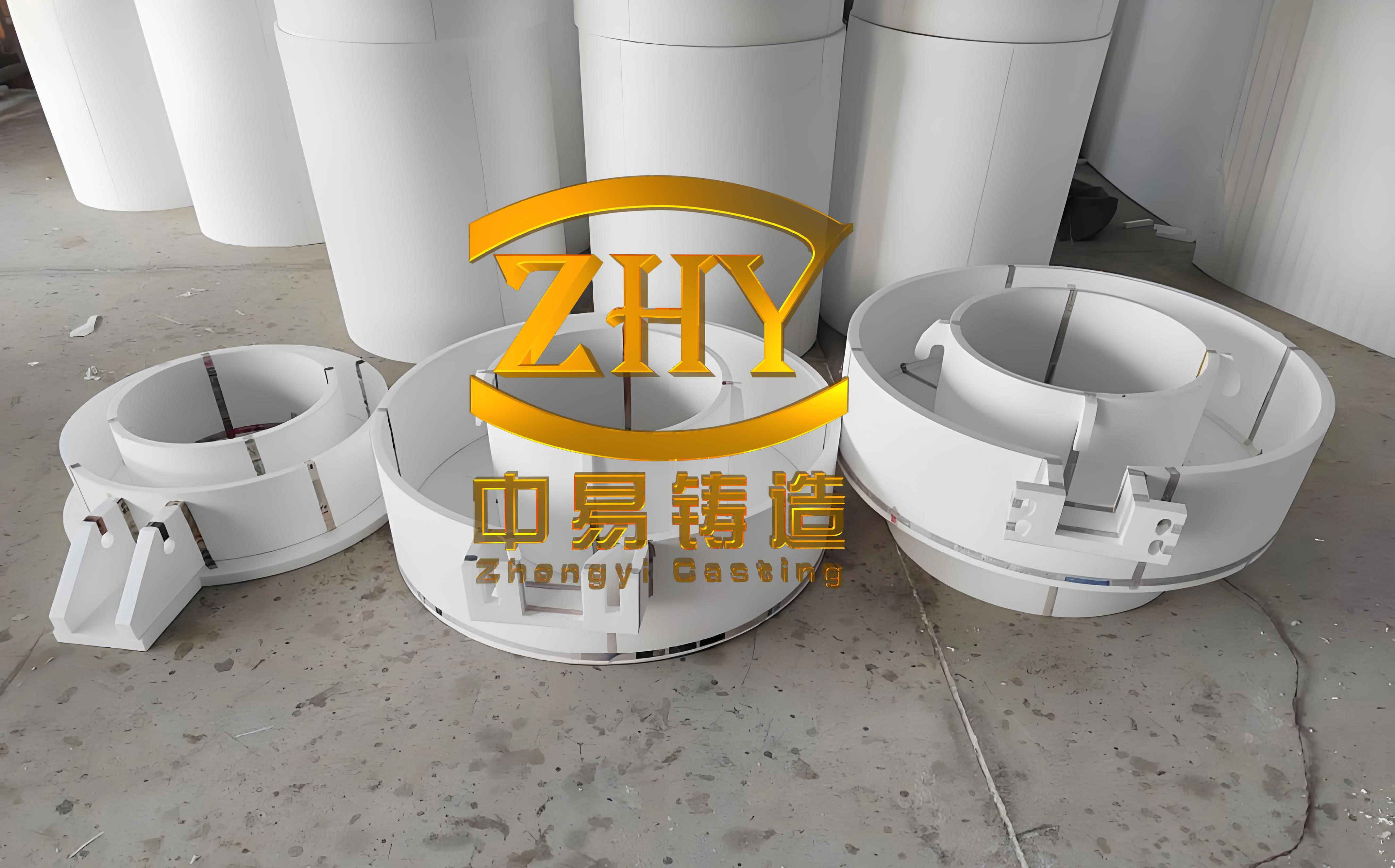
While the focus here is on precision investment casting, it’s worth noting that other casting processes like lost-foam casting also produce complex internal passages and face similar inspection challenges. The fundamental borescope techniques and quantification principles discussed are broadly applicable across advanced casting methodologies where internal integrity is critical.
The integration of these detection and quantification strategies directly impacts the quality loop for precision investment casting. Accurate defect sizing allows for better disposition decisions: whether a part can be accepted, requires repair (if accessible), or must be scrapped. More importantly, it provides actionable feedback to the foundry. By knowing the exact size and location of internal defects, process engineers can pinpoint issues in the ceramic core manufacturing, shell building, metal pouring, or cleaning stages. This data-driven feedback is invaluable for continuous improvement in precision investment casting, ultimately reducing scrap rates and enhancing the reliability of aero engine components.
Looking forward, the evolution of inspection technology promises even greater accuracy. 3D laser scanning borescopes are emerging, capable of generating precise point clouds of internal surfaces. This technology could virtually eliminate the magnification and distortion challenges by providing direct three-dimensional measurements. However, their current cost and size limit application in very small-diameter passages. Another avenue is the development of automated defect recognition (ADR) software trained on vast libraries of borescope images from precision investment casting components. Such systems could provide consistent, unbiased initial screening, flagging potential defects for human expert review.
In conclusion, the accurate detection and sizing of defects within the oil circuits of complex aero engine castings is a non-negotiable requirement for safety and performance. Through my work, I have established that industrial borescope inspection, when supplemented with a clear understanding of optical magnification dynamics and practical comparative techniques, can transition from a qualitative to a semi-quantitative or even quantitative tool. The exponential relationship for perpendicular viewing, $$ M_{\perp}(d) = 26.32 \cdot e^{-0.11d} $$, and the anisotropic models for parallel probing provide a theoretical framework. Methods leveraging known geometry or reference objects offer robust practical solutions. The relentless pursuit of precision in both the manufacturing process—precision investment casting—and its subsequent inspection is what ensures the integrity of every component that takes to the skies. As casting designs grow ever more integrated and internal passages more complex, the refinement of these internal inspection methodologies will remain at the forefront of quality assurance in advanced manufacturing.