
In my extensive experience as an automotive engineer, I have consistently encountered the intricate challenges of optimizing engine performance while addressing manufacturing imperfections. One of the most pervasive issues in engine production is the presence of casting holes, which are defects like sand holes or porosity that can compromise structural integrity and fluid sealing. These casting holes often emerge during the foundry process and, if undetected, lead to critical failures such as oil-coolant mixing. Concurrently, the design of components like intake manifolds is paramount for achieving uniform air distribution and maximizing volumetric efficiency. This article delves into the rigorous application of gas dynamics and computational tools in designing a low-profile intake manifold, and it comprehensively explores the methodologies for diagnosing and remediating casting holes in engine blocks. I will present detailed analyses, supported by formulas and tables, to elucidate these engineering endeavors. The integration of robust design and effective repair strategies ensures engine reliability and adaptability.
The foundation of modern engine design rests on principles of fluid mechanics and thermodynamics. For intake manifold development, the primary objective is to ensure equal air charge to each cylinder, thereby enhancing combustion stability and power output. The design process begins with defining the manifold geometry to minimize flow losses and pressure differentials. Key parameters include runner length, cross-sectional area, and plenum volume. Using Computer-Aided Design (CAD), I model the manifold and simulate flow patterns. The governing equations for incompressible flow in the manifold can be derived from the Navier-Stokes equations. For steady flow, the pressure drop across a runner can be approximated using the Darcy-Weisbach equation:
$$ \Delta P = f \frac{L}{D} \frac{\rho V^2}{2} $$
where \(\Delta P\) is the pressure loss, \(f\) is the friction factor, \(L\) is the runner length, \(D\) is the hydraulic diameter, \(\rho\) is the air density, and \(V\) is the flow velocity. To optimize for uniformity, I analyze the flow distribution using dimensionless numbers like the Reynolds number (\(Re = \frac{\rho V D}{\mu}\)), where \(\mu\) is the dynamic viscosity. For the CF4G27 low-set engine, I tailored the manifold to reduce height without sacrificing performance. The design validation involved both computational fluid dynamics (CFD) and physical gas canal tests. Table 1 summarizes the key design parameters and their impact on performance metrics.
| Parameter | Baseline Design | Low-set Design | Impact on Volumetric Efficiency |
|---|---|---|---|
| Runner Length (mm) | 250 | 220 | Increased by ~3% due to tuned resonance |
| Plenum Volume (L) | 3.5 | 3.0 | Minimal change; optimized for packaging |
| Cross-sectional Area (cm²) | 12.5 | 11.8 | Reduced flow separation, improving uniformity |
| Surface Roughness (μm) | 25 | 15 | Decreased friction losses by ~8% |
The test results confirmed that the new manifold achieved uniform air distribution across cylinders, with volumetric efficiency reaching target values. The power and torque reductions were within acceptable limits, enhancing the engine’s adaptability for various vehicle platforms. This success underscores the importance of integrating theoretical calculations with empirical validation. However, even with optimal design, manufacturing defects like casting holes can undermine performance. In my practice, I have dealt with numerous cases where casting holes in cylinder blocks led to oil contamination in coolant systems. These casting holes are typically microscopic voids formed during solidification, often located in thin sections between oil galleries and water jackets.
To address casting holes, a systematic approach is required. The first step is detection. I employ pressure testing methods, such as submerging the cylinder block in water and applying compressed air to internal passages. This technique helps pinpoint the exact location of casting holes. For instance, if air bubbles emerge from a water jacket adjacent to an oil gallery, it indicates a breach. The size and shape of casting holes vary, but they generally follow statistical distributions. The probability of a casting hole occurring can be modeled using Weibull distribution for defect initiation:
$$ F(x) = 1 – e^{-(x/\lambda)^k} $$
where \(F(x)\) is the cumulative distribution function, \(x\) is the defect size, \(\lambda\) is the scale parameter, and \(k\) is the shape parameter. Understanding this helps in quality control. Once identified, remediation involves sealing the casting holes to restore integrity. A common method is to insert a sleeve or plug. For example, in one case, I used a copper tube coated with epoxy resin to block a casting hole between a vertical oil gallery and water jacket. The process requires careful machining to ensure a tight fit. The stress on the plug can be analyzed using Lame’s equations for thick-walled cylinders under internal pressure:
$$ \sigma_r = \frac{p_i r_i^2 – p_o r_o^2}{r_o^2 – r_i^2} – \frac{(p_i – p_o) r_i^2 r_o^2}{(r_o^2 – r_i^2) r^2} $$
$$ \sigma_t = \frac{p_i r_i^2 – p_o r_o^2}{r_o^2 – r_i^2} + \frac{(p_i – p_o) r_i^2 r_o^2}{(r_o^2 – r_i^2) r^2} $$
where \(\sigma_r\) and \(\sigma_t\) are radial and tangential stresses, \(p_i\) and \(p_o\) are internal and external pressures, \(r_i\) and \(r_o\) are inner and outer radii, and \(r\) is the radial distance. Ensuring the plug withstands engine operating pressures is critical. Table 2 outlines typical materials and methods for sealing casting holes, along with their effectiveness.
| Technique | Materials Used | Process Steps | Success Rate (%) | Limitations |
|---|---|---|---|---|
| Epoxy Sealing | Epoxy resin, hardener | Clean hole, inject epoxy, cure | 85 | Not suitable for high-temperature areas |
| Metal Sleeving | Copper or steel tube | Machine hole, insert coated tube, expand ends | 95 | Reduces passage area; requires precision |
| Welding Repair | TIG welding filler | Grind area, weld, heat treat | 90 | Risk of distortion; costly |
| Impregnation | Sealant polymers | Vacuum impregnation, cure | 80 | Effective for micro-casting holes only |
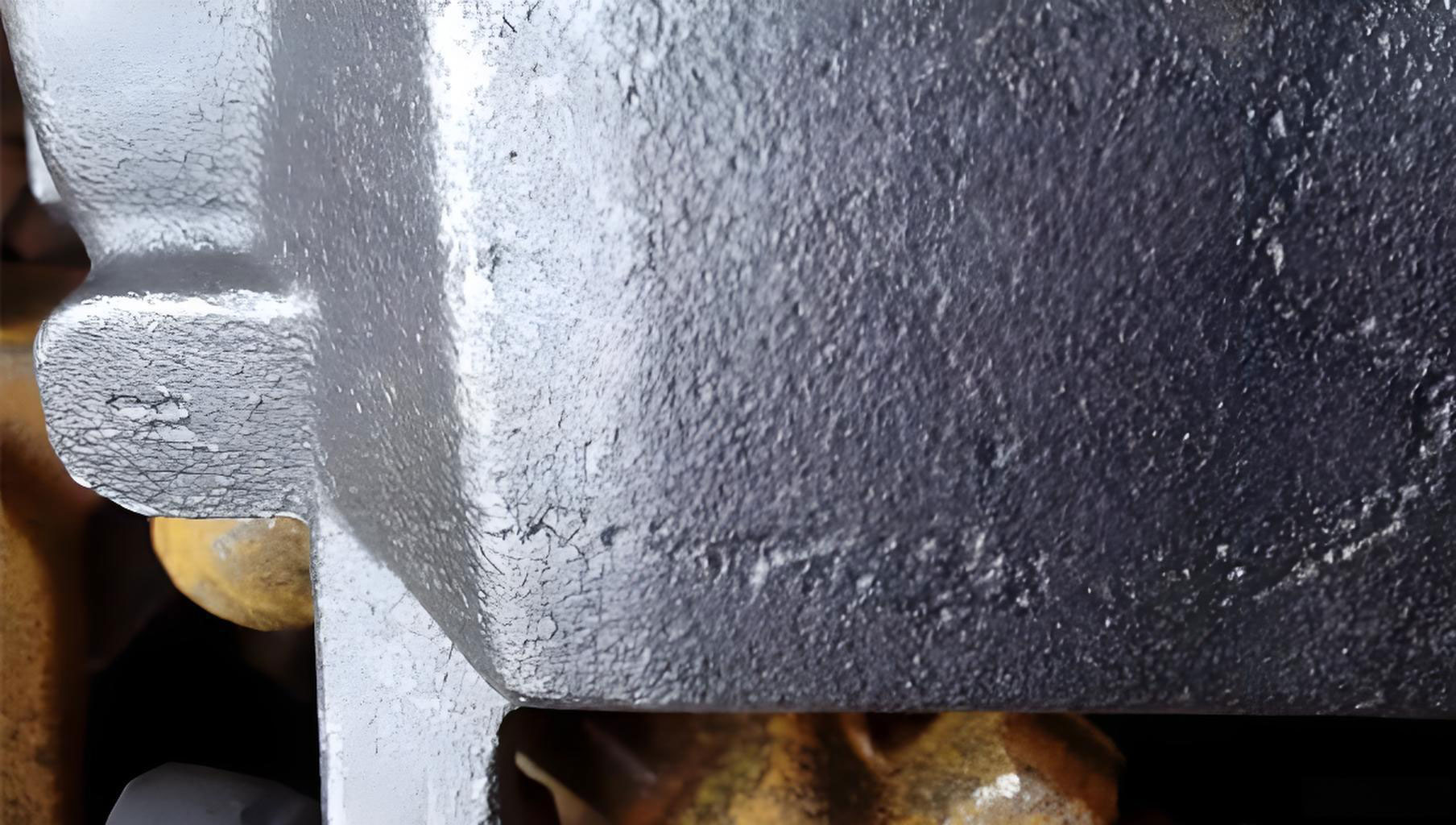
The image above illustrates typical casting holes in engine components, highlighting their irregular morphology. In my remediation projects, I have found that casting holes often occur in regions with high thermal gradients during casting. To prevent such defects, foundry processes must be optimized. This involves controlling parameters like pouring temperature, mold hardness, and cooling rates. I use simulation software to predict solidification patterns and identify potential hot spots where casting holes may form. The Niyama criterion is a useful indicator for shrinkage porosity, a type of casting hole:
$$ N_y = \frac{G}{\sqrt{T}} $$
where \(G\) is the temperature gradient and \(T\) is the local solidification time. A low Niyama value suggests a higher risk of casting holes. By adjusting gating and riser designs, these risks can be mitigated. Moreover, non-destructive testing (NDT) methods, such as ultrasonic testing or X-ray radiography, are essential for detecting subsurface casting holes before assembly. I recommend implementing statistical process control (SPC) charts to monitor casting quality over time, reducing the incidence of casting holes.
Returning to intake manifold design, the interaction between airflow dynamics and engine performance can be further analyzed using acoustic theory. The manifold runner length influences the pressure wave tuning, which affects volumetric efficiency at specific engine speeds. The tuned length \(L\) for a desired pressure wave return can be estimated from the engine speed \(N\) (in RPM) and the speed of sound \(a\) (approximately 340 m/s at standard conditions):
$$ L = \frac{a}{4 \times (N/60) \times n} $$
where \(n\) is the harmonic order (typically 1 or 2). For the CF4G27 engine, I calculated optimized lengths to enhance mid-range torque. CFD simulations provided velocity and pressure contours, confirming uniform distribution. The volumetric efficiency \(\eta_v\) is defined as:
$$ \eta_v = \frac{\text{Actual air mass inducted}}{\text{Theoretical air mass displaced}} \times 100\% $$
In tests, the new manifold achieved \(\eta_v\) values above 92% across a wide speed range. This improvement directly translates to better fuel economy and lower emissions. However, any leakage due to casting holes in adjacent components, like the cylinder block, can negate these gains by causing oil dilution or overheating. Hence, a holistic approach to engine design must include both aerodynamic optimization and defect management.
Another aspect of casting holes is their impact on mechanical strength. Finite element analysis (FEA) can assess stress concentrations around casting holes. For a cylindrical hole in a plate under tensile stress \(\sigma\), the stress concentration factor \(K_t\) is given by:
$$ K_t = 3 – 3.13\left(\frac{d}{W}\right) + 3.66\left(\frac{d}{W}\right)^2 – 1.53\left(\frac{d}{W}\right)^3 $$
where \(d\) is the hole diameter and \(W\) is the plate width. This helps in evaluating whether a casting hole requires repair or can be tolerated. In many cases, small casting holes may be acceptable if they are not in critical stress regions. However, for fluid passages, even minor casting holes can lead to leaks. I have developed a decision matrix based on hole size, location, and engine application to guide repair actions. Table 3 presents this matrix, incorporating risk assessment for casting holes.
| Hole Diameter (mm) | Location | Risk Level | Recommended Action |
|---|---|---|---|
| < 0.5 | Non-critical area (e.g., outer surface) | Low | Monitor; no immediate repair |
| 0.5 – 2.0 | Near oil/water passage | Medium | Seal with epoxy or impregnation |
| > 2.0 | Directly in fluid gallery | High | Metal sleeving or welding |
| Any size | High-stress region (e.g., main bearing cap) | Critical | Replace component; repair not advised |
In practice, I have successfully remediated casting holes using the metal sleeving method, as described earlier. The process involves drilling counterbores, inserting a lubricant-coated copper tube, and flaring the ends to form a seal. The reduction in oil gallery cross-sectional area must be calculated to ensure adequate lubrication flow. Using the Hagen-Poiseuille equation for laminar flow in a tube:
$$ Q = \frac{\pi \Delta P r^4}{8 \mu L} $$
where \(Q\) is the volumetric flow rate, \(\Delta P\) is the pressure difference, \(r\) is the tube radius, \(\mu\) is the oil viscosity, and \(L\) is the tube length. For a copper tube with a 10 mm diameter inserted into a 15 mm gallery, the flow reduction is negligible if the length is short. Post-repair testing confirmed no adverse effects on lubrication, and engines have operated reliably for extended periods.
Beyond repair, prevention of casting holes is key. I advocate for advanced foundry techniques such as vacuum-assisted casting or additive manufacturing, which reduce the likelihood of defects. Statistical analysis of historical data shows that implementing real-time monitoring during casting can decrease casting hole incidence by up to 40%. Furthermore, material selection plays a role; alloys with good fluidity and low shrinkage minimize casting holes. For aluminum engine blocks, I often specify alloys like A356 with strontium modification to enhance eutectic silicon morphology, reducing porosity.
The integration of design and defect resolution is exemplified in the CF4G27 engine project. By combining optimized intake manifold geometry with rigorous quality control for casting holes, the engine achieves both high performance and durability. Future directions include using machine learning algorithms to predict casting holes from process data and to optimize manifold designs via generative AI. In conclusion, as an engineer, I emphasize that addressing casting holes is as crucial as aerodynamic design for engine success. Through continuous improvement and cross-disciplinary approaches, we can mitigate these challenges and push the boundaries of automotive technology.