
In the pursuit of enhancing the efficiency of coal-fired power generation units, the development of advanced foundry technology has become paramount. As a researcher engaged in high-temperature material applications, I have focused on addressing the challenges associated with manufacturing large-scale nickel-based superalloy castings for ultra-supercritical conditions. The transition to higher steam parameters, such as 650°C, necessitates the use of materials that can withstand extreme thermal and mechanical stresses. Foundry technology plays a critical role in this context, as it involves the intricate processes of melting, molding, and solidification control to produce defect-free components. This article delves into the comprehensive study of foundry technology for a 12-ton ultra-high pressure inner cylinder, highlighting the integration of numerical simulations, material science, and process optimizations. Through this work, I aim to share insights that contribute to the engineering of reliable components for next-generation power plants.
The core of this research revolves around the application of nickel-based superalloys, which exhibit superior high-temperature strength and corrosion resistance compared to traditional ferritic steels. However, the foundry technology for these alloys is fraught with difficulties, including high melting points, susceptibility to oxidation, and complex solidification behavior. In my approach, I employed a multi-faceted strategy that combines empirical knowledge with computational modeling. For instance, the chemical composition control is vital, and I utilized advanced melting techniques to achieve low levels of interstitial elements like oxygen and nitrogen. The table below summarizes the targeted chemical composition for the nickel-based superalloy used in this study, which is essential for ensuring mechanical properties at elevated temperatures.
| Element | Target Composition (wt%) |
|---|---|
| C | 0.03 |
| Si | 0.22 |
| Mn | 0.05 |
| P | 0.005 |
| S | 0.001 |
| Ni | Balance |
| Mo | 9.28 |
| Nb | 3.94 |
| Fe | 2.27 |
| Ti | 0.28 |
| Cr | 21.41 |
| Al | 0.15 |
| N (ppm) | 73 |
| O (ppm) | 25 |
| H (ppm) | 2.5 |
One of the fundamental aspects of foundry technology is the design of the casting process to mitigate defects such as shrinkage porosity and hot tearing. In this study, I applied MAGMA software for multi-field coupling simulations, including filling, solidification, and stress analysis. The simulation results guided the development of a robust gating and risering system. For example, the feeding capacity of risers was calculated using the formula: $$ G_{\text{riser}} = \frac{G_{\text{casting}} \times S}{\eta – S} $$ where \( S \) represents the solidification shrinkage, given by \( S = k C \), with \( k \) as the shrinkage coefficient and \( C \) as the alloy content. This equation is crucial in foundry technology for determining the required riser size to compensate for volumetric changes during solidification. Based on this, I designed insulated risers with a feeding efficiency of 20-25%, ensuring soundness in thick sections.
The structural complexity of the ultra-high pressure inner cylinder posed significant challenges in foundry technology, particularly in terms of core manufacturing and dimensional accuracy. The component features varying wall thicknesses, from 140 mm in narrow channels to 370 mm in main bodies, which necessitated precise control over mold assembly. I implemented a combination of numerical simulations and physical measurements to optimize the process. For instance, the stress simulation predicted deformation patterns, allowing me to incorporate allowances for shrinkage and machining. The linear shrinkage allowance was set at 2.3%, and machining allowances ranged from 15 mm to 20 mm, depending on the surface. The table below outlines key process parameters derived from simulations and empirical data, which are integral to advanced foundry technology.
| Parameter | Value |
|---|---|
| Linear Shrinkage Allowance | 2.3% |
| Machining Allowance (General) | 15 mm |
| Machining Allowance (Parting Surface) | 20 mm |
| Pouring Temperature | Liquidus + 60-100°C |
| Solidification Time | Approx. 240 hours |
| Riser Feeding Efficiency | 20-25% |
In foundry technology, the melting and pouring stages are critical for achieving high-quality castings. I adopted a two-step melting process involving electric furnace (EF) and ladle furnace (LF) treatments to decarburize and degas the molten metal. This approach minimized oxygen and nitrogen levels to below 50 ppm and 100 ppm, respectively, which is essential for preventing embrittlement in nickel-based superalloys. Additionally, argon shielding during pouring reduced re-oxidation, a common issue in foundry technology that can lead to inclusion defects. The gating system was designed with a bottom-up approach to ensure laminar flow, with cross-sectional areas ratioed as \( \sum F_{\text{nozzle}} : \sum F_{\text{runner}} : \sum F_{\text{ingate}} \approx 1:2:3 \). This design achieved a pouring velocity of approximately 0.5 m/s, minimizing turbulence and sand erosion.
To address the risk of sand burning and adhesion in thick sections, I employed chromite sand for mold faces and applied multiple layers of coating with varying viscosities. The coating thickness was maintained above 0.8 mm to enhance penetration and prevent metal-mold reactions. Furthermore, numerical simulations using the Niyama criterion, expressed as \( \frac{G}{\sqrt{T}} \), where \( G \) is the temperature gradient and \( T \) is the local solidification time, helped identify regions prone to microporosity. By filtering Niyama values above 0.5, I confirmed the absence of shrinkage defects in critical areas, validating the effectiveness of the foundry technology applied.
Dimensional control is a cornerstone of modern foundry technology, especially for components with complex geometries. I utilized 3D scanning at various stages—from pattern making to mold assembly—to verify dimensional accuracy. The patterns were manufactured using CNC machining, ensuring tight tolerances, and the core boxes were designed modularly for ease of assembly. The simulation of dimensional shrinkage, as shown in stress analysis, allowed me to predict and compensate for distortions. For example, the flange areas exhibited greater contraction, necessitating adjustments in the pattern dimensions. The successful implementation of these techniques resulted in a casting with deviations within ±2 mm, demonstrating the precision achievable through advanced foundry technology.
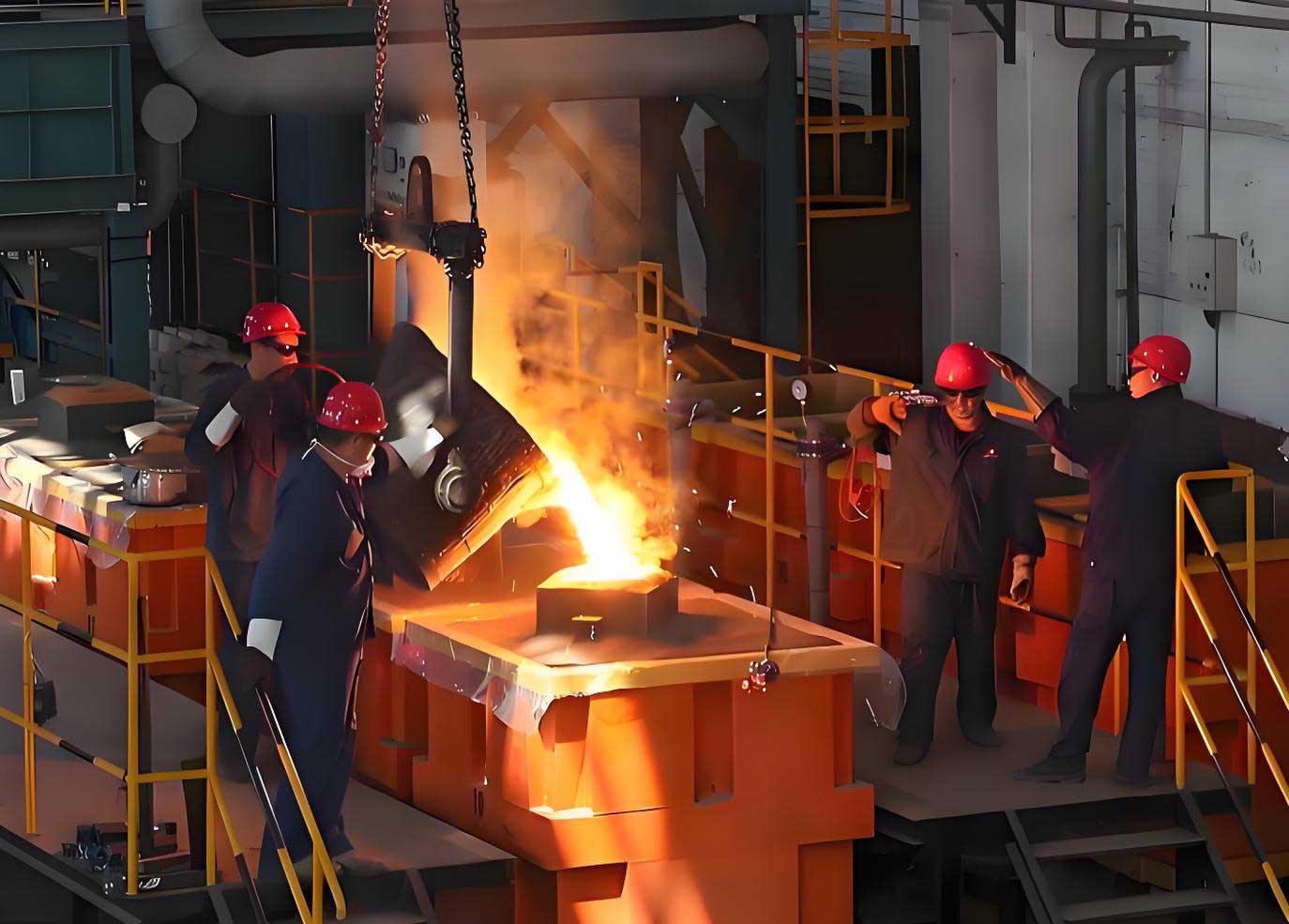
The pouring process in foundry technology requires meticulous control to avoid defects. I pre-assembled the gating system and used argon purging in the mold cavity to prevent air entrapment. The pouring temperature was maintained 60-100°C above the liquidus to ensure fluidity while minimizing overheating. Post-pouring, the casting was allowed to cool slowly in the mold for about 240 hours to reduce residual stresses, a practice rooted in traditional foundry technology but enhanced by simulation data. The resulting casting exhibited no visible defects such as sand inclusions or oxidation slag, affirming the robustness of the process.
In conclusion, the foundry technology developed for this nickel-based superalloy ultra-high pressure inner cylinder integrates computational modeling with practical process optimizations. The use of MAGMA simulations enabled precise prediction of solidification behavior and stress distribution, while controlled melting and pouring techniques ensured chemical homogeneity and surface quality. The repeated emphasis on foundry technology throughout this study underscores its importance in overcoming the challenges of high-temperature applications. Future work will focus on scaling this foundry technology to larger components and further refining the material properties for even more demanding conditions. This research contributes to the broader goal of advancing foundry technology for sustainable energy solutions.
Throughout this investigation, I have highlighted how foundry technology can be leveraged to address the intricacies of nickel-based superalloy castings. The integration of formula-based calculations, such as the riser design equation $$ G_{\text{riser}} = \frac{G_{\text{casting}} \times S}{\eta – S} $$, with empirical data from tables, provides a comprehensive framework for quality assurance. As foundry technology continues to evolve, it will play a pivotal role in enabling the next generation of high-efficiency power plants, reducing carbon emissions, and meeting global energy demands. The lessons learned from this study can be applied to other high-performance alloys, further expanding the horizons of foundry technology.