
In the realm of aerospace and advanced engineering, the demand for high-performance superalloy castings has escalated, driven by the need for components that operate under extreme conditions. These castings, essential for hot-section parts in engines and turbines, are evolving toward larger dimensions, more complex geometries, and thinner wall sections. Traditional investment casting methods are increasingly challenged by these requirements, as they push the boundaries of what is achievable in terms of internal metallurgical quality and external dimensional accuracy. Key issues such as shrinkage porosity control, complete filling of thin-walled sections, and maintaining precision throughout the manufacturing process have become critical hurdles. This article delves into the current state and future directions of foundry technology, focusing on process design, shell mold fabrication, full-process dimensional control, and advanced casting techniques like adjusted pressure casting. We also explore the emerging trends toward intelligent foundry systems leveraging big data and artificial intelligence.
The foundation of modern foundry technology lies in the ability to predict and mitigate defects during solidification. Shrinkage porosity, a common issue in superalloy castings, has been extensively studied through various predictive models. One widely recognized approach is the Niyama criterion, which relates the temperature gradient (G) and cooling rate (R) to assess the likelihood of microporosity formation. The criterion is expressed as:
$$ Ny = \frac{G}{\sqrt{R}} $$
where a lower Ny value indicates a higher propensity for defects. However, this model has limitations when applied to complex geometries and different alloy systems. To address this, researchers have developed dimensionless criteria that incorporate material properties and process parameters. For instance, a modified criterion accounting for solid fraction and shrinkage behavior can be represented as:
$$ \Delta P^* = \frac{24\mu\beta’n\tau^3\rho_L g}{(\Delta T_f G)^2} \left( \frac{df_s}{dt} \right) $$
Here, $\mu$ is the dynamic viscosity, $\beta’$ is the solidification shrinkage rate, $n$ is the number of interdendritic channels, $\tau$ is the tortuosity, $t$ is local solidification time, $\rho_L$ is liquid density, $\Delta T_f$ is the freezing range, $f_s$ is the solid fraction, and $g$ is gravity. Such models help in optimizing foundry technology parameters to minimize defects in large, thin-walled castings.
Riser design is another critical aspect of foundry technology, aimed at ensuring adequate feeding to compensate for solidification shrinkage. Traditional methods, such as Chvorinov’s rule based on modulus calculations, have been enhanced with computational tools. For example, the dimensionless parameter method considers the geometry and solidification characteristics to determine optimal riser sizes. A common approach involves solving equations like:
$$ M = \frac{V}{A} $$
where M is the modulus, V is volume, and A is surface area. Advanced simulations integrate these principles with real-time data to achieve higher yields and reduce trial-and-error in foundry operations.
Gating system design has evolved from经验-based methods to computer-aided optimization. In foundry technology, the goal is to achieve laminar flow and minimize turbulence, which can introduce inclusions and gas entrapment. Numerical simulations using software like ProCAST allow for virtual testing of different gating configurations. For instance, the use of bottom gating with filters has been shown to stabilize flow and reduce defects. The governing equations for fluid flow during mold filling include the Navier-Stokes equations and continuity equation:
$$ \rho \left( \frac{\partial \mathbf{v}}{\partial t} + \mathbf{v} \cdot \nabla \mathbf{v} \right) = -\nabla p + \mu \nabla^2 \mathbf{v} + \mathbf{f} $$
where $\rho$ is density, $\mathbf{v}$ is velocity vector, $p$ is pressure, $\mu$ is viscosity, and $\mathbf{f}$ represents body forces. By iterating through design parameters, foundry technology enables the creation of efficient gating systems that enhance casting quality.
| Method | Key Parameters | Applicability | Limitations |
|---|---|---|---|
| Niyama Criterion | G, R | Steel castings | Geometry-dependent |
| Dimensionless Models | Solid fraction, shrinkage | Wide range of alloys | Requires accurate data |
| Numerical Simulation | Flow, temperature fields | Complex geometries | Computationally intensive |
Ceramic shell molds play a pivotal role in investment casting foundry technology, directly influencing surface finish and dimensional accuracy. The shell’s performance depends on its composition, which typically includes refractories like silica, alumina, and zirconia, bound with colloidal silica or ethyl silicate. High-temperature mechanical behavior is governed by the balance between glassy and crystalline phases. For instance, the addition of alumina promotes mullite formation, enhancing strength at elevated temperatures. The high-temperature strength ($\sigma$) can be modeled as:
$$ \sigma = \sigma_0 \exp\left(-\frac{Q}{RT}\right) $$
where $\sigma_0$ is a constant, $Q$ is activation energy, $R$ is the gas constant, and $T$ is temperature. To improve permeability and collapsibility, organic fibers or carbon-based additives are incorporated, which burn out during firing, creating microporosity. The permeability ($k$) can be estimated using the Kozeny-Carman equation:
$$ k = \frac{\phi^3}{c(1-\phi)^2 S^2} $$
where $\phi$ is porosity, $c$ is a constant, and $S$ is specific surface area. Advances in shell manufacturing, such as the use of robotic dipping and drying systems, have streamlined production, reducing cycle times and improving consistency in foundry technology.
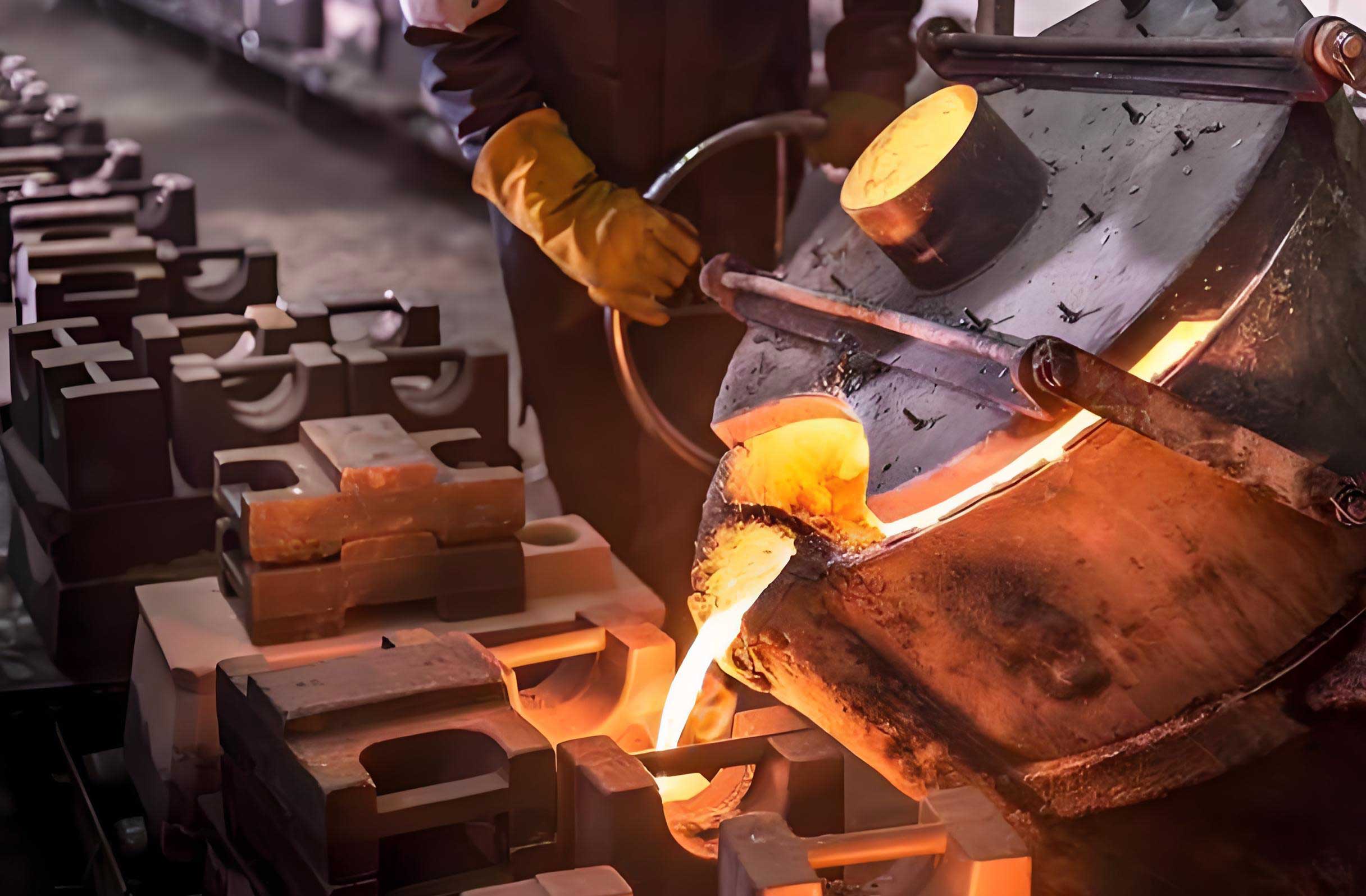
Additive manufacturing is revolutionizing shell fabrication in foundry technology. Techniques like digital light processing (DLP) enable the direct printing of complex shell molds with integrated cores, eliminating assembly steps and enhancing precision. For example, ceramic slurries are cured layer by layer to form green bodies, which are then sintered to achieve final properties. This approach allows for the creation of molds with customized thermal properties, such as graded insulation, to control solidification patterns. The dimensional accuracy of additively manufactured shells can be characterized by the relationship between printing parameters and shrinkage, often expressed as:
$$ \Delta L = \alpha L_0 \Delta T $$
where $\Delta L$ is dimensional change, $\alpha$ is the coefficient of thermal expansion, $L_0$ is initial length, and $\Delta T$ is temperature change. This innovation in foundry technology facilitates the production of ultra-thin-walled components that were previously unattainable.
Full-process dimensional control is essential for achieving net-shape castings in foundry technology. The journey begins with wax pattern injection, where parameters like temperature, pressure, and time influence shrinkage and distortion. Wax materials, often polymer-based, exhibit viscoelastic behavior, and their deformation can be modeled using constitutive equations. For instance, the residual stress ($\sigma_r$) after ejection can be approximated as:
$$ \sigma_r = E \epsilon_r $$
where $E$ is the elastic modulus and $\epsilon_r$ is residual strain. Subsequent stages, including shell building and dewaxing, introduce additional dimensional changes due to thermal expansion and chemical reactions. During solidification, the alloy undergoes volumetric shrinkage, which can be compensated through predictive modeling. A comprehensive approach involves simulating the entire process chain to account for cumulative errors, using finite element analysis to solve the heat transfer and stress equations:
$$ \rho c_p \frac{\partial T}{\partial t} = \nabla \cdot (k \nabla T) + \dot{q} $$
where $c_p$ is specific heat, $k$ is thermal conductivity, and $\dot{q}$ is heat source term. By integrating these simulations with real-time monitoring, foundry technology enables proactive adjustments to minimize deviations.
| Process Stage | Key Factors | Impact on Dimensional Error |
|---|---|---|
| Wax Injection | Temperature, pressure, time | Up to 70% of total error |
| Shell Building | Slurry viscosity, drying rate | 2-8% correction potential |
| Solidification | Cooling rate, alloy shrinkage | Residual stress and distortion |
Adjusted pressure casting, a variant of counter-gravity foundry technology, has emerged as a solution for filling thin-walled sections and reducing porosity. By applying a controlled pressure differential, molten metal is drawn upward into the mold, minimizing turbulence and improving feeding. The pressure sequence typically involves evacuating the mold cavity followed by pressurizing the furnace, creating a smooth fill. The filling velocity ($v$) can be derived from the balance between pressure gradient and viscous forces:
$$ v = \frac{\Delta P}{\mu L} A $$
where $\Delta P$ is pressure difference, $\mu$ is viscosity, $L$ is flow length, and $A$ is cross-sectional area. For superalloys, which have high melting points and viscosities, this technique requires precise control of parameters such as pressure ramp rate and shell preheat temperature. Experimental studies have shown that critical pressure rates (e.g., 12.5 kPa/s for 1 mm walls) are necessary to ensure complete filling. Moreover, the application of pressure during solidification enhances feeding by reducing pore formation, as described by the relationship:
$$ V_p = V_0 \left(1 – \frac{P}{P_c}\right) $$
where $V_p$ is pore volume, $V_0$ is initial volume, $P$ is applied pressure, and $P_c$ is a critical pressure. This aspect of foundry technology is particularly beneficial for components like combustion liners and turbine blades, where thin walls and complex internal features are common.
The integration of big data and artificial intelligence is shaping the future of foundry technology. By collecting data from various stages—such as process parameters, material properties, and inspection results—machine learning algorithms can identify patterns and optimize designs. For example, neural networks can predict defect formation based on historical data, reducing the need for physical prototypes. The general form of such a model might be:
$$ y = f(x_1, x_2, \ldots, x_n) + \epsilon $$
where $y$ is the output (e.g., defect score), $x_i$ are input variables (e.g., temperature, pressure), and $\epsilon$ is error. Digital twin technology, which creates virtual replicas of the casting process, allows for real-time adjustments and predictive maintenance. This data-driven approach in foundry technology not only improves quality but also reduces lead times and costs, enabling the production of ultra-limit components with higher reliability.
In conclusion, foundry technology for superalloy ultra-limit components is advancing rapidly through innovations in process design, shell engineering, and casting techniques. The adoption of adjusted pressure casting and additive manufacturing, combined with intelligent systems, promises to overcome current limitations. As we continue to push the boundaries of size, complexity, and thinness, these developments will play a crucial role in meeting the demands of next-generation aerospace and power generation applications. The future of foundry technology lies in the seamless integration of physical and digital realms, fostering a new era of precision and efficiency in metal casting.