
In the realm of modern manufacturing, titanium and its alloys are renowned for their exceptional properties, including high strength-to-weight ratio, excellent corrosion resistance, and biocompatibility. These characteristics make them indispensable in aerospace, biomedical, and automotive industries. Traditionally, the production of complex titanium components has relied on investment casting processes, which involve creating wax patterns from molds, assembling them into trees, building ceramic shells, and then melting out the wax to form molds for casting. However, this conventional investment casting process faces challenges such as long lead times, high costs for mold fabrication, and limitations in producing intricate geometries. To overcome these hurdles, I have integrated 3D printing, or additive manufacturing, with the investment casting process, enabling rapid prototyping and small-batch production without the need for expensive tooling. This fusion not only accelerates the investment casting process but also enhances design flexibility, allowing for the creation of lightweight, high-performance titanium parts that were previously unattainable. In this article, I will delve into the innovative steps involved, from model creation to final casting, highlighting how 3D printing revolutionizes the investment casting process for titanium alloys.
The foundation of this hybrid approach lies in the use of 3D printing to fabricate patterns directly from digital models. Unlike traditional investment casting, where wax patterns are injection-molded, I employ 3D printing technologies such as stereolithography (SLA) or fused deposition modeling (FDM) to produce “wax-like” patterns from various materials. These materials include thermoplastic wax, polylactic acid (PLA), and photopolymer resins, each with distinct properties affecting the investment casting process. For instance, wax and PLA patterns exhibit low ash content and minimal residues upon burnout, making them suitable for the investment casting process of reactive metals like titanium. In contrast, resin patterns tend to leave higher residues, which can contaminate the ceramic shell and degrade casting quality. By selecting appropriate 3D printing materials, I optimize the investment casting process for titanium, ensuring cleaner molds and reduced defects. The table below summarizes the key characteristics of these pattern materials, emphasizing their impact on the investment casting process.
| Pattern Material | Ash Content | Residue Level | Suitability for Titanium Investment Casting | 3D Printing Technology |
|---|---|---|---|---|
| Thermoplastic Wax | Low (<0.1%) | Minimal | High | FDM or SLA |
| Polylactic Acid (PLA) | Low (<0.2%) | Low | High | FDM |
| Photopolymer Resin | High (>1%) | Significant | Low (requires special treatment) | SLA |
Once the 3D-printed patterns are produced, I enhance their surface quality and prepare them for the investment casting process. Due to the layer-by-layer nature of 3D printing, patterns may exhibit stair-stepping effects or rough surfaces, which can transfer to the ceramic shell and ultimately the casting. To mitigate this, I apply a thin coating of molten wax (0.5–0.6 mm thick) by dipping the patterns into a wax bath at 60–70°C. This not only smooths the surface but also improves the adhesion of ceramic slurries during shell building—a critical step in the investment casting process. After coating, I carefully trim excess wax and polish the patterns with fine abrasives to achieve a high-gloss finish. This preparatory phase is essential for ensuring dimensional accuracy and reducing surface defects in the final titanium castings. Furthermore, for large or complex components, I segment the patterns and assemble them using hot-glue guns, which provide robust joints without compromising the investment casting process. The assembly, or “treeing,” involves attaching multiple patterns to a central gating system, mimicking traditional investment casting practices but with greater flexibility in design.
With the patterns ready, I proceed to the core of the investment casting process: building the ceramic shell. Titanium’s high reactivity necessitates inert refractory materials to prevent contamination during casting. I use yttria (Y₂O₃) for the primary coat, as it offers excellent chemical stability and low thermal conductivity, minimizing reactions with molten titanium. The binder is a zirconium silicate-based inorganic aqueous solution, which enhances shell strength and adhesion compared to conventional binders like zirconium acetate or yttria sol. This combination is particularly effective for 3D-printed patterns, as it reduces shell cracking and improves durability throughout the investment casting process. The slurry viscosity is controlled to optimize coating uniformity, with parameters detailed in the table below. The shell-building sequence involves dipping the pattern assembly into the slurry, stuccoing with refractory sands, and drying in controlled environments—typically 6–8 layers for adequate strength. Each layer’s properties are critical to the success of the investment casting process, influencing factors such as shell permeability and thermal shock resistance.
| Shell Layer | Refractory Material | Binder Type | Slurry Viscosity (seconds) | Drying Temperature (°C) | Drying Humidity (%) |
|---|---|---|---|---|---|
| Primary (Face Coat) | Yttria (Y₂O₃) | Zirconium Silicate Aqueous Solution | 40–60 | 60–70 | |
| Secondary (Backup Coats) | Mullite Sand/Powder | Colloidal Silica | 16–24 | 40–50 |
The investment casting process then moves to dewaxing and firing. For wax and PLA patterns, I employ steam autoclaves or flash firing to remove the pattern material, followed by high-temperature sintering to strengthen the shell. However, resin patterns require careful handling due to their tendency to expand and crack the shell during burnout. To address this, I preheat the shell at 60°C for 3 hours to melt the wax coating and create a gap between the pattern and shell, then transfer it to a natural gas furnace for rapid firing at 1050°C for 2 hours. This approach minimizes thermal stresses and ensures complete removal of residues, a key aspect of the investment casting process for titanium. The firing cycle can be modeled using heat transfer equations to optimize temperature profiles. For example, the rate of heat penetration into the shell can be approximated by Fourier’s law: $$q = -k \frac{dT}{dx}$$ where \(q\) is the heat flux, \(k\) is the thermal conductivity of the ceramic, and \(\frac{dT}{dx}\) is the temperature gradient. By controlling these parameters, I achieve shells with adequate strength for withstanding the pouring of molten titanium at temperatures exceeding 1600°C.
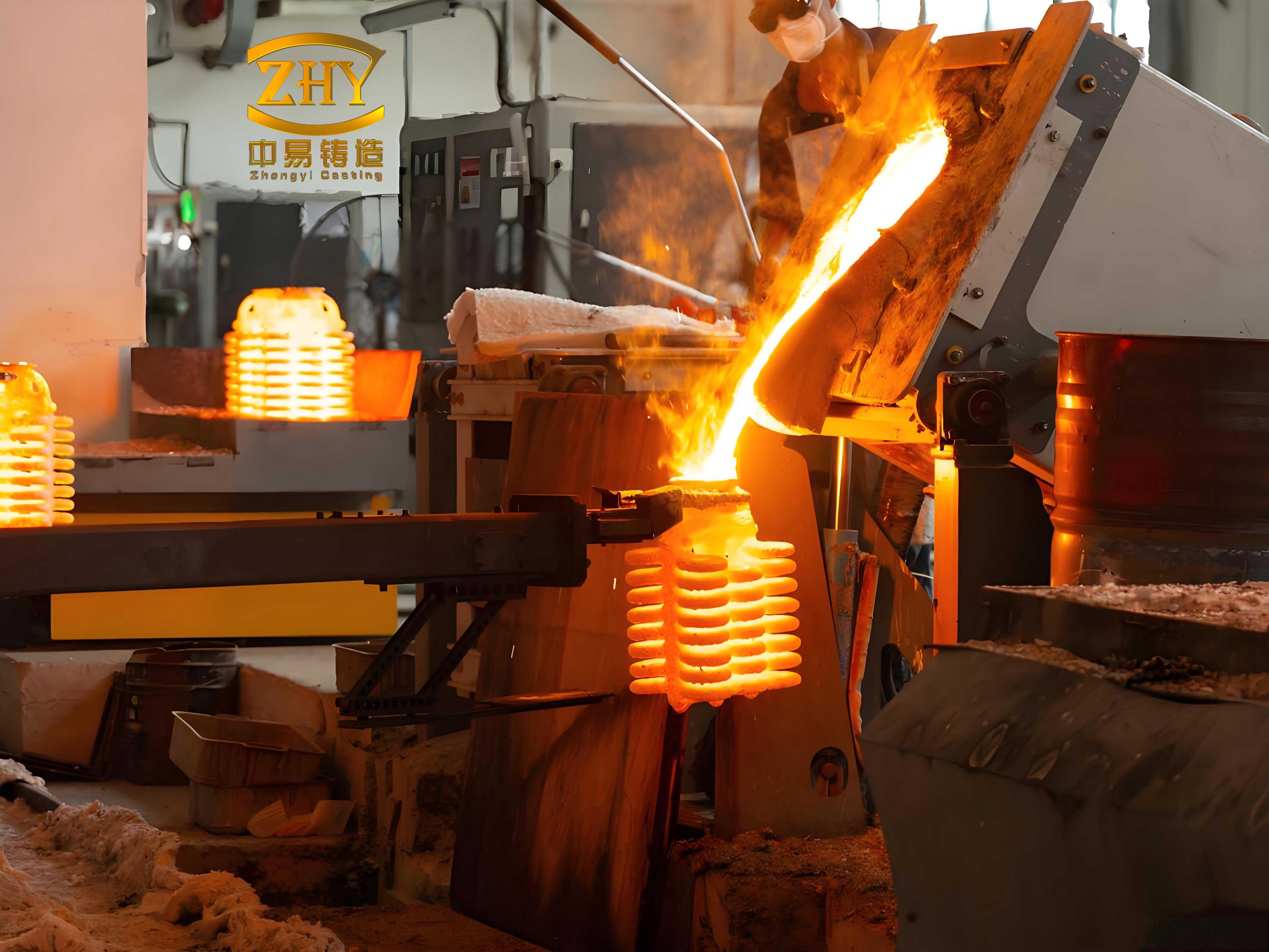
Pouring titanium into the prepared shells is a delicate phase of the investment casting process. I use vacuum arc remelting or induction melting to produce high-purity titanium alloys, which are then poured into the preheated ceramic molds. The reactivity of titanium necessitates an inert atmosphere, such as argon, to prevent oxidation. After solidification, the shells are removed via mechanical vibration or chemical dissolution, revealing the raw castings. For thin-walled or small parts, surface contamination is minimal, but thicker sections often develop an alpha-case layer—a brittle, oxygen-enriched surface layer that must be removed. This is where post-processing, specifically acid pickling, becomes integral to the investment casting process. I employ a novel pickling solution composed of polymeric ferric sulfate and hydrofluoric acid, which effectively dissolves the contamination without attacking the base metal. The chemical reaction can be represented as: $$\text{Ti} + 6\text{HF} + \text{Fe}_2(\text{SO}_4)_3 \rightarrow \text{TiF}_6^{2-} + 2\text{Fe}^{3+} + 3\text{SO}_4^{2-} + 3\text{H}_2 \uparrow$$ This formula highlights the dissolution of titanium into soluble fluorides, with the polymeric ferric sulfate enhancing the reaction rate. The pickling parameters, such as solution concentration and temperature, are optimized based on casting geometry, ensuring uniform removal of the alpha-case layer. This step is crucial for achieving the mechanical properties and surface finish required in high-performance applications.
Throughout the investment casting process, quality control is paramount. I utilize non-destructive testing methods like X-ray radiography and computed tomography to inspect for internal defects, while dimensional checks ensure compliance with design specifications. The integration of 3D printing allows for iterative design improvements, as digital models can be quickly modified and reprinted, reducing the time and cost associated with traditional mold revisions. Moreover, the investment casting process benefits from the ability to produce complex internal features, such as cooling channels or lattice structures, which are challenging with conventional methods. By leveraging 3D printing, I have streamlined the investment casting process for titanium, making it more adaptable to custom or low-volume production runs. The table below summarizes the advantages of this hybrid approach over traditional investment casting, emphasizing key metrics like lead time and cost efficiency.
| Aspect | Traditional Investment Casting | 3D-Printing-Enhanced Investment Casting | Improvement Factor |
|---|---|---|---|
| Pattern Fabrication Time | Weeks (due to mold making) | Hours to days (direct 3D printing) | Up to 70% reduction |
| Cost for Small Batches | High (tooling amortization) | Low (no tooling required) | 60–80% savings |
| Design Complexity | Limited by moldability | Virtually unlimited (freeform fabrication) | Significant enhancement |
| Surface Finish Control | Dependent on wax injection | Adjustable via coating and printing parameters | Improved consistency |
| Material Waste | Moderate (wax and ceramic usage) | Reduced (additive pattern creation) | 30% less waste |
In conclusion, the fusion of 3D printing with the investment casting process represents a transformative advancement for titanium alloy manufacturing. By addressing challenges such as pattern fabrication, shell building, and post-processing, I have developed a robust methodology that enhances efficiency, reduces costs, and expands design possibilities. The investment casting process, when augmented with additive manufacturing, becomes more agile and responsive to market demands, particularly for industries requiring high-precision, complex components. Looking ahead, further refinements in 3D printing materials and ceramic shell formulations will continue to optimize the investment casting process, potentially enabling the production of larger and more intricate titanium castings. As technology evolves, this hybrid approach is poised to become a standard in advanced manufacturing, driving innovation in sectors from aerospace to healthcare. Through continuous experimentation and adaptation, I aim to push the boundaries of what is achievable with titanium investment casting, leveraging 3D printing as a catalyst for progress.