
In my extensive experience working with diesel engines, I have consistently observed that the crankshaft is a critical component whose integrity directly impacts operational safety and efficiency. The prevalence of metal casting defects in spheroidal graphite iron crankshafts, particularly in the crank cheek region, poses a significant risk of catastrophic failure. These metal casting defects, often originating from the casting process as shrinkage porosity, inclusions, or micro-shrinkage, can act as stress concentrators and initiate fatigue cracks under dynamic loads. This article details a comprehensive non-destructive testing (NDT) methodology I developed and implemented to detect and characterize these subsurface metal casting defects, with a focus on the challenging geometry of the crank cheek. The core of this approach involves a novel ultrasonic testing technique using specially designed probes for internal bore inspection.
The failure of crankshafts typically manifests in two modes: wear beyond permissible limits and sudden fracture. Fracture failures are often fatigue-driven, and in numerous investigations I have conducted, the fatigue origin is invariably linked to a pre-existing discontinuity in the material. In the case of the 10L 207E diesel engine crankshaft, fractures predominantly initiate at the fillet radius transitioning from the main journal to the crank cheek. Metallurgical analysis of fracture surfaces reveals that these origins frequently correlate with clusters of metal casting defects located either at the surface or slightly subsurface. The crank cheek, being a thermal center during the casting process, is highly susceptible to the formation of such internal metal casting defects. These defects may not always be visible on machined surfaces and can remain latent until operational stresses cause crack propagation. Therefore, a reliable method to interrogate the entire volume of the crank cheek, especially the high-stress fillet regions, is paramount for quality assurance and failure prevention.
Traditional inspection methods, such as magnetic particle testing for surface flaws or standard ultrasonic testing from the journal’s outer surface, proved inadequate for a complete assessment. Surface methods cannot detect internal metal casting defects, while conventional longitudinal wave probes from the journal outer diameter are limited in their ability to inspect the crank cheek’s core and the critical area near the opposite fillet due to beam spread and geometric constraints. The key innovation was to use the crankshaft’s internal oil bores as an access point for ultrasonic inspection. This provides a direct acoustic path into the heart of the crank cheek. However, inspecting from a small-diameter, as-cast (rough surface) bore presents unique challenges: coupling efficiency, probe stability, and beam control within a curved interface.
The first challenge was achieving adequate acoustic coupling between the probe and the rough bore surface. After testing various agents, I found that a specialized foundry-grade syrup offered the best combination of viscosity, wettability, and acoustic transmission for this application. Its rheological properties allowed it to fill surface asperities effectively, ensuring consistent sound energy transfer into the material. To further stabilize the probe and bridge the gap between the flat transducer element and the curved bore wall, I incorporated a Perspex (polymethyl methacrylate) standoff wedge machined to match the bore’s radius. The probe assembly was designed with a small diameter (18 mm) for maneuverability within the bore.
The most critical aspect was controlling the ultrasonic beam profile. When a standard flat probe emits sound waves into a curved surface, the beam refracts and focuses unpredictably. To achieve a precise, small-diameter beam suitable for accurate defect localization, I designed a focused beam probe. The core principle involves using a standoff with a central Perspex lens surrounded by an acoustic damping material. This configuration effectively creates a waveguide that restricts the active aperture, resulting in a collimated beam with minimal divergence. The focusing effect is augmented by the concave geometry of the bore wall itself. The beam characteristics can be described by modifications to the standard near-field and divergence equations. The effective near-field length \(N’\) and beam diameter \(d_f\) at a distance \(S\) (sound path) can be approximated considering the curvature:
$$N’ = \frac{D_{eff}^2 f}{4v} – l_s$$
$$d_f \approx \frac{1.22 v S}{f D_{eff}}$$
where \(D_{eff}\) is the effective transducer diameter (the diameter of the Perspex core), \(f\) is the frequency, \(v\) is the longitudinal wave velocity in the crankshaft material, and \(l_s\) is the length of the standoff. This design yielded a beam with a half-angle divergence of approximately 8°, providing excellent lateral resolution for mapping metal casting defects.
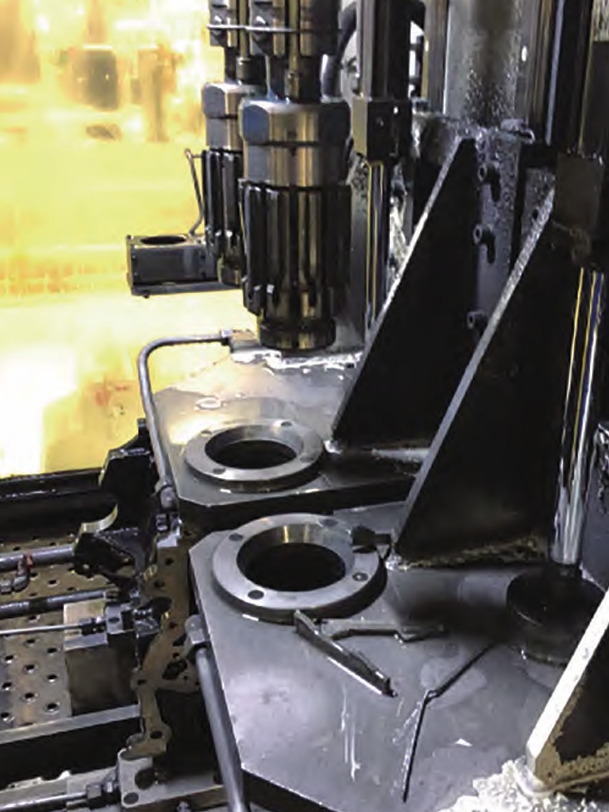
The testing procedure was systematized. The probe is inserted into the main journal bore and indexed axially along the bore. At each axial position, it is scanned circumferentially (along the arc of the bore) across the sector aligned with the crank cheek’s “danger zone”—the area connecting the main and pin journal fillets along a 45° line. The ultrasonic instrument’s sensitivity was calibrated using a reference block made of the same spheroidal graphite iron. The block features a concave surface matching the bore radius and a flat-bottom hole (FBH) at a depth simulating the crank cheek’s mid-thickness. The calibration establishes a baseline detectability for a specific reflector size, ensuring consistent identification of relevant metal casting defects. Any signal exceeding a predefined threshold level is recorded, noting its circumferential position, acoustic distance (time-of-flight), and amplitude. By combining scans from multiple axial positions, a three-dimensional map of the defect zone can be reconstructed.
The relationship between the acoustic path length (measured by time-of-flight) and the actual geometric location of a reflector within the crank cheek is non-linear due to the curved entry surface. I developed a set of calibration curves to translate instrument readings into physical coordinates. For a given bore diameter \(R\) and probe standoff curvature, the sound path \(S\) to a point at radial distance \(r\) and angular offset \(\theta\) from the bore centerline can be derived using trigonometric relations within the curved geometry. This translation is vital for determining if a detected metal casting defect lies within the critical fatigue-prone region.
| Parameter | Value / Description | Significance |
|---|---|---|
| Probe Frequency | 2.5 MHz | Optimal compromise between resolution (detect small metal casting defects) and penetration in nodular iron. |
| Probe Diameter | 18 mm | Ensures stability within the bore while maintaining a manageable near-field length. |
| Effective Aperture (Deff) | 6 mm | Creates a narrow, collimated beam for precise lateral defect localization. |
| Couplant | High-viscosity foundry syrup | Provides consistent coupling on rough, non-horizontal surfaces; non-corrosive. |
| Reference Reflector | Ø2 mm FBH at 40 mm depth in curved block | Sets sensitivity threshold for typical metal casting defect size. |
| Scanning Sector | ±10° from bore centerline aligned with cheek danger zone | Covers the high-stress region where metal casting defects are most detrimental. |
| Axial Scan Step | 5 mm | Provides sufficient resolution to map the volumetric extent of metal casting defects. |
To validate the technique, I applied it to several crankshafts suspected of containing significant metal casting defects based on previous fracture analysis or foundry records. The ultrasonic inspection clearly identified regions with clustered indications. Subsequent destructive analysis of these components confirmed the presence of shrinkage porosity and micro-shrinkage clusters precisely where the ultrasonic signals were strongest. Radiographic (X-ray) imaging of sectioned specimens provided further correlation, showing the morphology of the metal casting defects. The table below compares the ultrasonic prediction with the actual findings from one such validation case, demonstrating the method’s accuracy in locating and sizing major metal casting defects.
| Inspection Sector (Axial Position) | UT Signal Amplitude (dB above noise) | Predicted Defect Location (Radial Depth from Bore) | Actual Defect Type (Upon Sectioning) | Approximate Defect Size (mm) |
|---|---|---|---|---|
| +15 mm from center | +24 dB | 25-30 mm, near pin fillet | Shrinkage Porosity Cluster | ~8 x 5 |
| 0 mm (center) | +18 dB | 20-25 mm, central cheek | Micro-shrinkage Zone | Diffuse, ~15 mm dia. |
| -10 mm from center | +30 dB | 15-20 mm, near main fillet | Subsurface Shrinkage Cavity | ~4 x 3 |
Based on this successful validation, I propose a revised and comprehensive NDT protocol for new crankshafts. This protocol aims to catch both surface and subsurface metal casting defects, thereby significantly reducing the risk of in-service failure. The process should be integrated at two key stages of manufacturing.
Stage 1: Ultrasonic Testing (UT) of Rough or Semi-Finished Castings. This stage targets internal metal casting defects. After shot blasting (which cleans the surface but does not mask internal discontinuities), the crankshaft undergoes volumetric inspection using the internal bore UT method described. The primary evaluation criterion is based on the reflectivity and spatial distribution of indications. Indications with amplitudes exceeding those from the reference FBH and located within the predefined danger zone should be considered rejectable metal casting defects. The acceptance standard can be defined using the Distance-Amplitude-Correction (DAC) curve generated from the reference block. A simplified formula for the signal acceptance threshold \(A_{th}(S)\) as a function of sound path \(S\) can be:
$$A_{th}(S) = A_{ref} + 20 \log\left(\frac{S_{ref}}{S}\right) + C_{mat} – G_{res}$$
where \(A_{ref}\) is the amplitude from the Ø2 mm FBH at reference sound path \(S_{ref}\) (e.g., 40 mm), \(C_{mat}\) is a material attenuation correction factor (significant for nodular iron), and \(G_{res}\) is a reserved gain margin (e.g., 6 dB) to account for material noise. Any indication with amplitude \(A_{ind} > A_{th}(S)\) in the critical zone flags a potentially critical metal casting defect.
Stage 2: Magnetic Particle Testing (MPT) of Finished Crankshafts. Performed after final machining and before dispatch, MPT is excellent for detecting surface-breaking metal casting defects and grinding cracks, especially in the fillet radii. The crankshaft should be magnetized using a longitudinal current flow method to induce a circumferential magnetic field, which is optimal for revealing transverse discontinuities. This step is crucial because some metal casting defects may intersect the surface after machining, or surface stress concentrations could initiate new flaws.
The synergistic application of UT and MPT provides a robust defense against failures caused by metal casting defects. The table below outlines the proposed two-stage quality gate.
| Stage | Method | Objective | Key Inspection Area | Defect Type Targeted | Acceptance Criteria Basis |
|---|---|---|---|---|---|
| 1 (Post-casting) | Internal Bore Ultrasonic Testing | Detect subsurface volumetric metal casting defects | Entire crank cheek volume, especially danger zone | Shrinkage porosity, gas pores, inclusions | DAC curve from Ø2 mm FBH; reject indications in critical zone exceeding threshold. |
| 2 (Post-machining) | Wet Fluorescent Magnetic Particle Testing | Detect surface & near-surface metal casting defects and cracks | All fillet radii, journal surfaces | Surface-breaking shrinkage, hot tears, grinding cracks | Relevant industry standards (e.g., ASTM E1444); no linear indications in fillets. |
Implementing this protocol requires investment in specialized equipment and training, but the payoff in terms of reliability and reduced warranty costs is substantial. The internal bore UT method, in particular, fills a critical gap in traditional inspection regimens. It allows for the quantitative assessment of metal casting defect severity before significant value is added through machining. Furthermore, the data collected can be fed back to the foundry to optimize pouring and solidification parameters, actively reducing the incidence of such metal casting defects in future castings.
In conclusion, the threat posed by internal metal casting defects in diesel engine crankshafts is real and manageable through advanced non-destructive evaluation. The ultrasonic inspection technique from the crankshaft’s internal bore, employing a custom-focused probe, provides an effective solution for volumetric inspection of the critical crank cheek region. When combined with surface-sensitive methods like magnetic particle testing, it forms a comprehensive quality assurance shield. This integrated approach ensures that metal casting defects are identified and addressed early, safeguarding the structural integrity of the crankshaft and, by extension, the entire engine system. Future work could involve automating the scanning process and developing advanced signal processing algorithms, such as synthetic aperture focusing technique (SAFT), to further improve the sizing and characterization accuracy of these subtle metal casting defects.