
In the field of high manganese steel casting, the application of static molding technology presents significant challenges due to the material’s unique metallurgical and mechanical properties. High manganese steel, characterized by its austenitic structure, exhibits non-magnetic properties, high toughness, and substantial shrinkage during solidification. These characteristics complicate traditional casting processes, particularly when employing high-density green sand molding techniques. This study focuses on overcoming the limitations of static molding for high manganese steel casting in vehicle track shoes, addressing critical defects such as porosity, cold shuts, cracks, and sand inclusions. Through systematic process development, we have optimized the static molding parameters and high-density green sand formulations, resulting in improved casting quality and substantial economic benefits.
The static molding process for high manganese steel casting involves compacting sand using a combination of airflow pre-compaction and high-pressure squeezing. This method ensures high dimensional accuracy and surface finish but exacerbates issues like gas entrapment and restricted shrinkage. The core of our research lies in refining the high-density green sand composition and molding parameters to accommodate the specific needs of high manganese steel casting. Key aspects include sand composition selection, compaction pressure optimization, and the integration of specialized additives to enhance sand properties. The following sections detail our methodology, experimental results, and industrial applications, supported by quantitative data and analytical models.
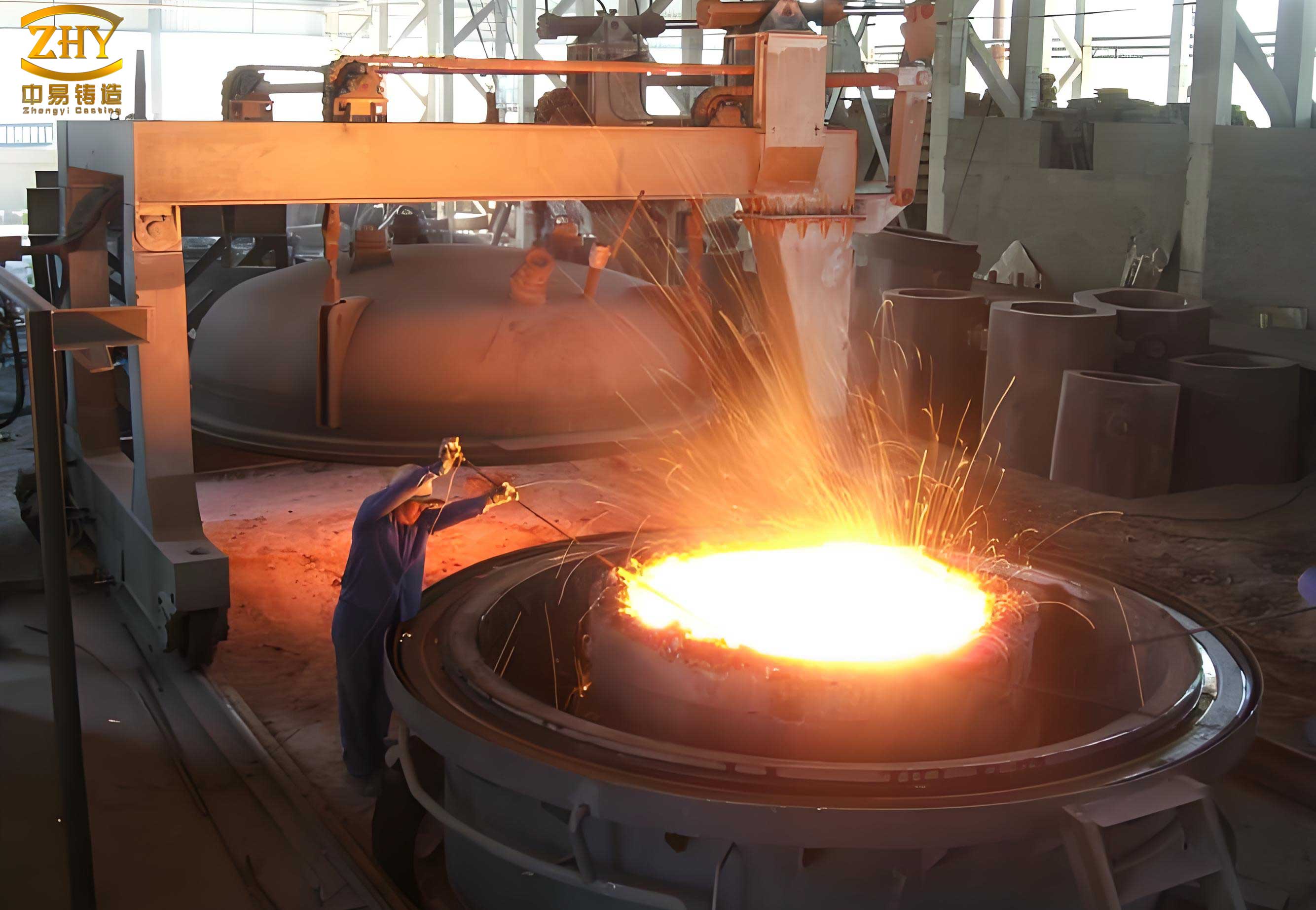
Static molding equipment, such as the EFA-SD4 model with a rotary table and multi-piston squeezing mechanism, operates at compaction pressures ranging from 0.2 to 1.2 MPa. The sand mold dimensions are 800 mm × 650 mm × 260/260 mm, with a production rate of 60 molds per hour. The high compaction pressure in high manganese steel casting leads to dense sand packing, reducing permeability and hindering gas escape. This is critical because high manganese steel has a high melting point and significant solidification shrinkage, increasing the propensity for defects. The relationship between compaction pressure (P) and sand mold hardness (H) can be expressed as:
$$ H = k \cdot P^n $$
where k is a material constant and n is an exponent dependent on sand properties. For high manganese steel casting, we target a hardness of 85–90 GF on the parting surface and ≥80 GF on vertical surfaces, with a deviation of ≤5 GF across the mold. This ensures adequate strength while minimizing cracking risks.
The high-density green sand for high manganese steel casting consists of recycled sand (95–97%), new sand (3–5%), bentonite (0.4–0.6%), steel casting binder (0.25–0.5%), and water. The selection of raw materials is crucial to achieving the desired sand properties. New sand with high SiO2 content (≥93%) and rounded grain morphology (40/100 mesh) ensures good permeability and fluidity. Sodium-based bentonite, with a process strength >120 kPa and hot wet tensile strength ≥3.5 kPa, provides enhanced bonding and thermal stability. The steel casting binder, a composite of polymeric colloids, polysaccharides, and refractory components, improves sand toughness, plasticity, and crack resistance. Its performance compared to α-starch is summarized in Table 1.
| Material | Appearance | Density (g/cm³) | pH | Key Components |
|---|---|---|---|---|
| Steel Casting Binder | Brown-red powder | <0.85 | 8 | Polymeric colloids, polysaccharides, organic fibers |
| α-Starch | Light yellow powder | <0.9 | 7 | Single-component starch |
The optimization of sand properties was conducted using orthogonal experiments (L9(3^4)) to analyze the effects of recycled sand, bentonite, binder, and water content. The key parameters include moisture content (2.6–3.3%), compactability (45 ± 5)%, permeability (280–400), and wet compressive strength (80–110 kPa). The clay content should be maintained at 7.0–10.0%, with effective bentonite at 4.0–6.0% and loss on ignition ≤5.0%. The recycled sand must have a moisture content of 1.5–2.0% and temperature below 45°C to prevent property degradation. The sand’s performance directly impacts the quality of high manganese steel casting, as described by the following relationship for wet tensile strength (σ_wt):
$$ \sigma_{wt} = A \cdot e^{B \cdot C} $$
where A and B are constants, and C is the binder concentration. This model helps in predicting sand behavior under varying conditions.
In high manganese steel casting, the compaction pressure must balance mold strength and permeability. Excessive pressure reduces gas escape paths, leading to porosity, while insufficient pressure causes mold instability. We determined an optimal pressure range of 0.5–0.8 MPa, which achieves the required hardness without compromising other properties. The gas evolution during pouring in high manganese steel casting can be modeled using the ideal gas law, where the volume of gas (V) generated is:
$$ V = \frac{nRT}{P} $$
Here, n is the moles of gas, R is the gas constant, T is the temperature, and P is the pressure. By controlling sand composition and compaction, we reduce gas entrapment in high manganese steel casting components.
Industrial application of this optimized process has demonstrated a significant reduction in defects. For instance, the rejection rate due to porosity and cracks in high manganese steel casting for track shoes decreased by over 20%, leading to cumulative economic benefits exceeding millions of dollars. The developed high-density green sand formulation ensures consistent performance, with regular monitoring of parameters like moisture, compactability, and strength. Additionally, the use of steel casting binder enhances sand reusability and reduces environmental impact compared to traditional additives.
Further improvements in high manganese steel casting involve controlling sand temperature and moisture during recycling. The cooling process includes two-stage water spraying, with the first stage accounting for 1/4–1/3 of total water usage, ensuring sand temperature remains below 40°C. This maintains the stability of the sand mixture and prevents property fluctuations. The overall process flow for high manganese steel casting in static molding is summarized in Table 2, highlighting key steps and parameters.
| Process Step | Parameter | Optimal Range |
|---|---|---|
| Sand Compaction | Pressure (MPa) | 0.5–0.8 |
| Mold Hardness | GF (Parting Surface) | 85–90 |
| Sand Composition | Recycled Sand (%) | 95–97 |
| Bentonite (%) | 0.4–0.6 | |
| Binder (%) | 0.25–0.5 | |
| Sand Properties | Moisture (%) | 2.6–3.3 |
| Permeability | 280–400 | |
| Wet Strength (kPa) | 80–110 |
The success of this high manganese steel casting process underscores the importance of tailored material selections and precise parameter control. Future work will focus on further enhancing sand reclamation and reducing energy consumption. By addressing the unique challenges of high manganese steel casting, we have established a robust methodology that leverages static molding technology for high-performance applications.