
In my extensive experience with high manganese steel casting, I have observed that this material uniquely combines a hard surface with a tough core, enabling it to withstand intense impact loads. Under significant冲击 and contact stress, the surface layer rapidly hardens, with hardness increasing dramatically from 200 HB to 500–700 HB, forming a highly wear-resistant layer. Meanwhile, the austenitic core maintains excellent toughness, ensuring stable耐磨性 in applications involving impact abrasion and high-stress crushing wear. High manganese steel casting requires substantial impact or pressure to achieve full hardening; larger components, such as those used in mining and construction, experience greater冲击 loads, leading to more complete work-hardening and superior wear resistance. If the冲击 force is insufficient, the surface may wear away before adequate hardening occurs. This explains why larger mill liners, jaw plates, and hammers made via high manganese steel casting outperform smaller ones in durability. The perceived inadequacy of high manganese steel often stems from improper application rather than material limitations.
Broadly, high manganese steel casting now includes ultra-high manganese grades based on manganese content. In industries like mining,建材, metallurgy, and power generation, where equipment is increasingly large and efficient, the advantages of high manganese steel casting become more pronounced. For instance, in my work, annual production of high manganese steel castings exceeds 3000 tons, with about half comprising large thick-walled components weighing over 1 ton and wall thicknesses above 80 mm—a significant increase from past volumes. This growth underscores the importance of optimizing high manganese steel casting processes for such demanding applications.
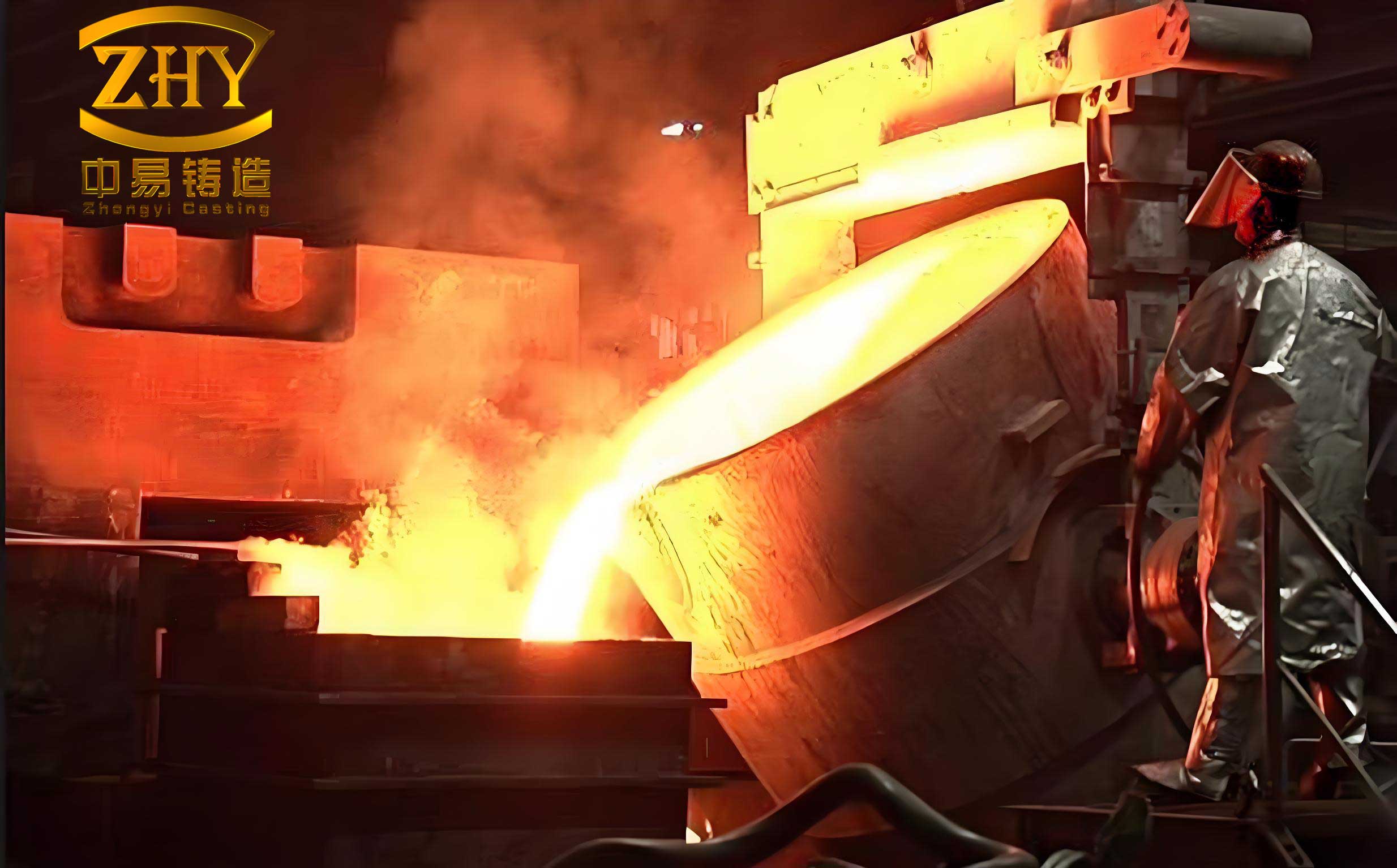
To delve deeper into high manganese steel casting, let’s analyze its chemical composition. The properties of high manganese steel casting are heavily influenced by elements like carbon, manganese, sulfur, phosphorus, silicon, and chromium. Carbon, ranging from 0.9% to 1.35%, promotes austenite formation and solid solution strengthening, but excessive carbon can lead to carbide networks that reduce toughness. Manganese, typically between 11.0% and 14.0%, stabilizes austenite and enhances strength; ultra-high manganese steels extend this to 14.0%–24.0%. Phosphorus and sulfur are detrimental, with phosphorus particularly harmful due to its tendency to form brittle phosphide eutectics, increasing hot tearing susceptibility. Silicon, used for deoxidation, should be limited to below 0.5% to avoid embrittlement. Chromium can improve yield strength and wear resistance but may reduce ductility and impact toughness. The interaction of these elements in high manganese steel casting can be summarized in the table below, which outlines their roles and optimal ranges.
| Element | Role | Optimal Range | Effects of Deviation |
|---|---|---|---|
| Carbon (C) | Promotes austenite formation and solid solution strengthening | 0.9%–1.1% for large thick-walled castings | High carbon increases carbides, reducing toughness; low carbon may limit hardening |
| Manganese (Mn) | Stabilizes austenite and provides strengthening | 11.0%–14.0% (standard); 14.0%–24.0% (ultra-high) | Insufficient Mn reduces austenite stability; excess may not significantly harm but requires control |
| Phosphorus (P) | Harmful impurity | <0.07% (general); <0.04% for complex castings | High P causes phosphide eutectics, leading to hot tearing and reduced mechanical properties |
| Sulfur (S) | Harmful impurity | Minimized due to natural desulfurization by Mn | Can form sulfides, but less critical than P with adequate Mn |
| Silicon (Si) | Deoxidizer and improves fluidity | <0.5% | High Si increases carbides and segregation, embrittling the steel |
| Chromium (Cr) | Enhances yield strength and wear resistance | 1.5%–2.5% | Increases casting stress and reduces ductility and impact toughness |
The solidification behavior of high manganese steel casting is characterized by an intermediate freezing pattern, with a larger feeder zone compared to carbon steel but a smaller end zone. Due to high carbon and manganese content, low thermal conductivity (approximately one-third that of carbon steel), and rapid crystal growth, coarse columnar grains often form. This can lead to issues like shrinkage porosity and hot tearing in high manganese steel casting, especially in thick sections. For large thick-walled high manganese steel casting, solidification times are prolonged, increasing the tendency for shrinkage defects. Riser feeding is essential to achieve dense structures, but the presence of multiple dispersed hot spots complicates this. Techniques such as inclined pouring and the use of high-thermal-capacity molding materials can enhance riser effectiveness. The solidification dynamics can be modeled using equations like the Chvorinov’s rule for solidification time, but adapted for high manganese steel casting: $$ t_s = k \cdot \left( \frac{V}{A} \right)^2 $$ where \( t_s \) is solidification time, \( V \) is volume, \( A \) is surface area, and \( k \) is a constant dependent on the material’s properties, which for high manganese steel casting is lower due to its thermal characteristics.
In large thick-walled high manganese steel casting, the casting process must address challenges like thermal stress and shrinkage. Risers are critical for feeding hot spots; however, their design should prioritize side risers or necked-down top risers to minimize cracking risks. The riser dimensions can be calculated using modulus methods: $$ M_r = 1.2 \cdot M_c $$ where \( M_r \) is the riser modulus and \( M_c \) is the casting modulus, ensuring adequate feeding. Chills, including external and internal types, regulate solidification rates and work in tandem with risers to eliminate shrinkage. External chills must be sized appropriately to avoid stress concentration, while internal chills, if used, should be minimal and made of compatible high manganese steel to prevent internal cracks. The gating system in high manganese steel casting should be open and designed with multiple ingates at thin sections to facilitate rapid, low-temperature pouring, reducing thermal gradients. Pouring temperature control is vital; for large thick-walled high manganese steel casting, the final pouring temperature should be maintained between 1410°C and 1430°C to minimize shrinkage and coarse grains. The relationship between pouring temperature and defect formation can be expressed as: $$ T_p = T_m – \Delta T_c $$ where \( T_p \) is the pouring temperature, \( T_m \) is the melting point, and \( \Delta T_c \) is a cooling factor specific to high manganese steel casting. Molding materials like chromite sand or magnesia-based compounds are preferred for their high heat capacity, aiding in finer grain structures.
Melting practices for high manganese steel casting predominantly involve electric arc furnaces or induction furnaces, with alkaline arc furnace oxidation melting being ideal for large thick-walled components due to superior dephosphorization and deoxidation capabilities. In contrast, induction furnaces offer faster heating and less element loss but struggle with slag-based reactions. The oxidation melting process includes stages: charging, melting, oxidation, reduction, and tapping. During oxidation, decarburization and dephosphorization occur, with oxygen blowing at 0.6–0.8 MPa to achieve a decarburization rate of 0.01%–0.03% per minute, removing impurities. The reduction phase focuses on deoxidation using manganese ferrite, silicon ferrite, and aluminum, under a reducing atmosphere to minimize inclusions. For high manganese steel casting, residual aluminum should exceed 0.06% to ensure effective deoxidation. The kinetics of dephosphorization can be described by: $$ [P] = [P]_0 \cdot e^{-k_p \cdot t} $$ where \( [P] \) is the phosphorus concentration at time \( t \), \( [P]_0 \) is the initial concentration, and \( k_p \) is the rate constant dependent on slag basicity and temperature. After tapping, argon stirring for 3–4 minutes at controlled rates helps purify the molten high manganese steel casting by promoting inclusion flotation and degassing.
| Stage | Key Actions | Temperature Range (°C) | Objectives |
|---|---|---|---|
| Melting | Max power melting; oxygen assistance | Up to ~1600 | Complete melting; initial slag formation |
| Oxidation | Oxygen blowing; slag adjustment | ~1600–1650 | Decarburization ≥0.3%; dephosphorization |
| Reduction | Slag removal; addition of Mn-Fe, Si-Fe, Al | ~1500–1550 | Deoxidation; composition adjustment | Tapping | Argon stirring; temperature stabilization | 1480–1520 (tapping); 1410–1430 (pouring) | Purification; homogeneity for high manganese steel casting |
Heat treatment is a cornerstone of high manganese steel casting, particularly for large thick-walled pieces, to achieve the desired austenitic microstructure and relieve stresses. The process involves pre-treatment, heating and soaking, water quenching, and optional intermediate treatments. Pre-treatment entails slow heating to intermediate temperatures (e.g., 600–700°C) to reduce casting stresses and partially decompose austenite, increasing nucleation sites for refinement during final heat treatment. Soaking at 1050–1080°C ensures complete dissolution of carbides and austenite homogenization, critical for high manganese steel casting performance. The time-temperature relationship can be approximated by the Arrhenius equation for diffusion: $$ D = D_0 \cdot e^{-Q/(RT)} $$ where \( D \) is the diffusion coefficient, \( D_0 \) is a pre-exponential factor, \( Q \) is activation energy, \( R \) is the gas constant, and \( T \) is temperature in Kelvin. Rapid water quenching (water toughening) follows, with components continuously agitated in circulating water to prevent carbide precipitation and achieve high toughness. For some high manganese steel casting applications, intermediate treatments at 400–600°C may be applied to enhance surface hardness and yield strength, but this requires precise control to avoid embrittlement. The entire heat treatment cycle must avoid prolonged exposure in the 250–800°C range to prevent carbide formation.
Post-casting operations in high manganese steel casting include shakeout, cutting, welding, and inspection. Shakeout should occur below 200°C to prevent thermal cracking due to the material’s low thermal conductivity. Cutting of risers is best done with the casting partially submerged in water to minimize heat-affected zone issues, as high manganese steel casting is prone to carbide precipitation upon reheating. Welding, performed after heat treatment, uses high manganese steel or austenitic stainless steel electrodes, with post-weld peening and water cooling to mitigate stress. Non-destructive testing, such as ultrasonic or radiographic inspection, ensures integrity, and mechanical tests validate properties like yield strength (often exceeding 350 MPa) and elongation (above 40%). If results are subpar, re-heat treatment is permitted, but multiple cycles should be avoided without consent. The reliability of high manganese steel casting in service is evidenced by its precise failure timing, often within ±5% of projected life, making it a preferred choice for safety-critical applications like heavy machinery and advanced equipment.
In conclusion, high manganese steel casting for large thick-walled components demands a holistic approach, integrating composition control, optimized casting design, precise melting, and rigorous heat treatment. The interplay of these factors in high manganese steel casting ensures superior toughness and wear resistance, underpinning its expanded use in evolving industries. As technologies advance, high manganese steel casting continues to evolve, cementing its role in both traditional and cutting-edge applications.