
In the realm of foundry technology, the development of complex castings like diesel engine cylinder blocks has always presented significant challenges due to intricate geometries and stringent technical requirements. As a professional engaged in this field, I have witnessed how traditional casting methods often fall short in terms of efficiency, precision, and cost-effectiveness, especially during the prototyping phase. The advent of 3D printing, however, has revolutionized our approach to foundry technology, enabling rapid iteration and enhanced process control. This article delves into my firsthand experience in utilizing 3D printing to design and implement a novel casting process for an in-line four-cylinder diesel engine cylinder block. By integrating advanced foundry technology principles, we have overcome common production hurdles, such as core shifting and dimensional inaccuracies, while optimizing parameters through mathematical models and empirical data. Throughout this discussion, I will emphasize the role of foundry technology in streamlining operations, reducing defects, and accelerating innovation in automotive component manufacturing.
The cylinder block, a critical component in automotive engines, is typically cast from gray iron with a grade of HT250, requiring high dimensional accuracy and structural integrity. In traditional foundry technology, the process involves assembling multiple sand cores—such as the crankcase core, front and rear end cores, and water jacket core—using specialized fixtures and manual measurements. This method, while established, is prone to human error, leading to issues like core floatation, breakage, and sand adhesion. For instance, the water jacket core, with walls as thin as 4 mm, is particularly vulnerable during pouring. These challenges not only increase scrap rates but also prolong development cycles, making it difficult to meet the demanding standards of modern foundry technology. The need for expensive molds in traditional approaches further escalates costs, highlighting the urgency for innovative solutions in foundry technology.
To address these limitations, we turned to 3D printing, specifically the binder jetting technique known as 3DP, which aligns with the evolving trends in foundry technology. This method involves depositing a binder onto powdered materials layer by layer to form complex sand molds and cores without the need for physical patterns. The key parameters of our 3DP system are summarized in Table 1, illustrating its suitability for high-precision foundry technology applications. For example, the layer thickness of 0.2–0.5 mm ensures fine detail, while the build volume accommodates large components like cylinder blocks. This technology has transformed our foundry technology practices by eliminating mold-related constraints and enabling direct digital fabrication.
| Parameter | Specification |
|---|---|
| Grain Size (mesh) | 70/140 |
| Layer Thickness (mm) | 0.2–0.5 |
| Maximum Build Dimensions (mm × mm × mm) | 2200 × 1500 × 700 |
| Printing Efficiency (L/h) | 400 |
| Mold Compressive Strength (MPa) | ≥6 |
In designing the casting process, we began with a thorough analysis of the cylinder block’s structure. The component measures 466 mm × 335 mm × 375 mm, with a mass of 70 kg and primary wall thicknesses of 5–7 mm. The cooling water jacket surrounding the cylinders features complex ribs, necessitating a robust foundry technology approach to prevent defects. We oriented the casting with the cylinder head face downward and the base flange upward to minimize quality issues in critical areas. This orientation facilitates the use of a top-feeding gating system, which is essential in foundry technology for controlling fluid dynamics and solidification. The pouring temperature was set high to avoid cold shuts, and the gating ratio was carefully calculated to ensure laminar flow, a cornerstone of effective foundry technology.
The gating system was designed as an open-type, medium-pouring arrangement, with the sprue located at the side of the casting to distribute molten iron evenly. The cross-sectional areas were proportioned according to the formula: ΣF_sprue : ΣF_runner : ΣF_ingate = 1 : 2 : 2–2.5, where F denotes the cross-sectional area. This ratio ensures a controlled flow velocity, critical in foundry technology to prevent turbulence and slag inclusion. The ingate velocity was maintained below 0.5 m/s, as per the equation: $$v = \frac{Q}{A}$$ where v is the velocity, Q is the flow rate, and A is the cross-sectional area. A SiC foam filter was placed in the pouring cup to trap impurities, aligning with best practices in foundry technology for reducing inclusion defects. Additionally, to address shrinkage in the thick base flange, we incorporated side risers based on volume calculations derived from Chvorinov’s rule: $$t = k \left( \frac{V}{A} \right)^2$$ where t is solidification time, V is volume, A is surface area, and k is a constant. The venting ratio was set as F_vent : F_choke = 1.5–2.0 to ensure proper gas escape, a vital aspect of foundry technology for minimizing porosity.
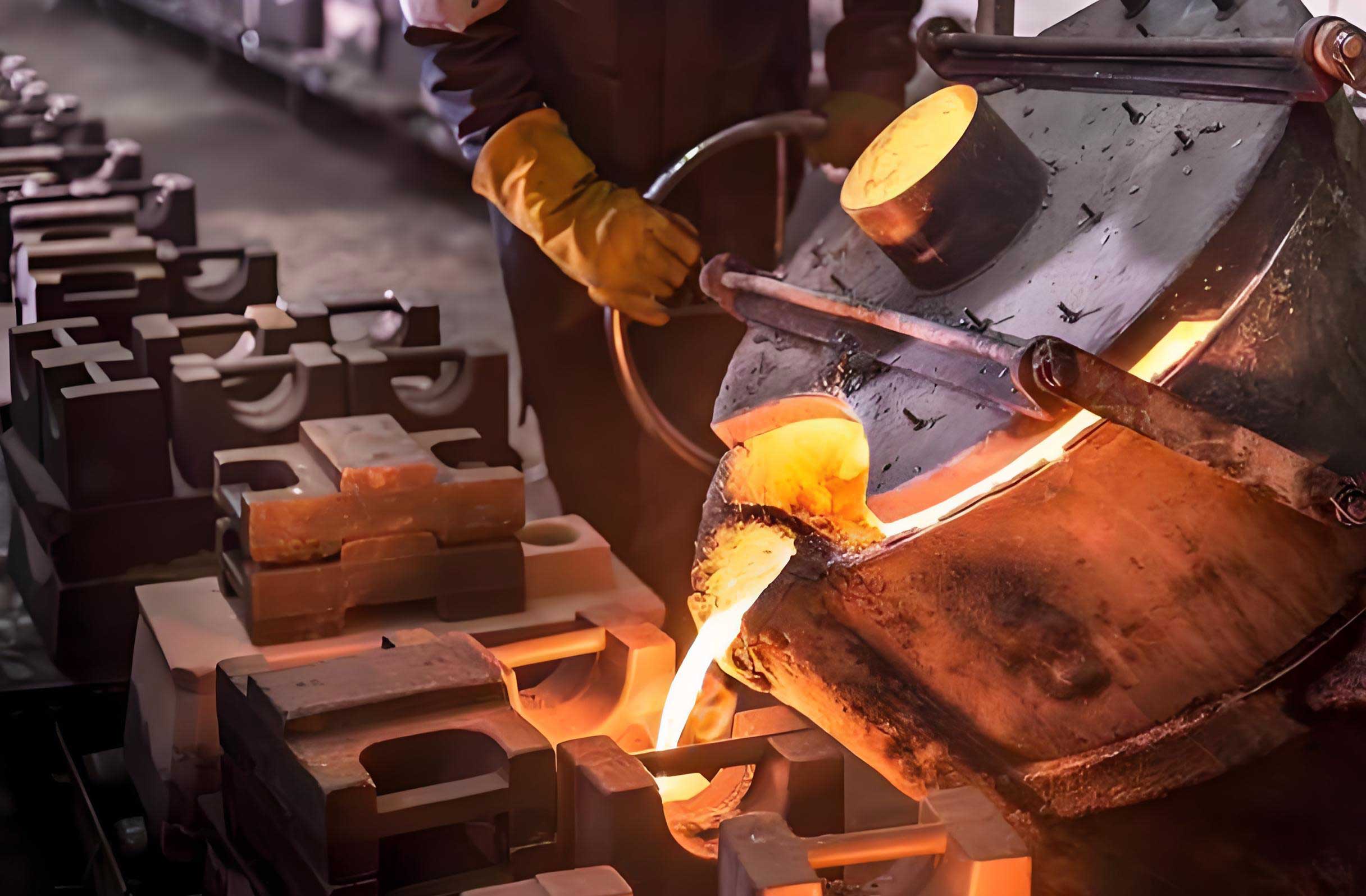
For the sand mold design, we leveraged the flexibility of 3D printing in foundry technology to consolidate multiple cores into integrated units, simplifying assembly. The parting surfaces were defined at the cylinder head face, water jacket top, and base flange, resulting in three main sand molds: #1, #2, and #3. Mold #1 combined the water jacket core, tappet bore core, base core, and cylinder cores; mold #2 included the front and rear end cores; and mold #3 housed the crankcase core, cover core, and oil passage cores. This integration reduces the total number of cores, a significant advancement in foundry technology that minimizes handling errors. Each mold was optimized for weight reduction and structural integrity, with alignment features like tongue-and-groove joints and handling lugs for ease of manipulation. The assembly sequence involved placing mold #3 onto mold #2, then lowering this sub-assembly onto mold #1, ensuring precise registration without the need for complex fixtures—a testament to the efficiency of modern foundry technology.
During production validation, we cast 21 units using this 3D printing-based foundry technology approach, achieving a scrap rate of only 4.7%, with one rejection due to slag inclusion. The process demonstrated remarkable stability, and the castings met all technical specifications. Microstructural analysis revealed over 90% type A graphite and a pearlite content exceeding 95%, while mechanical tests confirmed a tensile strength of ≥265 MPa and a hardness range of 190–240 HB, with a variation of less than 30 HB across the casting. Dimensional inspections complied with ISO 8062 CT9 standards, and air tightness tests at 350 kPa for 15 seconds showed no pressure drop. Internal measurements indicated a surface roughness below 25 μm, underscoring the precision achievable with this foundry technology. These results validate the effectiveness of 3D printing in enhancing foundry technology workflows, from design to production.
In conclusion, the integration of 3D printing into foundry technology has proven transformative for developing diesel engine cylinder blocks. By eliminating the need for expensive molds and simplifying core assembly, this approach reduces lead times and costs, making it ideal for prototyping and low-volume production. The use of mathematical models and empirical data in process design ensures optimal performance, aligning with the core principles of foundry technology. As we continue to refine these methods, the potential for innovation in foundry technology expands, driving advancements in automotive and other industries. This experience has reinforced my belief that embracing digital tools is essential for the future of foundry technology, enabling more sustainable and efficient manufacturing practices.