
In my extensive experience within the foundry industry, the pursuit of high-quality castings, particularly for critical automotive components, is a perpetual challenge. One such component is the pressure plate used in clutch assemblies, typically manufactured from grey cast iron due to its excellent wear resistance, damping capacity, and machinability. This narrative details a comprehensive project I undertook to rectify persistent quality issues in a grey cast iron pressure plate casting. The original process yielded unacceptable scrap rates primarily due to shrinkage porosity and slag/sand inclusions. Through a methodical approach involving defect root-cause analysis, computer-aided engineering (CAE) simulation—specifically using Intecast CAE software—and systematic process modifications, the casting yield was dramatically improved. The core of this improvement lay in re-engineering the gating and feeding systems while enhancing metal treatment, all validated through sophisticated simulation of filling and solidification dynamics.
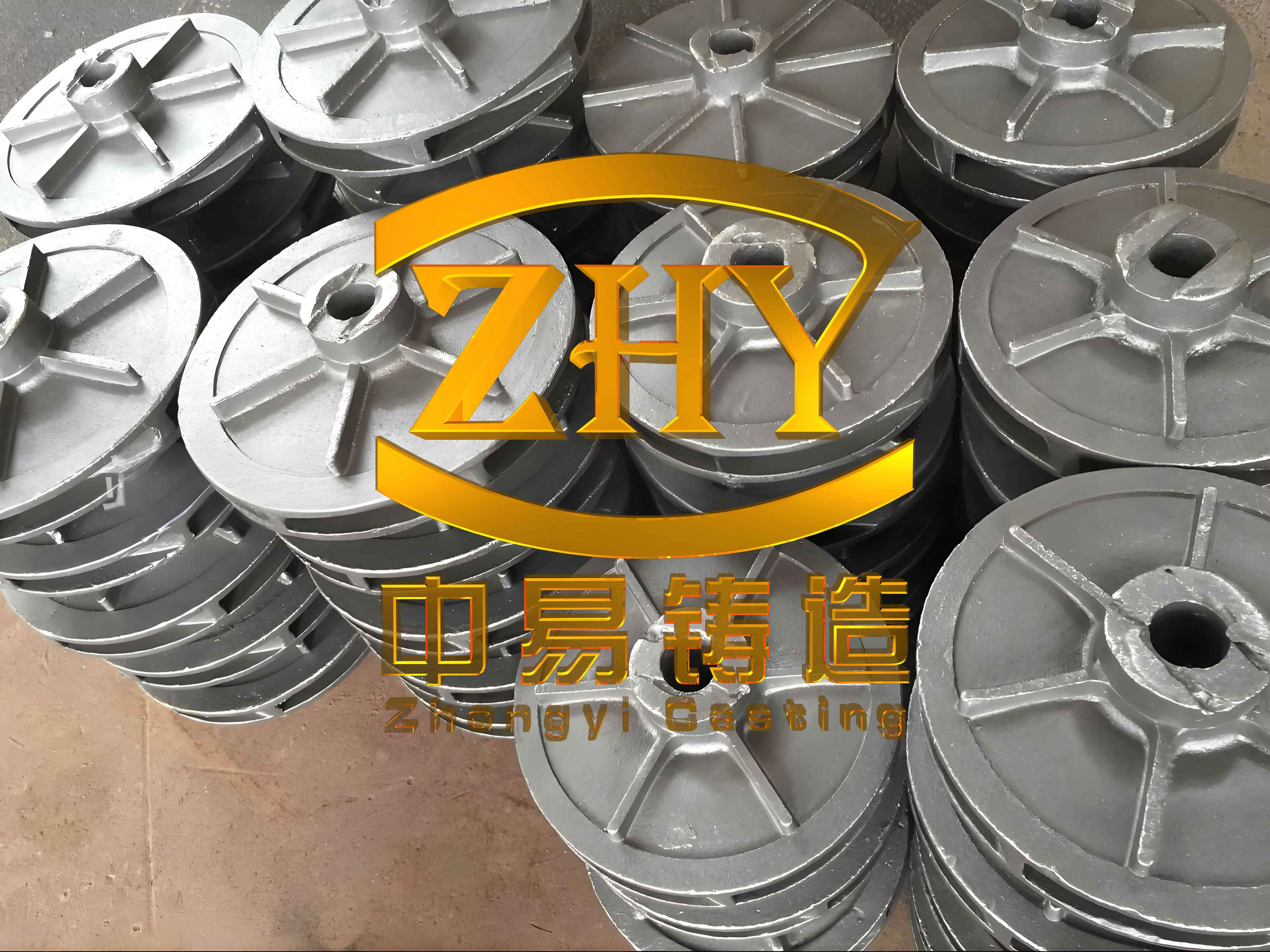
The subject component was a disc-shaped grey cast iron pressure plate with a nominal grade of HT250. Its key dimensions included a maximum outer diameter of 338 mm and a maximum thickness of 35 mm, with a final casting weight of approximately 12.3 kg. The functional requirements were stringent: the finished machined friction surface had to be entirely free from any discontinuities such as shrinkage cavities, porosity, slag holes, or gas pores. The base material, grey cast iron, derives its properties from the graphite flake morphology within a ferrous matrix, and its soundness is heavily dependent on controlled solidification and clean metal practice.
The initial manufacturing process utilized a vertically parted molding line (Disa style) with high-pressure squeeze molding, melting via medium-frequency induction furnace, and bottom-pour automated pouring. The standard pouring temperature was maintained between 1480°C and 1500°C. The original gating and feeding system, as deployed for years, is summarized in the table below.
| Element | Description | Cross-Sectional Area (mm²) | Ratio (ΣAchoke:ΣArunner:ΣAgate) |
|---|---|---|---|
| Pouring Cup | Standard | – | – |
| Sprue (Downsprue) | Vertical Channel | 360 (Calculated) | 1.5 |
| Runner (Cross Gate) | Horizontal Distribution | 240 | 1.0 (Choke) |
| Ingate | Single, Bottom-Poured | 288 | 1.2 |
| Riser | Cold Riser, Side Attached | – | – |
This system was a partially pressurized type, characterized by the relationship: $$ A_{runner} : A_{sprue} : A_{ingate} = 1.0 : 1.5 : 1.2 $$. The smallest choke area was at the junction of the runner and sprue (240 mm²). The ingate was located at the bottom side of the casting, and a cold riser was placed on the opposite side intended to feed solidification shrinkage.
The quality performance of this setup was chronically poor. External visual inspection at the foundry revealed a scrap rate of around 20%, primarily from shrinkage cavities at or near the riser neck. Furthermore, subsequent machining by the customer uncovered additional, often more critical, defects. The rejection rate at the customer’s end could reach up to 18%, mainly due to subsurface shrinkage porosity in the ingate region and scattered slag/sand inclusions on the critical friction surface. This not only represented a significant financial loss but also strained the supplier-customer relationship, forcing a production philosophy of over-casting to meet quantity demands—a highly inefficient practice.
My first step was a thorough analysis of the existing process system and the defect mechanisms. The observed defects in grey cast iron castings typically stem from incorrect thermal gradients during solidification, turbulent metal flow leading to oxide formation and sand erosion, and insufficient metal cleanliness.
Shrinkage Porosity Analysis: Shrinkage in grey cast iron is a complex phenomenon influenced by graphite expansion during eutectic solidification. However, inadequate feeding can still lead to micro-shrinkage or porosity, especially in sections that are not optimally designed for directional solidification. The original single, bottom ingate caused localized superheating of the mold and metal in that region. This area remained liquid longest, creating a “hot spot” that solidified last without adequate feed metal, leading to interdendritic shrinkage porosity. The CAE solidification simulation confirmed this, clearly showing a region of thermal isolation and last-to-freeze zones at the ingate and riser neck, predicting a high probability of shrinkage defects (see simulation output described later). The riser, being a “cold” type (filled after the main cavity), provided limited feeding efficiency. The riser neck connection to the casting was only 5 mm thick, which often froze too quickly, isolating the casting from the riser’s molten metal reservoir and creating a shrinkage cavity at the junction.
Slag and Sand Inclusion Analysis: These defects originated from two primary sources: internal slag from the molten metal and eroded sand from the mold walls. The original gating system was deficient in slag-trapping capability. A partially pressurized system with a single ingate promotes higher metal velocity at the ingate, causing turbulent flow into the cavity. Turbulence leads to air aspiration and the breaking up of any existing oxide films into fine dross, which becomes entrapped. The high-velocity stream also impinges on and erodes the sand mold at the ingate, washing sand grains into the cavity. The lack of effective filtration allowed non-metallic inclusions from the furnace or ladle to enter the casting. The table below categorizes the defect root causes.
| Defect Type | Primary Root Cause | Secondary Contributing Factors |
|---|---|---|
| Shrinkage Porosity (Ingate area) | Localized superheating from single bottom gating creating isolated hot spot. | Insufficient thermal gradient for directional solidification towards riser. |
| Shrinkage Cavity (Riser neck) | Premature freezing of narrow riser neck (5mm), blocking feed path. | Use of inefficient cold riser; lack of feed metal accessibility. |
| Slag Inclusions | Turbulent metal entry causing oxide film fragmentation; lack of slag traps in gating. | Inadequate metal cleanliness from melting/holding process. |
| Sand Inclusions | High velocity metal eroding sand at ingate; mold wall weakness. | Prolonged thermal attack on a single mold area. |
The governing fluid dynamics and heat transfer principles can be partially described by fundamental equations. The initial velocity of metal in the ingate can be approximated by Bernoulli’s equation applied to a pressurized system: $$ v = \mu \sqrt{2gh} $$ where \( v \) is the velocity at the ingate, \( \mu \) is the discharge coefficient, \( g \) is acceleration due to gravity, and \( h \) is the effective metallostatic head. For the original system, with a single ingate, this velocity was high, leading to high Reynolds numbers and turbulent flow: $$ Re = \frac{\rho v D}{\eta} $$ where \( \rho \) is density, \( D \) is hydraulic diameter, and \( \eta \) is dynamic viscosity. Turbulent flow (\( Re > 2000 \)) promotes inclusion entrapment.
Solidification time for a section, critical for feeding design, is often estimated using Chvorinov’s rule: $$ t = B \left( \frac{V}{A} \right)^n $$ where \( t \) is solidification time, \( V \) is volume, \( A \) is surface area, \( B \) is a mold constant, and \( n \) is an exponent (typically ~2). For the thin rim of the pressure plate versus the hotter ingate section, differing \( V/A \) ratios led to unsynchronized solidification.
Armed with this analysis, the process improvement strategy was multi-faceted, focusing on gating redesign, riser optimization, and metal quality enhancement. All proposed changes were first modeled and analyzed using Intecast CAE software to predict their effectiveness before costly and disruptive trials on the production floor.
1. Redesign of the Gating System to a Layered (Step) Approach: The single bottom ingate was replaced with a step gating system. This system introduces molten metal into the mold cavity at multiple vertical levels. The objectives were to:
- Reduce the velocity and kinetic energy of the metal stream at any single point.
- Fill the cavity progressively from the bottom upward, promoting a more favorable temperature gradient.
- Minimize localized sand heating and erosion.
- Use the topmost gate to directly feed the riser, converting it into a “hot” riser.
The new gating system ratio was carefully calculated. The total cross-sectional area was maintained to achieve a similar filling time, but the distribution was changed. The system became effectively unpressurized (choke at the sprue base) to ensure calm filling. The ingates were designed as thin, wide slots to facilitate easy breaking during shakeout and to distribute metal over a broader area of the mold wall, reducing erosion pressure. The area ratios for the ingates from bottom to top were set at 2:2:1, with the final portion of metal entering the riser itself.
| Gate Level (Bottom to Top) | Relative Area Ratio | Function | Target Fill Stage |
|---|---|---|---|
| Level 1 (Lowest) | 2 | Initial fill, establishes base thermal gradient. | Early ~40% |
| Level 2 (Middle) | 2 | Main fill, maintains upward progression. | Middle ~40% |
| Level 3 (Upper) & Riser Feed | 1 | Final fill & direct riser heating. | Late ~20% |
| System Type | Unpressurized Step Gate with direct hot riser feed. | ||
The CAE filling simulation for this new design showed a marked improvement. The velocity vectors displayed a layered, upward advancement with significantly lower magnitudes compared to the turbulent jet of the old system. The pressure distribution during filling was more uniform, reducing the potential for mold wall compression and sand penetration. The sequential activation of gates effectively managed the thermal profile, avoiding the creation of an isolated hot spot.
2. Riser Modification and Application of a Pad (Feeder Neck Enlargement): The cold riser was transformed into a hot riser by ensuring the last metal to enter the mold passed through it. This kept the riser molten longest, maximizing its feeding efficiency according to the principle: $$ V_{feed} \propto \left( t_{riser\_solid} – t_{casting\_solid} \right) $$ where feeding volume is proportional to the time difference between riser and casting solidification.
However, the geometric constraint of the thin casting rim (approx. 35mm) limited the connection size. To enlarge the effective feeding channel, a pad or subsidy was added on the non-functional backside of the casting at the riser neck. This increased the thermal mass and cross-section at the neck, delaying its solidification and ensuring an open feed path for a longer duration. The design aimed to satisfy the feeding range criteria for grey cast iron, which can be expressed as a distance from the riser: $$ L_f = k \sqrt{T} $$ where \( L_f \) is the feeding distance, \( T \) is section thickness, and \( k \) is a material/mold constant. The pad effectively increased the local \( T \), extending \( L_f \) to cover the critical rim area.
3. Incorporation of a Ceramic Foam Filter: To address slag and inclusion defects, a ceramic foam filter was placed in the pouring basin. This filter acts as a depth filtration medium, trapping non-metallic inclusions and also promoting laminar flow downstream. The pressure drop across the filter can be approximated by the Darcy-Forchheimer equation for flow through porous media: $$ \frac{\Delta P}{L} = \frac{\eta}{K} v + \beta \rho v^2 $$ where \( \Delta P \) is pressure drop, \( L \) is filter thickness, \( K \) is permeability, and \( \beta \) is the inertial coefficient. Proper sizing ensured adequate metal flow rate without unacceptable temperature drop.
4. Enhancement of Molten Grey Cast Iron Quality: The melting practice was refined. The superheating temperature was increased to 1550°C with a holding period for homogenization and degassing. During this hold, a protective cover flux was applied to minimize oxidation, and vigorous slag raking was performed. This practice significantly improved the cleanliness of the grey cast iron melt by allowing inclusions to float out and be removed, reducing the endogenous source of slag defects.
The Intecast CAE software was instrumental in validating the entire modified system. A side-by-side comparison of the solidification simulation results was conclusive. The original design’s simulation output displayed isolated red/orange zones (indicating last-to-solidify areas) at the ingate and riser neck, confirming the shrinkage defect locations found in practice. In stark contrast, the simulation of the modified process showed a clean, directional solidification pattern starting from the bottom of the casting and moving uniformly towards the hot riser at the top. No isolated hot spots were present within the casting body itself. The riser itself remained a large, hot reservoir until the end, confirming its effectiveness as a feeder. The simulated solidification sequence for the improved design satisfied the condition for soundness in grey cast iron castings: $$ \frac{dT}{dx} > 0 \text{ towards the riser} $$ where \( \frac{dT}{dx} \) is the thermal gradient along the feeding path.
The implementation of these changes on the production line yielded transformative results. The internal scrap rate observed at the foundry (visible defects like surface shrinkage) plummeted. More importantly, the quality feedback from the customer’s machining operations showed a dramatic reduction in rejections. The overall casting qualification rate stabilized at over 93%, a significant leap from the previous unpredictable yields that often fell below 80%. The table below summarizes the key performance indicators before and after the process optimization.
| Performance Metric | Original Process | Optimized Process | Improvement |
|---|---|---|---|
| Foundry Internal Scrap Rate (Visual) | ~20% | <3% | >85% reduction |
| Customer Rejection Rate (Machining) | Up to 18% | <4% | >75% reduction |
| Overall Qualified Yield | ~70-80% (variable) | >93% (stable) | ~15-20 percentage point increase |
| Major Defect: Shrinkage Porosity | Frequent in ingate/riser neck | Virtually eliminated | Effectively resolved |
| Major Defect: Slag/Sand Inclusions | Frequent on friction face | Occurrence rare and minor | Significantly controlled |
| Production Stability | Required over-casting | Predictable, lean production | Enhanced efficiency |
The success of this project underscores several critical principles in modern foundry engineering, especially for grades like grey cast iron. Firstly, a systemic approach to defect analysis is essential—treating symptoms without understanding root causes is futile. Secondly, the power of CAE simulation tools like Intecast CAE cannot be overstated. They provide a virtual prototyping environment where ideas can be tested without interrupting production, saving considerable time and resources. The software’s ability to visualize filling patterns, track solidification fronts, and predict defect locations was paramount in convincing stakeholders and guiding the design changes accurately. Thirdly, the interplay between gating design, feeding mechanics, and metal quality is complex but manageable through applied engineering principles.
For grey cast iron, which possesses a unique solidification behavior due to graphite expansion, ensuring directional solidification towards an adequately designed and placed feeder remains a cornerstone of sound casting production. The step gating system proved to be an excellent solution for this flat, plate-like geometry, effectively managing the thermal gradient. The combination of a hot riser and a neck pad solved the feeding distance challenge posed by the thin section. Furthermore, the addition of a filter and improved melting practice addressed the perennial issue of metal cleanliness, which is vital for the surface integrity and fatigue performance of grey cast iron components.
In my professional reflection, this project exemplifies a successful integration of traditional foundry wisdom with contemporary digital tools. The journey from chronic quality failure to reliable, high-yield production was paved by data-driven analysis, computer simulation, and careful implementation. It reaffirms that even for well-established materials like grey cast iron, continuous process improvement through technological adoption is not just beneficial but necessary to meet the ever-increasing quality demands of industries such as automotive manufacturing. The methodologies employed here—from CAE-based virtual optimization to the specific technical solutions of layered gating and targeted padding—form a replicable framework for tackling similar quality challenges in other grey cast iron or even other alloy casting applications.