
The relentless pursuit of efficiency, complexity, and precision in component manufacturing has consistently driven innovation in foundry techniques. Among these, investment casting stands out for its ability to produce near-net-shape parts with exceptional surface finish and dimensional accuracy, particularly for intricate geometries like turbine blades and impellers. However, the traditional workflow for prototype investment casting is often hampered by lengthy lead times and high costs associated with tooling and pattern fabrication. This research explores the paradigm-shifting integration of additive manufacturing (AM) into the prototype investment casting process, using a complex impeller as a case study. By directly fabricating sacrificial patterns via 3D printing, we bypass traditional mold-making constraints, enabling rapid iteration and production. This study details the systematic approach, from digital design and simulation-driven process optimization to physical validation, demonstrating a streamlined and efficient pathway for manufacturing high-integrity cast components.
The core challenge in casting a complex impeller lies in its geometry. The component typically features a central hub with a series of thin, twisted blades radiating outwards. These blades, often with airfoil-like cross-sections and thicknesses sometimes below 2.0 mm, present significant challenges for molten metal flow and solidification. Inadequate filling can lead to mistruns, while improper thermal management results in shrinkage porosity and cavities, critically weakening the part. Therefore, the initial and most crucial step in any successful prototype investment casting project is the design and optimization of the gating and feeding system. This system must ensure smooth, laminar filling to minimize turbulence and gas entrapment, and must provide directional solidification towards strategically placed feeders (risers) to compensate for volumetric shrinkage.
Digital Prototyping and Gating System Design
Our investigation began with the 3D CAD model of a specific impeller. The primary objective was to design a gating system that would yield a sound casting with minimal defects. Three classical gating system architectures were proposed for this prototype investment casting study: Top Gating, Side Gating, and Bottom Gating.
| Gating System Type | Description & Schematic Concept | Theoretical Advantages | Potential Drawbacks |
|---|---|---|---|
| Top Gating | Molten metal is introduced from the top of the mold cavity, directly onto the impeller’s upper surface or central hub. | Simple design, good temperature gradient favoring feeding, relatively fast filling. | |
| Side Gating | Metal enters the mold cavity at the parting line or a side face of the impeller, often through multiple ingates. | Can provide balanced filling, reduces vertical drop height, potentially less turbulent than top gating. | Complexity in ensuring uniform flow to all sections, may create unfavorable thermal zones. |
| Bottom Gating | Metal enters from the bottom of the mold, rising slowly upward to fill the cavity. | Minimizes turbulence and oxidation, provides calmest filling condition. | Creates an inverse temperature gradient (cold metal at bottom, hot at top), hindering directional solidification, slower fill rate. |
The optimal design for this specific prototype investment casting component could not be determined by heuristic analysis alone due to the complexity of the blade geometry. To virtually evaluate the performance of each system, we employed computational modeling. Numerical simulation has become an indispensable tool in modern foundry engineering, allowing for the prediction of filling patterns, solidification sequences, and defect formation before any physical pattern is made—a perfect complement to the agility of AM for prototype investment casting.
Process Simulation and Optimization
Using AnyCasting simulation software, the three gating system designs were rigorously analyzed. The impeller model, along with the gating systems, was discretized into a finite element mesh. For instance, the top-gating model required approximately 998,004 elements to ensure accurate resolution of the thin blades. The material was defined as ZL104 aluminum alloy, with standard thermophysical properties such as density ($\rho$), specific heat capacity ($c_p$), latent heat of fusion ($L_f$), and thermal conductivity ($k$). The boundary conditions were set as follows: a pouring temperature ($T_p$) of 750°C, a mold preheat temperature ($T_m$) of 650°C, and a filling velocity boundary condition.
The governing equations solved during the simulation include the Navier-Stokes equations for fluid flow and the energy equation for heat transfer during solidification. The volume of fluid (VOF) method was used to track the metal-air interface during filling. A critical output is the solidification time ($t_s$) at any point in the casting, which can be approximated by Chvorinov’s Rule for simple shapes, though the simulation calculates it precisely:
$$ t_s = B \left( \frac{V}{A} \right)^n $$
where $V$ is volume, $A$ is surface area, and $B$ and $n$ are constants dependent on mold material and metal properties. For complex shapes like the impeller, local solidification time maps are generated by the software.
| Analysis Metric | Top Gating System | Side Gating System | Bottom Gating System |
|---|---|---|---|
| Total Filling Time | ~3.2 s | ~3.5 s | ~4.8 s |
| Fill Behavior | Fast, turbulent impact on hub. Some splashing predicted. | Moderate, relatively balanced flow around side. | Slow, calm, upward fill. Potential for cold shuts. |
| Final Solidification Zone | Clearly located in the upper hub/feeder junction. | Scattered; hotspots in blade roots and central core. | Concentrated in the upper sections, but thermal gradient is poor. |
| Predicted Shrinkage Porosity (Niyama Criterion) | Low, isolated to feeder neck. Minimal in blades. | Moderate to High, dispersed in thick sections of hub and blade roots. | Moderate, located in upper central region due to poor thermal gradient. |
| Probability of Gas Entrapment | Medium (due to initial turbulence). | High (complex flow paths around twisted blades). | Low (quiet filling). |
The simulation results provided a clear, data-driven basis for selection. The side-gating system showed a high propensity for dispersed shrinkage and gas entrapment within the critical blade regions. The bottom-gating system, while calm, exhibited a fundamentally unfavorable solidification profile, making it difficult to feed shrinkage effectively. The top-gating system, despite its initial turbulent fill phase, demonstrated the most favorable outcome: it established a strong directional solidification gradient from the thin blade tips back towards the central hub and finally into the top-mounted feeders. The predicted defect zone was confined to the feeder neck—a sacrificial area that is removed during post-processing. Consequently, the top-gating system was selected as the optimal configuration for this prototype investment casting trial. This decision underscores the value of simulation in the AM-enabled prototype investment casting workflow, preventing costly trial-and-error with printed patterns.
Integration of Additive Manufacturing for Pattern Fabrication
With the gating design finalized, the next phase was the fabrication of the sacrificial pattern. This is where additive manufacturing transformative role in prototype investment casting is fully realized. Traditional methods would require machining a metal die or crafting a master pattern by hand—processes taking weeks. Instead, we utilized Fused Filament Fabrication (FFF) 3D printing with Polylactic Acid (PLA) filament. The complete assembly—impeller and integrated top-gating system—was printed as a single, monolithic pattern.
The choice of PLA is strategic for prototype investment casting. It has a suitably high melting point to withstand initial handling but combusts cleanly at relatively low temperatures compared to other polymers, leaving minimal ash residue. The printing parameters were optimized for surface quality to minimize stair-stepping and ensure a smooth finish, which is directly imparted to the ceramic shell. Key printing parameters can be expressed in a simplified model for layer adhesion strength ($\sigma_a$), which is critical for handling the pattern:
$$ \sigma_a \propto \frac{E \cdot (T_{nozzle} – T_{glass})}{v \cdot h} $$
where $E$ is the material’s Young’s modulus, $T_{nozzle}$ is the extrusion temperature, $T_{glass}$ is the glass transition temperature of PLA, $v$ is print speed, and $h$ is layer height. Lower $v$ and $h$ generally yield better surface finish and strength for prototype investment casting patterns.
| Parameter | Value / Specification | Rationale for Prototype Investment Casting |
|---|---|---|
| AM Technology | Fused Filament Fabrication (FFF) | Low cost, readily available, good material selection for burnout. |
| Pattern Material | Polylactic Acid (PLA) | Clean burnout, low ash content, easy to print. |
| Layer Height | 0.1 mm | Improves surface finish of the final casting. |
| Infill Density | 100% (Solid) | Provides structural integrity for handling and shell building. |
| Support Structure | Yes (Water-soluble or breakaway) | Necessary for supporting overhangs like gating systems. |
| Lead Time | ~8-12 hours | Dramatic reduction compared to traditional tooling (weeks). |
Shell Building, Dewaxing/Burnout, and Casting
The 3D-printed pattern assembly was then subjected to the standard ceramic shell building process. It was first dipped into a primary slurry of fine refractory flour (e.g., zircon) and binder, then stuccoed with coarse sand. This cycle was repeated 5-7 times to build a shell thick enough to withstand the metallostatic pressure of the molten aluminum. The fundamental strength of the green shell can be related to the ceramic layer properties:
$$ P_{max} = \frac{2 \cdot \sigma_{shell} \cdot t_{shell}}{R_{cavity}} $$
where $P_{max}$ is the maximum pressure the shell can withstand, $\sigma_{shell}$ is its tensile strength, $t_{shell}$ is its thickness, and $R_{cavity}$ is an effective radius of the cavity. After drying, the shell was placed in a furnace for the burnout cycle. The PLA pattern thermally decomposes. The burnout cycle must carefully control the heating rate to avoid shell cracking from rapid gas expansion, described by the pressure build-up inside the shell:
$$ \frac{dP}{dt} \propto \frac{R \cdot (dm/dt) \cdot T}{V} $$
where $R$ is the gas constant, $dm/dt$ is the rate of pyrolysis gas generation, $T$ is the absolute temperature, and $V$ is the free volume inside the shell. A slow ramp to 750°C ensured complete pattern removal and preheating of the ceramic mold to 650°C, ready for pouring.
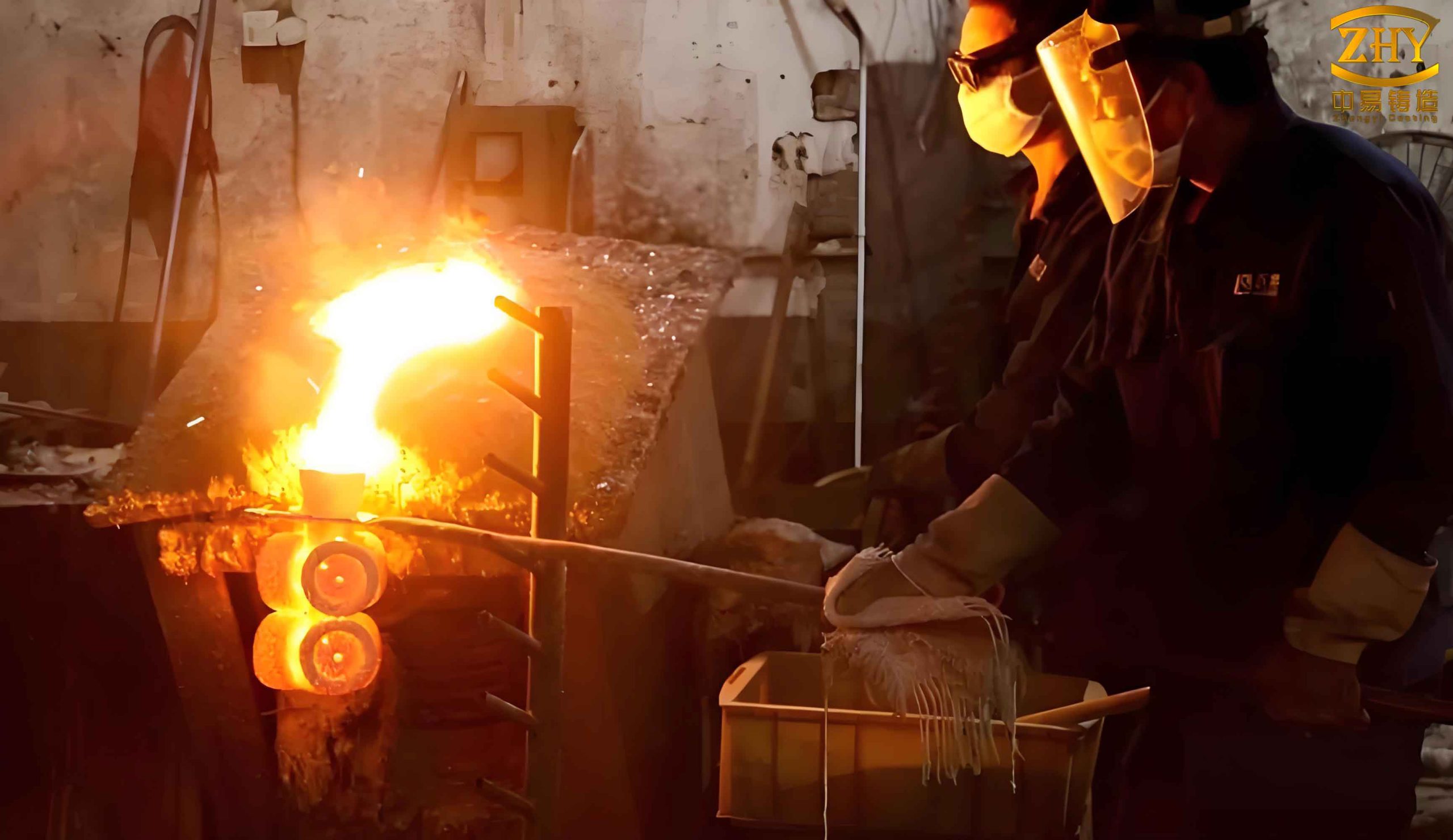
The ZL104 alloy was melted and superheated to 750°C. It was then poured into the preheated shell. The entire setup was left to cool to room temperature. Upon breaking the ceramic shell, a casting of the impeller with its attached gating system was revealed. Visual inspection showed excellent conformance to the printed pattern’s geometry, with sharp blade definition and no visible surface defects like misruns. The gating system was then removed via cutoff and grinding operations.
Validation and Post-Processing
The final step involved validating the internal quality of the prototype investment cast impeller. While simulation predicted soundness, physical verification is essential. Non-destructive testing (NDT) methods like X-ray radiography can reveal internal shrinkage or gas pores. The casting showed no major internal defects in the critical blade regions, confirming the simulation’s prediction that defects were isolated to the feeder necks. The dimensional accuracy was within acceptable limits for a prototype, demonstrating that the shrinkage allowances factored into the original CAD model were appropriate.
| Aspect | Result & Observation | Conclusion for Prototype Investment Casting |
|---|---|---|
| Pattern Lead Time | Reduced from potential weeks to < 24 hours. | AM enables ultra-rapid prototyping iterations. |
| Filling & Solidification | Simulation-predicted top-gating performance was confirmed. | CAE simulation is critical for first-time-right AM pattern design. |
| Casting Surface Finish | Excellent, directly replicating the printed pattern surface. | AM pattern quality is paramount for final casting quality. |
| Internal Soundness | No shrinkage in blades; minor porosity only in cutoff areas. | The optimized gating/feeding design was effective. |
| Geometric Complexity | Thin, twisted blades were successfully cast. | Process is capable of high complexity without tooling constraints. |
| Overall Cost for Prototype | Significantly lower than traditional method for single/few pieces. | AM is cost-effective for low-volume, high-complexity prototype investment casting. |
Conclusions and Future Perspectives
This comprehensive study successfully demonstrates a modernized, efficient framework for prototype investment casting, synergistically combining additive manufacturing for pattern fabrication and computational simulation for process optimization. The methodology was validated through the production of a sound, complex aluminum impeller casting.
The key findings and advantages of this integrated approach are manifold. First, additive manufacturing drastically compresses the lead time and cost associated with pattern production, making prototype investment casting viable for even single-piece orders or rapid design iterations. Second, numerical simulation provides a powerful tool to virtually test and optimize gating and feeding systems before any physical asset is created, ensuring a high probability of success on the first casting attempt—a crucial factor when using AM patterns to avoid wasteful cycles. The formula for the total development time ($T_{total}$) now becomes:
$$ T_{total} = T_{design} + T_{sim} + T_{print} + T_{shell} + T_{cast} $$
where $T_{print}$ is now a matter of hours rather than the $T_{tooling}$ (weeks) required in conventional methods.
Third, this workflow democratizes access to high-quality metal castings for complex parts, benefiting industries like aerospace, automotive, and energy where prototyping and small-batch production are common. Future work in this domain of AM-enhanced prototype investment casting could explore advanced pattern materials like UV-curable resins for higher resolution and smoother surfaces, the use of conformal cooling channels designed via simulation and printed directly into the patterns, and the direct 3D printing of ceramic shells, potentially eliminating the multi-step dipping process altogether.
In conclusion, the fusion of additive manufacturing and simulation represents a significant leap forward for prototype investment casting. It transforms it from a traditionally slow, tooling-dependent process into a agile, digital, and responsive manufacturing solution, perfectly aligned with the demands of modern product development and low-volume production of geometrically intricate, high-performance metal components.