
The quest for sustainable and efficient agricultural practices has driven significant innovation in tillage equipment. Among the critical components, the subsoiler shank tip operates under exceptionally abrasive conditions, directly engaging with soil, rocks, and plant residues. Wear and premature failure of these tips lead to increased draft forces, higher fuel consumption for tractors, and ultimately, elevated operational costs and material waste. This analysis delves into the efficacy of normalizing heat treatment as a method to enhance the performance and service life of subsoiler tips fabricated from nodular cast iron, a material prized for its favorable combination of strength and castability.
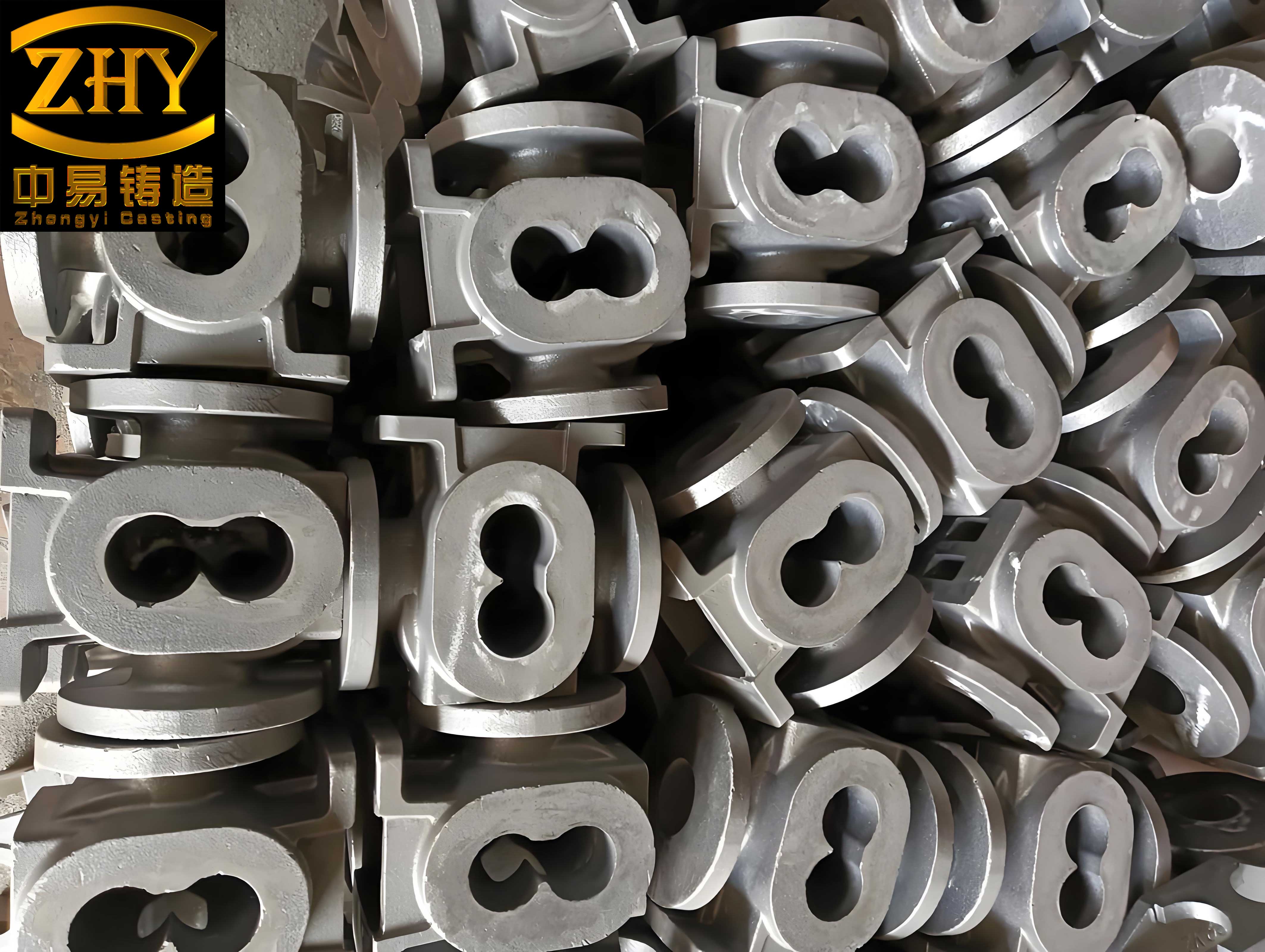
The microstructure of nodular cast iron is fundamentally defined by the presence of spherical graphite nodules embedded within a metallic matrix, which can be ferritic, pearlitic, or a mixture thereof. This unique structure is key to its properties; the spherical graphite morphology minimizes stress concentration points compared to the flake graphite in gray iron, thereby granting the material a superior balance of strength and ductility. The chemical composition of the nodular cast iron under investigation typically falls within the ranges presented in Table 1. Precise control over this composition, particularly low levels of impurities like phosphorus and sulfur, is crucial for achieving effective nodularization during casting and for subsequent heat treatment response.
| Element | Content (wt.%) |
|---|---|
| C | 3.5 – 3.9 |
| Si | 1.4 – 3.0 |
| Mn | 0.5 – 1.4 |
| P | ≤ 0.05 |
| S | ≤ 0.06 |
In the context of conservation tillage, the role of the subsoiler is paramount. Traditional moldboard plowing leads to soil structure degradation and the formation of a hardpan—a compacted layer typically 15-20 cm below the surface. This hardpan impedes root growth, water infiltration, and nutrient cycling. Subsoiling fractures this hardpan without inverting the soil profile, preserving surface residue and promoting a healthier soil ecosystem. The tip of the subsoiler bears the brunt of this operation, subjected to a complex wear mechanism involving abrasive gouging by soil particles, micro-cutting by siliceous plant residues, and impact from occasional stones. This multifaceted attack can lead to rapid wear, blunting of the tip, and in severe cases, brittle fracture, especially if the material lacks adequate toughness.
The core hypothesis explored here is that a normalizing heat treatment can optimize the matrix microstructure of nodular cast iron, tailoring it for the demanding requirements of soil-engaging components. Normalizing involves heating the material to a temperature above its upper critical transformation point (fully into the austenite phase field), holding for sufficient time to achieve homogenization, and then cooling in still air. For nodular cast iron, this process aims to transform the as-cast matrix—often a mixture of ferrite and pearlite with varying proportions and coarseness—into a uniform, fine-grained pearlitic structure. The dissolution of carbon from the graphite nodules into the austenite during soaking and its subsequent precipitation as fine, uniformly distributed carbide plates within the ferrite lamellae during air cooling is the metallurgical basis for this transformation.
The experimental design focused on evaluating the effect of varying normalizing temperatures on key performance metrics. Specimens of nodular cast iron, representative of commercial subsoiler tips, were subjected to normalizing treatments at temperatures of 860°C, 870°C, 880°C, 890°C, and 900°C, with a standardized holding time. These were compared against a control set of as-cast, untreated specimens. The evaluation encompassed hardness measurements, impact toughness assessment, and tribological wear testing, providing a comprehensive view of the mechanical property evolution.
Hardness serves as a primary indicator of a material’s resistance to plastic deformation and, often correlatively, its abrasion resistance. Vickers hardness (HV) testing was employed due to its accuracy and suitability for a wide range of metallic materials. The hardness was calculated based on the indentation diagonals produced by a diamond pyramid indenter under a known load. The formula governing this calculation is:
$$ HV = 0.102 \times \frac{2F \sin(\frac{\theta}{2})}{d^2} $$
where \( F \) is the applied force in Newtons, \( \theta \) is the face angle of the diamond pyramid (typically 136°), and \( d \) is the mean diagonal length of the indentation in millimeters. Results from the hardness survey are consolidated in Table 2, showing a clear trend influenced by the normalizing temperature.
| Normalizing Temp. (°C) | Vickers Hardness, HV0.1 (Avg.) | Standard Deviation |
|---|---|---|
| As-Cast (0) | 405 | 12.3 |
| 860 | 434 | 25.1 |
| 870 | 424 | 23.5 |
| 880 | 426 | 14.8 |
| 890 | 475 | 23.7 |
| 900 | 406 | 37.5 |
The data reveals that normalizing generally increased the hardness of the nodular cast iron compared to its as-cast state, with the peak hardness of 475 HV0.1 achieved at 890°C. This increase is attributed to the formation of a fine, continuous network of pearlite. The subsequent drop in hardness at 900°C suggests possible microstructural coarsening or the onset of undesirable phase transformations at this elevated temperature, highlighting the sensitivity of nodular cast iron properties to precise thermal control.
While hardness is desirable for wear resistance, toughness is equally critical to prevent catastrophic failure under impact loads, such as striking a rock during field operation. Charpy V-notch impact tests were conducted to measure the absorbed energy (impact toughness). The impact energy \( A_k \) is directly read from the testing machine, and the impact toughness \( a_k \) can be derived as:
$$ a_k = \frac{A_k}{S} $$
where \( S \) is the cross-sectional area at the notch. The results, presented in Table 3, demonstrate a significant and consistent improvement in impact toughness due to normalizing treatment.
| Normalizing Temp. (°C) | Impact Energy, \(A_k\) (J) (Avg.) | Estimated Toughness \(a_k\) (J/cm²) | Improvement vs. As-Cast |
|---|---|---|---|
| As-Cast (0) | 1.81 | ~3.62 | — |
| 860 | 2.19 | ~4.38 | +21% |
| 870 | 2.27 | ~4.54 | +25% |
| 880 | 2.31 | ~4.62 | +28% |
| 890 | 2.36 | ~4.72 | +30% |
| 900 | 2.44 | ~4.88 | +35% |
Remarkably, the impact energy increased by approximately 1.5 times (from 1.81 J to 2.36 J) at the 890°C treatment. This enhancement in toughness, even as hardness increased, is a key benefit of properly executed normalizing on nodular cast iron. It refines the matrix, improves homogeneity, and can lead to a more favorable distribution of micro-constituents, allowing the material to absorb more energy before fracture. The spherical graphite nodules play a vital role here by blunting propagating cracks. The relationship between crack propagation energy \( G_c \) and microstructure can be conceptually linked to factors like mean free path in the matrix \( \lambda \), as suggested by models such as:
$$ \sigma_f \propto \frac{1}{\sqrt{\lambda}} $$
where a finer microstructure (smaller \( \lambda \)) generally increases fracture stress \( \sigma_f \), contributing to higher toughness.
The paramount property for a tillage tool is wear resistance. Pin-on-disc or block-on-ring wear tests simulate abrasive wear conditions. In this study, weight loss under controlled sliding conditions (e.g., 200 rpm, 50 N load, 30 min duration) was used as a direct measure of wear resistance. A lower weight loss indicates superior performance. The wear results are summarized in Table 4. The wear rate \( W \) can be expressed as weight loss per unit sliding distance or time.
| Normalizing Temp. (°C) | Weight Loss (g) (Avg.) | Relative Wear Resistance (As-Cast = 1) |
|---|---|---|
| As-Cast (0) | 0.128 | 1.00 |
| 860 | 0.090 | 1.42 |
| 870 | 0.078 | 1.64 |
| 880 | 0.071 | 1.80 |
| 890 | 0.070 | 1.83 |
| 900 | 0.104 | 1.23 |
The data shows a clear trend: wear resistance improves (weight loss decreases) with increasing normalizing temperature up to 890°C, where it plateaus. The sample normalized at 890°C exhibited a weight loss of only 0.070 g, representing a ~45% reduction compared to the as-cast material. This aligns well with the peak hardness observed at the same temperature, supporting the general correlation between hardness and abrasive wear resistance for metallic materials. The degradation in wear performance at 900°C further corroborates the microstructural deterioration suggested by the hardness drop. The coefficient of friction \( \mu \), an indirect indicator of wear behavior, was also observed to decrease with successful normalizing treatments, typically falling from around 0.12 for the as-cast condition to approximately 0.09-0.10 for optimally treated nodular cast iron. This can be related to the real area of contact \( A_r \) and shear strength \( s \) of the material junction: $$ \mu = \frac{s}{H} $$ where a higher hardness \( H \) can reduce the real contact area, potentially lowering the friction coefficient.
To statistically validate the significance of the normalizing temperature’s effect, Analysis of Variance (ANOVA) was applied to the datasets. The p-values (significance) for the effects on hardness, impact energy, and weight loss were all found to be less than 0.05, and often below 0.001. This statistically confirms that the normalizing temperature is a highly significant factor influencing all three critical properties of the nodular cast iron. The underlying metallurgical mechanism is the transformation and refinement of the matrix. In the as-cast state, the matrix may contain coarse pearlite colonies and patches of free ferrite surrounding the graphite nodules. During normalizing, heating into the austenite region allows carbon to diffuse from the graphite nodules into the austenite. Upon air cooling, this carbon-supersaturated austenite transforms into fine, uniformly distributed pearlite. This refined, strong matrix better supports the graphite nodules and provides a more consistent barrier against abrasive penetration and crack propagation. The optimal temperature of 890°C likely represents the best balance for complete austenitization without causing excessive grain growth or other detrimental effects.
The implications for agricultural engineering are substantial. Implementing a controlled normalizing heat treatment at around 890°C for nodular cast iron subsoiler tips presents a relatively simple and cost-effective method to significantly enhance field performance. The treated tips would benefit from a synergistic improvement: increased hardness for better abrasion resistance, coupled with markedly higher impact toughness to resist fracture. This translates directly into longer service intervals, reduced frequency of tip replacement, lower draft forces leading to fuel savings, and decreased downtime for maintenance. The enhanced durability of components made from treated nodular cast iron contributes to the economic and environmental sustainability of conservation tillage systems.
Further research could explore the interplay between normalizing parameters (e.g., holding time, cooling rate variations) and the specific alloying additions within the nodular cast iron. The effect of prior microstructure (fully ferritic vs. as-cast pearlitic) on the normalizing response also warrants investigation. Additionally, field validation trials comparing treated and untreated tips under identical soil conditions would provide crucial real-world performance data to complement laboratory findings. The study underscores that nodular cast iron, a versatile and widely used engineering material, possesses significant latent potential that can be unlocked through tailored heat treatment like normalizing, moving it beyond its standard specifications to meet the rigorous demands of modern, high-efficiency agriculture.