
In my extensive experience with materials engineering, I have dedicated significant effort to understanding and improving the performance of wear-resistant alloys, particularly high manganese steel castings. These castings, primarily based on the ZGMn13 composition, are renowned for their exceptional work-hardening capability and high impact toughness after water toughening treatment. They are widely employed in demanding applications such as mining, cement machinery, and other industrial sectors where abrasion and impact resistance are critical. However, the quest to enhance their service life remains a pivotal challenge, as it directly correlates with economic savings and operational efficiency. In this comprehensive discussion, we will delve into the microstructural characteristics, failure mechanisms, and innovative strategies to boost the durability of high manganese steel castings. Our focus will be on optimizing chemical composition, controlling impurities, incorporating alloying elements, and refining heat treatment processes—all aimed at achieving a superior balance between wear resistance and mechanical integrity.
The service life of high manganese steel castings is often limited by two primary failure modes: excessive wear leading to dimensional loss and catastrophic fracture due to insufficient strength or toughness. In practical scenarios, these castings are subjected to varying degrees of impact and abrasion, and their performance hinges on the material’s ability to rapidly harden under stress while maintaining structural integrity. From my observations, many premature failures can be attributed to suboptimal material properties or inappropriate application conditions. Therefore, a holistic approach to improving high manganese steel castings must address both wear resistance and fracture resistance. This involves a deep understanding of the metallurgical principles governing their behavior, which we will explore in detail.
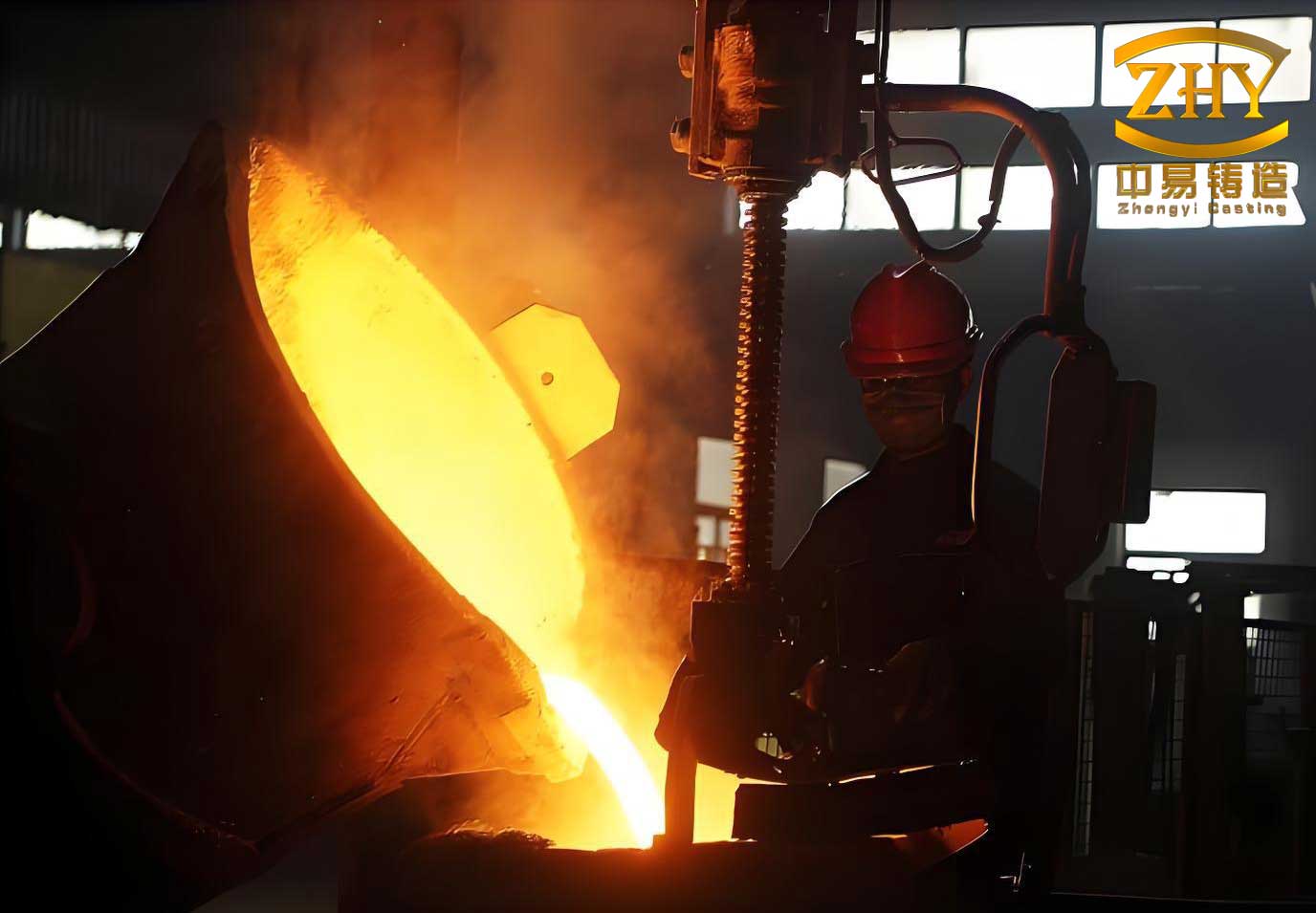
The microstructure of high manganese steel castings in the as-cast state typically consists of austenite (γ) and a significant amount of carbides, often distributed as a continuous network along grain boundaries. When the cooling rate is slow, these carbides may appear as coarse blocks or plates extending into the grains. This铸态组织 results in poor mechanical properties, including low hardness, reduced impact toughness, and inadequate wear resistance. Consequently, high manganese steel castings must undergo water toughening treatment—a solution heat treatment followed by rapid quenching—to dissolve the carbides and achieve a homogeneous austenitic structure. After this treatment, the high manganese steel casting exhibits a single-phase austenite or austenite with minor discontinuous carbides, granting it remarkable toughness and the ability to work-harden under impact or pressure. The work-hardening phenomenon elevates surface hardness to over 500 HB, providing excellent abrasion resistance. However, the initial hardness of a high manganese steel casting is relatively low, around 200 HB, making it less effective in non-impact applications such as slurry pumps. Thus, the performance of high manganese steel castings is highly dependent on service conditions, and optimizing their composition and processing is essential for extending their lifespan.
To systematically improve high manganese steel castings, we must consider several key factors. First, the carbon and manganese content play a crucial role in determining the balance between wear resistance and toughness. The allowable ranges for carbon and manganese in high manganese steel castings are typically 0.9% to 1.5% and 11% to 14%, respectively. Carbon enhances work-hardening ability but reduces impact toughness when excessive, while manganese stabilizes austenite and improves toughness but may lower wear resistance if too high. The relationship between carbon solubility in austenite and temperature can be approximated using phase diagram data. For instance, the maximum solubility of carbon in austenite at elevated temperatures is given by:
$$ C_{max} = 1.2\% \text{ at } 1100^\circ C $$
This solubility decreases with temperature, influencing carbide precipitation during cooling. In high manganese steel castings, a higher carbon content increases work-hardening rate, but it also promotes carbide formation, which can degrade toughness if not properly controlled. The carbon-manganese ratio (C/Mn) is often emphasized, with a common guideline of C/Mn ≥ 1/10. However, recent studies suggest that this ratio should be tailored based on application specifics. For high-impact, thick-section high manganese steel castings, a lower carbon content (0.9% to 1.1%) and higher manganese (12% to 14%) are preferable to ensure toughness. Conversely, for thin-section high manganese steel castings under moderate impact, carbon can be increased to 1.2% to 1.4% with manganese reduced to 11% to 12% to enhance wear resistance. This optimization is critical for maximizing the service life of high manganese steel castings.
Phosphorus is another detrimental element that significantly affects the performance of high manganese steel castings. It tends to form brittle phosphides or phosphorus-containing eutectics, which reduce impact toughness and promote surface spalling or fracture. The solubility of phosphorus in austenite is limited, typically below 0.03%, and it tends to segregate, leading to localized embrittlement. In my work, I have observed that even phosphorus levels as low as 0.05% can cause phosphide precipitation, drastically shortening the life of high manganese steel castings. Therefore, stringent control of phosphorus content is imperative. International standards often specify phosphorus limits below 0.07% for premium grades, but for extended durability, aiming for less than 0.03% is advisable. The impact of phosphorus on toughness can be quantified using empirical relationships, such as:
$$ \Delta K = -A \cdot P^{2} $$
where ΔK represents the reduction in impact toughness, A is a material constant, and P is the phosphorus content. By reducing phosphorus through refined melting practices, the service life of high manganese steel castings can be improved by 20% to 30%, as evidenced in field trials.
Alloying elements offer a powerful means to enhance the properties of high manganese steel castings. Additions of molybdenum, chromium, vanadium, and titanium can refine microstructure, increase initial hardness, and improve work-hardening response. Molybdenum, for instance, is a strong carbide former that stabilizes austenite and enhances hardenability. When added in amounts of 0.5% to 1.0%, it allows for a reduction in manganese content to 10% to 12% while maintaining austenite stability, thereby improving wear resistance. The formation of alloy carbides like (Fe,Mo)23C6 contributes to dispersion strengthening. Similarly, chromium additions of 1.0% to 2.0% can form complex carbides and improve淬透性, leading to better toughness and wear resistance in high manganese steel castings. Vanadium and titanium, added in trace amounts (0.1% to 0.3%), form fine carbonitrides that act as grain refiners, reducing columnar grains and enhancing yield strength without compromising ductility. The synergistic effect of these elements can be summarized in the following table, which compares the properties of standard and alloy-modified high manganese steel castings:
| Elemental Addition | Typical Content (%) | Effect on Microstructure | Improvement in Service Life |
|---|---|---|---|
| Molybdenum (Mo) | 0.5–1.0 | Refines carbides, stabilizes γ | 20–40% increase |
| Chromium (Cr) | 1.0–2.0 | Enhances hardenability, forms carbides | 15–30% increase |
| Vanadium (V) | 0.1–0.3 | Grain refinement, dispersion hardening | 10–25% increase |
| Titanium (Ti) | 0.05–0.2 | Nitride formation, reduces segregation | 10–20% increase |
In my experiments with high manganese steel castings for cone crusher liners, the incorporation of molybdenum and vanadium-titanium combinations, coupled with optimized heat treatment, resulted in a lifespan extension of over 50% compared to conventional grades. This underscores the potential of alloy design in advancing high manganese steel castings.
Heat treatment is equally vital for optimizing high manganese steel castings. The standard water toughening process involves heating to 1050–1100°C, holding to dissolve carbides, and then quenching in water. However, modified techniques such as dispersion strengthening heat treatment—involving holding at 500–600°C after quenching—can precipitate fine carbides uniformly within grains, improving both hardness and toughness. The kinetics of carbide dissolution and precipitation can be described using diffusion equations. For example, the time required for carbide dissolution during heating is given by:
$$ t_d = \frac{k \cdot d^2}{D} $$
where t_d is the dissolution time, k is a constant, d is the carbide size, and D is the diffusion coefficient of carbon in austenite. By controlling these parameters, we can tailor the microstructure of high manganese steel castings to specific service conditions. Additionally, post-quench tempering at low temperatures (200–300°C) can relieve residual stresses without compromising hardness, further enhancing durability.
The work-hardening behavior of high manganese steel castings is a key aspect of their wear resistance. Under impact, the austenite undergoes plastic deformation, leading to dislocation accumulation and strain-induced transformation to martensite in some cases. The work-hardening rate can be modeled using the Hollomon equation:
$$ \sigma = K \epsilon^n $$
where σ is the true stress, ε is the true strain, K is the strength coefficient, and n is the work-hardening exponent. For high manganese steel castings, n typically ranges from 0.3 to 0.5, depending on composition and processing. Higher carbon and alloy content tend to increase n, resulting in more rapid hardening. This is crucial for applications like crusher liners, where repeated impact generates a hardened surface layer that resists abrasion. In contrast, for low-impact environments, the initial hardness of high manganese steel castings may be insufficient, necessitating composition adjustments or surface treatments.
To illustrate the interplay between composition and performance, consider the following table summarizing the recommended chemical ranges for different applications of high manganese steel castings:
| Application Type | Carbon (%) | Manganese (%) | Phosphorus (max, %) | Alloy Additions | Expected Service Life Gain |
|---|---|---|---|---|---|
| High-impact crusher liners | 0.9–1.1 | 12–14 | 0.03 | Mo, V, Ti | 30–50% |
| Moderate-impact mill liners | 1.1–1.3 | 11–13 | 0.04 | Cr, Mo | 20–40% |
| Low-impact slurry pump parts | 1.2–1.5 | 10–12 | 0.05 | Ti, B | 10–30% |
These guidelines are derived from both industrial experience and laboratory testing, highlighting the importance of customization for each high manganese steel casting component.
Furthermore, the role of microstructure in determining the fatigue and fracture resistance of high manganese steel castings cannot be overlooked. Non-metallic inclusions and porosity, often introduced during casting, act as stress concentrators and crack initiation sites. Through improved foundry practices—such as vacuum melting or inert gas shielding—the cleanliness of high manganese steel castings can be enhanced, leading to better mechanical properties. The fracture toughness KIC can be related to inclusion content by models like:
$$ K_{IC} = \sigma_y \sqrt{\pi a_f} $$
where σ_y is the yield strength and a_f is the critical flaw size. By reducing inclusions, we increase a_f, thereby improving the fracture resistance of high manganese steel castings. This is particularly important for components subjected to cyclic loading, such as grinding balls or hammer heads.
In addition to material modifications, design optimizations can contribute to the longevity of high manganese steel castings. For instance, increasing section thickness in critical areas, incorporating wear-resistant overlays, or using composite structures with hard-facing alloys can mitigate wear and extend service intervals. However, these approaches must be balanced against cost and manufacturability. From my perspective, the most cost-effective strategy remains the optimization of the base high manganese steel casting through compositional and processing refinements.
Looking ahead, emerging technologies like additive manufacturing offer new avenues for producing high-performance high manganese steel castings with complex geometries and tailored microstructures. By leveraging powder bed fusion or directed energy deposition, we can achieve finer grain structures and reduced segregation, potentially pushing the limits of durability. Research in this area is ongoing, but early results suggest significant promise for next-generation high manganese steel castings.
In conclusion, the service life of high manganese steel castings can be substantially improved through a multifaceted approach that encompasses careful control of carbon and manganese levels, minimization of phosphorus, strategic alloying with elements like molybdenum, chromium, vanadium, and titanium, and advanced heat treatment techniques. Each of these factors contributes to enhancing both wear resistance and toughness, ensuring that high manganese steel castings perform reliably in harsh environments. As industries continue to demand more durable components, the evolution of high manganese steel castings will remain a critical focus for materials engineers. By integrating theoretical insights with practical innovations, we can unlock the full potential of these remarkable alloys, delivering economic benefits and operational efficiency across numerous sectors. The journey to perfecting high manganese steel castings is ongoing, but with continued research and application, their lifespan will only continue to grow.