
In the competitive landscape of automotive manufacturing, the demand for high-precision, net-shape components is paramount. The conventional investment casting process, while versatile, often faced limitations in achieving the surface finish and dimensional accuracy required to eliminate secondary machining. This article details a comprehensive technical evolution from a first-person perspective, focusing on the development and implementation of a hybrid, or composite, investment casting process. By critically analyzing and synergizing improvements in pattern making and shell building techniques, we successfully transitioned from a process yielding parts with a surface roughness of Ra 12.5–25 and dimensional tolerances of CT7–CT8 to one capable of producing components with Ra 3.2–6.3 and CT5–CT6. This advancement has enabled the production of over 60 distinct automotive precision castings in a true net-shape condition, resulting in significant annual cost savings.
I. Foundational Analysis and the Drive for Composite Process Development
The traditional investment casting process employed in our operations utilized a low-melting-point paraffin-stearic acid wax blend and a shell system based on sodium silicate binder with quartz refractory materials. This setup, while economical and suitable for many applications, imposed inherent constraints. The low strength and thermal stability of the wax pattern limited the use of high-pressure injection, leading to less dimensionally stable patterns. Concurrently, the sodium silicate-quartz shell system, though fast in build-up, struggled to replicate fine surface details and maintain tight dimensional control during the high-temperature firing and pouring stages. The resultant castings consistently required machining allowances, adding substantial time and cost to the final component. This analysis identified two core areas for systematic improvement: the pattern-making stage and the shell-building stage. The goal was not merely to adopt a wholly new, expensive system like full silica sol, but to engineer a composite investment casting process that strategically combined the strengths of different material systems and techniques to achieve the target quality at an optimized cost.
II. Pattern Making: From Manual Craft to Engineered Replication
The wax pattern is the first and arguably most critical replica in the investment casting process. Its quality directly dictates the final casting’s geometry and surface characteristics. Our improvements focused on both the material (wax) and the method of its formation.
A. Wax Formulation Performance Parameters
The selection and engineering of pattern wax are governed by a set of interlinked thermal, mechanical, and processing properties. Key parameters and their impact on the investment casting process are summarized below:
| Property | Definition & Significance | Target Range/Value |
|---|---|---|
| Melting Point / Melting Range | The temperature(s) at which the wax transitions from solid to liquid. A broader range allows for more stable process control during injection and dewaxing. | 60–90 °C (Ideal); A range >20°C is preferred for process stability. |
| Softening Point | The temperature at which the wax begins to deform under its own weight. Determines safe handling and storage temperatures for patterns. | > 35 °C |
| Linear Contraction/Shrinkage | The percentage reduction in size from the injection die cavity to the cooled pattern. Lower values promote dimensional accuracy and reduce shell cracking risk during dewaxing. | < 1.0% |
| Tensile Strength | The resistance to breaking under tension. Ensures patterns survive handling, assembly, and the initial coating stages without damage. | > 1.4 MPa |
| Ash Content | Residue left after complete wax burnout. Must be minimized to prevent ceramic inclusions on the casting surface. | < 0.05% |
The traditional paraffin-stearic acid blend, with a narrow melting range around 50–51°C and a low softening point (~31°C), was inherently limited. Its reaction with alkaline elements to form soaps (“mold slag”) was a particular concern for surface finish.
B. Process and Equipment Evolution
We pursued a dual-path strategy: modifying the existing low-temperature wax and adopting a dedicated mid-temperature wax system for critical applications. The modified low-temperature wax involved adjusting the paraffin-stearic acid ratio and incorporating polymer additives to elevate the softening point and improve green strength. The more significant leap came with the introduction of a proprietary mid-temperature wax (e.g., comparable to US Type 162). Its higher melting range (70–80°C) and superior mechanical properties enabled a fundamental shift from low-pressure manual or semi-automatic injection to high-pressure, automated injection molding. The comparative process parameters are detailed below:
| Parameter / Equipment | Traditional Paraffin-Stearic | Modified Low-Temp Wax | Mid-Temp Wax (e.g., Type 162) |
|---|---|---|---|
| Wax Temperature | 45–48 °C (paste) | 56–59 °C (liquid) | 54–62 °C (in cylinder) |
| Injection Pressure | 0.1–0.3 MPa | 0.6–0.8 MPa | 1.5–3.5 MPa |
| Primary Equipment | Manual Press Table | Semi-Auto High-Pressure Machine | Fully Automated High-Pressure Machine |
| Tooling | Soft Metal Dies | Steel Dies | Precision Steel Dies |
| Resultant Pattern Ra | ~12.5 µm | ~3.2 µm | ~1.6 µm |
| Dimensional Stability | Poor | Good | Excellent |
The high-pressure injection of a stable mid-temperature wax ensures complete filling of intricate die cavities, minimal surface irregularities, and exceptionally high dimensional repeatability. This step is foundational for the subsequent investment casting process stages to yield net-shape parts.
III. Shell Building: The Strategic Composite Approach
The ceramic shell is the negative mold that must withstand metallostatic pressure and thermal shock while precisely transferring the pattern’s geometry. Our composite shell strategy is based on a principle of functional layering: using high-performance materials where they are most critical for surface finish, and robust, cost-effective materials for building shell strength.
A. Refractory Material Selection
The choice of refractory is dictated by chemical inertness, thermal stability, thermal expansion coefficient, and cost. For the composite shell, we employ a two-tier refractory system:
Face Coat: Zircon sand and flour are used due to their excellent chemical stability against most molten alloys, low thermal expansion (minimizing cracking), and high thermal conductivity (promoting directional solidification). Their ability to produce a very smooth surface finish is crucial.
Backup Coats: Alumino-silicate refractories, such as mullite or fused silica-based aggregates, are used. They provide good insulation, moderate cost, and compatible thermal expansion with the face coat when properly engineered.
B. Binder System Analysis and Synergy
The binder is the “glue” holding the refractory particles together. The three primary systems have distinct characteristics:
Silica Sol (Colloidal Silica): Provides excellent surface finish and high room-temperature strength. Drying is slow (physical dehydration), leading to long production cycles but minimal shell distortion.
Sodium Silicate: Offers very fast shell build-up via chemical hardening (e.g., with ammonium salts or CO₂). However, it can lead to a rougher surface finish and has a higher nonlinear thermal expansion.
Silicate Ester: Delivers high strength and good finish but involves flammable solvents and ammonia vapor curing, posing environmental and safety challenges for high-volume production.
Our composite strategy leverages the strength of each: Silica Sol is used for the critical first (face) coat and often a second (transition) coat to capture perfect surface detail and provide a stable, high-quality interface with the metal. Sodium Silicate is then used for the subsequent reinforcement coats, rapidly building the necessary shell thickness and strength for handling and pouring. This hybrid investment casting process optimizes both quality and productivity.
C. Composite Shell Process Parameters
The successful implementation requires precise control over slurry viscosity, coating, stuccoing, and drying/hardening cycles. The following tables outline the key parameters for our established composite shell process.
| Slurry Layer | Binder : Refractory Ratio (by mass) | Additives (Proportion) | Target Viscosity (Flow Cup, sec) |
|---|---|---|---|
| Face Coat (Silica Sol) | 1 : 3.6 (Zircon Flour) | Wetting Agent (0.003), Defoamer (0.003) | 30 ± 2 |
| Transition Coat (Silica Sol) | 1 : 2.0 (Mullite Flour) | – | 22 ± 2 |
| Reinforcement Coats (Sodium Silicate) | 1 : 1.05–1.1 (High-Alumina Cement Flour) | – | 14 ± 2 |
The viscosity is critical for controlling slurry thickness and ensuring complete, bubble-free coverage. The mathematical relationship for a simple fluid in a flow cup can be approximated, though slurries are non-Newtonian:
$$ \eta = k \cdot t \cdot \rho $$
where $\eta$ is the apparent viscosity, $t$ is the efflux time, $\rho$ is the slurry density, and $k$ is an instrument constant. Tight control of ‘t’ as per the table is the practical imperative.
| Layer | Stucco Material | Ambient Temperature (°C) | Ambient Relative Humidity (%) | Drying Time (hours) |
|---|---|---|---|---|
| 1 (Face) | Zircon Sand, 100-120 mesh | 24 ± 2 | 50 – 60 | 5 – 7 |
| 2 (Transition) | Mullite, 30-60 mesh | 24 ± 2 | 50 – 60 | 10 – 15 |
Drying is a diffusion-controlled process. The drying time $t_d$ for a layer can be related to the square of its thickness $L$ and the diffusion coefficient $D$, which is a function of temperature $T$ and humidity $H$:
$$ t_d \propto \frac{L^2}{D(T, H)} $$
Maintaining stable temperature and humidity is therefore essential for consistent and complete dehydration of the silica sol binder between coats.
| Coats | Hardening Process | Drying Process | Notes |
|---|---|---|---|
| Medium / Time | Temperature / Time | ||
| 3-5 | NH₄Cl Solution, 10-12 min | 25-35°C, 12-40 min | Standard hardening & drying cycle |
| Seal Coat | NH₄Cl Solution, 12-15 min | 20-32°C, 14-16 min | Final coat without stucco to seal surface |
The chemical hardening of sodium silicate involves the reaction with an ammonium salt to form a silica gel:
$$ \text{Na₂O·nSiO₂ + 2NH₄Cl -> 2NaCl + 2NH₃↑ + nSiO₂·H₂O (gel)} $$
The rapid gel formation allows for quick cycle times, making it ideal for building the thick, robust reinforcement layers after the critical face coats have been established with silica sol.
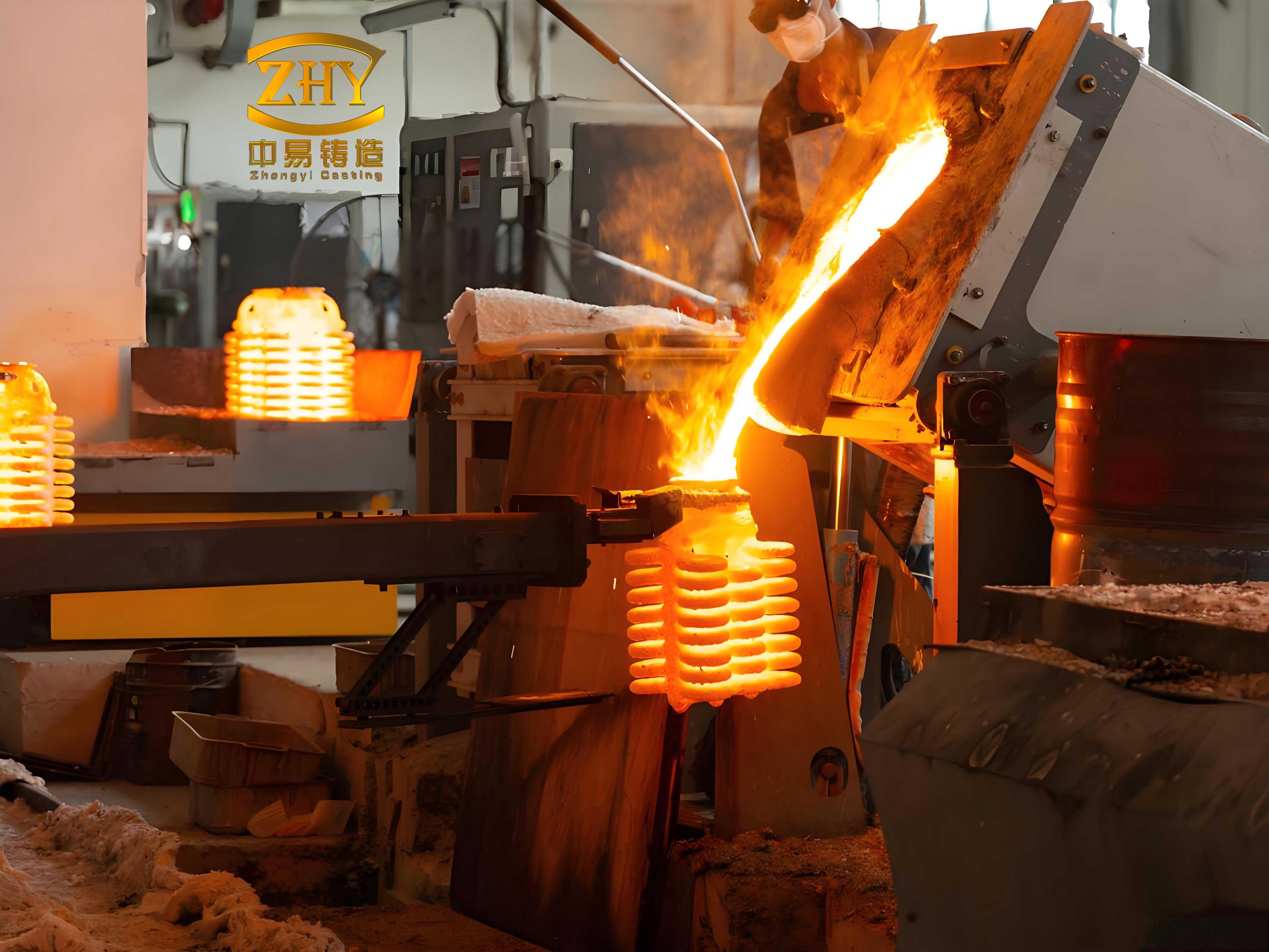
IV. System Integration and Production-Scale Implementation
The developed composite investment casting process demanded a production system to match its precision and volume requirements. To achieve a daily output of nearly 1000 pattern clusters, we engineered a dedicated 328-meter long, light-duty overhead conveyor drying line for the silica sol shell coats. This system ensures:
- Consistent Drying Environment: The entire drying tunnel maintains the required 24±2°C and 50-60% RH.
- Optimized Drying Dynamics: The continuous movement of clusters promotes uniform air circulation around all surfaces of the complex wax assemblies, leading to more consistent and efficient drying compared to static drying rooms. The process can be modeled by enhancing the diffusion equation with a convective boundary condition term.
- High Throughput: With a designed capacity of 820 shells per day, the line seamlessly integrates with the subsequent sodium silicate shelling line, enabling true high-volume流水线 production for automotive components.
The integration of high-precision pattern making with the composite shell system on this scalable platform is what solidifies the commercial viability of the advanced investment casting process.
V. Quality and Economic Outcomes
The definitive measure of any process improvement lies in its output and impact. The implemented composite investment casting process yielded transformative results.
A. Dimensional and Surface Quality
The capability of the process is quantitatively defined by two key metrics:
Surface Roughness: Consistently achieved Ra 3.2 – 6.3 µm. This represents a 50-75% improvement over the prior process and meets the requirements for as-cast functional surfaces in many automotive applications (e.g., hydraulic valve bodies, sensor mounts).
Dimensional Accuracy: Achieved CT5 – CT6 tolerance grades as per international casting tolerance standards. The CT number relates to the casting’s basic dimensional tolerance. For a nominal dimension $D$ (in mm), the tolerance $\Delta D$ can be approximated by an empirical power-law relationship:
$$ \Delta D = a \cdot D^b $$
Where $a$ and $b$ are coefficients specific to the casting process and CT level. For our composite process at CT5/6, the achievable tolerances are significantly tighter than before, often making machining for size unnecessary.
The primary factors contributing to this dimensional stability are: 1) The high-integrity, low-shrinkage wax pattern; 2) The dimensionally stable silica sol face coats that faithfully replicate the pattern; 3) The controlled, uniform drying and firing of the composite shell which minimizes distortion.
B. Economic Impact
The most significant outcome has been the transition to net-shape manufacturing for a growing family of over 60 components. The elimination of machining operations—including milling, drilling, and fine finishing—has a cascading positive effect:
Direct Cost Savings: Removal of machine time, tooling wear, and related labor.
Material Efficiency: Net-shape casting uses only the metal required for the part, unlike machining from a larger casting blank which generates scrap.
Lead Time Reduction: The production cycle is shortened by removing a major post-casting processing step.
The aggregate annual saving from this investment casting process optimization was quantified at over 2 million RMB, a testament to the powerful synergy of the composite technical approach.
VI. Conclusion and Forward Perspective
The journey from a conventional to a composite investment casting process underscores the importance of a holistic, system-level engineering approach. By dissecting the limitations of each sub-process—pattern making and shell building—and strategically combining advanced materials (modified and mid-temperature waxes, zircon, silica sol) with optimized processes (high-pressure injection, controlled drying, rapid chemical hardening), we developed a capability that bridges the gap between standard and premium investment casting. This hybrid process delivers surface finish and dimensional accuracy comparable to a full silica sol process but at a lower cost and with higher production throughput, making it ideally suited for the high-volume, cost-sensitive automotive industry.
The success of this composite investment casting process opens avenues for further refinement, such as the integration of computational modeling to predict wax injection filling, shell stress during dewaxing, and solidification patterns. The core principle established—of functionally grading the shell’s composition and process—remains a powerful paradigm for tailoring the investment casting process to meet ever-more demanding application-specific requirements for precision metal components.