
In the evolving landscape of automotive engineering, the transmission system stands as a pivotal component, and within it, the shell castings play a fundamental role. As a critical structural element, the performance of these shell castings directly dictates power transmission efficiency, overall vehicle reliability, and driver comfort. The dual pressures of environmental regulations and consumer demand for performance have made the optimization of transmission shell castings a primary focus. This review, from our perspective, synthesizes and analyzes the key technological advancements across four interconnected domains: lightweight design, reliability analysis, casting processes, and vibration-noise control. We aim to provide a holistic overview, emphasizing how integrated approaches can enhance the comprehensive performance of these essential shell castings. Throughout this discussion, we will frequently highlight the term ‘shell castings’ to underscore their specific manufacturing and functional context.
The drive for vehicle lightweighting is relentless, aimed at reducing fuel consumption and emissions. However, for transmission shell castings, mass reduction cannot come at the expense of structural integrity or acoustic performance. This balance is the core challenge. Simultaneously, ensuring long-term durability under complex dynamic loads requires sophisticated fatigue and dynamic analysis. The manufacturing process itself, predominantly casting, holds the key to achieving defect-free, high-quality shell castings with consistent properties. Finally, controlling vibration and radiated noise is paramount for meeting stringent Noise, Vibration, and Harshness (NVH) standards. This review will delve into each area, employing tables and mathematical formulations to summarize key findings and methodologies, thereby offering a structured reference for researchers and engineers working on the next generation of automotive transmission shell castings.
Lightweight Design of Transmission Shell Castings
Lightweight design of transmission shell castings is a multi-objective optimization problem that seeks to minimize mass while preserving or enhancing stiffness, strength, and modal characteristics. Modern approaches leverage advanced simulation tools, with topology optimization and detailed structural optimization leading the way.
Topology optimization has revolutionized the conceptual design phase for shell castings. Using a material distribution approach, it determines the optimal layout of material within a given design space. A common method is the Solid Isotropic Material with Penalization (SIMP) model, where the design variable is the relative density of each finite element, $\rho_e$, ranging from 0 (void) to 1 (solid). The optimization problem is often formulated as:
$$
\begin{aligned}
& \min_{\boldsymbol{\rho}} : m(\boldsymbol{\rho}) = \sum_{e=1}^{N} \rho_e v_e \\
& \text{subject to:} \\
& \quad \mathbf{K}(\boldsymbol{\rho}) \mathbf{u} = \mathbf{f}, \\
& \quad \sigma_{\max}(\boldsymbol{\rho}) \leq \sigma_{\text{allowable}}, \\
& \quad f_j(\boldsymbol{\rho}) \geq f_{j,\text{target}}, \\
& \quad 0 \leq \rho_{\min} \leq \rho_e \leq 1,
\end{aligned}
$$
where $m$ is the total mass, $v_e$ is the element volume, $\mathbf{K}$ is the global stiffness matrix, $\mathbf{u}$ is the displacement vector, $\mathbf{f}$ is the force vector, $\sigma_{\max}$ is the maximum stress, and $f_j$ are the natural frequencies. This approach has yielded innovative rib patterns and material layouts, significantly reducing the weight of shell castings without compromising performance.
Following topology optimization, detailed structural optimization refines the design. This includes optimizing the dimensions, cross-section, and placement of reinforcing ribs, as well as implementing variable thickness designs. The stiffness contribution of a rib can be approximated by its moment of inertia. For a rectangular rib, the bending stiffness is proportional to $b h^3$, where $b$ is the width and $h$ is the height. Optimizing these parameters allows for targeted stiffening of weak areas identified through finite element analysis (FEA).
| Optimization Method | Primary Design Variables | Typical Constraints | Reported Mass Reduction | Key Impact on Shell Castings |
|---|---|---|---|---|
| Topology Optimization (Density-based) | Elemental relative density ($\rho_e$) | Displacement, Stress, Frequency | 10% – 21% | Generates optimal internal rib and web layouts for fundamental load paths. |
| Size & Shape Optimization | Rib height/width, wall thickness | Stress, Strain, Local deformation | 3% – 10% | Enhances local stiffness and mitigates stress concentrations in specific regions of the shell castings. |
| Multi-disciplinary Optimization | Combined structural and acoustic variables | Dynamic response, Radiated Sound Power | 5% – 15% (with NVH goal) | Simultaneously addresses mass reduction and noise control in the shell castings. |
The exploration of new materials, such as high-strength aluminum alloys, magnesium alloys, and metal matrix composites, also contributes to lightweighting. The specific strength $\sigma_y / \rho$ and specific stiffness $E / \rho$ are key metrics, where $\sigma_y$ is yield strength, $E$ is Young’s modulus, and $\rho$ is density. While aluminum is prevalent, magnesium offers greater lightweight potential for shell castings, though challenges in corrosion resistance and machinability remain. Future trends point towards multi-material and functionally graded shell castings, where material properties are tailored locally to meet specific requirements.
Reliability and Durability Analysis
The reliability of transmission shell castings is paramount, as failures can lead to catastrophic system breakdowns. Reliability analysis encompasses static and fatigue strength assessment, dynamic characteristic evaluation, and crack initiation/propagation studies.
Fatigue life prediction is critical due to the cyclic loading from gear meshing and engine vibrations. The stress-life ($S-N$) approach and strain-life ($\varepsilon-N$) approach are commonly used. For high-cycle fatigue, the modified Goodman or Gerber criteria can account for mean stress effects:
$$
\frac{\sigma_a}{\sigma_{-1}} + \frac{\sigma_m}{\sigma_u} = 1 \quad \text{(Goodman)},
$$
where $\sigma_a$ is the stress amplitude, $\sigma_m$ is the mean stress, $\sigma_{-1}$ is the fully reversed fatigue limit, and $\sigma_u$ is the ultimate tensile strength. Cumulative damage is often assessed using Miner’s linear damage rule:
$$
D = \sum_{i=1}^{k} \frac{n_i}{N_i},
$$
where $D$ is the total damage (failure assumed at $D \geq 1$), $n_i$ is the number of cycles at stress level $i$, and $N_i$ is the cycles to failure at that level. For shell castings, surface finish, casting defects (like micro-shrinkage), and residual stresses significantly influence the actual fatigue life, making a conservative design essential.
Dynamic analysis focuses on understanding the vibration characteristics of shell castings. Modal analysis solves the eigenvalue problem:
$$
\left( \mathbf{K} – \omega_j^2 \mathbf{M} \right) \boldsymbol{\phi}_j = \mathbf{0},
$$
where $\omega_j$ is the $j$-th natural frequency and $\boldsymbol{\phi}_j$ is the corresponding mode shape. It is crucial to ensure that these natural frequencies do not coincide with major excitation frequencies (e.g., gear mesh frequencies $f_m = n \cdot Z \cdot \text{rpm}/60$, where $n$ is the gear order and $Z$ is the number of teeth) to avoid resonance. Harmonic response analysis then computes the steady-state response to sinusoidal excitation:
$$
\mathbf{u}(\omega) = \left( -\omega^2 \mathbf{M} + i\omega \mathbf{C} + \mathbf{K} \right)^{-1} \mathbf{F}(\omega).
$$
This helps identify areas of high vibration amplitude in the shell castings, which are potential noise radiation sources.
| Analysis Type | Primary Objective | Key Metrics/Outputs | Common Methods for Shell Castings |
|---|---|---|---|
| Static Stress Analysis | Assess strength under peak loads | Von Mises stress, Factor of Safety, Displacement | Finite Element Analysis (FEA) under maximum torque or shock load conditions. |
| Modal Analysis | Identify natural frequencies & mode shapes | Natural Frequencies ($f_n$), Mode Shape plots | FEA (Lanczos, Block Lanczos methods), Experimental Modal Analysis (EMA). |
| Fatigue Analysis | Predict service life under cyclic loads | Fatigue life (cycles), Damage distribution | Stress-life approach with FEA stress results, strain-life for local plasticity. |
| Transient Dynamic Analysis | Evaluate response to time-varying loads | Time-history of stress, strain, acceleration | Direct integration methods (Newmark-$\beta$, HHT) in FEA solvers. |
Crack analysis in shell castings often stems from stress concentrations at geometric discontinuities or inherent casting defects. Fracture mechanics parameters like the stress intensity factor $K_I$ are used to assess crack growth:
$$
\frac{da}{dN} = C (\Delta K)^m,
$$
where $da/dN$ is the crack growth rate per cycle, $\Delta K$ is the stress intensity factor range, and $C$ and $m$ are material constants. For ductile materials like aluminum alloys used in shell castings, J-integral or crack tip opening displacement (CTOD) methods might be more appropriate. Preventive measures include structural optimization to smooth stress raisers and stringent quality control during the casting of these shell components to minimize defects.
Casting Process for Shell Castings
The manufacturing process is foundational to achieving high-performance transmission shell castings. High-pressure die casting (HPDC), low-pressure die casting, and gravity casting are prevalent methods, with HPDC being favored for complex, thin-walled aluminum shell castings in high-volume production. Process optimization is vital to ensure dimensional accuracy, mechanical properties, and freedom from defects.
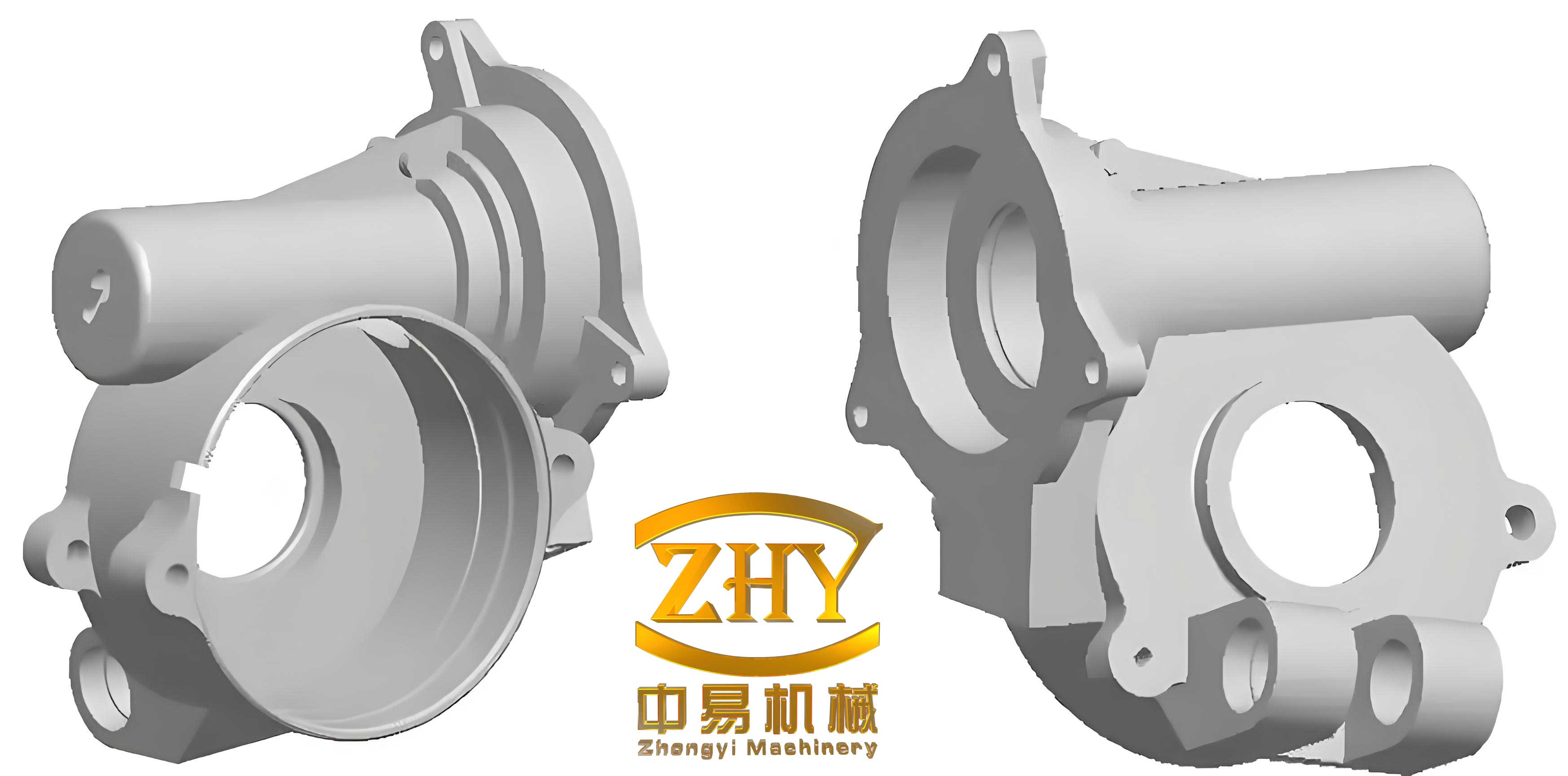
The casting process involves complex coupled phenomena of fluid flow, heat transfer, and solidification. Numerical simulation has become indispensable. The governing equations for mold filling include the Navier-Stokes equations for incompressible flow:
$$
\rho \left( \frac{\partial \mathbf{v}}{\partial t} + \mathbf{v} \cdot \nabla \mathbf{v} \right) = -\nabla p + \mu \nabla^2 \mathbf{v} + \rho \mathbf{g},
$$
$$
\nabla \cdot \mathbf{v} = 0,
$$
where $\mathbf{v}$ is velocity, $p$ is pressure, $\rho$ is density, $\mu$ is dynamic viscosity, and $\mathbf{g}$ is gravity. Heat transfer during solidification is governed by:
$$
\rho c_p \frac{\partial T}{\partial t} = \nabla \cdot (k \nabla T) + \rho L \frac{\partial f_s}{\partial t},
$$
where $T$ is temperature, $c_p$ is specific heat, $k$ is thermal conductivity, $L$ is latent heat, and $f_s$ is solid fraction. Optimizing process parameters like pouring temperature $T_p$, injection velocity $v_{inj}$, mold temperature $T_m$, and intensification pressure $P_{int}$ is critical. These parameters are often optimized using design of experiments (DOE) and response surface methodology (RSM). For example, a quadratic response model for porosity percentage ($Y$) might be:
$$
Y = \beta_0 + \sum_{i=1}^{n} \beta_i x_i + \sum_{i=1}^{n} \beta_{ii} x_i^2 + \sum_{i < j} \beta_{ij} x_i x_j + \epsilon,
$$
where $x_i$ are coded process parameters and $\beta$ are coefficients.
| Process Parameter | Typical Range (Al HPDC) | Primary Influence on Shell Castings | Optimization Goal |
|---|---|---|---|
| Pouring Temperature ($T_p$) | 660°C – 720°C | Fluidity, shrinkage defect formation, microstructure. | Minimize turbulence and porosity while ensuring complete filling. |
| Slow Shot Velocity ($v_{slow}$) | 0.1 – 0.3 m/s | Avoids air entrapment during cavity filling. | Maintain laminar flow front to reduce gas pores. |
| Fast Shot Velocity ($v_{fast}$) | 2.5 – 5.0 m/s | Final filling and intensification; impacts surface finish and internal integrity. | Achieve proper packing before solidification starts. |
| Mold Temperature ($T_m$) | 150°C – 250°C | Solidification rate, thermal fatigue of die, soldering. | Maintain uniform cooling to minimize shrinkage and warpage in shell castings. |
| Intensification Pressure ($P_{int}$) | 50 – 100 MPa | Feeds shrinkage during solidification, reduces porosity. | Apply sufficient pressure for a dense microstructure in thick sections. |
Common defects in shell castings include gas porosity, shrinkage porosity, cold shuts, and hot tears. Countermeasures are often integrated into process design. For instance, local squeeze pin technology applies high pressure at specific thick sections during solidification to compensate for shrinkage. Vacuum-assisted HPDC reduces air entrapment, lowering gas porosity. The following table summarizes major defects and their mitigation strategies specific to the production of transmission shell castings.
| Defect Type | Root Cause | Impact on Shell Castings | Typical Mitigation Strategies |
|---|---|---|---|
| Gas Porosity | Entrapped air or gas from lubricant burnout. | Reduces mechanical strength, can cause leakage under pressure. | Vacuum die casting, optimized venting, controlled slow-shot phase. |
| Shrinkage Porosity | Inadequate feeding during solidification. | Local weakness, potential initiation point for fatigue cracks. | Local squeeze pins, optimized cooling channels, proper gating/riser design. |
| Cold Shut | Premature solidification before mold filling is complete. | Surface discontinuity, severe stress concentrator. | Increase mold/pouring temperature, increase injection velocity. |
| Hot Tear | Restrained contraction during solidification. | Crack in the casting, catastrophic for shell castings’ integrity. | Modify part geometry (smooth transitions), optimize mold cooling for uniform solidification. |
Enhancing the productivity of shell castings involves optimizing the casting cycle time and improving yield. This includes designing efficient gating and cooling systems, implementing automated ladling and spraying, and employing real-time process monitoring. The integration of Industry 4.0 concepts, such as digital twins for the casting process, allows for predictive quality control and further optimization of these complex shell components.
Vibration Characteristics and Noise Control
Transmission shell castings are primary paths for structure-borne vibration and significant radiators of airborne noise. Controlling their vibration and noise is essential for vehicle NVH refinement. The problem is inherently coupled: dynamic forces from gears and bearings excite the shell castings, which vibrate and radiate noise.
The vibrational response of shell castings can be analyzed through modal and harmonic analysis, as previously mentioned. A key metric is the frequency response function (FRF), particularly the driving point mobility or its inverse, the dynamic stiffness $K_d(\omega)$ at mounting points or critical areas:
$$
K_d(\omega) = \frac{F(\omega)}{X(\omega)},
$$
where $F(\omega)$ is the applied force and $X(\omega)$ is the resulting displacement. High dynamic stiffness in key frequency ranges helps attenuate vibration transmission. The vibration velocity of the shell surface, $v(\omega, \mathbf{r})$, is the source for radiated noise. The sound power $W$ radiated by a vibrating structure can be estimated by:
$$
W = \rho_0 c_0 \sigma \int_S \langle |v(\mathbf{r})|^2 \rangle \, dS,
$$
where $\rho_0$ is air density, $c_0$ is the speed of sound, $\sigma$ is the radiation efficiency, $S$ is the radiating surface area, and $\langle \cdot \rangle$ denotes a time average.
Noise control strategies for shell castings often involve structural modifications to alter their vibration response. Acoustic contribution analysis is a powerful tool that identifies which surface panels or modes contribute most to the sound pressure at a target field point. The contribution can be quantified, guiding targeted design changes. Structural-acoustic coupling analysis further refines this by solving the coupled equations:
$$
\begin{bmatrix}
\mathbf{Z}_s & -\mathbf{C}_{sa} \\
\mathbf{0} & \mathbf{Z}_a
\end{bmatrix}
\begin{bmatrix}
\mathbf{v} \\
\mathbf{p}
\end{bmatrix}
=
\begin{bmatrix}
\mathbf{f} \\
\mathbf{0}
\end{bmatrix},
$$
where $\mathbf{Z}_s$ is the structural impedance matrix, $\mathbf{Z}_a$ is the acoustic impedance matrix, $\mathbf{C}_{sa}$ is the coupling matrix, $\mathbf{v}$ is the structural velocity vector, $\mathbf{p}$ is the acoustic pressure vector, and $\mathbf{f}$ is the structural force vector.
| Control Strategy | Mechanism of Action | Typical Implementation on Shell Castings | Expected Outcome |
|---|---|---|---|
| Structural Stiffening | Increases natural frequencies and reduces vibration amplitudes. | Adding ribs, increasing flange thickness, using T-shaped or X-shaped rib patterns. | Shift resonances away from excitation frequencies; reduce overall vibration levels. |
| Damping Treatments | Dissipates vibrational energy. | Applying constrained layer damping (CLD) pads or coatings to flat panels of shell castings. | Attenuate resonant peaks, especially in medium to high frequencies. | Dynamic Vibration Absorbers (DVA) | Introduces a tuned mass-spring system to counteract specific frequency vibrations. | Attaching inertial mass actuators or tuned dampers to identified hot spots on the shell castings. | Targeted reduction of vibration at a troublesome gear mesh order. |
| Acoustic Optimization | Modifies radiation efficiency or directivity. | Topology optimization with acoustic objective (minimize radiated sound power). | Redesign of shell casting geometry to inherently radiate less noise. |
Recent advancements include the use of metamaterials, such as locally resonant acoustic metamaterials (LRAMs), which can be integrated into or attached to shell castings. These materials exhibit band gaps—frequency ranges where elastic wave propagation is strongly attenuated—offering a novel passive control method. The effective dynamic mass $m_{\text{eff}}$ of a simple LRAM unit cell can become negative near its resonance frequency, leading to wave attenuation. Active noise control (ANC) using piezoelectric actuators is another frontier, though its complexity and cost limit current application in mass-produced shell castings. The future lies in multi-physics co-design, where the shell casting’s structural, acoustic, and manufacturing constraints are optimized simultaneously from the earliest design stages.
Conclusion and Future Perspectives
This review has traversed the key technological domains shaping the development of automotive transmission shell castings. We have seen that lightweight design, powered by topology and size optimization, can significantly reduce mass while meeting performance targets. Reliability analysis, underpinned by sophisticated FEA and fatigue methodologies, ensures durability under demanding operating conditions. The casting process itself is a critical determinant of quality, where simulation-driven optimization of parameters and defect mitigation strategies are essential for producing sound shell castings. Finally, understanding and controlling the vibration and noise radiation characteristics are vital for passenger comfort, employing techniques from dynamic stiffening to advanced acoustic optimization.
The trajectory for future research and development in shell castings is clear and multi-faceted. Firstly, the integration of artificial intelligence and machine learning with simulation tools will accelerate design exploration and process optimization, potentially discovering novel, high-performance geometries for shell castings that defy traditional intuition. Secondly, the development and adoption of new alloy systems, including high-entropy alloys or advanced magnesium alloys, promise further lightweighting gains. Thirdly, the fusion of casting with additive manufacturing (hybrid manufacturing) could enable highly optimized, functionally graded shell castings with integrated cooling channels or sensor cavities. Fourthly, the concept of the “digital thread” will connect design, simulation, manufacturing process control, and in-service monitoring data for shell castings, enabling closed-loop quality assurance and predictive maintenance. In conclusion, the evolution of transmission shell castings is a microcosm of broader trends in automotive engineering: a relentless pursuit of performance, efficiency, and refinement through the intelligent application of cross-disciplinary knowledge and cutting-edge technology. The shell casting, once a simple enclosure, is now a critically engineered component at the heart of the vehicle’s powertrain.