
In the realm of advanced manufacturing, the lost wax casting process stands as a cornerstone for producing high-integrity components, particularly gas turbine blades. As a researcher deeply involved in this field, I have witnessed the critical role ceramic cores play in forming intricate internal cooling channels within these blades. This article delves into the comprehensive research progress surrounding ceramic cores used in the lost wax casting of gas turbine blades, emphasizing structural design, processing techniques, and performance optimization. The lost wax casting method, with its ability to achieve complex geometries, relies heavily on ceramic cores that must withstand extreme conditions during metal pouring and subsequently be removed to create hollow passages. Through years of study, we have identified key factors influencing ceramic core performance, from initial composition design to final preheating stages, all aimed at enhancing the quality and reliability of turbine blades.
The lost wax casting process, also known as investment casting, involves creating a wax pattern, coating it with ceramic slurry to form a mold, melting out the wax, and pouring molten metal. Ceramic cores are inserted into wax patterns to define internal features, such as cooling channels. These cores must exhibit high thermal stability, mechanical strength, and chemical inertness, while also being removable after casting. Our research focuses on advancing ceramic core technology to meet the demanding requirements of modern gas turbines, which operate at increasingly higher temperatures for improved efficiency. In this discussion, we will explore various aspects of ceramic core development, incorporating tables and formulas to summarize key insights. The journey begins with the fundamental design of ceramic cores, where balancing porosity, strength, and surface finish is paramount.
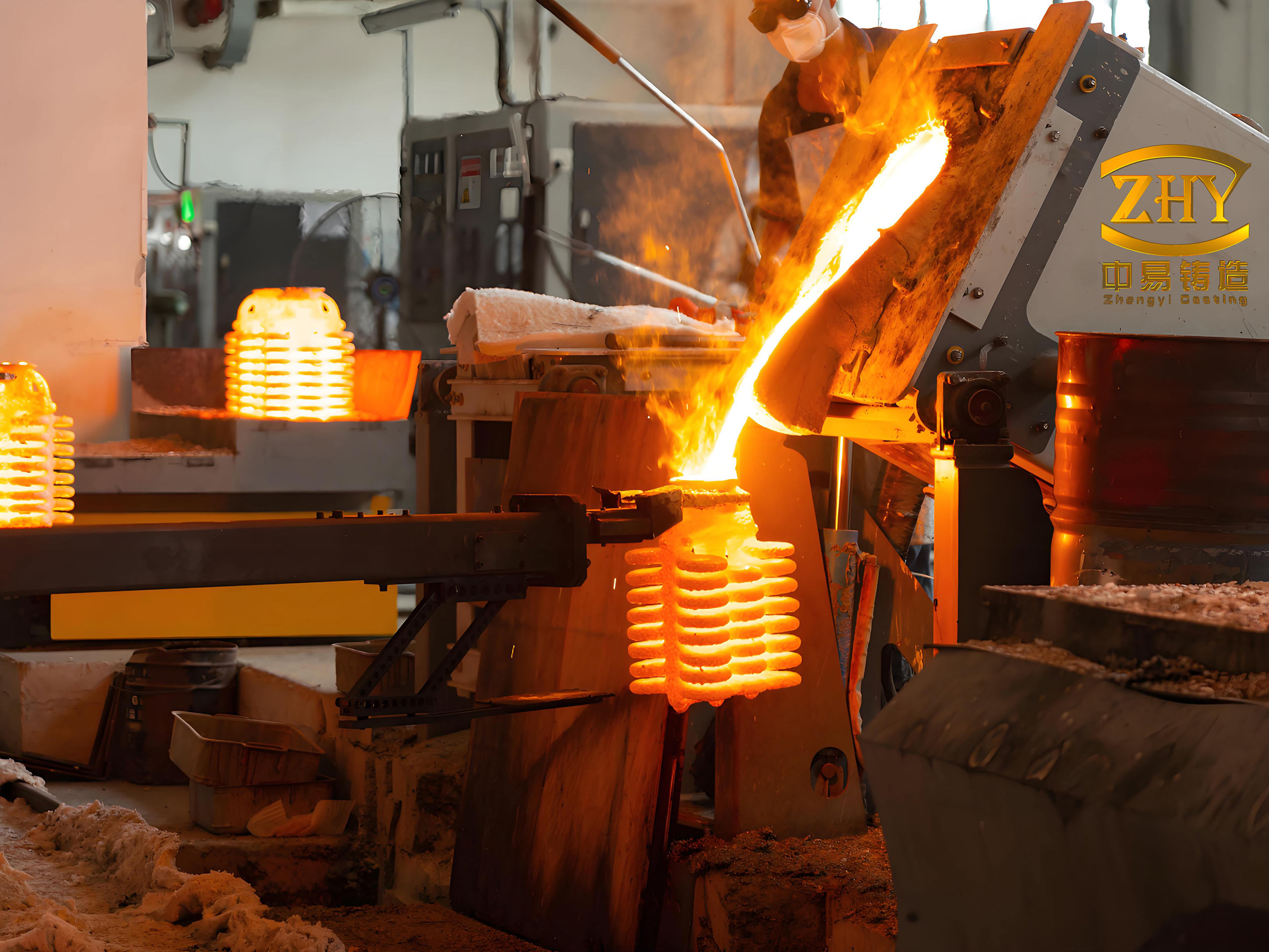
In lost wax casting, the ceramic core serves as a sacrificial template, and its design directly impacts the final blade’s performance. We have pioneered a gradient ceramic core structure to address the conflicting needs of high porosity for easy removal and high strength for dimensional stability. This approach involves three distinct layers: an inner layer with optimized strength to resist deformation during metal injection, a middle layer with controlled porosity to facilitate leaching, and an outer layer with high purity and smooth surface to minimize reactions with the alloy. The gradient design not only improves core performance but also reduces material costs by using expensive high-purity materials only where necessary. For instance, the outer layer may consist of alumina or silica-based compounds, while the inner layers incorporate more economical fillers. The porosity (P) of the core can be expressed as a function of layer composition, where the total porosity is given by:
$$ P = \sum_{i=1}^{3} \phi_i P_i $$
where $\phi_i$ is the volume fraction of layer $i$, and $P_i$ is its intrinsic porosity. This formula guides our design process, ensuring that the core meets specific criteria for lost wax casting applications. Moreover, the thermal expansion coefficient mismatch between the core and the metal must be minimized to prevent cracking, which is modeled using the following relation:
$$ \Delta \alpha = \alpha_{\text{metal}} – \alpha_{\text{core}} $$
where $\Delta \alpha$ should be kept within a narrow range to avoid stress accumulation. Table 1 summarizes typical material properties used in gradient ceramic cores for lost wax casting.
| Layer | Material Composition | Porosity (%) | Strength (MPa) | Thermal Expansion Coefficient (10^{-6}/K) |
|---|---|---|---|---|
| Outer | High-purity Al₂O₃ | 5-10 | 50-70 | 8.0 |
| Middle | Al₂O₃-SiO₂ mixture | 20-30 | 20-30 | 5.5 |
| Inner | Recycled ceramic with binders | 15-25 | 30-40 | 6.0 |
The fabrication of ceramic cores begins with green body formation, typically through hot injection molding. In this process, a ceramic slurry is injected into a heated mold under pressure, cooled, and demolded to produce the core shape. We have found that mold temperature consistency is crucial for dimensional accuracy. Using temperature sensors and water-cooling channels, we maintain the mold within a tight range, often between 40°C and 60°C, to prevent variations in core size. The demolding time and temperature are also controlled; for example, we wait until the green body cools to 30°C before extraction to minimize warping. The injection pressure (P_inj) and temperature (T_inj) can be optimized using empirical equations derived from fluid dynamics:
$$ P_{\text{inj}} = k \cdot \eta \cdot \frac{Q}{A} $$
where $k$ is a constant, $\eta$ is the slurry viscosity, $Q$ is the flow rate, and $A$ is the cross-sectional area. This ensures uniform filling in lost wax casting cores. After demolding, cores are cooled on fixtures to maintain shape, with infrared thermography monitoring to detect thermal gradients. Table 2 outlines key parameters for hot injection molding in lost wax casting.
| Parameter | Optimal Range | Impact on Core Quality |
|---|---|---|
| Mold Temperature | 45-55°C | Prevents shrinkage and ensures dimensional stability |
| Injection Pressure | 2-4 MPa | Avoids defects like air pockets |
| Slurry Temperature | 70-80°C | Enhances flowability for complex geometries |
| Cooling Time | 30-60 seconds | Reduces internal stresses |
Following green body formation, ceramic cores undergo packing and sintering to achieve final mechanical properties. We employ ring-shaped crucibles to enhance thermal symmetry, as shown in earlier designs, ensuring uniform heat distribution during sintering. The sintering temperature profile is critical, often involving a slow ramp-up to remove organic binders, followed by a high-temperature hold for densification. The sintering kinetics can be described by the following formula, based on the Arrhenius equation:
$$ \frac{d\rho}{dt} = A \exp\left(-\frac{E_a}{RT}\right) f(\rho) $$
where $\rho$ is the density, $A$ is a pre-exponential factor, $E_a$ is activation energy, $R$ is the gas constant, $T$ is temperature, and $f(\rho)$ is a function of density. This model helps us optimize sintering cycles for lost wax casting cores. Additionally, the packing material, such as alumina sand, is refreshed regularly to maintain consistent thermal conductivity. We have observed that adding 20-30% new packing material to used batches stabilizes core properties across production runs. The sintering process in lost wax casting not only strengthens the core but also establishes its porosity, which is vital for subsequent leaching. Table 3 summarizes sintering parameters and their effects.
| Sintering Stage | Temperature Range (°C) | Time (hours) | Objective |
|---|---|---|---|
| Binder Removal | 300-500 | 2-4 | Eliminate organic components |
| Intermediate Sintering | 800-1000 | 3-5 | Initiate particle bonding |
| Final Sintering | 1200-1400 | 5-8 | Achieve target density and strength |
To address the trade-off between porosity and strength, we implement strengthening treatments for ceramic cores. Low-temperature strengthening involves applying organic compounds, such as polyvinyl alcohol (PVA) solutions, which increase room-temperature strength without affecting high-temperature performance. These organics burn out during mold firing, leaving the core’s porosity intact. High-temperature strengthening, on the other hand, uses inorganic binders like silica sol to enhance strength at casting temperatures. The strengthening effect can be quantified by the following formula, which relates strength increase to binder concentration:
$$ \sigma = \sigma_0 + k_c C^n $$
where $\sigma$ is the strengthened strength, $\sigma_0$ is the base strength, $k_c$ is a constant, $C$ is binder concentration, and $n$ is an exponent typically between 1 and 2. This allows us to tailor core properties for lost wax casting. We often combine both strengthening methods by immersing cores in a mixed solution of silica sol and PVA, followed by drying. This dual approach ensures that cores withstand handling during wax pattern assembly and metal pouring. Table 4 compares different strengthening techniques for lost wax casting cores.
| Strengthening Type | Materials Used | Application Method | Strength Gain (%) | Impact on Porosity |
|---|---|---|---|---|
| Low-Temperature | PVA, acrylic emulsions | Dip-coating | 20-30 | Negligible |
| High-Temperature | Silica sol, alumina binders | Spraying or immersion | 15-25 | Slight decrease (5-10%) |
| Combined | Silica sol + PVA mixture | Sequential treatment | 30-40 | Moderate decrease (10-15%) |
Prior to wax pattern injection, ceramic cores require pretreatment to prevent issues during lost wax casting. We fill gaps and weak areas with wax to reinforce the core against the impact of molten wax during injection. This selective filling avoids pressure imbalances that could cause core shift or fracture. Surface treatments, such as applying surfactants, improve adhesion between the core and wax, reducing the risk of separation. Additionally, we attach small wax shims or plastic supports to control wall thickness and prevent core deflection. The wax filling process can be modeled using capillary pressure equations:
$$ P_c = \frac{2\gamma \cos\theta}{r} $$
where $P_c$ is capillary pressure, $\gamma$ is surface tension, $\theta$ is contact angle, and $r$ is pore radius. This helps us optimize wax penetration in lost wax casting cores. These pretreatments are essential for maintaining dimensional accuracy and reducing scrap rates in turbine blade production. Table 5 outlines common pretreatment steps and their purposes.
| Pretreatment Step | Description | Purpose in Lost Wax Casting |
|---|---|---|
| Gap Filling | Inject wax into cavities | Enhance strength and reduce wax sink |
| Surface Coating | Apply adhesion promoters | Improve wax-core bond |
| Support Attachment | Place wax shims at critical points | Control wall thickness and prevent breakage |
In the lost wax casting process, ceramic cores must be securely positioned within the ceramic mold. We design cores with fixed ends that bond directly to the mold shell, providing anchorage during metal pouring. Free ends are left with a small gap to accommodate thermal expansion, preventing stress buildup. High-temperature pins or supports are inserted into wax patterns to contact the core, offering additional stability at casting temperatures. The design of these features involves thermal expansion calculations to ensure proper clearances. The gap size ($g$) can be determined by:
$$ g = L \cdot \Delta \alpha \cdot \Delta T $$
where $L$ is the core length, $\Delta \alpha$ is the difference in thermal expansion coefficients, and $\Delta T$ is the temperature change. This minimizes the risk of core fracture in lost wax casting. These design elements are critical for producing blades with precise internal channels, as any core movement can lead to defective cooling passages.
Dewaxing is a critical phase where the wax pattern is removed, and the ceramic core must endure thermal and mechanical stresses. We use autoclave dewaxing with controlled pressure and temperature cycles to avoid core damage. High pressurization rates and low depressurization rates are employed to prevent wax expansion from cracking the core. The dewaxing process can be described by heat transfer equations, such as:
$$ \frac{\partial T}{\partial t} = \alpha \nabla^2 T $$
where $T$ is temperature, $t$ is time, and $\alpha$ is thermal diffusivity. This ensures uniform wax removal in lost wax casting. We monitor parameters like steam temperature and pressure to optimize dewaxing for different core geometries, reducing the likelihood of core failure.
After dewaxing, the ceramic mold undergoes firing and preheating before metal pouring. During these stages, ceramic cores experience additional sintering, which can alter their dimensions and strength. We position molds vertically to minimize core sagging and use precise temperature profiles. The firing temperature ($T_f$) and time ($t_f$) are optimized based on core composition, often following a relationship like:
$$ t_f = B \exp\left(\frac{Q}{RT_f}\right) $$
where $B$ is a constant and $Q$ is activation energy. This controls core properties in lost wax casting. Preheating to temperatures near the metal pouring point reduces thermal shock, enhancing blade surface quality. Table 6 summarizes key parameters for firing and preheating in lost wax casting.
| Process Stage | Temperature Range (°C) | Time (hours) | Goal |
|---|---|---|---|
| Mold Firing | 900-1100 | 4-6 | Remove residual organics and strengthen shell |
| Core Preheating | 1000-1200 | 2-3 | Reduce thermal gradient during pouring |
Throughout our research, we have recognized that lost wax casting is a complex interplay of multiple factors, and ceramic core technology is at its heart. By advancing gradient designs, optimizing processing parameters, and implementing strengthening techniques, we have improved the quality and yield of gas turbine blades. The lost wax casting process continues to evolve, with ceramic cores playing a pivotal role in enabling higher turbine efficiencies. Future work may focus on additive manufacturing of cores or novel materials to further push the boundaries. As we refine these aspects, the synergy between ceramic core development and lost wax casting will drive innovation in aerospace and power generation industries.
In summary, the progress in ceramic core technology for lost wax casting of gas turbine blades encompasses a holistic approach from design to application. We have detailed how structural innovations, precise manufacturing controls, and tailored treatments contribute to core performance. The use of tables and formulas in this article underscores the scientific rigor behind these advancements. As lost wax casting remains essential for producing high-performance blades, ongoing research into ceramic cores will ensure they meet the ever-increasing demands of modern engineering. Through continuous improvement, we aim to achieve higher reliability and cost-effectiveness in turbine blade production, solidifying the importance of lost wax casting in advanced manufacturing.