
In my extensive research and experience within the field of advanced manufacturing, the investment casting process stands as a cornerstone technology for producing high-integrity components, particularly in the aerospace sector. This sophisticated investment casting process enables the fabrication of large, complex, thin-walled superalloy castings that are integral to modern jet engines and aerospace structures. The evolution of this investment casting process has been driven by relentless demands for lightweight, high-performance, and reliable components capable of withstanding extreme thermal and mechanical stresses. This article delves into the recent progress, challenges, and future directions of this pivotal manufacturing technique, drawing from both historical developments and contemporary innovations.
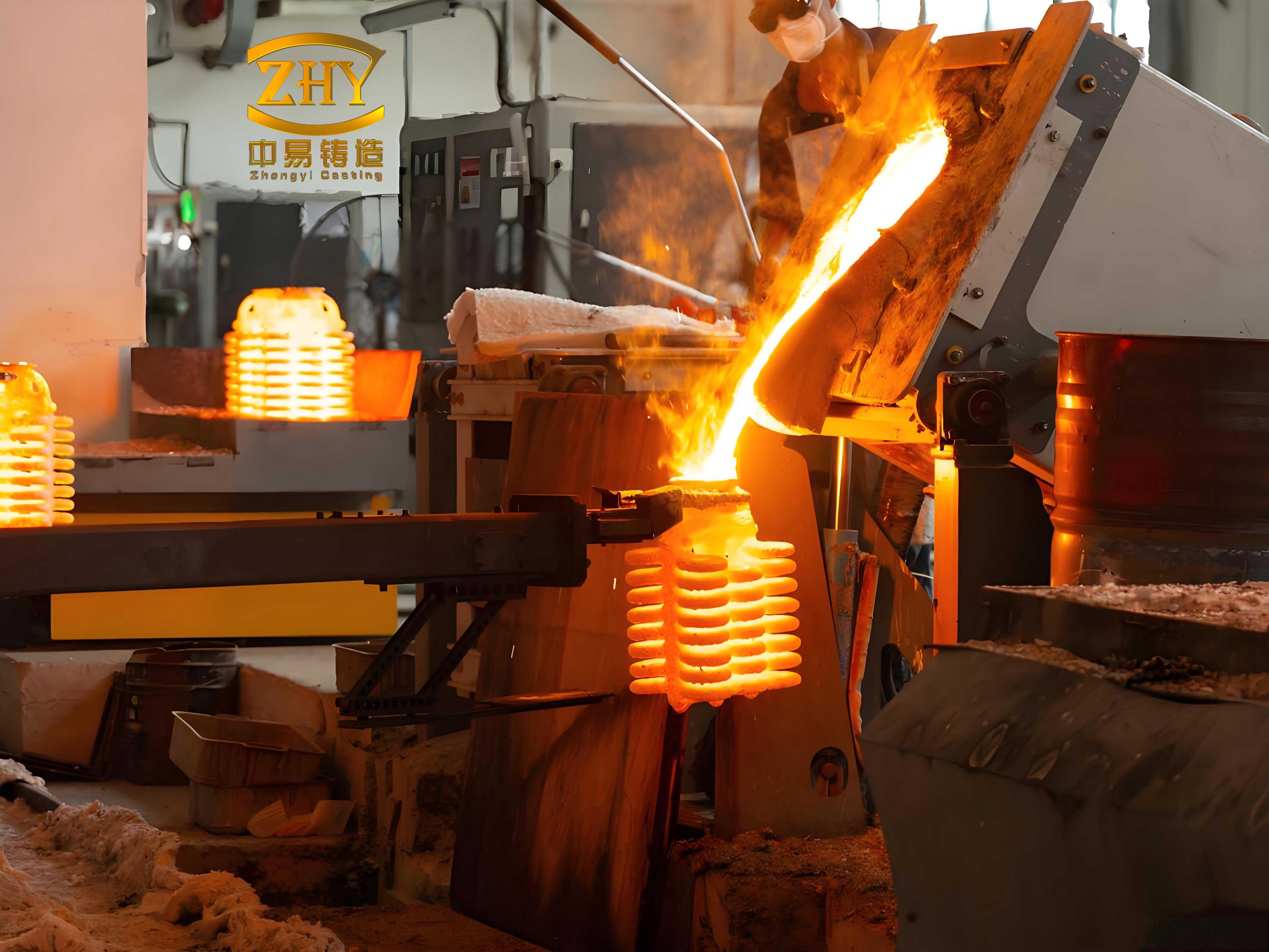
The investment casting process, often referred to as lost-wax casting, has a storied history but its modern incarnation for aerospace applications began in earnest during the mid-20th century. The ability to create intricate internal passages, thin sections down to 1 mm or less, and near-net-shape geometries with excellent surface finish makes it indispensable. For large thin-wall castings, typically defined as components with diameters exceeding 800 mm and wall thicknesses around 2 mm, the technical hurdles are immense. These include ensuring complete mold filling, controlling solidification to avoid defects, managing grain structure, and achieving the required metallurgical properties. My work has consistently focused on overcoming these hurdles through integrated approaches in design, metallurgy, and process control. The core of the investment casting process involves creating a ceramic shell around a wax pattern, which is then melted out, leaving a cavity into which molten superalloy is poured under controlled conditions.
The selection of superalloy materials is fundamental to the success of the investment casting process. Nickel-based superalloys, such as Inconel 718 (K4169), are predominantly used due to their exceptional high-temperature strength, corrosion resistance, and weldability. Other alloys like Mar-M247, Inconel 738, and René 220C are also employed for specific applications. The table below summarizes key superalloys used in large thin-wall investment casting and their principal characteristics.
| Alloy Designation | Primary Base | Key Characteristics | Typical Application in Castings |
|---|---|---|---|
| Inconel 718 (K4169) | Nickel-Iron | Excellent weldability, good strength up to 650°C, precipitation hardened | Turbine casings, compressor housings |
| Mar-M247 | Nickel | High creep resistance, excellent oxidation resistance, coarse grain structure | Turbine blades, vanes |
| Inconel 738 | Nickel | Superior hot corrosion resistance, good castability | Industrial turbine components |
| René 220C | Nickel | High temperature capability, excellent fatigue life | Advanced engine structural parts |
The performance of these alloys in the investment casting process is heavily influenced by their compositional control and melt cleanliness, topics that will be explored in later sections.
Gating and Riser System Design and Optimization
A critical phase in the investment casting process is the design of the gating and riser system. This network of channels dictates the flow of molten metal, feeding for solidification shrinkage, and ultimately, the soundness of the final casting. For large thin-wall structures, traditional empirical design methods often fall short. I have adopted and advanced computational modeling techniques to simulate the entire investment casting process, from mold filling to solidification. The governing equations for fluid flow and heat transfer are central to these models.
The Navier-Stokes equations describe the fluid motion during mold filling:
$$ \rho \left( \frac{\partial \mathbf{v}}{\partial t} + \mathbf{v} \cdot \nabla \mathbf{v} \right) = -\nabla p + \mu \nabla^2 \mathbf{v} + \rho \mathbf{g} $$
where \( \rho \) is the density, \( \mathbf{v} \) is the velocity vector, \( t \) is time, \( p \) is pressure, \( \mu \) is dynamic viscosity, and \( \mathbf{g} \) is gravitational acceleration. Simultaneously, the energy equation governs heat transfer:
$$ \rho c_p \frac{\partial T}{\partial t} + \rho c_p \mathbf{v} \cdot \nabla T = \nabla \cdot (k \nabla T) + \dot{Q} $$
with \( c_p \) as specific heat, \( T \) as temperature, \( k \) as thermal conductivity, and \( \dot{Q} \) as any internal heat source. The solidification phenomenon is often modeled using the enthalpy-porosity method, where the liquid fraction \( f_l \) is tracked. The evolution of \( f_l \) can be related to temperature via the alloy phase diagram or a simplified relationship:
$$ f_l = \begin{cases} 0 & T < T_s \\ \frac{T – T_s}{T_l – T_s} & T_s \leq T \leq T_l \\ 1 & T > T_l \end{cases} $$
where \( T_s \) and \( T_l \) are the solidus and liquidus temperatures, respectively.
Through simulation, one can predict potential defects like misruns, cold shuts, shrinkage porosity, and hot tears. For instance, the Niyama criterion is a widely used indicator for shrinkage porosity:
$$ G / \sqrt{\dot{R}} \leq C $$
where \( G \) is the temperature gradient, \( \dot{R} \) is the cooling rate, and \( C \) is a constant specific to the alloy. Optimizing the gating system involves iterative simulations to ensure \( G \) and \( \dot{R} \) remain within desirable ranges throughout the casting. Advanced techniques like the Heat Control Solidification Process (HCSP) have been developed, which actively manage thermal gradients to promote equiaxed grain growth in critical sections, enhancing both integrity and properties. This represents a significant leap in the investment casting process, allowing for concurrent control of filling and microstructure.
| Defect Type | Primary Cause | Key Gating/Riser Design Parameter to Control | Simulation Output to Monitor |
|---|---|---|---|
| Shrinkage Porosity | Inadequate feeding during solidification | Riser size and location, chills | Niyama criterion value, thermal gradient (G) |
| Misrun/Cold Shut | Premature freezing of metal front | Gating cross-section, pouring temperature | Fluid front temperature, filling time |
| Gas Porosity | Entrapped air or mold gases | Vent placement, gating geometry for turbulence reduction | Velocity field, pressure distribution |
| Hot Tear | Strain concentration in mushy zone | Uniform cooling, use of padding | Thermal stress, strain rate during solidification |
Melting, Pouring, and Melt Treatment Technologies
The quality of the molten metal is paramount in the investment casting process. Impurities, non-metallic inclusions, and undesirable microstructural features can severely compromise the performance of thin-wall sections, where the size of a defect may be comparable to the wall thickness itself. My research emphasizes ultra-clean melting practices. Vacuum Induction Melting (VIM) is the standard, but its effectiveness can be greatly enhanced. The use of calcia (CaO) crucibles, for example, promotes desulfurization and deoxidation reactions. The chemical reactions can be represented as:
$$ 3[\text{CaO}] + 2[\text{Al}] + 3[\text{S}] \rightarrow 3\text{CaS} + \text{Al}_2\text{O}_3 $$
$$ [\text{CaO}] + [\text{O}] \rightarrow \text{CaO} \text{ (slag)} $$
where brackets denote elements in the melt. This can reduce sulfur and oxygen contents to levels below \( 5 \times 10^{-4} \) wt.%. The effectiveness of such refining can be quantified by the equilibrium constant \( K \) for the reaction at temperature \( T \):
$$ K(T) = \frac{a_{\text{CaS}}^3 \cdot a_{\text{Al}_2\text{O}_3}}{a_{\text{CaO}}^3 \cdot a_{\text{Al}}^2 \cdot a_{\text{S}}^3} $$
where \( a_i \) represents the activity of component \( i \).
Melt superheating and thermal cycling, sometimes referred to as High Temperature Melt Treatment (HTMT) or BTOP, is another technique I’ve investigated. By holding the melt at a temperature significantly above the liquidus, long-range ordered clusters are dissociated, improving fluidity and reducing the tendency for freckle defects. The optimal superheating temperature \( T_{opt} \) can be empirically related to the liquidus temperature \( T_l \) and alloy composition:
$$ T_{opt} = T_l + \Delta T_{sh} $$
where \( \Delta T_{sh} \) is a superheat increment determined through experimentation, often in the range of 150-250°C for nickel superalloys.
During the pouring stage of the investment casting process, filtration is critical. Ceramic foam filters, placed in the gating system, trap inclusions. The filtration efficiency \( \eta \) for a filter with pore size \( d_p \) can be estimated by models considering depth filtration and cake filtration mechanisms. A simplified form is:
$$ \eta = 1 – \exp\left(-\lambda L\right) $$
where \( \lambda \) is the filter coefficient (dependent on particle size, melt velocity, etc.) and \( L \) is the filter thickness. Common filter materials are listed below.
| Filter Base Material | Typical Chemical Composition | Maximum Service Temperature (°C) | Primary Filtration Mechanism |
|---|---|---|---|
| Partially Stabilized Zirconia | 97% ZrO₂ – 3% MgO | ~1700 | Depth filtration, cake formation |
| Zirconia-Alumina | 65% ZrO₂ – 35% Al₂O₃ | ~1650 | Interception, inertial impaction |
| High Purity Mullite | 3Al₂O₃·2SiO₂ | ~1600 | Depth filtration |
| High Purity Alumina | Al₂O₃ | ~1800 | Cake filtration |
Grain refinement is equally vital. For nickel-based superalloys like IN718, inoculants such as cobalt oxide (CoO) or Ni-Al-Ti master alloys are added to the face coat of the ceramic shell. The CoO reduces to metallic Co during pre-heating, providing heterogeneous nucleation sites. The potency of an inoculant particle can be assessed by the lattice mismatch \( \delta \) with the solidifying phase (e.g., γ-Ni):
$$ \delta = \frac{|a_s – a_n|}{a_n} \times 100\% $$
where \( a_s \) and \( a_n \) are the lattice parameters of the substrate and nucleant, respectively. A lower \( \delta \) generally promotes more effective nucleation. This grain refinement directly enhances yield strength via the Hall-Petch relationship:
$$ \sigma_y = \sigma_0 + k_y d^{-1/2} $$
where \( \sigma_y \) is yield strength, \( \sigma_0 \) is friction stress, \( k_y \) is the strengthening coefficient, and \( d \) is the average grain diameter.
Heat Treatment and Hot Isostatic Pressing
Post-casting thermal processes are indispensable for achieving the target mechanical properties and ensuring internal soundness in the investment casting process. Hot Isostatic Pressing (HIP) is almost mandatory for large complex thin-wall castings to close internal microporosity and shrinkage cavities. The HIP process subjects the casting to high temperature and isostatic gas pressure (typically Argon). The densification kinetics can be modeled by power-law creep or diffusion-based mechanisms. A common constitutive equation for HIP densification is:
$$ \dot{\rho} = A \left( \frac{P}{\sigma_0} \right)^n \exp\left(-\frac{Q}{RT}\right) f(\rho) $$
where \( \dot{\rho} \) is the densification rate, \( A \) is a constant, \( P \) is the applied pressure, \( \sigma_0 \) is a reference stress, \( n \) is the stress exponent, \( Q \) is the activation energy, \( R \) is the gas constant, \( T \) is temperature, and \( f(\rho) \) is a function of the relative density \( \rho \). For IN718 castings, a typical HIP cycle is 1160°C at 130 MPa for 4 hours.
Following HIP, a tailored heat treatment sequence is applied to develop the optimal microstructure. For precipitation-hardened alloys like IN718, this involves solution treatment, quenching, and aging. The dissolution of primary phases during solution treatment can be described by diffusion-controlled kinetics. The volume fraction of a dissolving phase \( V \) over time \( t \) at temperature \( T \) often follows an Avrami-type equation:
$$ V(t) = V_0 \exp\left[-(K t)^n\right] $$
where \( V_0 \) is the initial volume fraction, \( K \) is a temperature-dependent rate constant, and \( n \) is an exponent. The rate constant follows an Arrhenius relationship: \( K = K_0 \exp(-Q_d / RT) \), with \( Q_d \) as the activation energy for dissolution.
The subsequent aging treatment precipitates strengthening phases like γ” (Ni₃Nb) and γ’ (Ni₃(Al,Ti)) in IN718. The precipitation kinetics and resultant particle size distribution govern the final strength. The growth of spherical precipitates can be modeled by the Lifshitz-Slyozov-Wagner theory:
$$ \bar{r}^3 – \bar{r}_0^3 = \frac{8}{9} \frac{\gamma D c_\infty V_m}{RT} t $$
where \( \bar{r} \) is the mean radius at time \( t \), \( \bar{r}_0 \) is the initial radius, \( \gamma \) is the interfacial energy, \( D \) is the diffusivity of the rate-limiting solute, \( c_\infty \) is the equilibrium solute concentration in the matrix, and \( V_m \) is the molar volume.
| Processing Step | Temperature | Time | Atmosphere/Cooling | Primary Metallurgical Objective |
|---|---|---|---|---|
| Homogenization | 1095°C | 2 hours | Vacuum/Argon, forced cooling (~400°C/h) | Dissolve segregation, reduce microchemical heterogeneity |
| Solution Treatment | 955°C | 1 hour | Vacuum/Argon, rapid cool to 755°C then air cool | Take alloying elements into solid solution, adjust grain boundaries |
| Aging (Two-Step) | 720°C then 620°C | 8 hours each | Vacuum/Argon, furnace cool at 40-60°C/h between steps, then air cool | Precipitate γ” and γ’ phases for strengthening |
For large castings with significant section variations, distortion during heat treatment is a major concern. I have developed finite element models to simulate thermal stress evolution during heating and cooling cycles. The thermo-elasto-plastic constitutive model is used:
$$ \boldsymbol{\sigma} = \mathbf{C}(T) : (\boldsymbol{\epsilon} – \boldsymbol{\epsilon}^{th} – \boldsymbol{\epsilon}^{pl}) $$
where \( \boldsymbol{\sigma} \) is the stress tensor, \( \mathbf{C}(T) \) is the temperature-dependent stiffness tensor, \( \boldsymbol{\epsilon} \) is the total strain, \( \boldsymbol{\epsilon}^{th} \) is the thermal strain (\( = \alpha (T – T_{ref}) \mathbf{I} \), with \( \alpha \) as CTE), and \( \boldsymbol{\epsilon}^{pl} \) is the plastic strain. These simulations guide the design of support fixtures to minimize warpage.
Non-Destructive Evaluation and Quality Assurance
Ensuring the integrity of components produced by the investment casting process requires rigorous non-destructive evaluation (NDE). For large thin-wall castings, the complexity of geometry makes defect detection challenging. Radiographic testing (X-ray and γ-ray) is primary for volumetric inspection. The attenuation of X-rays through a material follows the Beer-Lambert law:
$$ I = I_0 \exp(-\mu x) $$
where \( I_0 \) and \( I \) are the incident and transmitted intensities, \( \mu \) is the linear attenuation coefficient (dependent on material and photon energy), and \( x \) is the path length. For variable thicknesses, computed tomography (CT) is increasingly used. CT reconstructs a 3D volume from multiple 2D projections. The fundamental operation is solving the Radon transform. The value at a point in the reconstruction \( f(x,y) \) is related to the line integrals (projections) \( p(\theta, t) \):
$$ p(\theta, t) = \int_{L(\theta, t)} f(x, y) \, ds $$
where \( L(\theta, t) \) is the line at angle \( \theta \) and distance \( t \) from the origin. Filtered back-projection is a common reconstruction algorithm.
Surface defect detection relies on fluorescent penetrant inspection (FPI). The process involves capillary action of a penetrant into surface-breaking flaws. The sensitivity is governed by the penetrant’s surface tension \( \gamma \) and contact angle \( \theta \) with the defect wall. The pressure required to force liquid into a crack of width \( w \) is given by the Washburn equation:
$$ P = \frac{2\gamma \cos\theta}{w} $$
For effective penetration, \( \theta < 90^\circ \), so \( \cos\theta > 0 \). Advanced NDE methods like phased array ultrasonics are being adapted for coarse-grained superalloy castings. The time-of-flight diffraction (TOFD) technique uses the diffraction of ultrasound from crack tips. The depth \( d \) of a defect can be calculated from the diffracted signal time \( \Delta t \):
$$ d = \sqrt{\left(\frac{v \Delta t}{2}\right)^2 – S^2} $$
where \( v \) is the sound velocity and \( S \) is the probe separation divided by 2.
| Technique | Physical Principle | Detectable Defect Types | Typical Sensitivity/Resolution | Limitations for Large Thin-Wall Castings |
|---|---|---|---|---|
| X-Ray Radiography | Differential absorption of X-rays | Volumetric porosity, inclusions, shrinkage | ~1-2% of thickness for porosity | Geometry complexity, superposition, requires multiple angles |
| Computed Tomography (CT) | 3D reconstruction from X-ray projections | Internal voids, inclusions, wall thickness variation | Voxel size down to ~10 µm (lab micro-CT) | High cost, time-consuming for large parts, equipment size limits |
| Fluorescent Penetrant Inspection (FPI) | Capillary action of fluorescent liquid | Surface-breaking cracks, porosity | Crack width > ~0.5 µm, length > ~1 mm | Surface preparation critical, detects only surface-connected flaws |
| Phased Array Ultrasonics | Controlled beam steering and focusing of ultrasound | Internal cracks, lack of fusion, large inclusions | Flaw size ~ wavelength/2 (e.g., ~0.5 mm at 5 MHz) | Attenuation in coarse grains, requires coupling, complex geometry interpretation |
Applications in Aerospace and Future Trajectories
The investment casting process has enabled revolutionary designs in aerospace propulsion and airframe structures. Large thin-wall castings such as turbine rear frames, compressor diffuser cases, and combustor housings are now commonplace in commercial and military engines. For example, a single-piece investment cast turbine rear frame can replace an assembly of dozens of forged and machined parts, leading to significant weight reduction, improved leakage control, and enhanced structural efficiency. The economic benefits are captured by the cost model for a component:
$$ C_{total} = C_{material} + C_{processing} + C_{assembly} + C_{inspection} $$
For a cast vs. fabricated design, \( C_{assembly} \) and often \( C_{processing} \) are substantially lower for the monolithic casting, despite potentially higher \( C_{inspection} \) due to rigorous NDE. The performance benefit is quantified by metrics like specific strength (strength/density) and creep life, which are superior in well-processed cast superalloys.
Future developments in the investment casting process are geared towards further integration, precision, and intelligence. Digital twin technology is emerging, where a virtual replica of the entire process—from wax pattern to heat treatment—is continuously updated with sensor data. This allows for real-time prediction and correction of deviations. The digital twin relies on multi-physics simulation coupled with data-driven models (e.g., machine learning). A simplified representation of the information flow can be:
$$ \text{Digital Twin} = f_{sim}(\text{Design}, \text{Material Props}, \text{Process Params}) + g_{ML}(\text{Historical Data}, \text{Real-time Sensor Data}) $$
where \( f_{sim} \) represents deterministic physics-based models and \( g_{ML} \) represents a machine learning model correcting for uncertainties and unmodeled phenomena.
Another promising avenue is the integration of additive manufacturing (AM) with the investment casting process. AM can be used to fabricate complex wax or polymer patterns directly from CAD data, eliminating the need for hard tooling for prototype or low-volume production. Furthermore, AM can create conformal cooling channels within ceramic cores, enabling even more intricate internal geometries. The combination is sometimes called “hybrid investment casting.”
Material science will continue to push boundaries. The development of new refractory ceramic shell materials with higher temperature stability and better thermal shock resistance will allow the casting of alloys with even higher liquidus temperatures. Research into novel grain refiners and eutectic modifiers for next-generation superalloys is ongoing. The goal is to achieve cast microstructures with controlled orientation (e.g., directionally solidified or single-crystal) even in large thin-wall geometries, though this remains a formidable challenge.
Finally, process variants like counter-gravity or low-pressure investment casting are being explored to achieve even better filling control for ultra-thin sections. In counter-gravity filling, the mold is placed above the melt and a vacuum or pressure differential draws metal upward. This minimizes turbulence and oxide entrainment. The pressure difference \( \Delta P \) required to lift metal a height \( h \) is:
$$ \Delta P = \rho g h $$
where \( \rho \) is melt density and \( g \) is gravity. By precisely controlling \( \Delta P \), one can achieve very smooth, controlled filling—a significant advantage in the investment casting process for delicate structures.
In conclusion, the investment casting process for large complex thin-wall superalloy castings is a dynamic field synthesizing advances in computational modeling, metallurgy, process engineering, and inspection technology. My perspective, shaped by hands-on research and industry engagement, is that its evolution will be characterized by greater digitization, material-process co-design, and hybrid manufacturing strategies. The relentless pursuit of performance in aerospace ensures that this ancient craft, refined by modern science, will remain at the forefront of manufacturing innovation for decades to come. The mathematical frameworks and empirical relationships discussed herein provide a foundation for continued optimization and breakthrough in this essential investment casting process.