
From my extensive experience in a manganese steel casting foundry, I have witnessed the evolution of high manganese steel since its invention in 1882. This material, renowned for its impact hardening特性, remains a cornerstone for wear-resistant parts in mining machinery. In our foundry, we focus on enhancing ordinary high manganese steel, such as ZGMn13, by adding alloying elements like Cr, Ni, Mo, Ti, and rare earths (RE) to improve performance. Through meticulous control of chemical composition, process parameters, and heat treatment, we refine the grain structure, thereby boosting properties. Currently, our manganese steel casting foundry primarily uses ZGMn13Mo, where molybdenum enhances carbide distribution, refines grains, increases service temperature, and improves weldability. By combining micro-alloying, controlled pouring temperatures, and optimized heat treatment, we achieve superior grain refinement, extending the service life of castings.
High manganese steel, also known as austenitic steel, is extensively used in excavator components like bucket lips, support wheels, tension wheels, teeth, and track plates. The traditional chemical composition is outlined in Table 1, but our manganese steel casting foundry has stabilized the formulation for ZGMn13Mo, as shown in Table 2. The mechanical properties are detailed in Table 3, highlighting the strength and toughness achievable in our operations.
| Element | C | Mn | P | Si | S |
|---|---|---|---|---|---|
| Content (%) | 1.1~1.4 | 11~14 | ≤0.07 | 0.3~1.0 | ≤0.05 |
| Element | C | Mn | P | Si | Mo | S |
|---|---|---|---|---|---|---|
| Content (%) | 1.05~1.2 | 12~14 | ≤0.06 | 0.30~0.80 | 0.80~1.20 | ≤0.03 |
| Property | Yield Strength ReL (MPa) | Tensile Strength Rm (MPa) | Elongation A (%) | Reduction of Area Z (%) | Impact Energy Cv at -40°C (J) | Hardness (HBW) |
|---|---|---|---|---|---|---|
| Value | ≥379 | ≥758 | ≥30 | ≥30 | ≥67 | 180~240 |
In our manganese steel casting foundry, typical castings include tension wheels, support wheels, track plates, and bucket teeth. These components demand robust铸造工艺 to address challenges like chemical burn-on sand and hot tearing. High manganese steel exhibits excellent fluidity due to high carbon and manganese content, but MnO reacts with silica in molding sand, forming low-melting-point MnO·SiO2 and causing severe粘砂. To mitigate this, many foundries use expensive materials like magnesite or olivine sand, but we employ cost-effective silica sand coated with magnesite powder paint, effectively controlling chemical粘砂 while facilitating sand reclamation.
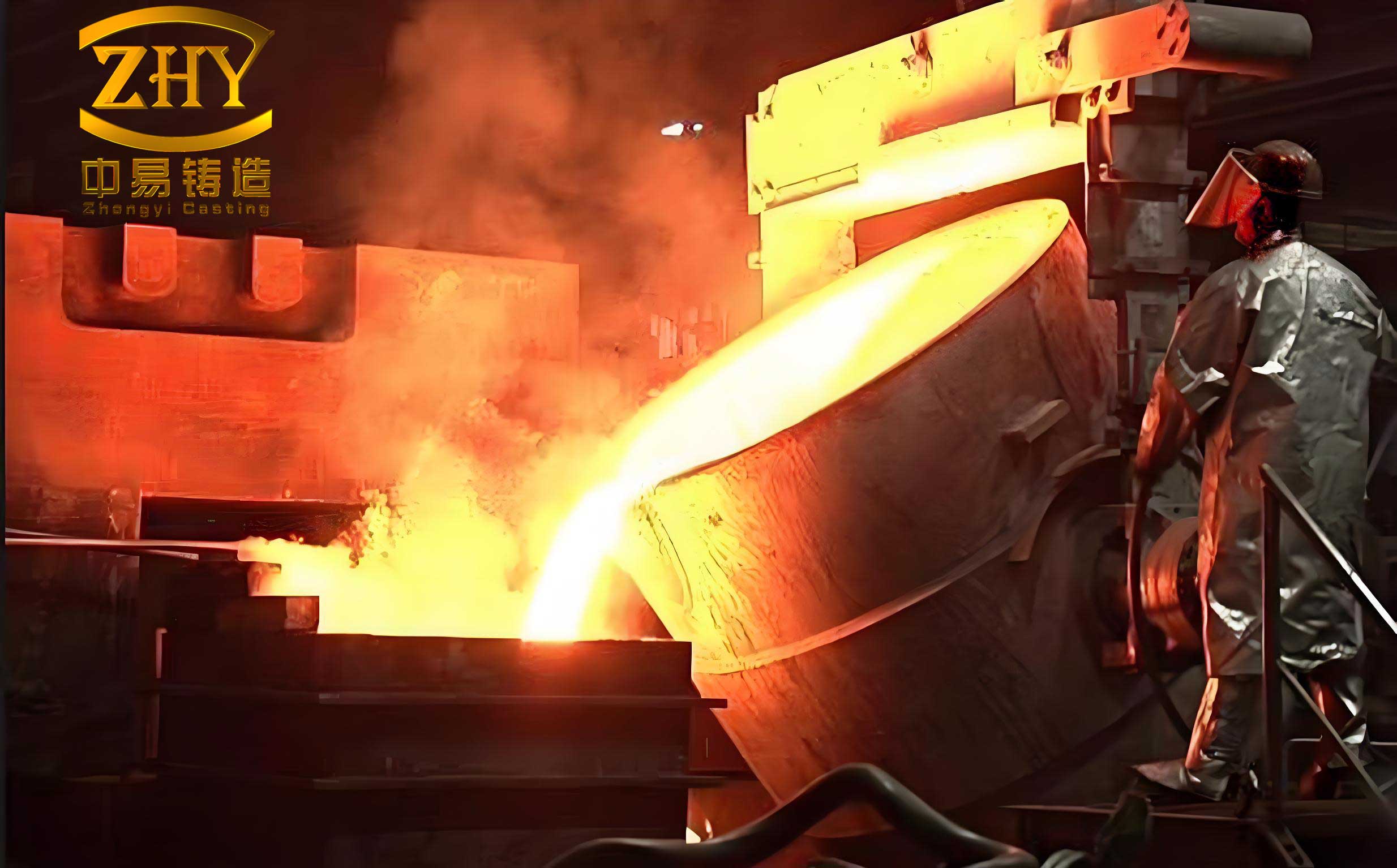
The core of our improvements lies in optimizing工艺 parameters. Micro-alloying with rare earths is a key strategy in our manganese steel casting foundry. Adding RE硅铁合金 during melting refines grains, purifies grain boundaries, and deoxidizes the steel. We tested various RE additions (0.2% to 0.8%) and observed peak tensile strength at 0.4% RE, as shown in Figure 1. The relationship can be approximated by a quadratic equation: $$ R_m = a \cdot (\omega(RE))^2 + b \cdot \omega(RE) + c $$ where $R_m$ is tensile strength, $\omega(RE)$ is RE content, and $a$, $b$, $c$ are constants derived from experimental data. For our manganese steel casting foundry, this optimization enhances strength significantly.
| RE Content ω(RE) (%) | 0.2 | 0.4 | 0.6 | 0.8 |
|---|---|---|---|---|
| Tensile Strength Rm (MPa) | 860 | 915 | 890 | 870 |
Pouring temperature control is another critical factor in our manganese steel casting foundry. Lower temperatures promote finer grains, as detailed in Table 5. The grain size $d$ can be related to pouring temperature $T_p$ by an empirical formula: $$ d = k_1 \cdot e^{k_2 \cdot T_p} $$ where $k_1$ and $k_2$ are material constants. By maintaining pouring temperatures around 1400°C, we achieve grain refinement, improving mechanical properties.
| Pouring Temperature (°C) | 1420 | 1450 | 1480 |
|---|---|---|---|
| Grain Size Number | 3 | 2 | 1 | Density (g/cm3) | 7.7800 | 7.7503 | 7.6209 |
Heat treatment is pivotal in our manganese steel casting foundry. Standard water toughening involves heating to 1050–1100°C, holding, and quenching in water to dissolve carbides into austenite. However, we developed a refined process that leverages phase transformations. During heating, austenite transforms to pearlite around 550–600°C, and upon reheating above Ac1, pearlite colonies revert to austenite through recrystallization. The number of austenite grains $N_a$ after recrystallization depends on pearlite dispersion: $$ N_a = f(P_s) $$ where $P_s$ is pearlite spacing. By controlling heating rates and holding times, we increase $N_a$, refining grains. Post-quenching aging further strengthens the steel by precipitating fine carbides. Table 6 compares conventional and improved heat treatments, showing enhanced tensile strength and grain size.
| Heat Treatment Method | Tensile Strength Rm (MPa) | Yield Strength Rp0.2 (MPa) | Elongation A (%) | Grain Size Number |
|---|---|---|---|---|
| Conventional Water Toughening | 865 | 420 | 44.0 | 2.5 |
| Improved Process + Aging at 350°C | 930 | 465 | 60.5 | 3.5 |
To optimize these parameters, our manganese steel casting foundry conducted orthogonal experiments using an L9(34) array. Factors included RE addition (A), pouring temperature (B), and aging temperature (C), each at three levels, as in Table 7. The response variable was tensile strength $R_m$. Table 8 presents the experimental design and results, with analysis in Table 9.
| Factor | Level 1 | Level 2 | Level 3 |
|---|---|---|---|
| A: RE Addition ω(RE) (%) | 0.2 | 0.4 | 0.6 |
| B: Pouring Temperature (°C) | 1400 | 1440 | 1480 |
| C: Aging Temperature (°C) | 300 | 350 | 400 |
| Experiment No. | A: RE (%) | B: Pouring Temp. (°C) | C: Aging Temp. (°C) | Empty Column | Tensile Strength Rm (MPa) |
|---|---|---|---|---|---|
| 1 | 0.2 | 1400 | 300 | 1 | 860 |
| 2 | 0.2 | 1440 | 350 | 2 | 890 |
| 3 | 0.2 | 1480 | 400 | 3 | 845 |
| 4 | 0.4 | 1400 | 400 | 2 | 880 |
| 5 | 0.4 | 1440 | 300 | 3 | 870 |
| 6 | 0.4 | 1480 | 350 | 1 | 920 |
| 7 | 0.6 | 1400 | 350 | 3 | 890 |
| 8 | 0.6 | 1440 | 400 | 1 | 885 |
| 9 | 0.6 | 1480 | 300 | 2 | 850 |
The analysis involves calculating sums and averages for each factor level. For factor A:
– Level 1 (0.2% RE): Sum I = 860 + 890 + 845 = 2595, Average Ī = 2595/3 = 865 MPa
– Level 2 (0.4% RE): Sum II = 880 + 870 + 920 = 2670, Average IĪ = 2670/3 = 890 MPa
– Level 3 (0.6% RE): Sum III = 890 + 885 + 850 = 2625, Average IIĪ = 2625/3 = 875 MPa
The range R for A is max(865, 890, 875) – min(865, 890, 875) = 890 – 865 = 25 MPa. Similarly, for B:
– Level 1 (1400°C): Sum I = 860 + 880 + 890 = 2630, Average Ī = 2630/3 ≈ 876 MPa
– Level 2 (1440°C): Sum II = 890 + 870 + 885 = 2645, Average IĪ = 2645/3 ≈ 881 MPa
– Level 3 (1480°C): Sum III = 845 + 920 + 850 = 2615, Average IIĪ = 2615/3 ≈ 871 MPa
Range R = 881 – 871 = 10 MPa. For C:
– Level 1 (300°C): Sum I = 860 + 870 + 850 = 2580, Average Ī = 2580/3 = 860 MPa
– Level 2 (350°C): Sum II = 890 + 920 + 890 = 2700, Average IĪ = 2700/3 = 900 MPa
– Level 3 (400°C): Sum III = 845 + 880 + 885 = 2610, Average IIĪ = 2610/3 = 870 MPa
Range R = 900 – 860 = 40 MPa. The results are summarized in Table 9.
| Factor | Level 1 Mean (MPa) | Level 2 Mean (MPa) | Level 3 Mean (MPa) | Range R (MPa) |
|---|---|---|---|---|
| A: RE Addition | 865 | 890 | 875 | 25 |
| B: Pouring Temperature | 876 | 881 | 871 | 10 |
| C: Aging Temperature | 860 | 900 | 870 | 40 |
Based on the ranges, factor C (aging temperature) has the largest effect (R=40 MPa), followed by A (RE addition, R=25 MPa), and B (pouring temperature, R=10 MPa). The optimal combination is A2B1C2: 0.4% RE, pouring temperature 1400°C, and aging at 350°C. This aligns with trends where strength peaks at moderate RE levels, lower pouring temperatures, and specific aging temperatures. The improvement can be modeled using a response surface equation: $$ R_m = \beta_0 + \beta_1 A + \beta_2 B + \beta_3 C + \beta_{12} AB + \beta_{13} AC + \beta_{23} BC + \beta_{11} A^2 + \beta_{22} B^2 + \beta_{33} C^2 $$ where $A$, $B$, $C$ are coded factors, and $\beta$ coefficients are derived from regression analysis in our manganese steel casting foundry.
Implementing these optimizations in our manganese steel casting foundry has yielded remarkable results. Castings exhibit refined grain structures, with grain size numbers improving by over 2 levels. Impact energy at -40°C often exceeds 167 J, and service life has extended by approximately 1.5 times. This success underscores the importance of integrated process control in a manganese steel casting foundry. The use of silica sand with magnesite coating effectively combats chemical burn-on sand, while micro-alloying, temperature management, and advanced heat treatment synergistically enhance performance.
In conclusion, our manganese steel casting foundry has advanced through systematic optimization. Key takeaways include: the efficacy of rare earth additions up to 0.4% for grain refinement, the benefits of lower pouring temperatures around 1400°C, and the critical role of aging at 350°C after improved water toughening. These practices, validated by orthogonal experiments, ensure high-quality castings with superior durability. As the industry evolves, continuous innovation in our manganese steel casting foundry will drive further improvements in wear-resistant applications.